
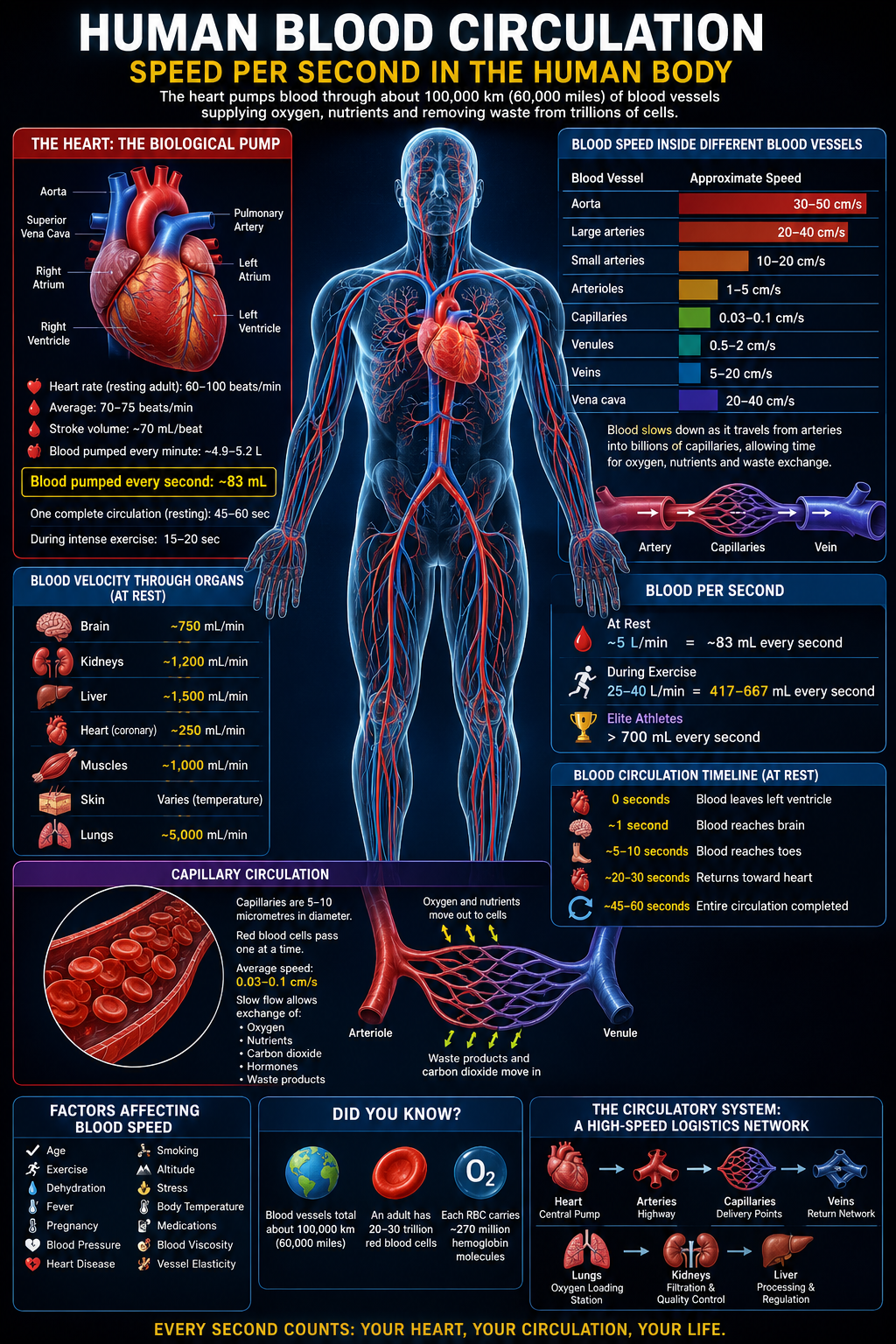
Human Blood Circulation Speed per Second in the Human Body


6
Abstract
The human circulatory system is one of the fastest, most efficient biological transport networks in nature. Every second, the heart pumps blood through approximately 100,000 kilometers (60,000 miles) of blood vessels, supplying oxygen, nutrients, hormones, immune cells, and removing waste products from trillions of cells.
Although people often ask, “How fast does blood move through the body?”, there is no single answer. Blood speed changes continuously depending on the type of blood vessel, the organ involved, physical activity, body position, and health status.
On average:
- Heart beats: 60–100 beats per minute
- Average resting adult: 70–75 beats per minute
- Blood pumped every second: ≈80–100 millilitres
- Blood completes one full circulation in approximately 45–60 seconds at rest.
- During intense exercise, circulation time can decrease to 15–20 seconds.
Chapter 1
Introduction
Blood is the body’s transportation highway.
Unlike water flowing through fixed pipes, blood is a living tissue containing:
- Red blood cells
- White blood cells
- Platelets
- Plasma
- Hormones
- Nutrients
- Immune proteins
- Dissolved gases
The cardiovascular system functions like a high-speed logistics company, delivering billions of microscopic packages every second.
Chapter 2
The Heart: The Biological Pump


4
The heart weighs approximately:
- 250–350 grams
- About the size of a clenched fist
Every heartbeat consists of:
- Filling
- Contraction
- Relaxation
Each contraction ejects approximately
70 mL of blood
This is called the Stroke Volume.
If the heart beats
70 times per minute
then
70 × 70 mL
=
4.9 litres every minute
Nearly the entire blood volume circulates once every minute during rest.
Chapter 3
Blood Speed Inside Different Blood Vessels
Blood does not travel at one constant speed.
| Blood Vessel | Approximate Speed |
|---|---|
| Aorta | 30–50 cm/s |
| Large arteries | 20–40 cm/s |
| Small arteries | 10–20 cm/s |
| Arterioles | 1–5 cm/s |
| Capillaries | 0.03–0.1 cm/s |
| Venules | 0.5–2 cm/s |
| Veins | 5–20 cm/s |
| Vena cava | 20–40 cm/s |
Why Does Blood Slow Down?
The total cross-sectional area increases dramatically.
For example:
One aorta
↓
Millions of arterioles
↓
Billions of capillaries
Since there are billions of capillaries simultaneously carrying blood, flow becomes extremely slow.
This slow speed allows:
- oxygen diffusion
- nutrient exchange
- carbon dioxide removal
- immune surveillance
- hormone delivery
Chapter 4
Blood Speed Per Second
Average resting adult:
Heart output:
≈5 litres/minute
That equals
5000 mL ÷ 60
=
approximately
83 mL every second
During exercise:
Cardiac output may reach
25–40 litres per minute
which equals
417–667 mL every second
Elite endurance athletes may exceed
700 mL per second.
Chapter 5
Blood Velocity Through Organs
Different organs receive different blood flow.
Brain
Approximately
750 mL/min
Blood arrives continuously because neurons require oxygen every second.
Kidneys
Approximately
1.2 litres/min
Around 20–25% of total cardiac output.
Liver
Approximately
1.5 litres/min
The liver receives blood from both the hepatic artery and portal vein.
Muscles
At rest
≈1 litre/min
During exercise
More than 20 litres/min
Skin
Depends heavily on temperature.
Cold weather:
Blood vessels constrict.
Hot weather:
Blood vessels dilate.
Chapter 6
Blood Circulation Timeline
One heartbeat
↓
0 seconds
Blood leaves left ventricle.
↓
1 second
Blood reaches brain.
↓
5–10 seconds
Blood reaches toes.
↓
20–30 seconds
Returns toward heart.
↓
45–60 seconds
Entire circulation completed.
Chapter 7
The Physics of Blood Flow
Blood movement depends upon:
Pressure
Created by heart contraction.
Resistance
Small arteries regulate resistance.
Vessel Diameter
Small changes dramatically alter flow.
Blood Viscosity
Thicker blood flows slower.
Elasticity
Healthy arteries stretch and recoil.
Chapter 8
Capillary Circulation


4
Capillaries are microscopic vessels measuring about:
5–10 micrometres in diameter.
Red blood cells pass through them almost one at a time.
Average speed:
0.03–0.1 cm/s
This slow movement allows efficient exchange of oxygen and nutrients with surrounding tissues.
Chapter 9
Blood Speed During Exercise
Running increases:
- Heart rate
- Stroke volume
- Cardiac output
- Blood velocity
Elite marathon runners can achieve:
Heart rate:
180–200 bpm
Cardiac output:
30–40 litres/minute
Blood circulation time:
15–20 seconds
Chapter 10
Blood Speed During Sleep
During deep sleep:
- Heart rate falls
- Blood pressure decreases
- Blood flow to muscles declines
- Brain blood flow remains tightly regulated
Circulation becomes more energy efficient while still supporting vital organs.
Chapter 11
Factors Affecting Blood Speed
Blood flow changes with:
- Age
- Exercise
- Dehydration
- Fever
- Pregnancy
- High blood pressure
- Heart disease
- Smoking
- Altitude
- Emotional stress
- Body temperature
Chapter 12
Oxygen Transport
Each red blood cell contains approximately 270 million hemoglobin molecules. A healthy adult has around 20–30 trillion red blood cells, enabling the transport of vast quantities of oxygen every second to sustain metabolism throughout the body.
Chapter 13
Engineering Perspective
The circulatory system resembles an advanced logistics network:
- Heart → central pump
- Arteries → high-pressure distribution highways
- Arterioles → flow-control valves
- Capillaries → delivery points
- Veins → return network
- Lungs → oxygen loading station
- Kidneys → filtration and quality control
- Liver → processing and chemical regulation
This decentralized design allows continuous operation and rapid adaptation to changing demands.
Chapter 14
Medical Importance
Abnormal blood flow may contribute to conditions such as:
- Hypertension
- Atherosclerosis
- Heart Failure
- Anemia
- Stroke
Understanding blood circulation helps clinicians assess cardiovascular health and guide appropriate treatments.
Conclusion
Human blood circulation is among the most sophisticated transport systems known in biology. At rest, the heart pumps about 83 millilitres of blood every second, and a complete circuit of the body typically takes 45–60 seconds. During strenuous exercise, blood flow can increase several-fold, reducing circulation time to 15–20 seconds while delivering dramatically more oxygen and nutrients to active tissues.
The combination of a powerful four-chambered heart, an extensive network of approximately 100,000 kilometres of blood vessels, and trillions of circulating cells enables the human body to maintain homeostasis, respond rapidly to changing physiological demands, and support life continuously from before birth until death.





Be First to Comment