
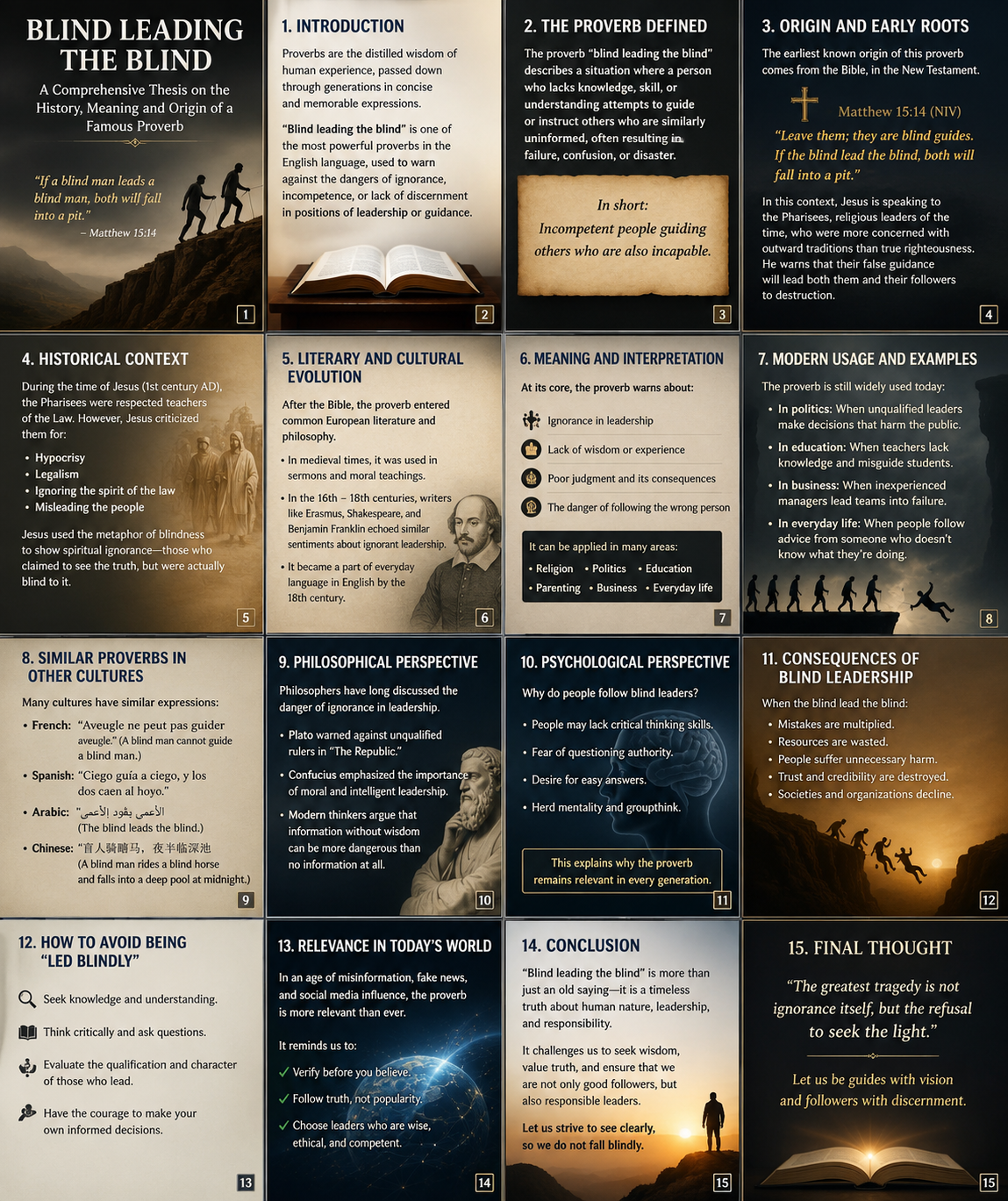
The Blind Leading the Blind: A Comprehensive Study of the History, Meaning, Origin, Interpretation, and Modern Relevance of a Famous Proverb
Abstract
The expression “the blind leading the blind” is one of the world’s most widely recognized proverbs and metaphors. It describes a situation in which a person who lacks knowledge, understanding, competence, or direction attempts to guide another person who is similarly uninformed. The result is often confusion, failure, or disaster because neither the leader nor the follower possesses the ability to identify the correct path.
The proverb has a particularly strong connection to religious and philosophical history. Its most famous early literary form appears in the New Testament, specifically in the Gospel of Matthew, where Jesus criticizes religious leaders who claim to guide others while themselves lacking spiritual understanding. A similar teaching is also recorded in the Gospel of Luke. The imagery of one blind person leading another is powerful because blindness, in this context, represents a lack of insight rather than simply a physical disability.
Over centuries, the expression developed beyond its religious origins and became a general metaphor used in education, politics, business, leadership, management, technology, social relationships, and everyday life. Today, it is commonly applied whenever an inexperienced or uninformed person attempts to direct others who are equally uncertain.
This thesis examines the proverb’s history, linguistic development, biblical origin, philosophical meaning, symbolism, historical use, psychological implications, leadership lessons, modern applications, and continuing relevance in contemporary society.
Table of Contents
- Introduction
- Understanding the Meaning of the Proverb
- The Origin of the Expression
- Biblical and Religious Background
- Historical Development of the Proverb
- The Symbolism of Blindness
- The Meaning of Leadership in the Proverb
- Knowledge, Ignorance, and Human Decision-Making
- The Proverb and Leadership
- The Proverb in Education
- The Proverb in Business and Management
- The Proverb in Politics and Government
- The Proverb in Science and Technology
- The Proverb in Modern Society
- Lessons, Conclusion, and References
1. Introduction
Human civilization has always depended on leadership and guidance. From ancient communities to modern nations, people have needed individuals who possess knowledge, experience, wisdom, and the ability to make sound decisions. Families require guidance, businesses require management, governments require leadership, and societies depend on institutions capable of distinguishing between correct and incorrect courses of action.
However, leadership becomes dangerous when the person providing direction does not understand the path themselves.
This fundamental problem is captured by the famous proverb:
“The blind leading the blind.”
The expression is normally used to describe a situation in which someone who lacks knowledge or understanding attempts to guide another person who also lacks knowledge or understanding. Instead of leading toward safety or success, the two may move together toward an undesirable outcome.
The proverb is particularly powerful because it communicates a complicated idea through a simple image. Imagine two people who cannot see. One is placed in front of the other and told to lead. The second person trusts the first, assuming that the leader knows where to go. Yet the first person is equally unable to see the path. Neither person possesses the information necessary to navigate safely.
The central lesson is therefore about the danger of unqualified leadership.
The proverb does not necessarily mean that the leader is intentionally dishonest or malicious. Sometimes the leader sincerely believes that they know what they are doing. The problem is that confidence is not the same as knowledge. A person may be confident and still be wrong.
This distinction is extremely important in modern society. The development of the internet, social media, artificial intelligence, financial markets, political communication, and rapidly changing technologies has created an environment in which information is abundant but reliable knowledge is not always easy to identify.
People can now influence thousands or millions of others without necessarily possessing expertise in the subjects they discuss. Consequently, the ancient metaphor of “the blind leading the blind” remains highly relevant.
2. Understanding the Meaning of the Proverb
The basic meaning of “the blind leading the blind” is:
A person who lacks the necessary knowledge or understanding attempts to guide another person who is equally uninformed.
The proverb can be interpreted at several levels.
2.1 Literal Meaning
At the literal level, blindness refers to the inability to see. If one blind person attempts to physically guide another blind person without assistance, both may encounter obstacles.
However, the proverb is generally not intended as a statement about people who are physically blind. Its deeper meaning is metaphorical.
2.2 Metaphorical Meaning
Metaphorically, blindness represents ignorance, lack of awareness, confusion, or absence of insight.
The “leader” is someone who claims, or is assumed, to possess knowledge.
The “follower” is someone who trusts the leader.
The problem occurs because the leader does not actually possess the knowledge needed to provide proper direction.
2.3 A Simple Example
Suppose a person has never operated a particular computer system. Another person asks them for instructions on how to use it. Instead of admitting that they do not know, the first person confidently gives instructions.
The second person follows those instructions and makes mistakes.
In this situation, the first person is metaphorically “blind,” and the second person is also “blind” because they are unable to independently determine whether the instructions are correct.
This is an example of the blind leading the blind.
2.4 The Difference Between Ignorance and Deception
The proverb does not necessarily describe deliberate deception.
There are two possible situations:
- The leader knows they are ignorant but pretends to know.
- The leader genuinely believes they are knowledgeable but is mistaken.
The second situation can sometimes be more dangerous because the leader may communicate incorrect information with great confidence.
3. The Origin of the Expression
The expression has a long history, but its most famous and influential form is associated with the teachings of Jesus Christ recorded in the New Testament.
In the Gospel of Matthew, Jesus criticizes certain religious teachers and describes them metaphorically as blind guides. The teaching emphasizes the contradiction between claiming to guide others and lacking the understanding necessary to guide oneself.
A related passage appears in the Gospel of Luke, where the idea is expressed in the form of one blind person guiding another.
The biblical teaching became one of the major sources for the modern proverb.
The phrase is therefore rooted in a much older philosophical and religious idea:
A person cannot effectively guide others through a path that they themselves do not understand.
This principle, however, is not exclusive to Christianity. Similar ideas can be found in many cultures and philosophical traditions. Ancient thinkers frequently warned against following ignorant teachers or accepting the authority of people who lacked wisdom.
The proverb’s biblical form became particularly influential in European languages and later entered English as a common idiom.
4. Biblical and Religious Background
The biblical context is essential for understanding the original force of the metaphor.
In the Gospel of Matthew, Jesus criticizes religious authorities for their failure to understand the deeper spiritual meaning of their teachings. They present themselves as guides to others, yet they are described as lacking true spiritual vision.
The central criticism is not simply that they lack information. It is that they have misunderstood the truth while assuming the role of teachers.
This creates a serious leadership problem.
A teacher has greater responsibility than an ordinary individual because other people depend upon the teacher’s knowledge.
If a person makes a mistake privately, the consequences may affect only themselves. But if a leader makes a mistake and convinces thousands of people to follow them, the consequences can become much greater.
This is one reason why the biblical metaphor remains relevant to leadership today.
The lesson can be summarized as follows:
Before attempting to guide others, a person should first develop the knowledge, wisdom, and self-awareness necessary to guide themselves.
5. Historical Development of the Proverb
The concept developed over many centuries.
5.1 Ancient Period
Ancient societies often placed great importance on wisdom and the role of teachers. Philosophers, religious leaders, elders, and rulers were expected to possess superior understanding.
The danger of false knowledge was therefore recognized as a serious social problem.
A teacher who did not understand the subject could mislead students. A ruler who lacked wisdom could mislead a nation.
The basic concept existed long before the modern English proverb.
5.2 Medieval Period
During the medieval period, biblical teachings strongly influenced European education, philosophy, literature, and political thought.
The metaphor of blind guides became associated with religious criticism and discussions about spiritual authority.
It was often used to describe leaders who appeared authoritative but lacked genuine wisdom.
5.3 Early Modern English
As English developed, biblical language entered everyday speech.
Expressions derived from Scripture became increasingly common in literature and ordinary communication.
“The blind leading the blind” gradually moved beyond strictly religious contexts.
It became useful for describing:
- Poor leadership
- Bad teaching
- Incompetent management
- Misguided political movements
- Incorrect advice
- Poor decision-making
5.4 Modern Usage
Today, the proverb is used in almost every area of life.
A manager who does not understand a project but gives employees incorrect instructions may be described as leading the blind.
A student who has misunderstood a subject but attempts to teach another student may be said to be participating in a situation where the blind are leading the blind.
A social media influencer who spreads misinformation to followers may also fit the metaphor.
The proverb has therefore evolved from a primarily spiritual warning into a universal description of misguided leadership.
6. The Symbolism of Blindness
The word “blind” in the proverb has symbolic meaning.
It represents a lack of:
- Knowledge
- Awareness
- Understanding
- Wisdom
- Experience
- Critical thinking
- Foresight
- Judgment
The metaphor suggests that people can be “blind” in many ways even when they have perfect physical eyesight.
For example, a person can be:
Economically blind
They may not understand how money, investment, debt, or inflation works.
Politically blind
They may accept political claims without examining evidence.
Scientifically blind
They may reject scientific evidence because of misinformation.
Technologically blind
They may use technology without understanding its risks.
Socially blind
They may fail to recognize how their decisions affect other people.
Morally blind
They may fail to recognize the ethical consequences of their actions.
Thus, blindness in the proverb represents a limitation of human understanding.
7. The Meaning of Leadership in the Proverb
The proverb is fundamentally a statement about leadership.
Leadership is not simply the ability to give orders. True leadership requires:
- Knowledge
- Responsibility
- Vision
- Communication
- Experience
- Accountability
- Humility
- Ethical judgment
A person may hold a leadership position without possessing these qualities.
This creates a dangerous situation.
The proverb teaches that authority and competence are not necessarily the same thing.
A person can have a title but lack wisdom.
A person can have power but lack understanding.
A person can speak confidently but provide incorrect information.
A person can be popular but still be wrong.
Therefore, effective leadership requires more than the appearance of authority.
The true leader must be capable of seeing the path clearly enough to help others navigate it.
8. Knowledge, Ignorance, and Human Decision-Making
The proverb also provides an important lesson about knowledge.
Human beings often make decisions based on incomplete information.
When people do not know something, they may still feel pressure to provide an answer.
This can create a psychological phenomenon in which people overestimate their understanding.
A person may know a little about a subject and believe that they know everything.
This creates the conditions for the blind leading the blind.
The problem becomes worse when the followers do not question the leader.
A healthy society therefore requires critical thinking.
People should ask:
- What evidence supports this claim?
- Does the person giving the advice have relevant experience?
- Are there alternative explanations?
- Can the information be independently verified?
- What are the consequences if the advice is wrong?
These questions help prevent people from blindly following others.
9. The Proverb and Leadership
The proverb has enormous relevance to modern leadership.
In organizations, leaders make decisions that affect employees, customers, investors, and communities.
If management does not understand the organization, several problems can occur.
For example, a company may introduce a new technology without understanding how it will affect employees.
A government may implement a policy without studying its economic consequences.
A school may introduce a curriculum without considering the actual needs of students.
A business executive may make decisions based entirely on assumptions rather than evidence.
In each case, leadership can become a form of blind guidance.
The solution is not to eliminate leadership.
The solution is to improve the quality of leadership.
Good leaders recognize their limitations.
They consult experts.
They ask questions.
They listen to evidence.
They learn continuously.
They admit when they do not know something.
This is why humility is one of the strongest defenses against the blind leading the blind.
10. The Proverb in Education
Education is another area where the proverb is highly relevant.
A teacher is expected to possess greater knowledge than the student in a particular subject.
However, teachers are also human beings and may sometimes make mistakes.
The proverb teaches an important principle:
Teaching requires continuous learning.
An educator who stops learning may eventually teach outdated information.
Students also have a responsibility to think critically.
They should not accept every statement simply because it comes from a teacher.
The best educational environment encourages respectful questioning.
Students should learn not only what to think, but also how to think.
This protects them from becoming followers of misinformation.
11. The Proverb in Business and Management
In business, poor leadership can be extremely expensive.
Imagine a company entering a new market without conducting research.
The management team assumes that customers will buy its products.
Employees follow the strategy because management has authority.
However, the strategy fails because the original assumptions were incorrect.
This is a classic example of the metaphor.
The managers are “blind” because they do not understand the market.
The employees are “blind” because they follow the managers without questioning the assumptions.
The result may include:
- Financial losses
- Employee dissatisfaction
- Product failure
- Poor customer service
- Business closure
Modern organizations can reduce this risk through:
- Data analysis
- Market research
- Professional training
- Independent audits
- Expert consultation
- Employee feedback
- Continuous evaluation
The proverb therefore teaches businesses the importance of evidence-based decision-making.
12. The Proverb in Politics and Government
Political leadership provides some of the clearest examples of the proverb.
Governments make decisions involving:
- Economic development
- Healthcare
- Education
- Infrastructure
- National security
- Environmental protection
- Employment
If political leaders lack reliable information, they may make policies that fail to solve the problems they were designed to address.
The situation can become even more complicated when citizens receive information from unreliable sources.
A population may follow political claims without checking the evidence.
This creates a cycle:
Incorrect information → poor decisions → public support → greater confidence in incorrect information.
The proverb warns against this cycle.
Good governance requires informed leadership and informed citizens.
13. The Proverb in Science and Technology
The modern technological revolution has created new forms of the blind leading the blind.
The internet allows almost anyone to publish information.
This has many benefits.
Knowledge can spread quickly.
People can access educational resources.
Experts can communicate with global audiences.
However, misinformation can also spread quickly.
One person may publish incorrect information.
Thousands of people may repeat it.
Millions may eventually believe it.
Artificial intelligence has introduced another dimension.
AI systems can produce highly convincing information, but users must still evaluate the reliability of the output.
Technology therefore makes critical thinking more important, not less important.
The modern version of the proverb might be expressed as:
Technology can amplify both knowledge and ignorance.
If knowledgeable people use technology responsibly, it can improve society.
If uninformed people use powerful communication systems to spread misinformation, the consequences can be enormous.
14. The Proverb in Modern Society
The expression remains highly relevant because modern society faces an unprecedented information challenge.
Human beings now have access to more information than at any previous point in history.
However, access to information does not automatically create wisdom.
A person can read thousands of articles and still misunderstand a subject.
The challenge is therefore not merely obtaining information.
The challenge is determining:
- Which information is accurate?
- Which sources are trustworthy?
- Which experts are qualified?
- Which claims are supported by evidence?
- Which opinions are being presented as facts?
Social media has increased the importance of these questions.
A person with a large following may influence public opinion without having expertise.
Popularity can therefore become confused with knowledge.
The proverb reminds us that being followed does not necessarily mean being qualified to lead.
15. Lessons and Conclusion
The proverb “the blind leading the blind” has survived for centuries because it expresses a universal truth about human society.
Its famous biblical origin gives it a strong historical and religious foundation, but its meaning has expanded far beyond its original context.
The central message is simple:
People should be careful about following leaders who lack the knowledge, wisdom, or understanding required to guide them.
The proverb teaches several important lessons.
First: Leadership requires knowledge.
People who lead others should understand the direction in which they are going.
Second: Confidence is not competence.
A person may speak confidently while being completely mistaken.
Third: Followers have responsibility.
People should not surrender their critical thinking simply because someone else claims authority.
Fourth: Humility is essential.
A wise person recognizes what they do not know.
Fifth: Education must be continuous.
The world changes rapidly, so leaders must continue learning.
Sixth: Evidence matters.
Good decisions should be based on reliable information rather than assumptions.
Seventh: Authority should be questioned respectfully.
Healthy societies allow people to ask questions and examine claims.
Eighth: Technology increases responsibility.
Modern communication can amplify both truth and misinformation.
Ultimately, the proverb is not merely a warning about incompetent leaders. It is a warning about the relationship between knowledge, authority, trust, and responsibility.
A society becomes vulnerable when people follow leaders without examining whether those leaders actually understand the path.
The best alternative to the blind leading the blind is a culture of learning, evidence, humility, accountability, and critical thinking.
A truly effective leader does not pretend to see everything. Instead, a good leader understands their limitations, seeks knowledge, consults others, listens carefully, and continuously improves their ability to guide people.
The enduring wisdom of the proverb can therefore be summarized in one principle:
Before leading others, learn to see clearly yourself; before following someone, make sure they can see the path.
Selected Historical and Reference Sources
For further academic research, the proverb can be studied through:
- The Gospel of Matthew, particularly the passages concerning “blind guides” and the metaphor of the blind leading the blind.
- The Gospel of Luke, which contains a related teaching about blind guides.
- The Oxford English Dictionary, for the historical development of English expressions and idioms.
- The King James Bible, whose influential English language helped popularize biblical expressions in English-speaking cultures.
- Biblical commentaries and historical studies on the teachings of Jesus and first-century religious leadership.
- Classical philosophical literature, which contains broader discussions about wisdom, ignorance, knowledge, and the responsibilities of teachers and leaders.
Final Thesis Statement
“The blind leading the blind” is a timeless proverb that originated from an ancient metaphor of spiritual and intellectual blindness and became one of the world’s most recognizable expressions about misguided leadership. Its continued relevance demonstrates that, despite enormous advances in education, science, technology, and communication, humanity still faces the fundamental challenge of distinguishing genuine knowledge from ignorance and competent leadership from false authority. The proverb therefore remains a powerful reminder that responsible leadership begins with knowledge, self-awareness, humility, and the willingness to seek truth before attempting to guide others.






Be First to Comment