Advantages, Memory Functions, Learning, and Development in Modern Society
Page 1 — Introduction
Human beings have developed many systems for communicating ideas, knowledge, emotions, instructions, and history. Among the world’s most influential writing systems are Chinese characters and alphabetic writing systems, such as the English alphabet.
Although both systems perform the same fundamental task—representing human language—they do so in very different ways. English primarily uses a relatively small set of letters to represent sounds. Chinese writing uses thousands of characters, many of which carry meaning directly and often provide clues about pronunciation or concepts.
The purpose of this study is not to declare one writing system “better” than the other. Instead, it is to simplify their advantages and explain how each system contributes to memory, education, literacy, science, business, technology, cultural preservation, and modern society.
A simple way to understand the difference is:
Alphabetic writing is strongly connected to sound, while Chinese characters are strongly connected to meaning and visual form.
This difference influences how people read, learn, remember information, and communicate.
Page 2 — What Is a Writing System?
A writing system is a method used to represent language visually.
When we speak, information travels through sound. When we write, information is stored using visible symbols.
For example, English uses letters:
A, B, C, D, E…
Chinese uses characters:
人 = person
山 = mountain
水 = water
火 = fire
The English word “water” is built from five alphabetic letters. The Chinese character 水 represents the concept of water in a single visual symbol.
Both approaches are highly effective, but they organize information differently.
Alphabetic system
Sound → Letters → Words → Meaning
Chinese character system
Visual symbol → Meaning + often pronunciation → Word/concept
Neither system is simply “primitive” or “advanced.” They evolved according to different linguistic and historical conditions.
Page 3 — The English Alphabetic System
English uses the Latin alphabet, consisting of 26 basic letters.
These letters can be combined to form thousands of words.
Examples:
- C + A + T = CAT
- B + O + O + K = BOOK
- C + O + M + P + U + T + E + R = COMPUTER
The major strength of alphabetic writing is its economy.
A learner does not need to memorize a unique symbol for every word. Instead, the learner learns a relatively small inventory of letters and combinations.
This makes alphabetic writing particularly powerful for:
- Basic literacy
- Typing
- Digital communication
- International communication
- Scientific terminology
- Programming
- Technical documentation
- Rapid creation of new words
Once someone understands the alphabetic principle, they can potentially decode unfamiliar words, although English spelling has many irregularities.
Page 4 — What Are Chinese Characters?
Chinese characters, often called Hanzi (汉字), are a logographic or morphosyllabic writing system.
This means that characters generally represent meaningful linguistic units, often corresponding to syllables and morphemes.
Examples include:
- 人 — person
- 大 — big
- 小 — small
- 日 — sun/day
- 月 — moon/month
- 木 — tree/wood
- 林 — woods
- 森 — forest
Some characters have historical visual connections to the things they represent, although modern characters are not simply pictures.
Chinese characters are constructed using recurring components called radicals and other components. These components can provide information about meaning or pronunciation.
For example, many characters containing the water-related radical 氵 have meanings associated with water or liquids.
This gives Chinese writing a highly structured visual organization.
Page 5 — The First Major Advantage of Chinese Characters: Meaning
One of the most important advantages of Chinese characters is their ability to communicate meaning visually.
Consider:
山
Even without knowing the pronunciation, a learner who has studied the character may recognize its meaning as “mountain.”
Similarly:
火 = fire
木 = wood/tree
日 = sun/day
This creates a strong connection between:
Visual form → Concept → Meaning
In an alphabetic language, the written word may be strongly dependent on knowing the language’s sound system.
For example, someone who does not know English may not know what “mountain” means simply by looking at the letters.
Chinese characters can therefore provide a useful semantic memory anchor.
However, it is important to recognize that modern Chinese characters are not all visually transparent. Many are complex and must be learned through education and practice.
Page 6 — The First Major Advantage of English: Simplicity of the Basic Alphabet
The English alphabet has only 26 basic letters.
This is a major advantage for beginners.
A learner can quickly memorize:
A B C D E F G…
After learning the alphabet, the learner can begin combining letters to create words.
This makes alphabetic writing particularly efficient for:
- Early childhood education
- Basic literacy
- Keyboard input
- Writing systems adapted to new languages
- International communication
The small number of symbols also makes alphabetic systems relatively easy to reproduce using:
- Pens
- Typewriters
- Computers
- Mobile phones
- Keyboards
- Digital displays
This simplicity helped alphabetic writing become extremely widespread internationally.
Page 7 — Chinese Characters and Visual Memory
Human memory is strongly influenced by visual information.
Chinese characters provide learners with thousands of distinct visual patterns.
For example:
日
目
田
These symbols have different structures and meanings.
Learning Chinese characters requires the brain to remember:
- Shape
- Stroke order
- Components
- Meaning
- Pronunciation
- Usage
This can create a rich network of associations.
A learner may remember a character by connecting its shape with its meaning and pronunciation.
This is an example of multidimensional learning.
The brain is not necessarily remembering only a sound. It is remembering a combination of visual, linguistic, semantic, and motor information.
Page 8 — English and Phonological Memory
Alphabetic writing creates a particularly strong relationship between written symbols and speech sounds.
For example:
B → /b/
M → /m/
S → /s/
When reading English, learners often convert written symbols into sounds.
This activates phonological processing.
The learner develops connections between:
Letter → Sound → Word → Meaning
This is particularly useful for reading unfamiliar words.
However, English has many spelling irregularities.
For example:
- though
- through
- tough
- thought
These words contain similar letters but have different pronunciations.
Therefore, English learners often need to memorize both spelling rules and exceptions.
Page 9 — Which System Is Better for Memory?
The answer depends on what type of memory is being considered.
Chinese characters may strongly support:
- Visual recognition
- Semantic associations
- Pattern recognition
- Character-component memory
- Long-term recognition of meaningful symbols
Alphabetic writing may strongly support:
- Phonological awareness
- Sound-symbol relationships
- Spelling strategies
- Rapid decoding
- Word construction
A useful simplified comparison is:
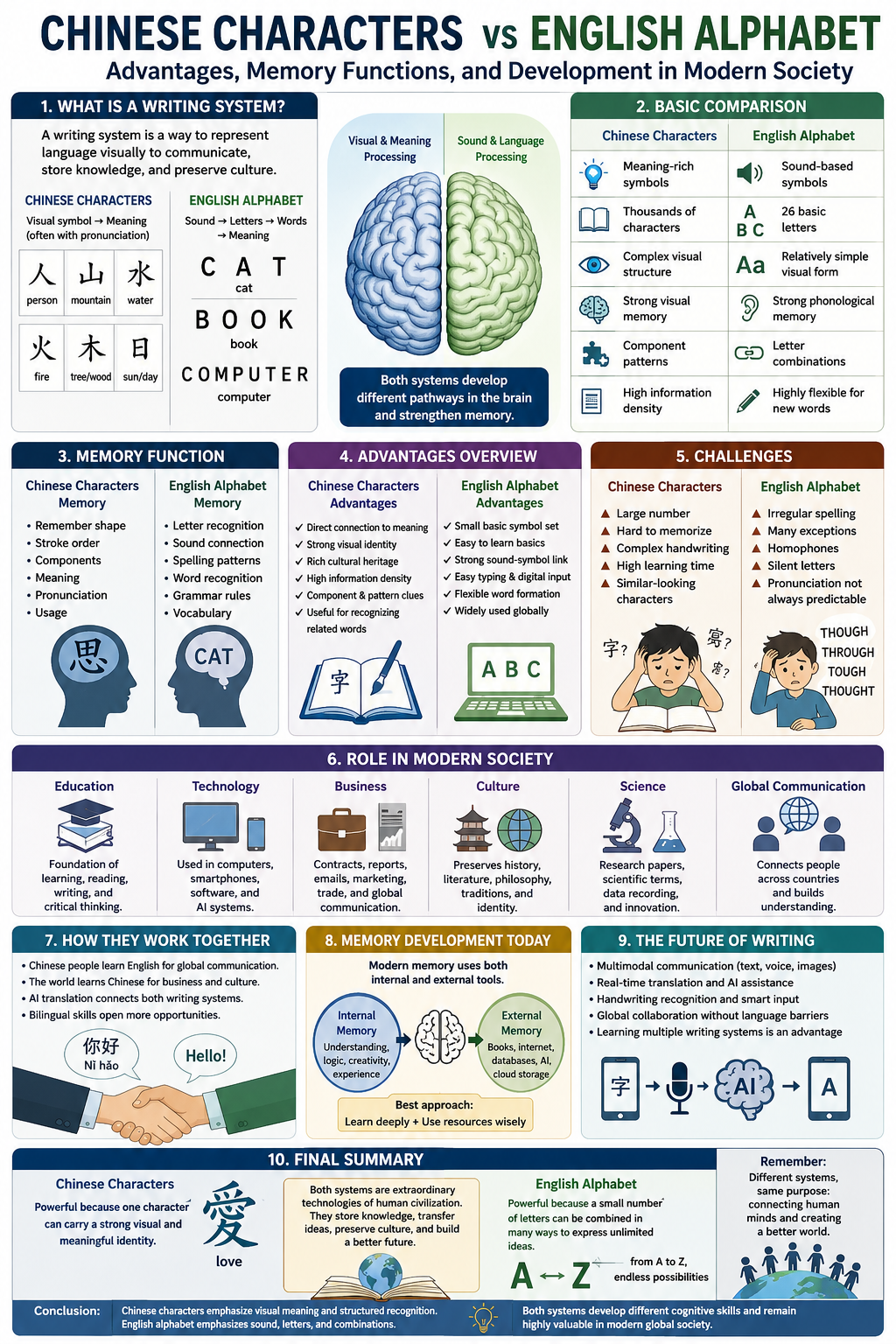
| Chinese Characters | English Alphabet |
|---|---|
| Strong visual identity | Strong sound identity |
| Meaning-rich symbols | Sound-based symbols |
| Many characters to memorize | Few basic letters |
| Complex visual recognition | Relatively simple symbol inventory |
| Strong component patterns | Strong letter combinations |
| High character-learning demand | High spelling irregularity in English |
The important conclusion is that both systems exercise different aspects of human learning.
Page 10 — Memory and the Human Brain
Memory is not a single function.
Human learning involves several interconnected processes:
- Sensory memory
- Working memory
- Short-term memory
- Long-term memory
- Visual memory
- Auditory memory
- Motor memory
- Semantic memory
- Procedural memory
Learning Chinese characters can involve many of these simultaneously.
A learner sees the character, remembers its shape, writes it by hand, associates it with a sound, and connects it to meaning.
English literacy also involves multiple systems.
A learner sees a word, processes its letters, converts them into sounds, recognizes the word, and connects it to meaning.
Therefore, writing systems do not simply “store memory.” They provide different pathways for accessing information.
Page 11 — The Role of Writing in Human Civilization
Writing transformed human civilization.
Before widespread writing, knowledge depended heavily on:
- Oral traditions
- Human memory
- Storytelling
- Demonstration
- Apprenticeship
Writing allowed knowledge to be stored outside the human brain.
This created a kind of external memory system.
Books, records, maps, contracts, scientific papers, databases, and digital documents all extend human memory.
Chinese characters played an important role in preserving Chinese civilization for thousands of years.
Alphabetic writing systems similarly enabled large-scale preservation and transmission of knowledge across Europe and, later, globally.
The fundamental achievement of writing is therefore:
It allows knowledge to survive beyond the lifetime of the individual who created it.
Page 12 — Cultural Preservation
Writing is essential for preserving culture.
Chinese characters have helped preserve:
- Historical records
- Philosophy
- Literature
- Government documents
- Poetry
- Scientific knowledge
- Religious and cultural texts
Alphabetic writing has similarly preserved:
- Ancient Greek philosophy
- Roman history
- European literature
- Scientific discoveries
- Legal systems
- Modern journalism
Writing allows societies to communicate with future generations.
A modern student can read a text created hundreds or thousands of years ago.
This is one of the greatest advantages of written language.
Page 13 — Chinese Characters and Cultural Continuity
Chinese characters have contributed significantly to cultural continuity across long periods.
Although spoken varieties of Chinese have changed considerably, written Chinese has historically provided a common written framework.
This helped facilitate communication across large geographical regions.
Characters also connect modern readers with historical literature and documents.
However, this continuity does not mean that all historical Chinese texts are automatically easy for modern readers. Classical Chinese can be substantially different from modern Chinese.
Nevertheless, the writing system has provided an important cultural bridge.
Page 14 — English and Global Communication
English alphabetic writing has become extremely influential in modern global communication.
English is widely used in:
- International business
- Science
- Aviation
- Computing
- Diplomacy
- Higher education
- Internet communication
- International trade
The Latin alphabet is also used by many languages around the world.
This makes alphabetic writing particularly useful for global information exchange.
The combination of English and digital technology has created an enormous global information network.
However, English dominance is not simply a result of the alphabet. Historical, economic, political, technological, and educational factors have all contributed.
Page 15 — Chinese Characters in Modern Technology
At first glance, Chinese characters might appear difficult to use with computers because there are thousands of characters.
Modern technology, however, has largely solved this problem.
Chinese can now be entered digitally using methods such as:
- Pinyin input
- Handwriting recognition
- Voice input
- Character recognition
- Predictive text
- Smartphone keyboards
For example, a person can type the pronunciation ni hao and select:
你好
Technology therefore creates a bridge between alphabetic input and character-based output.
This is an excellent example of how different writing systems can cooperate.
Page 16 — English in Computing
English and the Latin alphabet have played a major role in computing.
Many programming languages use English-based keywords:
- if
- else
- while
- for
- return
- class
- function
Technical documentation is also frequently written in English.
This does not mean computers fundamentally “think in English.” Computers process binary data and encoded representations.
However, the historical development of computing has made English terminology highly influential in technology.
The alphabet’s limited symbol inventory also makes it convenient for programming environments and technical systems.
Page 17 — Writing and Education
Education depends heavily on writing.
Students use writing to:
- Take notes
- Read textbooks
- Complete assignments
- Record experiments
- Study mathematics
- Learn history
- Communicate ideas
Chinese education requires substantial character learning.
English education requires extensive vocabulary and spelling development.
Both systems require discipline.
A student who learns a writing system develops more than literacy. The student also develops:
- Concentration
- Recognition skills
- Memory
- Attention to detail
- Communication
- Analytical thinking
Writing is therefore both a communication technology and a learning technology.
Page 18 — Handwriting and Memory
Handwriting can be an important part of learning.
When a person writes by hand, the brain coordinates:
Visual recognition + movement + attention + memory
Writing a Chinese character requires remembering its structure and stroke sequence.
Writing English requires remembering letters, spelling, and word structure.
This physical activity can reinforce learning.
However, modern society is increasingly digital.
People now type more frequently than they write by hand.
This creates an important educational question:
Should schools continue teaching handwriting when technology can type for us?
The answer is generally yes, because handwriting can support literacy development, fine motor skills, and memory, even though digital typing is essential.
Page 19 — Characters, Words, and Information Density
One interesting feature of Chinese writing is its information density.
A Chinese character often represents a meaningful unit.
For example:
电 relates to electricity.
It appears in words such as:
电脑 — computer
电话 — telephone
电视 — television
A learner who understands the meaning of a component may gain clues about related vocabulary.
English works differently.
The word:
electricity
does not visually resemble:
computer
or:
telephone
even though these concepts are related.
However, English has its own morphological systems, such as:
- electric
- electrical
- electrify
- electronics
Therefore, both systems have ways of connecting vocabulary, but they do so differently.
Page 20 — The Advantage of Alphabetic Flexibility
Alphabetic systems are highly adaptable.
They can be used to represent:
- New scientific terms
- Brand names
- Technical vocabulary
- Foreign names
- Acronyms
- Computer commands
For example:
AI
CPU
DNA
NASA
Abbreviations can communicate complex ideas efficiently.
The alphabet also makes it relatively straightforward to transliterate names from one language into another, although pronunciation can change.
This flexibility is particularly useful in international science and business.
Page 21 — The Advantage of Character Components
Chinese characters also have internal structure.
Many characters contain components that provide clues about meaning or pronunciation.
This creates a system of visual associations.
A learner can gradually recognize recurring components.
Instead of seeing thousands of completely unrelated symbols, the learner begins to see patterns.
This is similar to learning building blocks.
For example:
Character
→ Components
→ Meaning clues
→ Pronunciation clues
→ Related vocabulary
This is why advanced Chinese learners often develop a powerful ability to recognize patterns across characters.
Page 22 — Writing Systems and Artificial Intelligence
Artificial intelligence has created new possibilities for language.
AI can now assist with:
- Translation
- Speech recognition
- Optical character recognition
- Handwriting recognition
- Text generation
- Language learning
- Spelling correction
- Grammar correction
- Character recognition
AI can recognize both Chinese characters and alphabetic writing.
This is important because the future of communication may increasingly involve multiple modes simultaneously:
Voice + Text + Images + Symbols + AI
A person may speak Chinese, have AI translate it into English, and communicate with someone thousands of kilometres away.
Technology is therefore reducing some of the practical barriers between writing systems.
Page 23 — Chinese and English Working Together
The future is not necessarily about choosing Chinese or English.
Increasingly, the world uses both.
Examples include:
- Chinese companies using English technical terminology
- International companies operating in China
- Scientists publishing research in English while communicating locally in Chinese
- Students learning both languages
- AI translating between the systems
- Businesses using bilingual websites
This creates a powerful combination.
Chinese characters can provide cultural and semantic richness.
English can provide broad international accessibility.
Together, they support cross-cultural communication.
Page 24 — The Role of Writing in Business
Modern business depends on written communication.
Businesses use writing for:
- Contracts
- Invoices
- Emails
- Reports
- Marketing
- Websites
- Product descriptions
- Financial statements
- Government documents
English is widely used in international business.
Chinese is essential for communication within China’s enormous domestic market and among Chinese-speaking communities worldwide.
Businesses that understand both systems can potentially access wider markets.
In the modern economy, language literacy is therefore a form of economic capital.
Page 25 — Advantages and Challenges
Every writing system has advantages and challenges.
Chinese characters: Advantages
- Strong visual identity
- Direct connection to meaning
- Rich cultural heritage
- High information density
- Strong component-based patterns
- Useful semantic recognition
Chinese characters: Challenges
- Large number of characters
- Significant memorization requirements
- Complex handwriting
- Difficult initial literacy acquisition
- Character confusion
- Need for sustained practice
English alphabet: Advantages
- Small basic symbol inventory
- Relatively accessible initial literacy
- Strong sound-symbol relationship
- Easy digital input
- Global usage
- Flexible word formation
English alphabet: Challenges
- Irregular spelling
- Many pronunciation exceptions
- Homophones
- Silent letters
- Difficult spelling rules
- Pronunciation cannot always be predicted from spelling
The key lesson is that simplicity in one area can create complexity in another.
Page 26 — Memory Development in Modern Society
Modern society is experiencing a major transformation in how humans use memory.
In the past, people needed to memorize more information because written and digital resources were limited.
Today, people can search for information instantly.
This has created the concept of externalized memory.
Instead of memorizing everything, people remember:
- Where to find information
- How to search
- How to evaluate information
- How to use information
This is increasingly important in the digital age.
However, this does not mean memory is becoming unnecessary.
Strong memory remains important for:
- Critical thinking
- Problem solving
- Language
- Creativity
- Decision-making
- Professional expertise
The ideal modern learner should combine internal memory with external information tools.
Page 27 — The Future of Writing and Human Development
The future of writing will probably be increasingly multimodal.
People will communicate through:
Text + Voice + Images + Video + Symbols + AI
Chinese characters and English alphabetic writing will continue to evolve within this environment.
Future technologies may include:
- Real-time translation
- AI-powered language tutors
- Automatic handwriting recognition
- Augmented reality translation
- Brain-computer interfaces
- Voice-to-text systems
- Intelligent educational platforms
The distinction between writing systems may become less important for basic communication because technology can translate between languages.
However, learning different writing systems will remain valuable because language carries:
- Culture
- History
- Identity
- Knowledge
- Ways of thinking
- Social relationships
Technology can translate words, but understanding a language deeply involves understanding the people and culture behind it.
Page 28 — Conclusion
Chinese characters and English alphabetic writing represent two highly successful approaches to human communication.
The English alphabet offers the advantage of a relatively small set of basic symbols and a powerful connection between writing and sound. This has contributed to its usefulness in education, technology, science, computing, and international communication.
Chinese characters offer a different strength. They provide visually distinctive symbols that often connect directly with meaningful linguistic units. Their components create networks of visual and semantic associations, while their long history has contributed significantly to cultural continuity.
From a memory perspective, the two systems can encourage different learning pathways.
Chinese characters emphasize:
Visual recognition + meaning + structure + pronunciation
English alphabetic writing emphasizes:
Letters + sounds + word construction + meaning
Neither system is universally superior.
The most important lesson is that human intelligence is flexible enough to learn multiple systems of representation.
In modern society, the greatest advantage may come not from choosing one writing system over another, but from understanding how different systems complement each other.
A future global citizen may be able to:
- Read Chinese characters
- Read English alphabetic text
- Speak multiple languages
- Use AI translation
- Communicate through images
- Interpret data
- Program computers
- Search digital information
- Evaluate knowledge critically
The ultimate purpose of writing is not simply to create symbols on paper or screens. It is to store human knowledge, transfer ideas, preserve civilization, coordinate societies, and enable generations to build upon the discoveries of those who came before them.
In this sense, both Chinese characters and alphabetic English writing are extraordinary technologies of human civilization.
They demonstrate one of humanity’s greatest achievements: the ability to transform thoughts inside the human mind into symbols that can travel across space and time.
Simple Final Comparison
| Feature | Chinese Characters | English Alphabet |
|---|---|---|
| Basic principle | Meaning-bearing characters | Letters representing language sounds |
| Main strength | Visual and semantic recognition | Phonological and alphabetic efficiency |
| Memory demand | Many individual characters | Smaller alphabet, large vocabulary |
| Visual structure | Highly complex | Relatively simple |
| Spelling | Character memorization | Many irregular spellings |
| Digital technology | Pinyin, handwriting, voice input | Direct keyboard input |
| Cultural role | Strong historical continuity | Strong global international reach |
| Education | Significant character learning | Strong phonics and vocabulary learning |
| Global role | Major world writing system | Extremely widespread international system |
| AI future | Recognition and translation | Recognition and translation |
| Best overall lesson | Meaning through visual structure | Communication through efficient symbols |
Chinese writing is powerful because one character can carry a strong visual and meaningful identity. English writing is powerful because a small number of letters can be combined in many ways to represent a huge vocabulary.
Chinese can be thought of as a system that strongly emphasizes visual meaning and structured recognition, while English strongly emphasizes sound, letters, and combinations. Both systems develop different cognitive skills, and both remain highly valuable in modern global society.





Be First to Comment