
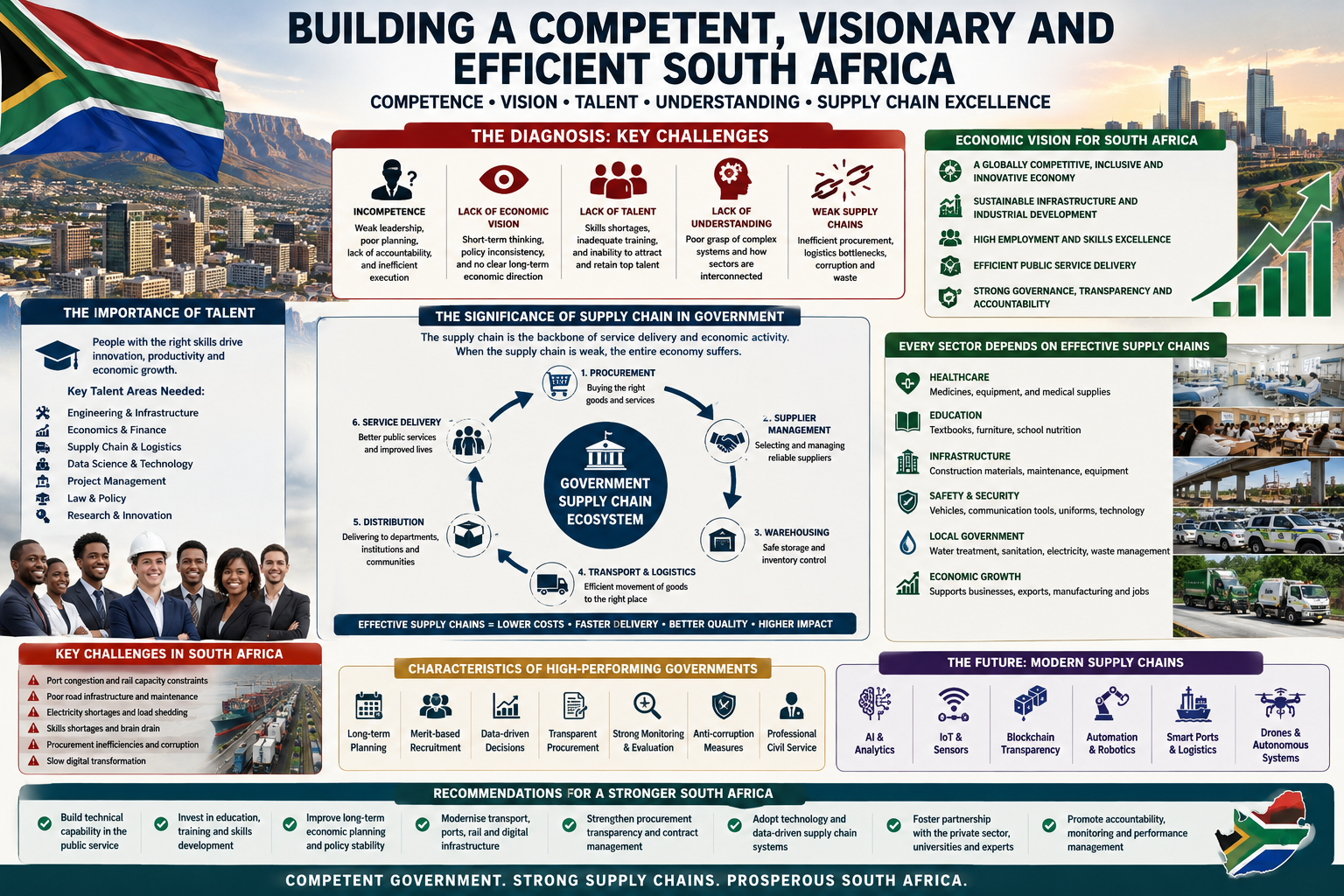
1. Core Diagnosis: Systemic Incompetence and Administrative Weakness
The most persistent challenge in South Africa’s government ecosystem is institutional capacity failure. This is not about individuals alone—it is structural.
Key symptoms
- Slow decision‑making caused by fragmented departments and unclear mandates.
- Weak project management leading to delays in infrastructure, procurement, and service delivery.
- Poor enforcement of accountability, allowing underperformance to continue without consequence.
- High turnover in leadership, which disrupts continuity and long‑term planning.
- Overreliance on consultants, indicating internal skill gaps.
Impact
- Infrastructure projects stall for years.
- Budgets are underspent or misallocated.
- Policy implementation becomes inconsistent across provinces.
- Citizens lose trust in government capability.
2. Lack of Economic Vision: Absence of a Coherent National Strategy
South Africa’s economy requires a unified, long‑term economic vision, but government often operates reactively instead of strategically.
Key gaps
- No clear industrialisation roadmap for manufacturing, logistics, energy, or technology.
- Weak alignment between national, provincial, and municipal economic plans.
- Insufficient focus on productivity, competitiveness, and innovation.
- Failure to modernise key sectors such as rail, ports, energy, and digital infrastructure.
- Limited anticipation of global economic shifts, including AI, automation, and green energy.
Consequences
- Investors face uncertainty.
- Job creation stagnates.
- South Africa loses ground to faster‑moving economies like Kenya, Rwanda, and Vietnam.
- The country remains commodity‑dependent instead of value‑adding.
3. Talent Deficit: Skills Shortages and Misaligned Appointments
A critical part of the diagnosis is the shortage of specialised talent inside government.
Where talent gaps are most severe
- Supply chain management
- Engineering and infrastructure planning
- Digital transformation and automation
- Data analytics and economic modelling
- Project management and contract administration
Root causes
- Cadre deployment and political appointments override merit.
- Skilled professionals migrate to private sector or overseas.
- Limited investment in training, upskilling, and leadership development.
- Weak graduate pipelines for public‑sector technical roles.
Result
Government struggles to execute complex projects, negotiate with suppliers, or design modern economic policies.
4. Lack of Understanding: Policy Misalignment and Poor Technical Literacy
Many decision‑makers lack technical understanding of the sectors they oversee.
Examples
- Energy policy decisions made without engineering insight.
- Transport strategies developed without logistics modelling.
- Procurement rules applied without understanding supply‑chain dynamics.
- Digital transformation plans created without IT architecture knowledge.
Outcome
Policies become theoretical, not operational, leading to:
- Misguided regulations
- Unrealistic timelines
- Poorly scoped projects
- Budget overruns
- Failure to integrate global best practices
5. The Significance of Supply Chain Management in Government
Supply chain is the backbone of government service delivery. When it fails, everything fails.
Why supply chain is central
- Government is the largest buyer of goods and services in the country.
- Procurement determines the success of infrastructure, health, education, transport, and safety.
- Efficient supply chains reduce costs, improve delivery speed, and prevent corruption.
Current weaknesses
- Fragmented procurement systems across departments.
- Manual processes instead of digital platforms.
- Poor contract management, leading to delays and disputes.
- Weak supplier vetting, enabling fraud and inflated pricing.
- Lack of logistics coordination, especially in health, transport, and infrastructure.
Strategic importance
A modern supply chain would:
- Cut wasteful expenditure by billions.
- Improve delivery of medicines, textbooks, and infrastructure materials.
- Strengthen national security through reliable procurement.
- Boost local manufacturing by prioritising domestic suppliers.
- Increase transparency and reduce corruption.
6. How These Issues Interconnect
These problems do not exist in isolation—they reinforce each other.
| Problem | How It Connects |
|---|---|
| Incompetence | Leads to poor supply‑chain decisions and weak economic planning. |
| Lack of economic vision | Prevents government from building the talent and systems needed for growth. |
| Talent shortages | Cause project failures, procurement inefficiencies, and policy misalignment. |
| Lack of understanding | Results in unrealistic policies and mismanaged budgets. |
| Supply‑chain failures | Directly undermine service delivery and economic competitiveness. |
Together, they create a cycle of underperformance that slows national development.
7. Strategic Recommendations for Government Modernisation
A credible turnaround requires structural reforms, not cosmetic changes.
1. Professionalise the public service
- Merit‑based appointments
- Mandatory qualifications for technical roles
- Leadership development academies
2. Build a national economic vision
- 20‑year industrialisation plan
- Modernisation of ports, rail, and energy
- Digital economy and AI strategy
- Green industrial policy
3. Modernise supply chain
- Full digital procurement platforms
- Real‑time supplier performance dashboards
- Centralised contract management
- Transparent tender processes
- Logistics optimisation for health, transport, and infrastructure
4. Strengthen talent pipelines
- Graduate programmes for engineers, economists, and supply‑chain specialists
- Partnerships with universities and private sector
- Incentives for high‑skill professionals to join government
5. Improve policy literacy
- Technical training for ministers and senior officials
- Sector‑specific advisory councils
- Evidence‑based policymaking
8. A Final Insight
South Africa’s challenges are not unsolvable—they are management and capability problems, not destiny. Countries like Singapore, Rwanda, and South Korea transformed themselves by fixing state capacity, professionalising supply chains, and building long‑term economic vision.
South Africa can do the same with disciplined execution.






Be First to Comment