
A full academic‑style thesis
PAGE 1 — Introduction
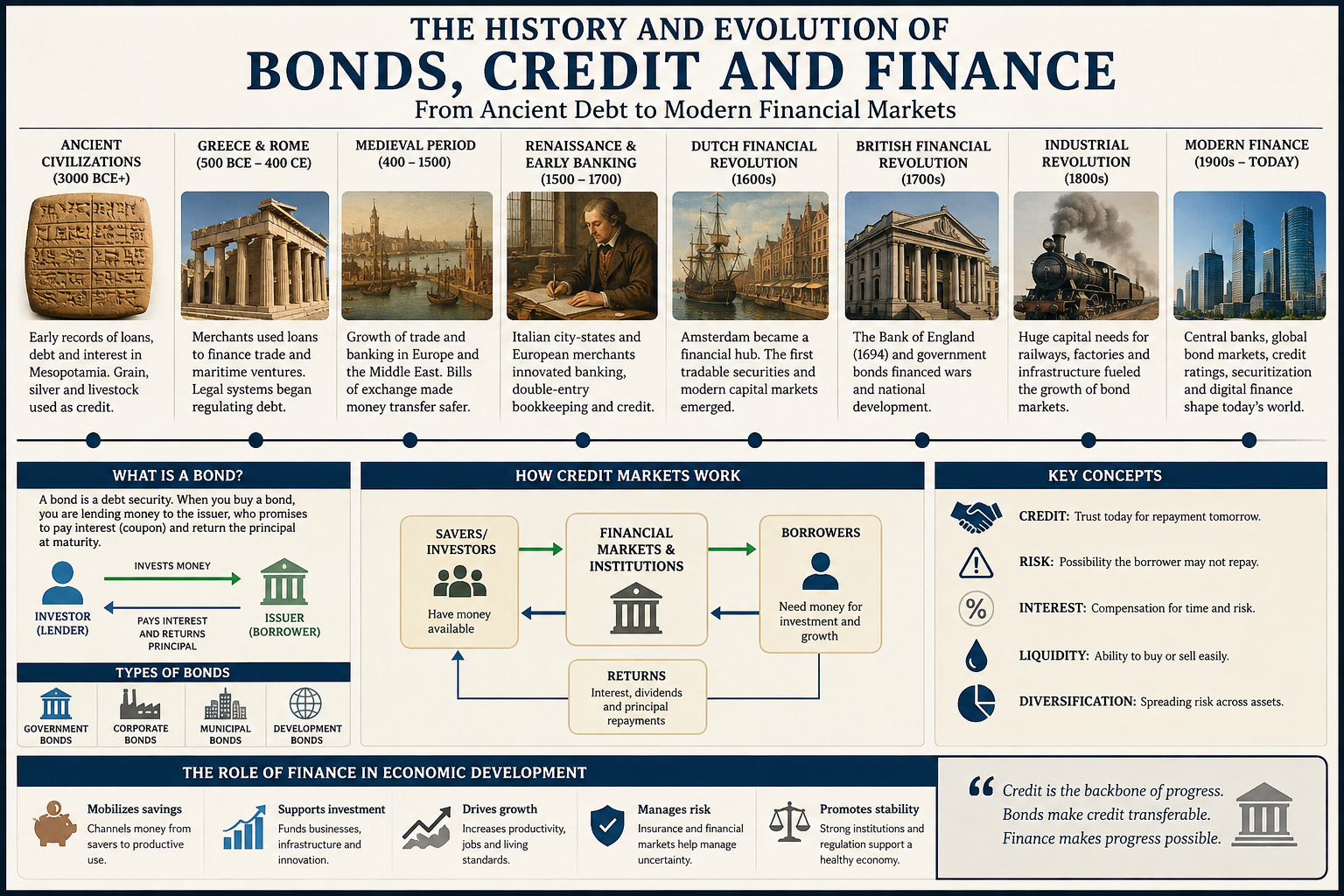
The global financial system is built on three foundational pillars: credit, debt, and bonds. These instruments shape how governments fund infrastructure, how corporations expand, and how individuals access capital. The history of the bonds market and credit finance stretches back thousands of years, evolving from primitive lending practices into a sophisticated global architecture that underpins modern economies.
PAGE 2 — Early Human Exchange Systems
Before formal credit existed, ancient societies relied on barter, exchanging goods directly. As trade expanded, barter became inefficient, leading to the creation of commodity money such as grain, livestock, and precious metals. These early forms of value storage laid the groundwork for credit systems.
PAGE 3 — Mesopotamia: The Birthplace of Credit
The earliest recorded credit transactions date to Mesopotamia (3000–2000 BCE). Clay tablets discovered in Sumer and Babylon show detailed loan agreements involving grain, silver, and land. Temples and palaces acted as proto‑banks, issuing loans and recording interest obligations. This marks the first institutionalized credit system.
PAGE 4 — Hammurabi’s Code and Legal Credit Frameworks
Around 1754 BCE, the Code of Hammurabi formalized lending rules, interest caps, collateral requirements, and penalties for default. This was the first legal framework governing credit, influencing future civilizations.
PAGE 5 — Ancient Egypt and Agricultural Credit
Egyptian farmers borrowed seeds and tools from state granaries, repaying after harvest. These seasonal credit cycles resembled modern short‑term loans and contributed to agricultural stability.
PAGE 6 — Ancient Greece: Maritime Loans
Greek merchants pioneered maritime loans, where lenders financed voyages and charged higher interest due to risk. If the ship sank, the loan was forgiven. This is the ancestor of modern risk‑based lending and insurance.
PAGE 7 — Ancient Rome: The Rise of Public Debt
Rome introduced the earliest form of government bonds. The Roman state borrowed from wealthy citizens to fund wars, infrastructure, and expansion. These loans were recorded in public registers and paid interest, forming the first recognizable sovereign debt market.
PAGE 8 — Roman Banking Innovations
Roman bankers (argentarii) offered deposit accounts, loans, promissory notes, and credit transfers. Their practices resemble modern commercial banking.
PAGE 9 — Collapse of Rome and Medieval Credit Regression
After Rome fell, Europe entered a period of fragmented trade. Credit systems weakened, and lending became localized. The Catholic Church banned usury (charging interest), slowing financial innovation.
PAGE 10 — Islamic Golden Age: Revival of Credit
Between the 7th and 13th centuries, Islamic finance introduced interest‑free credit, profit‑sharing contracts, and bills of exchange (sakk). These instruments influenced European banking.
PAGE 11 — Medieval Europe: Bills of Exchange
Italian merchant families (Medici, Bardi, Peruzzi) created bills of exchange, allowing merchants to transfer money across borders without carrying gold. This innovation revived long‑distance trade and laid the foundation for modern credit instruments.
PAGE 12 — Birth of Government Bonds in Renaissance Italy
City‑states like Venice and Florence issued prestiti, early government bonds used to finance wars. Citizens were compelled to lend money to the state, receiving interest in return. This marks the beginning of structured sovereign debt markets.
PAGE 13 — The Dutch Republic: Modern Bond Market Emerges
In the 1600s, the Dutch created the first voluntary, tradable government bonds. Amsterdam became the world’s financial capital, with a secondary market for bonds and shares. The Dutch East India Company issued the first corporate bonds.
PAGE 14 — Bank of Amsterdam and Financial Stability
Founded in 1609, the Bank of Amsterdam standardized currency and stabilized credit markets. It became the model for central banking.
PAGE 15 — England: Consolidation of Public Debt
After the Glorious Revolution (1688), England established the Bank of England (1694) to manage government borrowing. The British government issued long‑term bonds (consols), creating a stable national debt system.
PAGE 16 — Industrial Revolution and Corporate Finance
The 18th–19th centuries saw rapid industrialization. Railways, factories, and mining companies issued bonds to raise capital. Credit markets expanded dramatically.
PAGE 17 — U.S. Treasury Bonds and National Development
The United States issued bonds to fund:
- The Revolutionary War
- The Civil War
- Railroads
- The New Deal
- World War II
U.S. Treasury bonds became the world’s benchmark for risk‑free assets.
PAGE 18 — Emergence of Municipal Bonds
Cities began issuing bonds to build water systems, roads, schools, and public infrastructure. Municipal bonds remain a major financing tool today.
PAGE 19 — 20th Century: Globalization of Credit
The 20th century saw:
- Central banks formalized
- Credit scoring systems introduced
- International bond markets created
- Corporate finance standardized
Credit became essential for economic growth.
PAGE 20 — Bretton Woods and Global Financial Architecture
In 1944, the Bretton Woods Agreement established:
- IMF
- World Bank
- Fixed exchange rates
This stabilized global credit markets and encouraged cross‑border lending.
PAGE 21 — Eurobond Market Emergence
In the 1960s, companies began issuing Eurobonds—bonds sold outside the issuer’s home country. This created a global, borderless bond market.
PAGE 22 — Junk Bonds and High‑Yield Finance
In the 1980s, Michael Milken pioneered high‑yield bonds, enabling risky companies to raise capital. This transformed corporate finance and fueled mergers and acquisitions.
PAGE 23 — Securitization and Structured Finance
Banks began bundling loans into securities:
- Mortgage‑backed securities (MBS)
- Asset‑backed securities (ABS)
- Collateralized debt obligations (CDOs)
This expanded credit availability but increased systemic risk.
PAGE 24 — Credit Rating Agencies
Moody’s, S&P, and Fitch became central to bond markets by rating creditworthiness. Ratings influence interest rates and investor confidence.
PAGE 25 — Derivatives and Risk Management
Financial derivatives such as:
- Interest rate swaps
- Credit default swaps
- Futures and options
These instruments allow institutions to hedge risk and speculate on credit markets.
PAGE 26 — 2008 Global Financial Crisis
Excessive credit expansion and risky mortgage securitization triggered the 2008 crisis. Bond markets froze, banks collapsed, and governments intervened with massive bailouts.
PAGE 27 — Post‑Crisis Regulation
New regulations emerged:
- Basel III
- Dodd‑Frank
- Stress testing
- Liquidity coverage ratios
These reforms strengthened credit markets.
PAGE 28 — Rise of Emerging Market Bonds
Countries in Africa, Asia, and Latin America began issuing sovereign bonds to fund development. South Africa’s bond market became one of the largest in Africa.
PAGE 29 — Digital Finance and Fintech Credit
Fintech innovations introduced:
- Peer‑to‑peer lending
- Digital credit scoring
- Blockchain‑based bonds
- Mobile microfinance
Credit became more accessible globally.
PAGE 30 — Cryptocurrency and Decentralized Finance (DeFi)
DeFi platforms allow users to:
- Lend
- Borrow
- Issue synthetic bonds
- Earn interest
All without traditional banks. This represents a new frontier in credit finance.
PAGE 31 — ESG Bonds and Sustainable Finance
Environmental, Social, and Governance (ESG) bonds emerged to fund:
- Renewable energy
- Climate adaptation
- Social development
Green bonds are now a major global asset class.
PAGE 32 — Sovereign Debt Crises
Countries like Greece, Argentina, and Sri Lanka experienced debt crises due to:
- Excessive borrowing
- Currency depreciation
- Weak fiscal management
These events highlight the risks of sovereign credit.
PAGE 33 — The Role of Central Banks Today
Modern central banks influence bond markets through:
- Interest rate policy
- Quantitative easing
- Open market operations
Bond yields guide global investment decisions.
PAGE 34 — The Bond Market as a Global Indicator
Bond markets reflect:
- Inflation expectations
- Economic growth
- Investor confidence
- Government stability
They are the backbone of global finance.
PAGE 35 — Conclusion
From ancient clay tablets to digital blockchain bonds, the evolution of credit and bond markets reveals humanity’s continuous pursuit of economic expansion. Bonds finance nations, corporations, and infrastructure. Credit empowers individuals and businesses. Together, they form the architecture of modern civilization.
The future will likely merge traditional finance with digital innovation, creating a more inclusive, efficient, and global credit ecosystem.






Be First to Comment