
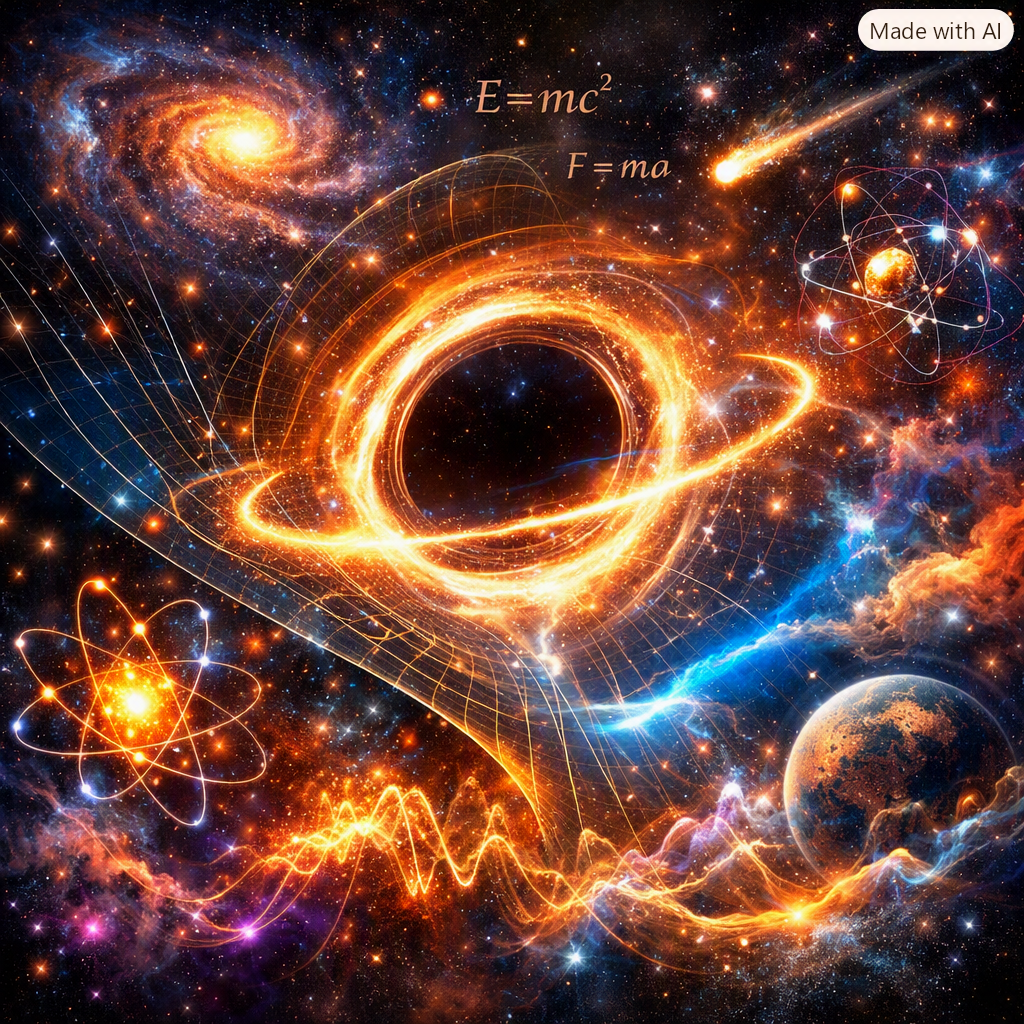
Explaining What the Laws of Physics Are and How They Work — A Complete Foundational Treatise
ABSTRACT
The laws of physics are the universal principles governing matter, energy, motion, forces, fields, and the structure of space‑time. They describe how objects behave, how energy flows, how waves propagate, how particles interact, and how the universe evolves. This thesis provides a comprehensive, deeply detailed explanation of what the laws of physics are and how they work, covering classical mechanics, thermodynamics, electromagnetism, relativity, quantum mechanics, and cosmology. It integrates conceptual explanations, mathematical formulations, real‑world applications, and philosophical implications.
CHAPTER 1 — INTRODUCTION TO THE LAWS OF PHYSICS
1.1 What Are the Laws of Physics?
The laws of physics are universal rules describing how the universe behaves at all scales — from atoms to galaxies. They are not invented; they are discovered through observation, experimentation, and mathematical reasoning. They explain:
- Why objects move
- Why forces act
- How energy transforms
- How waves carry information
- How matter interacts
- How space and time behave
Physics laws are consistent, predictive, and quantitative, forming the backbone of all scientific and technological advancement.
1.2 Why Physics Laws Matter
They allow us to:
- Build machines, engines, vehicles, and infrastructure
- Understand natural phenomena (storms, earthquakes, planetary motion)
- Develop electronics, communication systems, and medical devices
- Explore space and predict cosmic evolution
Physics is the operating system of the universe.
CHAPTER 2 — FOUNDATIONS OF CLASSICAL MECHANICS
Classical mechanics explains the motion of objects under forces.
2.1 Newton’s Laws of Motion
Newton’s laws are the foundation of mechanics.
First Law — Inertia
Objects resist changes in motion unless acted upon by an external force.
Second Law — F = ma
Force equals mass times acceleration. This law quantifies motion.
Third Law — Action–Reaction
For every action, there is an equal and opposite reaction.
How Newton’s Laws Work in Reality
- A car accelerates when the engine applies force.
- A rocket launches because exhaust gases push downward.
- A ball thrown upward slows due to gravity and air resistance.
2.2 Kinematics: Describing Motion
Kinematics deals with velocity, acceleration, and displacement.
Key formulas:
- Free fall:
2.3 Forces and Equilibrium
- Friction opposes motion.
- Static equilibrium: forces balanced, object at rest.
- Dynamic equilibrium: forces balanced, constant velocity.
2.4 Momentum and Impulse
- Momentum:
- Impulse:
- Conservation of momentum governs collisions.
CHAPTER 3 — CONSERVATION LAWS
Conservation laws are the deepest truths in physics.
3.1 Conservation of Energy
Energy cannot be created or destroyed; only transformed.
Forms of energy:
- Kinetic
- Potential
- Thermal
- Chemical
- Electrical
- Nuclear
3.2 Conservation of Momentum
Total momentum in a closed system remains constant.
3.3 Conservation of Charge
Electric charge is constant in all interactions.
3.4 Conservation of Mass–Energy
Einstein’s equation:
Mass and energy are interchangeable.
CHAPTER 4 — THERMODYNAMICS
Thermodynamics explains heat, energy flow, and entropy.
4.1 Zeroth Law
Defines temperature and thermal equilibrium.
4.2 First Law — Energy Conservation
Heat added = increase in internal energy + work done.
4.3 Second Law — Entropy
Entropy always increases in isolated systems.
Implications:
- Heat flows from hot to cold.
- No engine is 100% efficient.
- Time has a direction (“arrow of time”).
4.4 Third Law
Absolute zero cannot be reached.
CHAPTER 5 — ELECTROMAGNETISM
Electromagnetism governs electricity, magnetism, and light.
5.1 Electric Fields and Forces
Charges create electric fields; fields exert forces.
5.2 Magnetic Fields
Moving charges create magnetic fields.
5.3 Maxwell’s Equations
They unify electricity and magnetism and show that light is an electromagnetic wave.
5.4 Applications
- Motors
- Generators
- Transformers
- Wireless communication
- Electronics
CHAPTER 6 — WAVES AND OSCILLATIONS
Waves transfer energy without transferring matter.
6.1 Wave Properties
- Amplitude
- Frequency
- Wavelength
- Speed:
6.2 Types of Waves
- Transverse
- Longitudinal
- Electromagnetic
- Mechanical
6.3 Applications
- Sound
- Light
- Radio waves
- Earthquake waves
CHAPTER 7 — GRAVITATION
Gravity is the force of attraction between masses.
7.1 Newtonian Gravity
Explains planetary motion, tides, orbits.
7.2 Einstein’s General Relativity
Gravity is curvature of space‑time.
Effects:
- Time dilation
- Black holes
- Gravitational waves
CHAPTER 8 — RELATIVITY
Relativity explains space, time, and high‑speed motion.
8.1 Special Relativity
Principles:
- Speed of light is constant.
- Laws of physics same in all inertial frames.
Consequences:
- Time dilation
- Length contraction
- Mass–energy equivalence
8.2 General Relativity
Explains gravity as geometry.
CHAPTER 9 — QUANTUM MECHANICS
Quantum physics governs atoms and subatomic particles.
9.1 Wave–Particle Duality
Particles behave like waves and particles.
9.2 Uncertainty Principle
Cannot know position and momentum exactly.
9.3 Quantum Fields
Particles are excitations of fields.
9.4 Applications
- Semiconductors
- Lasers
- MRI
- Nuclear energy
CHAPTER 10 — COSMOLOGY AND THE UNIVERSE
Physics laws govern the entire cosmos.
10.1 Big Bang Theory
Universe began from a hot, dense state.
10.2 Expansion of the Universe
Galaxies move apart due to cosmic expansion.
10.3 Dark Matter and Dark Energy
Invisible components shaping cosmic evolution.
CHAPTER 11 — HOW PHYSICS LAWS WORK TOGETHER
Physics laws are interconnected:
- Mechanics explains motion.
- Thermodynamics explains energy flow.
- Electromagnetism explains fields and light.
- Relativity explains space‑time.
- Quantum mechanics explains particles.
Together, they form a unified description of reality.
CHAPTER 12 — PHILOSOPHICAL IMPLICATIONS
Physics raises deep questions:
- Why do these laws exist?
- Are they universal everywhere?
- Are they emergent or fundamental?
- Do they imply determinism or probability?
CHAPTER 13 — CONCLUSION
The laws of physics are the universal principles governing everything in existence. They describe motion, forces, energy, waves, particles, and the structure of space‑time. Understanding them reveals how the universe works and empowers humanity to innovate, explore, and evolve.





Be First to Comment