
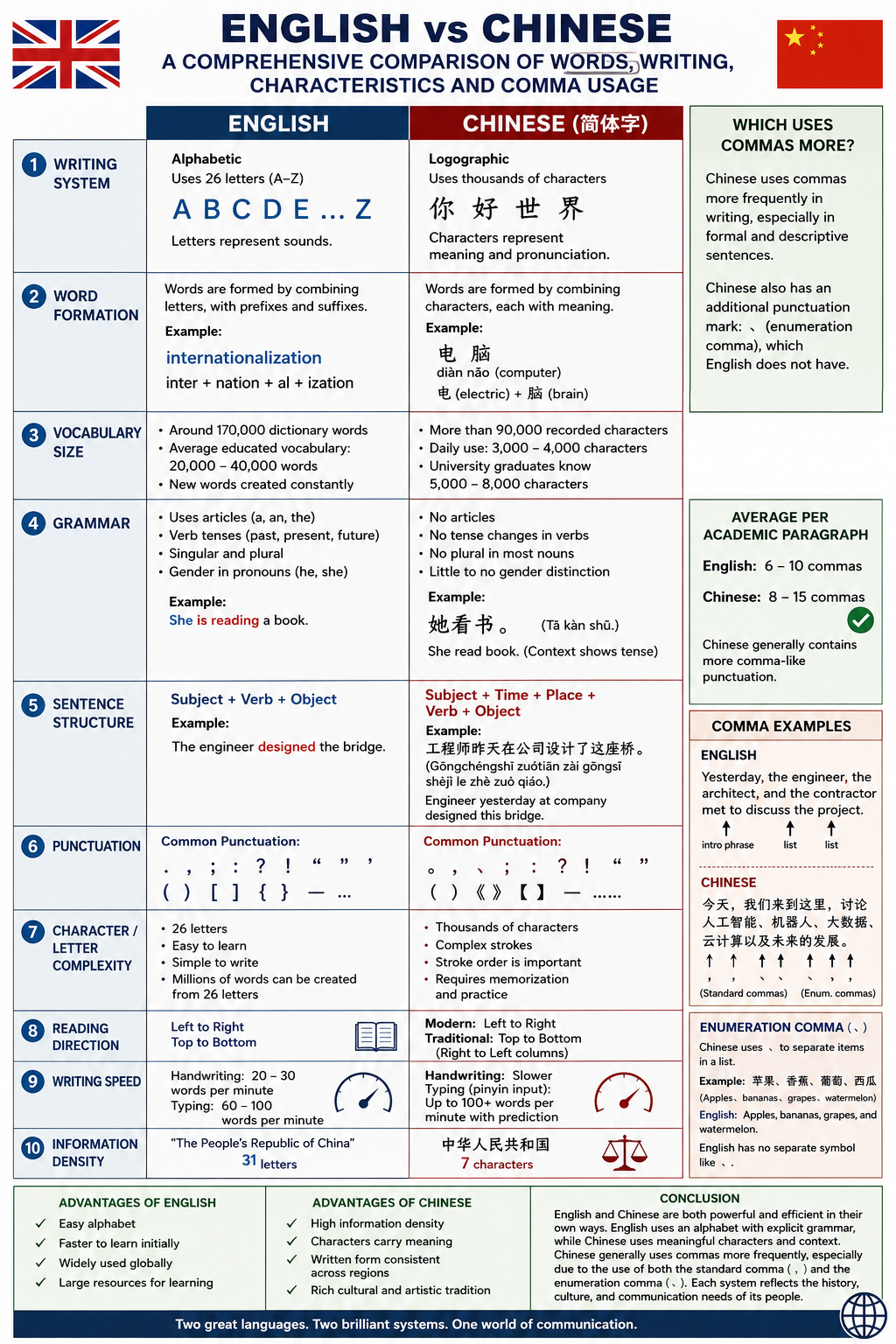
1. Writing System: Alphabet vs. Characters
English: Alphabetic
- Uses 26 letters forming words.
- Writing is linear, spacing separates words.
- Meaning is built from phonetic combinations.
Chinese: Logographic
- Uses characters (汉字), each representing a morpheme or idea.
- No alphabet; characters combine to form words.
- Characters occupy equal-sized square cells in traditional layout.
Example
| English | Chinese |
|---|---|
| “international” | 国际 (guójì) |
| Built from letters | Built from two characters |
🧠 2. Word Structure & Morphology
English
- Highly inflected: tense, plural, person. Example: “eat / eats / eating / ate”.
- Words change form depending on grammar.
Chinese
- No inflection. Verbs and nouns do not change form. Example: 吃 (chī) means eat, regardless of tense or subject.
🔠 3. Sentence Structure & Syntax
English
- Flexible but rule-heavy.
- Uses punctuation to show pauses, clauses, lists.
Chinese
- More rigid word order.
- Modifiers always come before nouns. Example: “a very big house” → 非常大的房子 (fēicháng dà de fángzi).
✒️ 4. Punctuation System: Full-width vs. Half-width
English punctuation
- Uses half-width marks: . , ? ! ; :
- Always places a space after punctuation.
- Uses one comma for all purposes.
Chinese punctuation
- Uses full-width marks: 。 , 、 ! ?
- No space after punctuation.
- Uses two different commas:
- , clause comma (逗号)
- 、 enumeration comma (顿号) for lists
- Period is a circle (。), not a dot.
🔍 5. Comma Usage: Which Language Uses More?
Short answer:
English uses commas far more frequently than Chinese.
Why English uses more commas
- English grammar requires commas for:
- Introductory phrases
- Dependent clauses
- Non-essential information
- Lists
- Preventing “comma splices” (joining two sentences incorrectly)
Why Chinese uses fewer commas
- Chinese sentences often flow with fewer breaks.
- Chinese uses two comma types, but each has a narrow purpose:
- , separates clauses
- 、 separates items in a list
- Chinese does not use commas to separate dependent clauses the same way English does.
- Chinese sentences can be long without punctuation and still be grammatically correct.
📘 6. Detailed Examples
A. Clause separation
English:
I live in Beijing, and he lives in Shanghai.
Chinese:
我住在北京,他住在上海。 Only one clause comma (,) is used.
B. Lists
English:
apples, bananas, oranges, and watermelon
Chinese:
苹果、香蕉、橘子和西瓜 Uses enumeration comma (、) — English does not have this punctuation.
C. Comma splice problem (English only)
Incorrect English:
I finished the report, I sent it to my manager.
Correct English:
I finished the report. I sent it to my manager. OR I finished the report, and I sent it to my manager. English forbids joining two full sentences with a comma.
Chinese does not have this problem.
D. Period differences
English:
Today is Sunday.
Chinese:
今天是星期天。 Ends with a circle period (。).
🏁 7. Summary Table
| Feature | English | Chinese |
|---|---|---|
| Writing system | Alphabetic | Logographic |
| Word formation | Letters → words | Characters → words |
| Inflection | Yes | No |
| Punctuation width | Half-width | Full-width |
| Comma types | 1 | 2 (, and 、) |
| Comma frequency | High | Lower |
| Period | Dot (.) | Circle (。) |
| Spaces | Required after punctuation | None |
🎯 8. Final Answer (Thesis Conclusion)
English and Chinese differ fundamentally in writing structure, word formation, and punctuation. English relies heavily on commas to organize complex grammatical structures, while Chinese uses fewer commas and distinguishes between clause commas and enumeration commas. English punctuation is half-width with spacing rules, whereas Chinese punctuation is full-width and space-free. These differences shape how each language expresses pauses, lists, and sentence flow.





Be First to Comment