
1. Abstract
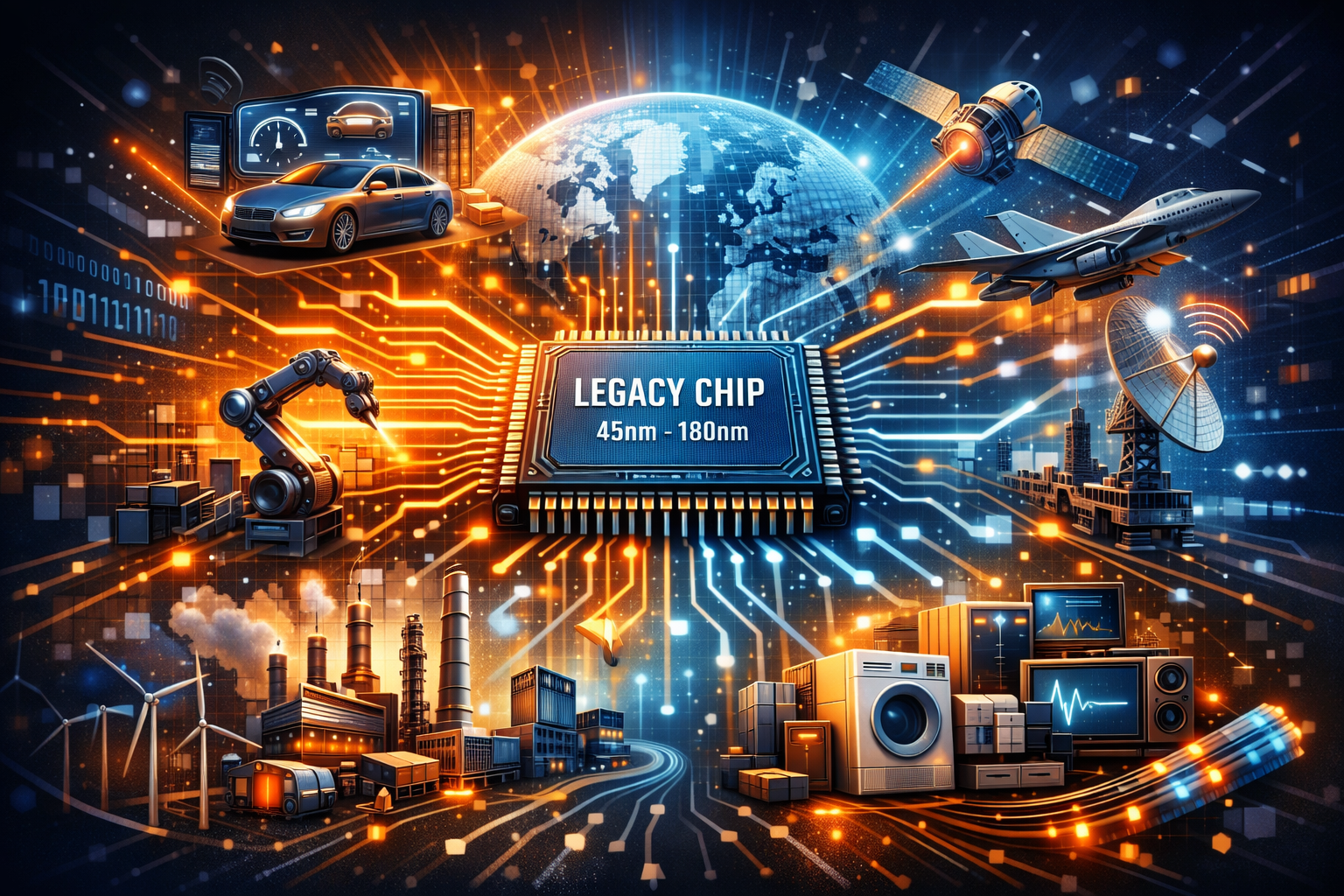
Legacy semiconductor chips—older‑generation integrated circuits manufactured on mature process nodes such as 180nm, 130nm, 90nm, 65nm, and 45nm—form the invisible backbone of the global digital economy. While modern discourse often focuses on cutting‑edge chips at 7nm, 5nm, and 3nm, the world’s critical infrastructure, industrial systems, automotive platforms, defense technologies, and consumer appliances rely heavily on legacy chips. Their durability, reliability, cost efficiency, and long product life cycles make them indispensable. This thesis explores the anatomy, economic significance, geopolitical relevance, industrial dependence, and future trajectory of legacy semiconductor chips in the modern economy.
2. Introduction
Semiconductors are the foundational building blocks of modern technology. They power smartphones, satellites, medical devices, vehicles, and industrial automation systems. Yet, the global semiconductor narrative is often dominated by advanced chips used in AI, cloud computing, and high‑performance graphics.
However, over 60% of all chips shipped globally are legacy chips, not advanced ones. These chips operate quietly in the background, enabling essential functions such as power management, signal processing, micro‑control, and safety operations. Without them, modern society would face catastrophic disruptions.
This thesis examines why legacy chips remain economically and strategically vital, how they are manufactured, where they are used, and why global supply chains depend on them.
3. Anatomy of Legacy Semiconductor Chips
3.1 Definition and Process Nodes
Legacy chips are typically manufactured on older fabrication nodes such as:
- 180nm
- 130nm
- 90nm
- 65nm
- 45nm
- 28nm (transitional node, still widely used)
These nodes prioritize stability, yield, and cost efficiency rather than transistor density.
3.2 Core Architectural Features
Legacy chips often include:
- Microcontrollers (MCUs) Used in automotive ECUs, appliances, and industrial machines.
- Analog chips Power regulation, voltage control, sensor interfaces.
- Mixed-signal chips Combine analog and digital functions.
- Power semiconductors MOSFETs, IGBTs, and regulators.
- RF chips Used in communication modules, IoT devices, and industrial sensors.
3.3 Why Legacy Chips Are Still Manufactured
- Long product lifecycles (10–30 years)
- Proven reliability
- Lower manufacturing cost
- Compatibility with existing systems
- Lower heat generation
- Higher tolerance for harsh environments
4. Historical Evolution of Legacy Chips
4.1 Early Semiconductor Era (1960s–1980s)
The first integrated circuits were simple logic chips and analog components. These formed the basis of early computing, telecommunications, and industrial automation.
4.2 Rise of Microcontrollers (1990s–2000s)
MCUs became central to embedded systems, enabling automation in vehicles, factories, and consumer electronics.
4.3 Stabilization of Mature Nodes (2000s–2010s)
As advanced nodes shrank, mature nodes stabilized and became the backbone of mass‑market electronics.
4.4 Modern Dependence (2010s–2020s)
The automotive industry, defense sector, and industrial manufacturing became deeply dependent on legacy chips.
5. Economic Significance of Legacy Semiconductor Chips
5.1 Global Market Share
Legacy chips account for:
- 60–70% of global semiconductor shipments
- Over $300 billion in annual economic value
5.2 Cost Efficiency
Legacy chips are cheaper to produce due to:
- Lower capital expenditure
- Higher yields
- Mature manufacturing processes
- Lower defect rates
5.3 Industrial Dependence
Industries relying heavily on legacy chips include:
- Automotive manufacturing
- Aerospace and defense
- Telecommunications
- Industrial automation
- Consumer appliances
- Medical devices
- Energy systems
5.4 Supply Chain Stability
Legacy chips ensure:
- Predictable supply
- Long-term availability
- Stable pricing
6. Legacy Chips in Critical Industries
6.1 Automotive Industry
Modern vehicles contain 1,000–3,000 chips, most of which are legacy chips:
- Engine control units (ECUs)
- Airbag systems
- Anti-lock braking systems (ABS)
- Power steering
- Battery management systems
- Infotainment modules
The 2020–2022 global chip shortage demonstrated that a shortage of $1 legacy chips can halt production of $40,000 vehicles.
6.2 Industrial Automation
Factories rely on:
- PLCs (Programmable Logic Controllers)
- Sensor modules
- Motor drivers
- Power regulators
These systems require stability and long-term availability, making legacy chips ideal.
6.3 Defense and Aerospace
Legacy chips are used in:
- Radar systems
- Communication modules
- Navigation systems
- Missile guidance
- Satellites
Defense systems require chips that are:
- Radiation-resistant
- Heat-tolerant
- Long-lasting
6.4 Telecommunications
Legacy chips power:
- Routers
- Base stations
- Fiber-optic modules
- IoT devices
6.5 Consumer Electronics
Appliances such as:
- Refrigerators
- Washing machines
- Microwaves
- TVs
- Remote controls
All rely on low-cost legacy MCUs and analog chips.
7. Geopolitical Importance of Legacy Chips
7.1 Concentration of Manufacturing
Most legacy chip production is concentrated in:
- Taiwan (TSMC)
- China (SMIC, Hua Hong)
- Malaysia
- South Korea
- Japan
This concentration creates geopolitical vulnerabilities.
7.2 U.S.–China Semiconductor Competition
The U.S. and China both recognize that legacy chips are strategically critical:
- The U.S. CHIPS Act includes funding for legacy chip manufacturing.
- China invests heavily in mature nodes to reduce dependence on foreign suppliers.
7.3 National Security
Legacy chips are essential for:
- Military equipment
- Critical infrastructure
- Energy grids
- Transportation networks
A disruption in legacy chip supply could destabilize national security.
8. Supply Chain Vulnerabilities
8.1 COVID‑19 Chip Shortage
The pandemic exposed weaknesses:
- Automotive production halted globally.
- Electronics prices surged.
- Lead times increased from 12 weeks to 52+ weeks.
8.2 Overdependence on Asia
Over 80% of legacy chips are produced in Asia, creating:
- Political risk
- Trade dependency
- Supply bottlenecks
8.3 Aging Manufacturing Equipment
Legacy fabs use older lithography machines that are difficult to replace.
9. Technological Relevance in the Modern Economy
9.1 Complementary Role to Advanced Chips
Legacy chips handle:
- Power management
- Sensor interfaces
- Basic logic
- Safety functions
Advanced chips handle:
- AI processing
- Graphics
- High-speed computation
Both are required for modern systems.
9.2 Reliability Over Performance
Legacy chips prioritize:
- Stability
- Durability
- Predictability
This makes them ideal for mission-critical systems.
9.3 Long Product Lifecycles
Industrial machines often operate for 20–30 years, requiring chips that remain available for decades.
10. Future Outlook
10.1 Continued Demand
Demand for legacy chips is expected to grow due to:
- Electric vehicles
- Smart appliances
- Industrial IoT
- Renewable energy systems
10.2 Government Incentives
Countries are investing in legacy chip manufacturing:
- U.S. CHIPS Act
- EU Chips Act
- China’s semiconductor self-sufficiency program
10.3 Modernization of Legacy Fabs
Manufacturers are upgrading:
- Automation systems
- Yield optimization
- Energy efficiency
10.4 Integration with AI and IoT
Legacy chips will increasingly support:
- Edge computing
- Smart sensors
- Autonomous systems
11. Conclusion
Legacy semiconductor chips are the unsung heroes of the modern economy. They power essential industries, ensure stability in global supply chains, and support critical infrastructure. While advanced chips drive innovation in AI and high-performance computing, legacy chips maintain the operational backbone of society.
Their significance will continue to grow as industries expand automation, electrification, and connectivity. The future economy will rely not only on cutting-edge chips but also on the enduring reliability of legacy semiconductors.
12. Key Takeaways
- Legacy chips represent 60–70% of global chip shipments.
- They are essential for automotive, defense, industrial, and consumer electronics.
- The global economy cannot function without them.
- Geopolitical tensions make legacy chip supply a strategic priority.
- Demand will continue rising due to EVs, IoT, and industrial automation.






Be First to Comment