
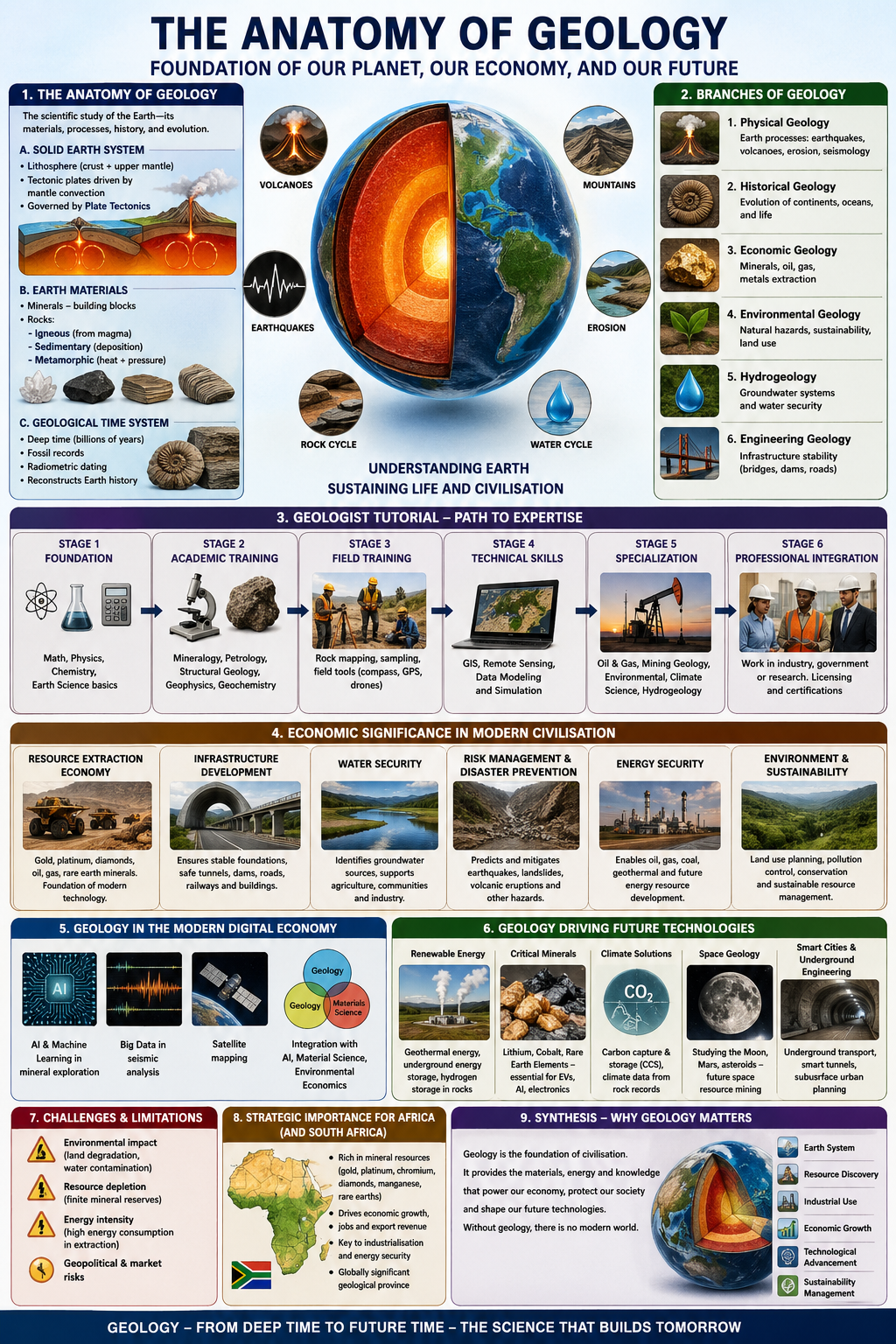
1. The Anatomy of Geology (Discipline Structure)
At its core, Geology is the scientific study of the Earth—its materials, processes, history, and evolution. Its “anatomy” can be broken into interconnected subsystems:
1.1 Core Structural Components
A. Solid Earth System
- Lithosphere: Crust + upper mantle (rocks, minerals)
- Tectonic plates: Driven by mantle convection
- Governed by Plate Tectonics
B. Earth Materials
- Minerals (building blocks)
- Rocks:
- Igneous (from magma)
- Sedimentary (deposition)
- Metamorphic (heat + pressure)
C. Geological Time System
- Deep time concept (billions of years)
- Fossil records + radiometric dating
- Enables reconstruction of Earth history
1.2 Functional Branches of Geology
1. Physical Geology
- Earth processes: earthquakes, volcanoes, erosion
- Includes Seismology
2. Historical Geology
- Evolution of continents, oceans, life
3. Economic Geology
- Minerals, oil, gas, metals extraction
4. Environmental Geology
- Natural hazards, sustainability, land use
5. Hydrogeology
- Groundwater systems and water security
6. Engineering Geology
- Infrastructure stability (bridges, dams, roads)
2. Geologist Tutorial Framework (Step-by-Step Development)
This is a structured “learning anatomy” of becoming a geologist.
Stage 1: Foundational Knowledge
- Mathematics, physics, chemistry
- Earth science basics
Stage 2: Core Academic Training
Study programs in:
- Mineralogy
- Petrology
- Structural geology
- Geophysics
- Geochemistry
Stage 3: Field Training (Critical)
- Rock mapping
- Sampling techniques
- Use of tools (compass, GPS, drones)
Stage 4: Technical Skills
- GIS (Geographic Information Systems)
- Remote sensing
- Data modeling and simulation
Stage 5: Specialization
- Oil & gas exploration
- Mining geology
- Environmental consulting
- Climate science
Stage 6: Professional Integration
- Work in mining, energy, government, or research
- Licensing and certifications
3. Economic Significance in Modern Civilisation
Geology is not theoretical—it is the backbone of the global economy.
3.1 Resource Extraction Economy
Geologists enable:
- Gold, platinum, and diamond mining (critical in South Africa)
- Oil & gas exploration
- Rare earth minerals (for electronics)
Without geology:
- No smartphones
- No infrastructure
- No energy systems
3.2 Infrastructure Development
Geology ensures:
- Stable foundations for cities
- Tunnel and dam safety
- Road and rail construction
Example:
- Preventing collapse due to weak rock formations
3.3 Water Security
Through Hydrogeology:
- Identifying underground water sources
- Managing drought-prone regions
- Supporting agriculture
3.4 Risk Management & Disaster Prevention
Geology helps predict and mitigate:
- Earthquakes
- Landslides
- Volcanic eruptions
This reduces:
- Economic loss
- Human casualties
4. Geology in the Modern Digital Economy
4.1 Data-Driven Earth Science
- AI + machine learning in mineral exploration
- Big data in seismic analysis
- Satellite mapping
4.2 Integration with Other Fields
Geology intersects with:
- Artificial Intelligence
- Material Science
- Environmental economics
5. Future Technologies Driven by Geology
Geology is central to future innovation:
5.1 Renewable Energy Revolution
- Geothermal energy systems
- Underground energy storage
- Hydrogen storage in rock formations
5.2 Critical Minerals for Technology
Future tech depends on:
- Lithium (batteries)
- Cobalt (EVs)
- Rare earth elements (AI hardware)
Geologists locate and manage these resources.
5.3 Climate Change Solutions
Geology enables:
- Carbon capture and storage (CCS)
- Climate reconstruction (past climate data from rocks)
5.4 Space Geology (Astrogeology)
- Studying Moon and Mars surfaces
- Mining asteroids in future economies
Linked to Planetary Science
5.5 Smart Cities & Underground Engineering
- Underground transport systems
- Smart tunnels
- Subsurface urban planning
6. Challenges and Limitations
Environmental Impact
- Mining causes ecosystem damage
- Water contamination risks
Resource Depletion
- Finite mineral reserves
Energy Intensity
- Extraction processes consume large energy
7. Strategic Importance for Africa (and South Africa)
Geology is especially critical in:
- Mining-driven economies
- Job creation
- Export revenue
South Africa:
- One of the richest geological regions globally
- Major producer of platinum, gold, chromium
8. Synthesis: Why Geology Matters
Geology is:
- The foundation of civilisation (materials, energy, land)
- The engine of industrial growth
- The guardian of environmental sustainability
- The enabler of future technologies
Without geology:
- No infrastructure
- No modern technology
- No sustainable resource management
9. Conceptual Model (Simple Insight)
Think of geology as:
Earth System → Resource Discovery → Industrial Use → Economic Growth → Technological Advancement → Sustainability Management






Be First to Comment