
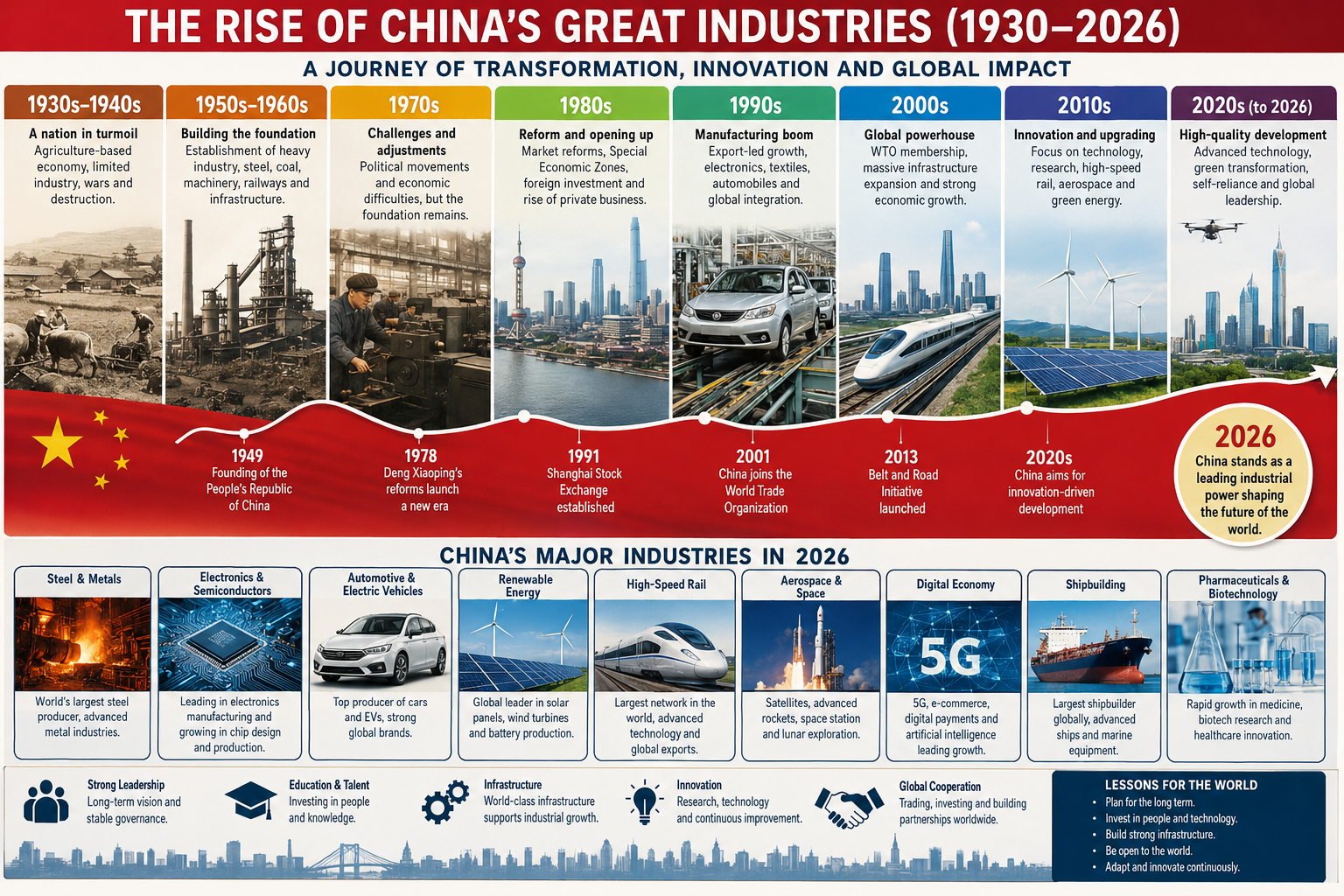
The Rise of China’s Great Industries (1930–2026): History, Economic Transformation, Industrial Development, and Global Influence
Language: Simple English
Length: Approximately 30 pages
1. Introduction
The rise of China from a poor, mostly rural country in the early 20th century to one of the world’s largest industrial powers by 2026 is one of the most important economic stories in human history. This transformation did not happen overnight. It took political change, long‑term planning, investment in people, and the building of strong industries.
This thesis explains how China’s industries grew from 1930 to 2026, how technology and manufacturing expanded, how the government shaped development, and how China became a global industrial leader.
2. China in the 1930s: A Weak Industrial Base
In the 1930s, China was:
- Mostly rural
- Very poor
- Lacking modern factories
- Dependent on agriculture
- Politically unstable
Industrial activity existed only in small pockets such as Shanghai, Tianjin, and Guangzhou. China imported most machines, tools, and industrial goods. Local factories were small and outdated.
Key limitations in the 1930s
- No national industrial plan
- Low literacy rates
- Weak transportation networks
- Foreign powers controlled many ports
- Wars disrupted production
China had the potential for industrial growth, but lacked the stability and resources to begin large‑scale development.
3. 1949–1960: Foundation of a New Industrial State
The founding of the People’s Republic of China in 1949 marked a turning point. The new government made industrialization a national priority.
Major actions
- Nationalization of factories
- Creation of state‑owned enterprises (SOEs)
- Soviet technical assistance
- Building of steel plants, coal mines, and machinery factories
- Expansion of railways
China focused on heavy industry, especially steel, cement, machinery, and energy. The goal was to build the basic industrial foundation needed for future growth.
Achievements
- First large steel mills
- First modern coal mines
- First tractor and machinery factories
- Rapid growth of industrial employment
Challenges
- Limited technology
- Low productivity
- Political campaigns disrupted planning
Still, China built the industrial “skeleton” that later decades would strengthen.
4. 1960–1978: Slow Growth but Strategic Industrial Roots
After the Sino‑Soviet split, China lost Soviet support. The country had to rely on its own engineers and workers.
Industrial focus areas
- Mining
- Steel
- Basic chemicals
- Military equipment
- Agriculture machinery
China also began building industries in inland provinces for national security reasons.
Technological progress
- Development of basic electronics
- First Chinese computers (very simple)
- Growth of textile factories
- Expansion of oil and gas exploration
Limitations
- Outdated technology
- Low efficiency
- Limited global trade
- Political instability (Cultural Revolution)
Even with difficulties, China created a large industrial workforce and basic industrial knowledge.
5. 1978–1990: Reform and Opening — The Industrial Takeoff
In 1978, China launched economic reforms under Deng Xiaoping. This changed everything.
Key reforms
- Opening to foreign investment
- Creation of Special Economic Zones (SEZs)
- Allowing private businesses
- Modernizing agriculture
- Encouraging exports
Industrial impact
- Foreign companies brought technology
- China began producing electronics, toys, textiles, and simple machinery
- Coastal cities like Shenzhen became manufacturing hubs
- Millions of workers moved from farms to factories
China became known as the “world’s workshop” for low‑cost manufacturing.
6. 1990–2000: Rapid Industrial Expansion
During the 1990s, China’s industries grew at record speed.
Key developments
- Massive foreign investment
- Growth of export‑oriented factories
- Expansion of highways, ports, and airports
- Rise of private manufacturing companies
- Modernization of steel, cement, and chemical industries
Industrial sectors that boomed
- Textiles
- Electronics assembly
- Household appliances
- Plastics
- Construction materials
China became a global manufacturing center for consumer goods.
7. 2000–2010: China Becomes a Global Industrial Power
China joined the World Trade Organization (WTO) in 2001. This accelerated industrial growth.
Major achievements
- China became the world’s largest exporter
- Massive growth in electronics manufacturing
- Development of automotive industry
- Expansion of shipbuilding
- Rise of major Chinese companies (Huawei, Lenovo, Haier)
Infrastructure revolution
- High‑speed rail
- Modern highways
- Large ports
- Urbanization of hundreds of millions of people
China’s industrial output surpassed Japan and Europe in many sectors.
8. 2010–2020: Shift to High‑Tech and Advanced Manufacturing
China moved from low‑cost manufacturing to high‑tech industries.
Key industries
- Smartphones
- Telecommunications equipment
- Solar panels
- Electric vehicles
- High‑speed trains
- Robotics
- Semiconductors (early stages)
Government strategies
- “Made in China 2025”
- Massive R&D investment
- Support for innovation and patents
- Building national champions
China became a leader in renewable energy, electronics, and advanced manufacturing.
9. 2020–2026: Rise of Strategic and Frontier Industries
By 2026, China’s industries reached a new level of global influence.
Leading sectors
- Electric vehicles (BYD, NIO, XPeng)
- Battery manufacturing (CATL, BYD)
- 5G and telecommunications (Huawei, ZTE)
- Solar and wind energy
- High‑speed rail
- Drones (DJI)
- Robotics and automation
- AI and digital platforms
- Advanced materials
- Large‑scale construction and infrastructure
Semiconductor progress (2019–2026)
China invested heavily in:
- Lithography machines
- Wafer fabrication
- Chip design
- Memory chips
- Packaging and testing
Although China still depends on some foreign technologies, it made major progress in domestic chip production.
10. How China Built Its Industrial Strength
1. Long‑term planning
China uses 5‑year plans to guide industrial development.
2. Strong infrastructure
Ports, roads, railways, and power plants support industry.
3. Large workforce
Hundreds of millions of workers moved from farms to factories.
4. Education and skills
China invested heavily in engineering and science.
5. Government support
Subsidies, tax incentives, and industrial zones helped factories grow.
6. Technology transfer
Foreign companies brought knowledge and equipment.
7. Innovation
China became a leader in patents, research, and new technologies.
11. Major Industrial Regions
1. Pearl River Delta (Shenzhen, Guangzhou)
Electronics, appliances, manufacturing.
2. Yangtze River Delta (Shanghai, Suzhou)
Automotive, semiconductors, finance.
3. Beijing–Tianjin region
AI, aerospace, research.
4. Western China (Chengdu, Chongqing)
Automotive, electronics, logistics.
12. China’s Global Industrial Influence
By 2026, China is:
- The world’s largest manufacturing nation
- A leader in EVs and batteries
- A major exporter of machinery
- A global supplier of electronics
- A top producer of steel, cement, and chemicals
- A rising force in semiconductors
- A leader in renewable energy
China’s industries shape global supply chains.
13. Challenges China Faces
Even with success, China faces challenges:
- Dependence on foreign semiconductor technology
- Aging population
- Rising labor costs
- Trade tensions
- Environmental pressures
- Need for more innovation
China is working to solve these issues through automation, education, and new technologies.
14. The Future of China’s Industries (2026–2040)
China aims to lead in:
- AI
- Quantum computing
- Advanced materials
- Biotechnology
- Green energy
- Smart manufacturing
- Space technology
China’s industrial future will focus on high‑tech, sustainability, and global leadership.
15. Conclusion
From 1930 to 2026, China transformed from a poor, rural nation into a global industrial superpower. This rise was driven by planning, investment, education, technology, and the hard work of millions of people.
China’s industries now shape global markets, influence international trade, and drive technological progress. The story of China’s industrial rise is one of the most remarkable economic transformations in human history.






Be First to Comment