
A Comprehensive 15‑Page Article in Simple English
Page 1 — Introduction: Rethinking Learning Difficulties
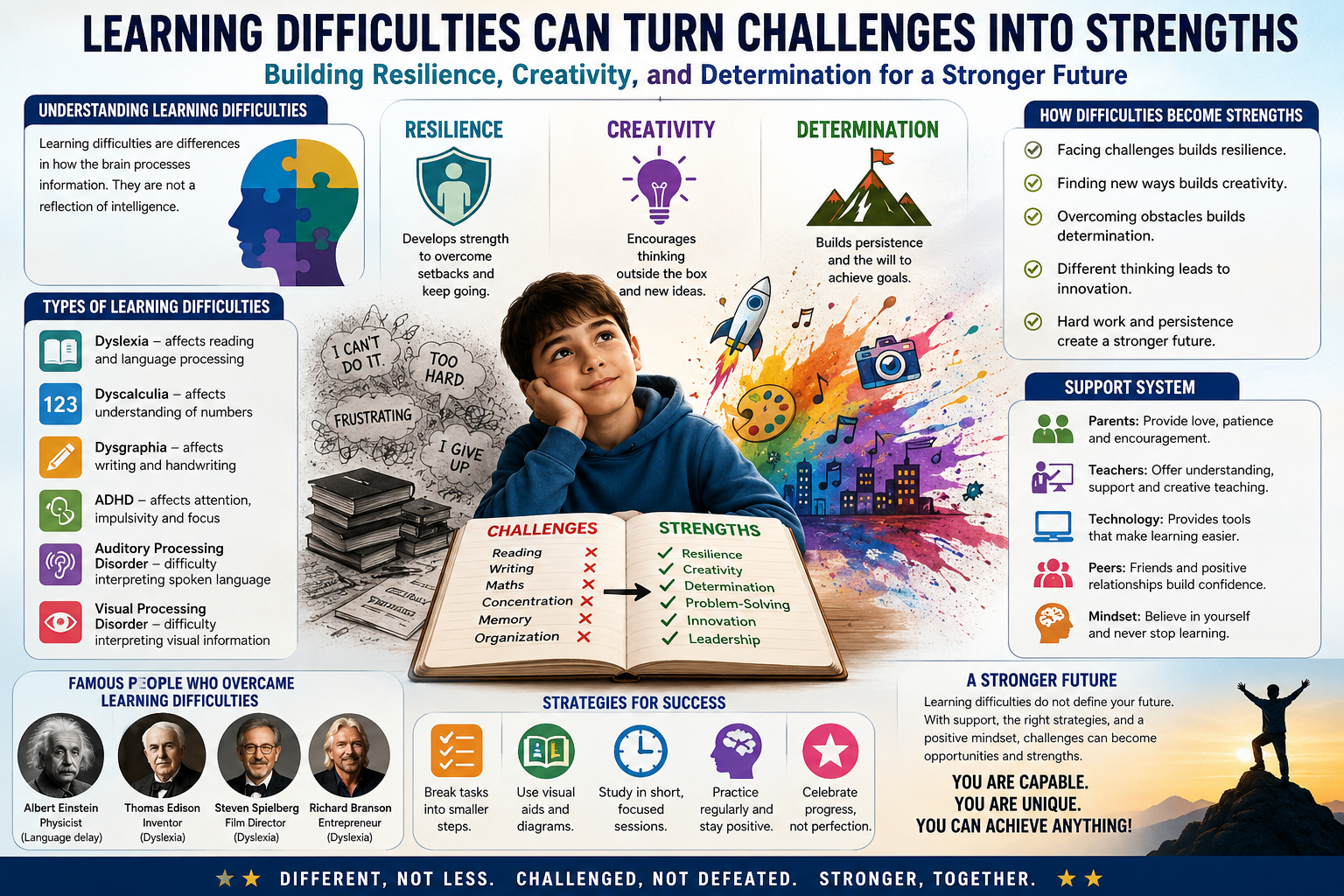
Learning difficulties are often misunderstood. Many people assume they are barriers that limit a person’s potential. In reality, learning difficulties can become powerful sources of strength. They push individuals to develop resilience, creativity, problem‑solving skills, and determination. These qualities often shape a stronger, more capable future.
This article explores how learning difficulties transform challenges into strengths, how they influence personal development, and how society can support individuals to thrive. It also explains different types of learning difficulties, their causes, and the strategies that help people succeed academically, socially, and professionally.
Page 2 — Understanding Learning Difficulties
Learning difficulties refer to conditions that affect how a person receives, processes, or expresses information. They are not related to intelligence. Many people with learning difficulties are highly intelligent, talented, and capable.
Common Types of Learning Difficulties
- Dyslexia — difficulty with reading, spelling, and language processing.
- Dyscalculia — difficulty understanding numbers and mathematical concepts.
- Dysgraphia — difficulty with writing, handwriting, and organizing thoughts on paper.
- ADHD (Attention Deficit Hyperactivity Disorder) — challenges with focus, attention, and impulse control.
- Auditory Processing Disorder — difficulty understanding spoken information.
- Nonverbal Learning Disorder — difficulty interpreting body language, spatial awareness, and abstract concepts.
Each condition affects learning differently, but all can be managed with the right support.
Page 3 — Causes of Learning Difficulties
Learning difficulties can arise from several factors:
1. Genetic Factors
Many learning difficulties run in families. Dyslexia and ADHD often have genetic links.
2. Brain Development
Differences in how the brain processes information can lead to learning challenges. These differences are natural variations, not defects.
3. Environmental Factors
Exposure to stress, trauma, or limited early learning opportunities can contribute to learning difficulties.
4. Medical Factors
Premature birth, infections, or neurological conditions may influence learning development.
Understanding the causes helps reduce stigma and encourages early support.
Page 4 — The Emotional Experience of Learning Difficulties
People with learning difficulties often face emotional challenges:
- Frustration when tasks take longer
- Anxiety during tests or reading aloud
- Low self‑esteem from repeated struggles
- Fear of being judged or misunderstood
- Social isolation due to communication difficulties
However, these emotional experiences also build emotional intelligence, empathy, and resilience.
Page 5 — How Challenges Become Strengths
Learning difficulties force individuals to find alternative ways to understand and solve problems. This process builds powerful strengths:
1. Resilience
Constant problem‑solving builds mental toughness.
2. Creativity
People with learning difficulties often think outside the box.
3. Determination
Overcoming obstacles develops strong willpower.
4. Adaptability
They learn to adjust quickly to new situations.
5. Innovative Thinking
Many inventors, artists, and entrepreneurs have learning difficulties.
These strengths often become advantages in adulthood.
Page 6 — Real‑World Examples of Strength Through Difficulty
Many successful people have learning difficulties:
- Albert Einstein — struggled with language as a child.
- Thomas Edison — had difficulty with traditional schooling.
- Richard Branson — dyslexic entrepreneur who built Virgin Group.
- Whoopi Goldberg — dyslexic actress and producer.
- Steven Spielberg — dyslexic filmmaker.
Their challenges shaped their creativity, persistence, and unique thinking.
Page 7 — Academic Strategies That Turn Challenges Into Growth
Schools can help students with learning difficulties thrive through:
1. Individualized Learning Plans
Tailored teaching methods based on the student’s needs.
2. Multisensory Learning
Using sight, sound, movement, and touch to reinforce learning.
3. Assistive Technology
Tools like:
- Text‑to‑speech software
- Audiobooks
- Speech‑to‑text tools
- Visual learning apps
4. Extra Time for Tests
Allows students to demonstrate knowledge without pressure.
5. Positive Reinforcement
Encourages confidence and motivation.
Page 8 — The Role of Teachers and Parents
Supportive adults play a major role in transforming learning difficulties into strengths.
Teachers
- Provide patience and understanding
- Use flexible teaching methods
- Encourage questions and curiosity
- Celebrate small achievements
Parents
- Offer emotional support
- Create a safe learning environment
- Advocate for their child’s needs
- Build confidence through encouragement
When adults believe in a child’s potential, the child begins to believe in themselves.
Page 9 — Social Development and Communication Skills
Learning difficulties can affect social interactions, but they also build strong communication skills over time.
Challenges
- Misunderstanding social cues
- Difficulty expressing thoughts
- Fear of embarrassment
Strengths Developed
- Empathy
- Active listening
- Clear communication
- Patience
- Emotional awareness
These strengths are valuable in relationships and workplaces.
Page 10 — Learning Difficulties in the Workplace
Adults with learning difficulties often excel professionally because of the strengths they developed.
Common Workplace Strengths
- Creative problem‑solving
- Strong verbal communication
- High emotional intelligence
- Persistence
- Leadership skills
- Ability to think differently
Supportive Workplace Practices
- Clear instructions
- Flexible deadlines
- Technology tools
- Strength‑based task assignments
Many companies now value neurodiversity as a competitive advantage.
Page 11 — Technology as a Powerful Support Tool
Modern technology has transformed how people with learning difficulties learn and work.
Examples
- Voice‑to‑text tools help with writing.
- Audiobooks support reading comprehension.
- Digital planners assist with organization.
- Math apps simplify calculations.
- Visual learning platforms help with memory.
Technology reduces barriers and unlocks potential.
Page 12 — Building Confidence and Self‑Belief
Confidence is one of the biggest challenges for individuals with learning difficulties. But once confidence grows, everything changes.
Ways to Build Confidence
- Celebrate progress, not perfection
- Focus on strengths
- Practice positive self‑talk
- Set achievable goals
- Surround yourself with supportive people
Confidence transforms learning difficulties into powerful assets.
Page 13 — The Future of Learning Difficulties in Society
Society is becoming more aware of neurodiversity. The future looks promising:
1. Inclusive Education
Schools are adopting flexible teaching methods.
2. Workplace Diversity
Companies value different thinking styles.
3. Improved Technology
AI tools support reading, writing, and organization.
4. Reduced Stigma
More public figures openly discuss their learning difficulties.
5. Stronger Advocacy
Parents, teachers, and organizations push for equal opportunities.
The world is slowly shifting from “learning difficulties” to “learning differences.”
Page 14 — How Learning Difficulties Shape a Stronger Future
Learning difficulties teach life skills that many people never develop:
- Persistence
- Creativity
- Problem‑solving
- Emotional strength
- Adaptability
- Courage
- Innovation
These qualities prepare individuals for leadership, entrepreneurship, and personal success.
Learning difficulties do not limit the future—they strengthen it.
Page 15 — Conclusion: Turning Challenges Into Strengths
Learning difficulties are not weaknesses. They are unique pathways to growth. They push individuals to think differently, work harder, and develop powerful strengths that shape a stronger future.
When society provides support, understanding, and encouragement, people with learning difficulties can achieve extraordinary things. Their challenges become their greatest strengths, and their stories inspire others to believe in their own potential.






Be First to Comment