
A Comprehensive Essay on Their Advantages, Disadvantages, and Future Impact
1. Introduction: Why This Debate Matters
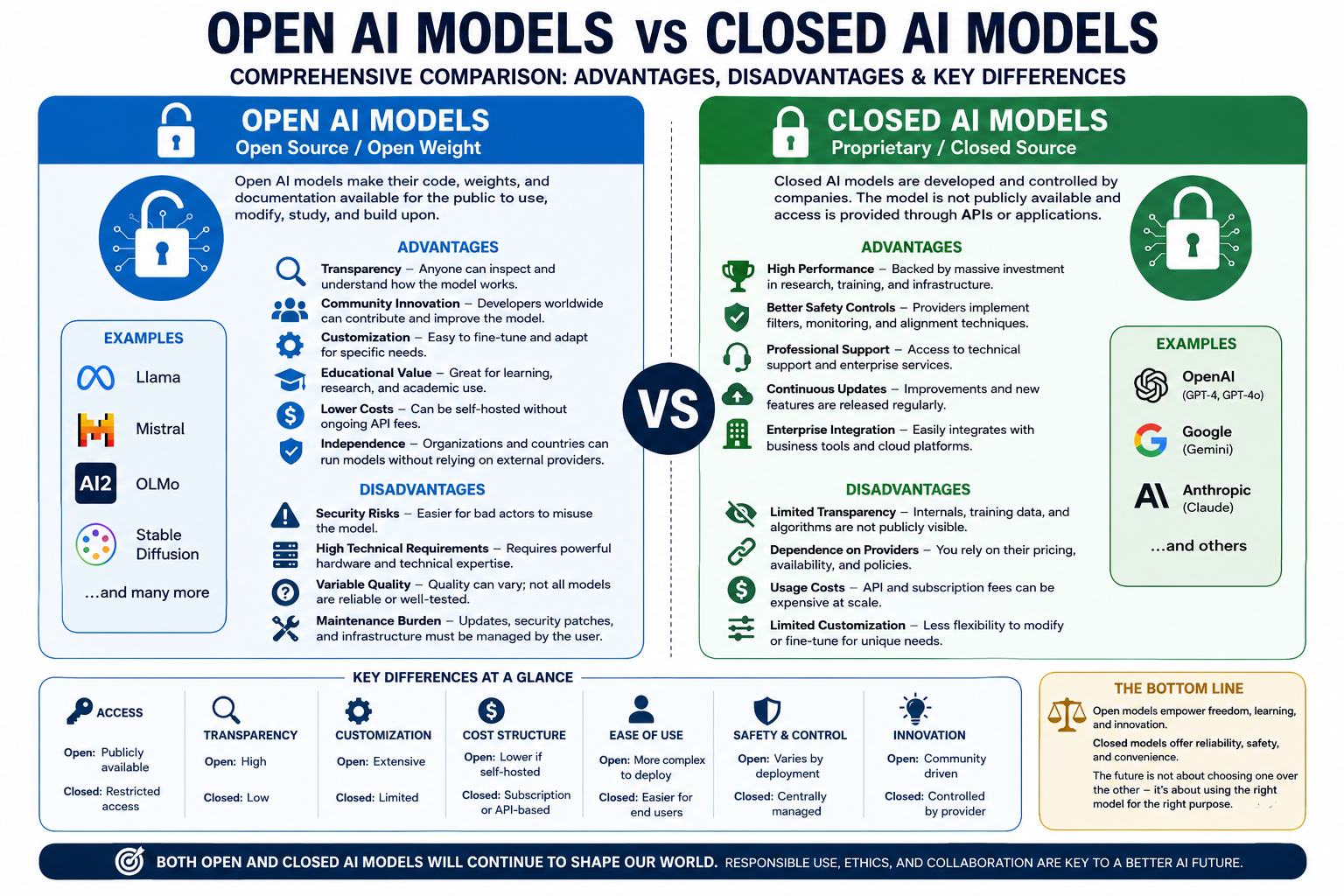
The choice between open and closed AI models is now one of the most strategic decisions in modern AI development. In 2026, open models (Llama, Qwen, DeepSeek, Mistral, Gemma) have closed 70–90% of the capability gap with frontier closed models (GPT‑4o/5, Claude 4.5, Gemini 2.x). This means the debate is no longer about “weak vs strong” — it is about control vs convenience, cost vs capability, and privacy vs performance ceiling.
2. Definitions
Open‑AI Models (Open‑Weight / Open‑Source)
- Model weights are publicly available.
- You can download, run, fine‑tune, and deploy them on your own hardware.
- Examples: Llama 3/4, Qwen, DeepSeek, Mistral, Gemma.
Closed‑AI Models
- Access only through API.
- Weights, training data, and internal architecture are hidden.
- Examples: GPT‑4o/5, Claude 4.5, Gemini 2.x.
3. Core Differences
Open Models
- You own the model.
- You control data flow.
- You can customise deeply.
- Costs drop dramatically at scale.
- Requires infrastructure and engineering skill.
Closed Models
- You rent the model.
- Provider controls data and updates.
- Highest capability ceiling.
- Zero infrastructure required.
- Costs grow with usage.
4. Advantages of Open‑AI Models
4.1 Full Data Privacy & Control
Open models allow on‑premises deployment, meaning sensitive data never leaves your environment — critical for healthcare, finance, government, and regulated industries.
4.2 Deep Customisation
You can fine‑tune open models on proprietary data, often outperforming larger closed models on domain‑specific tasks. A 7B model fine‑tuned on your data can beat a 70B general model in your niche.
4.3 No Vendor Lock‑In
You avoid:
- sudden price increases
- API outages
- policy changes
- rate limits
4.4 Cost Efficiency at Scale
Open models run 5–10× cheaper per inference compared to closed models. Once infrastructure is set, marginal cost per query is extremely low.
4.5 Transparency
You can inspect:
- weights
- architecture
- behaviour This improves trust and safety auditing.
5. Disadvantages of Open‑AI Models
5.1 Lower Peak Capability
Closed frontier models still lead on:
- complex reasoning
- coding
- multimodal tasks
- long‑context performance
5.2 Infrastructure Burden
You must manage:
- GPUs
- scaling
- security
- updates
- optimisation (KV‑cache, quantisation, vLLM/TGI)
5.3 Higher Upfront Costs
Hardware investment can be expensive before savings appear at scale.
5.4 Requires Skilled Engineers
Open‑model deployment skills are specialised and command higher salaries. Closed‑model usage is becoming commoditised.
6. Advantages of Closed‑AI Models
6.1 Highest Capability Ceiling
Closed models dominate benchmark leaderboards and deliver the best results on:
- reasoning
- coding
- multimodal understanding
6.2 Zero Infrastructure Required
You simply call an API — no GPUs, no servers, no maintenance.
6.3 Fastest Time‑to‑Value
Ideal for:
- startups
- rapid prototyping
- customer‑facing applications
6.4 Reliability & Support
Providers offer:
- uptime guarantees
- safety layers
- continuous model upgrades
- enterprise agreements
6.5 Strong Multimodal Capabilities
Closed models lead in:
- image reasoning
- audio understanding
- video analysis
- tool‑use orchestration
7. Disadvantages of Closed‑AI Models
7.1 Data Leaves Your Infrastructure
Even with enterprise agreements, your data goes to a third‑party provider. This is unacceptable for highly regulated sectors.
7.2 High Cost at Scale
Closed models charge per token forever. Bills grow without limit as usage increases.
7.3 No Customisation of Weights
You cannot:
- fine‑tune
- inspect
- modify
- self‑host
7.4 Vendor Lock‑In
You depend on:
- pricing
- rate limits
- policy changes
- API stability
8. Side‑by‑Side Comparison Table
| Factor | Open‑AI Models | Closed‑AI Models |
|---|---|---|
| Capability Ceiling | Good, improving fast | Best in class |
| Cost at Scale | 5–10× cheaper | Expensive, per‑token fees |
| Privacy | Full control, on‑prem | Data sent to provider |
| Customisation | Deep fine‑tuning | Limited (no weight access) |
| Infrastructure | Requires GPUs & engineering | None required |
| Vendor Lock‑In | None | High |
| Ease of Use | Medium | Very easy |
| Regulated Industries | Ideal | Risky |
| Multimodal Strength | Improving | Frontier‑level |
9. When Each One Wins
Choose Closed Models When:
- You need the absolute best performance.
- You want instant deployment with no infrastructure.
- You are building customer‑facing apps where quality matters.
Choose Open Models When:
- You handle sensitive data (healthcare, finance, government).
- You need predictable costs at scale.
- You want to fine‑tune for domain‑specific tasks.
- You want independence from vendors.
10. The Modern Reality: Hybrid Architectures
Most organisations now use both:
- Closed models for user‑facing tasks requiring high capability.
- Open models for internal workflows, batch processing, embeddings, and specialised fine‑tuned tasks.
This hybrid approach balances:
- cost
- capability
- privacy
- performance
11. Conclusion
The debate is not “which is better?” The real question is which is strategically correct for your environment.
Closed models dominate in raw capability and convenience. Open models dominate in privacy, control, and cost‑efficiency.
In 2026, the capability gap is small, but the strategic gap is huge.






Be First to Comment