
A Comprehensive 15‑Page Thesis & Technical Article
1. Introduction
The 21st‑century global economy is built on invisible infrastructure: satellites orbiting Earth and electromagnetic spectrum channels carrying data, voice, navigation signals, financial transactions, military intelligence, and scientific measurements. Modern civilisation—banking, aviation, agriculture, defence, climate monitoring, logistics, and digital communication—depends on a complex satellite ecosystem and a highly regulated communications spectrum.
This thesis explores the anatomy, history, technologies, economics, governance, and future trajectory of the satellite–spectrum ecosystem. It explains how satellites function, how spectrum is allocated, why these systems are strategic national assets, and how they shape global power, innovation, and economic development.
2. Historical Evolution of Satellite Technology
2.1 Early Concepts (Pre‑20th Century)
- 1865: James Clerk Maxwell formulates electromagnetic theory.
- 1901: Guglielmo Marconi demonstrates long‑distance radio transmission.
- 1945: Arthur C. Clarke proposes geostationary communication satellites.
2.2 Cold War Era and the Space Race
- 1957: USSR launches Sputnik 1, the first artificial satellite.
- 1960s: NASA launches Telstar and Syncom, enabling global TV and telephone.
- 1970s–1980s: Satellite navigation, weather satellites, and military reconnaissance mature.
2.3 Commercialisation and Globalisation (1990s–2000s)
- Satellite TV (DStv, DirecTV).
- GPS becomes globally available.
- Satellite internet emerges (Inmarsat, HughesNet).
2.4 NewSpace Revolution (2010s–2020s)
- Reusable rockets (SpaceX Falcon 9).
- Mega‑constellations (Starlink, OneWeb, Kuiper).
- CubeSats and nanosatellites democratise space access.
3. Anatomy of a Satellite Ecosystem
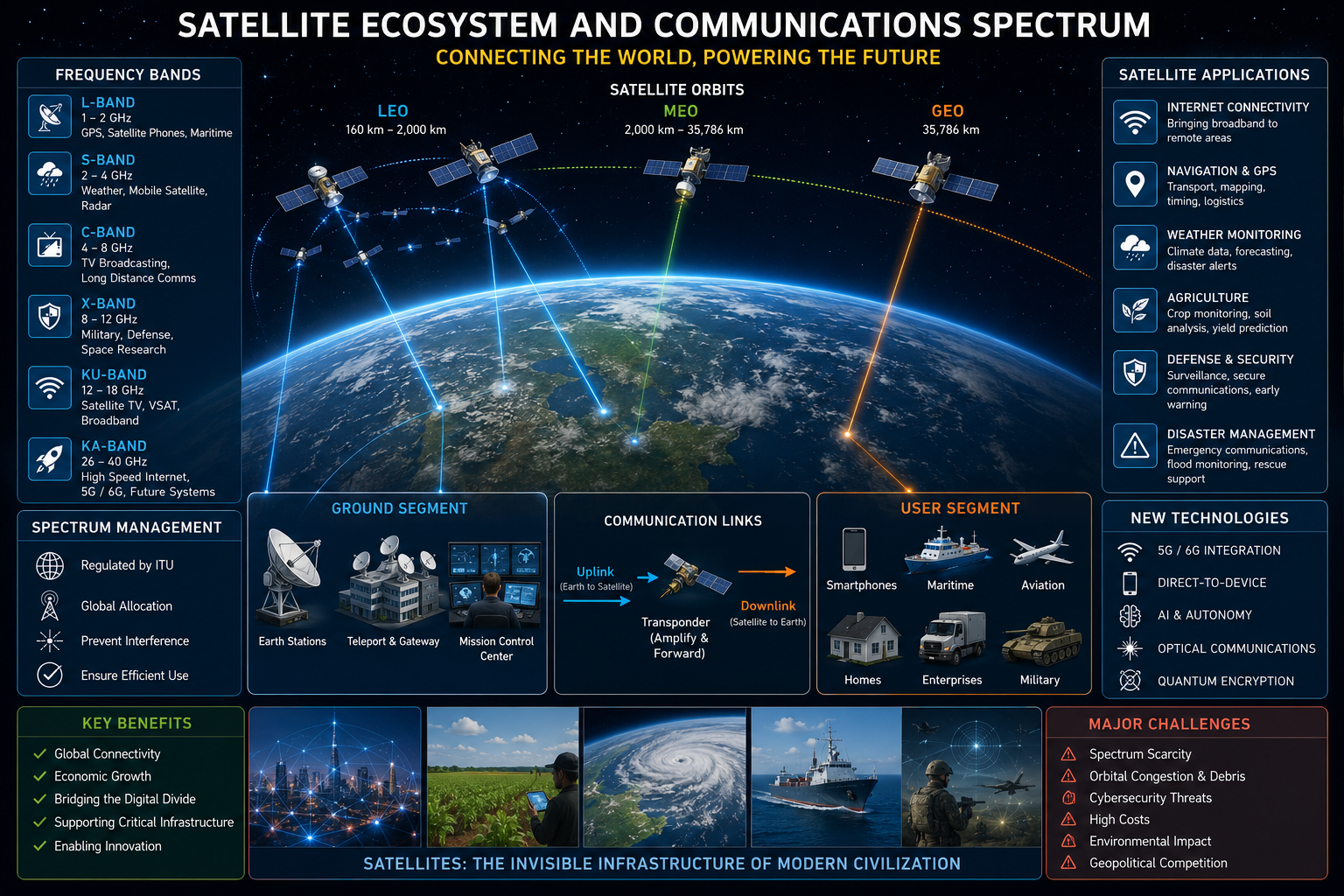
The satellite ecosystem consists of five integrated layers:
3.1 Space Segment
- Satellites (communication, navigation, Earth observation, scientific).
- Orbits (LEO, MEO, GEO, HEO).
- Constellations (Starlink, Galileo, GPS, GLONASS).
3.2 Ground Segment
- Teleports and gateway stations.
- User terminals (VSATs, satellite phones, IoT antennas).
- Mission control centres.
3.3 Launch Segment
- Rockets (Falcon 9, Ariane 6, Long March, GSLV).
- Launch sites (Cape Canaveral, Baikonur, Vandenberg, French Guiana).
3.4 Regulatory & Spectrum Management
- ITU (International Telecommunication Union).
- National regulators (FCC, ICASA, Ofcom).
- Orbital slot coordination.
3.5 Commercial & Industrial Ecosystem
- Satellite manufacturers (Airbus, Boeing, Thales Alenia).
- Operators (SES, Intelsat, Eutelsat).
- Service providers (Starlink, Inmarsat, Iridium).
4. Satellite Orbits and Their Strategic Roles
4.1 Low Earth Orbit (LEO) – 300 to 2,000 km
Used for:
- Broadband internet (Starlink).
- Earth observation (Planet Labs).
- Remote sensing and imaging.
Advantages:
- Low latency.
- High resolution imaging.
Challenges:
- Requires thousands of satellites.
- Space debris risk.
4.2 Medium Earth Orbit (MEO) – 2,000 to 20,000 km
Used for:
- Navigation systems (GPS, Galileo, GLONASS, BeiDou).
Advantages:
- Global coverage with fewer satellites.
- Stable orbits.
4.3 Geostationary Orbit (GEO) – 35,786 km
Used for:
- TV broadcasting.
- Weather monitoring.
- Military communications.
Advantages:
- Fixed position relative to Earth.
- Wide coverage footprint.
4.4 Highly Elliptical Orbits (HEO)
Used for:
- Polar communications.
- Military surveillance.
5. Communications Spectrum Technology
5.1 What Is the Spectrum?
The electromagnetic spectrum is a finite natural resource enabling:
- Radio
- TV
- Mobile networks (2G–6G)
- Satellite links
- Radar
- Wi‑Fi
- IoT
5.2 Key Satellite Frequency Bands
- L‑Band (1–2 GHz): GPS, maritime, aviation.
- S‑Band (2–4 GHz): Weather radar, telemetry.
- C‑Band (4–8 GHz): Broadcast, resilient to rain fade.
- Ku‑Band (12–18 GHz): TV, VSAT, broadband.
- Ka‑Band (26–40 GHz): High‑capacity internet (Starlink).
- V‑Band (40–75 GHz): Future ultra‑high‑capacity systems.
5.3 Spectrum Allocation
Managed by:
- ITU globally.
- National regulators locally.
Spectrum is allocated through:
- Auctions.
- Licensing.
- Coordination agreements.
5.4 Spectrum as a Strategic Asset
Countries compete for:
- Orbital slots.
- Frequency rights.
- 5G/6G leadership.
6. Satellite Communications Technologies
6.1 Transponders
Receive, amplify, and retransmit signals.
6.2 Spot Beams
Increase capacity and frequency reuse.
6.3 Inter‑Satellite Links (ISLs)
Laser links connecting satellites in space:
- Reduce reliance on ground stations.
- Enable global low‑latency networks.
6.4 Phased Array Antennas
Electronically steerable beams used in:
- Starlink terminals.
- Military radars.
- 5G/6G networks.
6.5 Software‑Defined Satellites
Reprogrammable in orbit:
- Change coverage.
- Adjust bandwidth.
- Support new protocols.
7. Economic Importance of Satellite Systems
7.1 Global Satellite Industry Value
As of 2025:
- $550+ billion global space economy.
- Satellites contribute over 60% of total value.
7.2 Key Economic Sectors Dependent on Satellites
- Banking (timestamping, secure links).
- Aviation (navigation, ADS‑B).
- Maritime (tracking, safety).
- Agriculture (precision farming).
- Mining (remote operations).
- Defence (surveillance, encrypted comms).
- Climate science (weather prediction).
- Logistics (fleet tracking).
- Telecommunications (backhaul, rural coverage).
7.3 Satellite Internet and Digital Inclusion
LEO constellations reduce:
- Rural connectivity gaps.
- Infrastructure costs.
- Digital inequality.
8. Military and Strategic Dimensions
Satellites are critical for:
- Intelligence, surveillance, reconnaissance (ISR).
- Missile early warning.
- Secure communications.
- Navigation for weapons systems.
- Cyber‑electromagnetic warfare.
Countries with advanced satellite capabilities:
- USA
- China
- Russia
- EU
- India
- Japan
9. Satellite Manufacturing and Launch Industry
9.1 Manufacturing Trends
- Miniaturisation (CubeSats).
- Mass production (Starlink factory).
- Modular satellite buses.
9.2 Launch Market
Key players:
- SpaceX (dominant).
- Blue Origin.
- ULA.
- Arianespace.
- ISRO.
- CNSA (China).
Reusable rockets reduce launch costs by 70–90%.
10. Regulatory and Governance Framework
10.1 International Bodies
- ITU: spectrum & orbital slots.
- UNOOSA: space law.
- COPUOS: peaceful use of space.
10.2 National Regulators
- FCC (USA)
- ICASA (South Africa)
- Ofcom (UK)
- TRAI (India)
10.3 Space Debris Policies
- End‑of‑life deorbiting.
- Collision avoidance.
- Space traffic management.
11. Challenges Facing the Satellite Ecosystem
11.1 Space Debris Crisis
Over 36,000 trackable objects; millions of micro‑debris.
11.2 Spectrum Congestion
Competition between:
- Mobile networks (5G/6G).
- Satellite operators.
- Military users.
11.3 Cybersecurity Threats
- Jamming.
- Spoofing.
- Hacking of ground stations.
11.4 Geopolitical Tensions
- Anti‑satellite weapons (ASAT).
- Orbital militarisation.
- Spectrum disputes.
12. Future of Satellite Communications
12.1 6G and Beyond
6G will integrate:
- Satellite + terrestrial networks.
- AI‑driven spectrum allocation.
- Holographic communications.
12.2 Quantum Communications
Quantum satellites enable:
- Unbreakable encryption.
- Secure global networks.
12.3 AI‑Optimised Satellite Networks
AI will manage:
- Traffic routing.
- Collision avoidance.
- Dynamic spectrum sharing.
12.4 Space‑Based Data Centres
Cooling advantages + solar power.
12.5 Lunar and Deep Space Communications
NASA’s Artemis and China’s lunar missions require:
- Lunar relay satellites.
- Deep‑space optical links.
13. Case Studies
13.1 Starlink (SpaceX)
- 5,000+ satellites.
- Global broadband.
- Laser interlinks.
- Disrupting telecom markets.
13.2 OneWeb
- Focus on enterprise and government.
- Polar coverage.
13.3 GPS vs Galileo vs BeiDou
- Strategic competition for navigation dominance.
13.4 African Satellite Initiatives
- South Africa’s SANSA.
- Nigeria’s NigComSat.
- Rwanda’s satellite programs.
14. Socio‑Economic Impact on Developing Economies
14.1 Bridging the Digital Divide
Satellite broadband enables:
- E‑learning.
- Telemedicine.
- E‑commerce.
- Remote work.
14.2 Agriculture & Climate Resilience
- Drought prediction.
- Crop monitoring.
- Water management.
14.3 National Security
- Border surveillance.
- Maritime domain awareness.
14.4 Economic Growth
Satellite-enabled industries contribute billions to GDP.
15. Conclusion
Satellites and communications spectrum technology form the backbone of the modern civilised economy. They enable global connectivity, economic growth, scientific discovery, national security, and digital transformation. As the world moves into the 6G era, AI‑driven networks, quantum communications, and mega‑constellations will redefine global power structures and economic competitiveness.
The future belongs to nations and industries that master:
- Spectrum governance.
- Satellite manufacturing.
- Launch capabilities.
- Data analytics.
- Cybersecurity.
- Space sustainability.
Satellites are no longer just tools—they are the infrastructure of civilisation.




Be First to Comment