1. Executive Overview
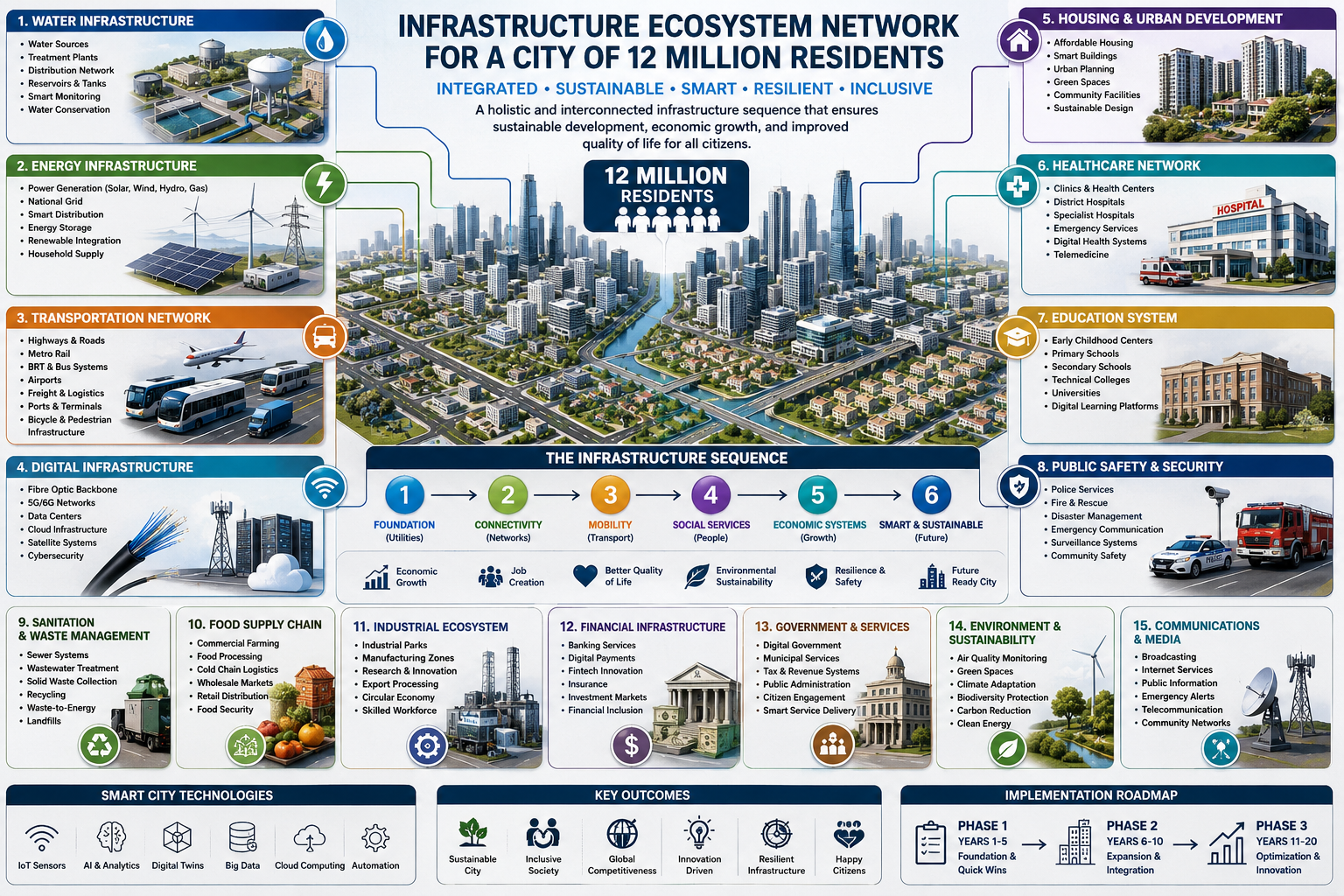
A modern infrastructure ecosystem for 12 million residents requires a synchronized network of physical assets, digital systems, governance structures, and service delivery pipelines. This blueprint outlines the sequential architecture needed to build a resilient, scalable, and future‑ready infrastructure ecosystem capable of supporting dense urban populations, peri‑urban zones, and rural extensions.
2. Population Dynamics & Spatial Distribution
Understanding demographic clusters is foundational.
- Urban core: 6.5 million
- Peri‑urban: 3 million
- Rural & semi‑rural: 2.5 million Population density determines infrastructure load, transport corridors, utility demand, and emergency response design.
3. Infrastructure Ecosystem Definition
An infrastructure ecosystem is a network of interconnected systems — transport, utilities, digital networks, housing, logistics, governance, and environmental assets — functioning as one coordinated organism. Key attributes: interoperability, redundancy, scalability, and automation.
4. Sequential Infrastructure Logic
Sequence refers to the order of development, ensuring each layer supports the next:
- Foundational utilities
- Transport corridors
- Digital backbone
- Housing & social infrastructure
- Economic zones
- Governance & regulatory systems
- Maintenance & lifecycle management
5. Foundational Utilities: Water
Water infrastructure must support 12 million residents with redundancy. Components:
- Bulk water supply
- Treatment plants
- Distribution networks
- Smart metering
- Leak detection
- Emergency reserves Demand: ±1.2 billion litres/day.
6. Foundational Utilities: Electricity
Electricity demand for 12 million residents: ±6,000 MW. Architecture:
- Generation mix (renewables + grid)
- Transmission backbone
- Distribution nodes
- Microgrids
- Smart load balancing
- Energy storage systems
7. Foundational Utilities: Waste Management
Waste generation: ±20,000 tonnes/day. System components:
- Collection fleet
- Sorting facilities
- Recycling plants
- Waste‑to‑energy conversion
- Landfill management
- Hazardous waste protocols
8. Foundational Utilities: Sanitation
Sanitation infrastructure includes:
- Sewer networks
- Treatment plants
- Sludge management
- Rural sanitation alternatives
- Smart monitoring for blockages Capacity: ±1 million m³/day.
9. Transport Ecosystem: Road Networks
Road infrastructure must support ±2.5 million daily vehicle movements. Elements:
- Primary corridors
- Secondary roads
- Freight routes
- Maintenance cycles
- Traffic management systems
- Autonomous vehicle readiness
10. Transport Ecosystem: Rail
Rail is the backbone of mass movement. Components:
- Commuter rail
- Freight rail
- Intermodal hubs
- Electrification
- Safety systems Capacity target: 1.5 million passengers/day.
11. Transport Ecosystem: Public Transit
Public transit must be integrated:
- BRT systems
- Minibus taxi modernization
- Metro buses
- Digital ticketing
- Real‑time tracking Coverage: 85% of population.
12. Transport Ecosystem: Non‑Motorized Mobility
Infrastructure includes:
- Sidewalks
- Cycling lanes
- Pedestrian bridges
- Safety lighting
- Accessibility design Goal: 20% modal shift.
13. Digital Infrastructure Backbone
Digital infrastructure is the nervous system. Components:
- Fibre backbone
- 5G/6G networks
- Data centres
- Cloud infrastructure
- Cybersecurity architecture Coverage: 99% population.
14. Digital Governance Systems
Digital governance enables automation:
- e‑Government portals
- Digital IDs
- Smart permits
- Procurement automation
- AI‑driven service delivery Goal: 90% digital public services.
15. Housing Infrastructure
Housing demand: ±3 million units. System includes:
- High‑density urban housing
- Affordable housing
- Mixed‑use developments
- Smart building standards
- Green building codes
16. Social Infrastructure: Health
Health ecosystem must support 12 million residents:
- Primary clinics
- District hospitals
- Specialized centres
- Telemedicine
- Emergency response networks Capacity: 1 bed per 500 residents.
17. Social Infrastructure: Education
Education infrastructure includes:
- Early childhood centres
- Primary & secondary schools
- TVET colleges
- Universities
- Digital learning platforms Capacity: 1 school per 5,000 residents.
18. Social Infrastructure: Safety & Security
Security ecosystem:
- Police stations
- Surveillance networks
- Emergency call centres
- Disaster management hubs
- Fire stations Coverage: 1 station per 50,000 residents.
19. Logistics & Supply Chain Infrastructure
Supply chain architecture includes:
- Warehousing hubs
- Distribution centres
- Cold chain networks
- Freight corridors
- Border & customs integration Goal: 24‑hour logistics cycle.
20. Economic Zones & Industrial Infrastructure
Economic infrastructure includes:
- SEZs
- Industrial parks
- Innovation hubs
- Manufacturing clusters
- Export processing zones Target: 1 million jobs.
21. Energy Transition Infrastructure
Transition systems:
- Solar farms
- Wind clusters
- Battery storage
- Hydrogen pilot plants
- Smart grids Goal: 40% renewable mix.
22. Environmental Infrastructure
Environmental systems include:
- Parks
- Wetlands
- Biodiversity corridors
- Air quality monitoring
- Climate resilience systems Coverage: 30% green space.
23. Water Resilience Infrastructure
Resilience systems:
- Desalination
- Groundwater recharge
- Rainwater harvesting
- Flood control
- Drought mitigation Goal: 20% alternative water sources.
24. Smart City Infrastructure
Smart systems include:
- IoT sensors
- Smart lighting
- Smart waste bins
- Digital traffic control
- Predictive maintenance Coverage: 70% urban zones.
25. Governance & Regulatory Architecture
Governance ecosystem includes:
- Infrastructure regulatory authority
- PPP frameworks
- Compliance systems
- Procurement transparency
- Performance dashboards
26. Financial Infrastructure & Funding Models
Funding architecture:
- Municipal bonds
- PPPs
- Infrastructure funds
- Development finance
- User‑pay models Target: R1.2 trillion over 20 years.
27. Workforce & Skills Infrastructure
Skills ecosystem includes:
- Engineering pipelines
- Technical training
- Digital skills
- Maintenance workforce Goal: 250,000 skilled workers.
28. Maintenance & Lifecycle Management
Lifecycle systems:
- Asset registers
- Predictive maintenance
- Replacement cycles
- Budgeting frameworks Goal: 95% uptime.
29. Risk & Resilience Infrastructure
Risk systems include:
- Disaster response
- Cybersecurity
- Infrastructure redundancy
- Insurance frameworks Goal: 99.9% resilience.
30. Rural Infrastructure Integration
Rural systems include:
- Rural roads
- Water access
- Digital connectivity
- Agricultural logistics Coverage: 100% rural inclusion.
31. Peri‑Urban Infrastructure Integration
Peri‑urban systems include:
- Transit links
- Utility expansion
- Housing corridors
- Economic nodes Goal: seamless integration.
32. Urban Core Infrastructure Optimization
Urban optimization includes:
- Congestion management
- High‑density utilities
- Vertical housing
- Smart mobility Goal: 30% efficiency gain.
33. Infrastructure Data & Analytics
Analytics systems include:
- Real‑time dashboards
- Predictive modelling
- AI‑driven planning
- Citizen feedback loops Goal: data‑driven governance.
34. Long‑Term Infrastructure Roadmap (20–50 Years)
Roadmap phases:
- Phase 1: Stabilization
- Phase 2: Expansion
- Phase 3: Automation
- Phase 4: Integration
- Phase 5: Global competitiveness
35. Conclusion: The Integrated Ecosystem Vision
A fully sequenced infrastructure ecosystem for 12 million residents creates a self‑sustaining, automated, resilient, and economically competitive region. This blueprint provides the architecture needed to build a modern civilization capable of supporting growth, innovation, and long‑term stability.






Be First to Comment