
PAGE 1 — Executive Summary
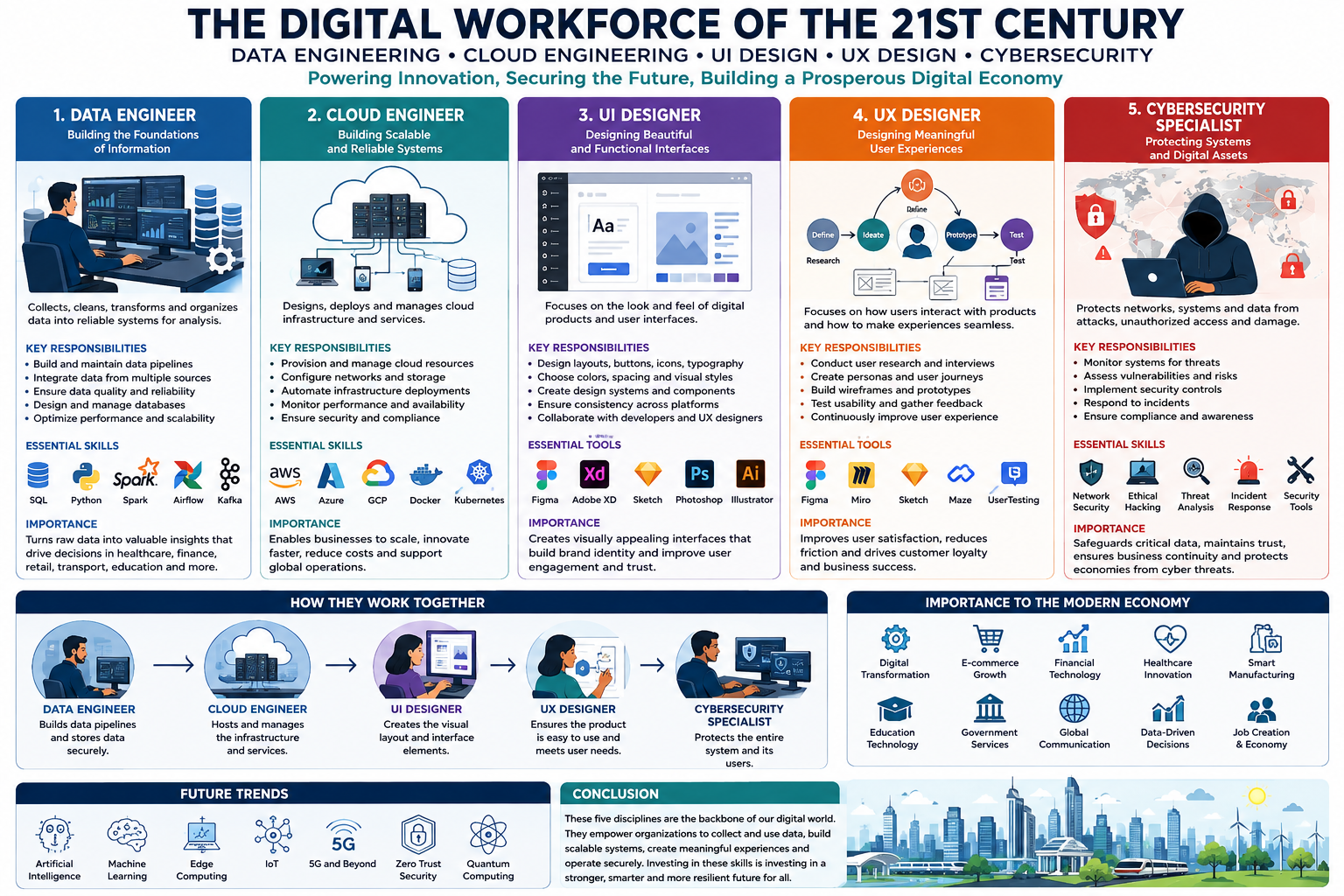
A modern civilised economy depends on data, cloud infrastructure, digital interfaces, user experience, and cyber security. These five disciplines form the backbone of digital transformation, automation, and economic competitiveness.
This tutorial explains each discipline in depth, covering:
- Core functions
- Technical skills
- Tools and technologies
- Workflows
- Real‑world applications
- Economic significance
- Career pathways
SECTION 1 — DATA ENGINEERING (Pages 2–7)
PAGE 2 — Definition & Purpose
Data Engineering is the discipline of collecting, storing, transforming, and delivering data for analytics, AI, automation, and business decision‑making.
It ensures organisations have clean, reliable, accessible data pipelines.
PAGE 3 — Core Responsibilities
- Build ETL/ELT pipelines
- Manage data warehouses and data lakes
- Design database schemas
- Ensure data quality and data governance
- Integrate multiple data sources
- Optimize data performance
PAGE 4 — Technical Skills
- SQL mastery
- Python for automation
- Big data frameworks (Spark, Hadoop)
- Data modelling
- API integration
- Workflow orchestration (Airflow, Prefect)
- Cloud data tools (AWS Glue, Azure Data Factory, GCP Dataflow)
PAGE 5 — Tools & Technologies
- Databases: PostgreSQL, MySQL, MongoDB
- Warehouses: Snowflake, BigQuery, Redshift
- Pipelines: Kafka, Spark, Flink
- Orchestration: Airflow, Dagster
- Version control: Git
PAGE 6 — Workflow Blueprint
- Ingest raw data
- Clean & validate
- Transform & enrich
- Store in warehouse
- Serve to BI tools
- Monitor pipeline health
PAGE 7 — Economic Significance
Data engineering powers:
- AI and machine learning
- Financial modelling
- Supply chain optimization
- Government planning
- Healthcare analytics
- Transport and logistics
- Retail forecasting
A country without strong data engineering capacity cannot compete in a digital economy.
SECTION 2 — CLOUD ENGINEERING (Pages 8–12)
PAGE 8 — Definition & Purpose
Cloud Engineering builds and maintains cloud‑based infrastructure that hosts applications, data, and services.
It enables scalability, automation, and cost‑efficient computing.
PAGE 9 — Core Responsibilities
- Deploy cloud infrastructure
- Manage virtual networks
- Implement security controls
- Automate deployments (CI/CD)
- Monitor cloud performance
- Optimize cloud costs
PAGE 10 — Technical Skills
- Linux administration
- Networking fundamentals
- Infrastructure as Code (Terraform, ARM, CloudFormation)
- Containers (Docker, Kubernetes)
- Cloud platforms (AWS, Azure, GCP)
PAGE 11 — Tools & Technologies
- Azure DevOps
- AWS Lambda
- Kubernetes clusters
- Terraform
- Jenkins
- Cloud monitoring tools
PAGE 12 — Economic Significance
Cloud engineering enables:
- Digital banking
- E‑commerce
- Government digital services
- Remote work infrastructure
- AI model deployment
- National cybersecurity resilience
Cloud is the foundation of modern digital economies.
SECTION 3 — UI DESIGN (Pages 13–17)
PAGE 13 — Definition & Purpose
UI Design focuses on visual interfaces—the screens, buttons, typography, and layouts users interact with.
It determines how a product looks.
PAGE 14 — Core Responsibilities
- Create visual layouts
- Design components and patterns
- Build design systems
- Ensure accessibility
- Collaborate with UX and developers
PAGE 15 — Technical Skills
- Visual hierarchy
- Typography
- Color theory
- Iconography
- Responsive design
- Prototyping
PAGE 16 — Tools & Technologies
- Figma
- Adobe XD
- Sketch
- Illustrator
- Design systems (Material UI, Fluent UI)
PAGE 17 — Economic Significance
UI design improves:
- Customer satisfaction
- Brand identity
- Digital adoption
- Conversion rates
- E‑government usability
A nation with poor UI design suffers digital exclusion.
SECTION 4 — UX DESIGN (Pages 18–22)
PAGE 18 — Definition & Purpose
UX Design ensures products are usable, intuitive, and meaningful.
It determines how a product works.
PAGE 19 — Core Responsibilities
- User research
- Persona creation
- Journey mapping
- Wireframing
- Prototyping
- Usability testing
PAGE 20 — Technical Skills
- Research methodologies
- Information architecture
- Interaction design
- Prototyping
- Analytics interpretation
PAGE 21 — Tools & Technologies
- Figma
- Miro
- Maze
- Hotjar
- UserTesting.com
PAGE 22 — Economic Significance
UX design drives:
- Digital transformation
- Customer retention
- Reduced operational costs
- Higher productivity
- Better public service delivery
UX is the difference between digital success and digital failure.
SECTION 5 — CYBER SECURITY (Pages 23–29)
PAGE 23 — Definition & Purpose
Cyber Security protects systems, networks, and data from attacks, breaches, and digital threats.
It is the defence system of a digital economy.
PAGE 24 — Core Responsibilities
- Threat detection
- Vulnerability management
- Incident response
- Security audits
- Identity & access management
- Network security
PAGE 25 — Technical Skills
- Ethical hacking
- SIEM tools
- Firewalls & IDS/IPS
- Encryption
- Risk assessment
- Cloud security
PAGE 26 — Tools & Technologies
- Splunk
- Wireshark
- Kali Linux
- Azure Sentinel
- CrowdStrike
- Nessus
PAGE 27 — Cyber Threat Landscape
- Ransomware
- Phishing
- Insider threats
- Nation‑state attacks
- Zero‑day exploits
PAGE 28 — Economic Significance
Cyber security protects:
- National infrastructure
- Banking systems
- Government databases
- Healthcare records
- Corporate intellectual property
A country without cyber security is economically vulnerable.
PAGE 29 — Final Integration: Why These Fields Matter Together
These five disciplines form a complete digital ecosystem:
- Data Engineering → Provides the data
- Cloud Engineering → Hosts the systems
- UI Design → Shapes the interface
- UX Design → Shapes the experience
- Cyber Security → Protects everything
Together, they create:
- Efficient governments
- Competitive businesses
- Secure digital economies
- Scalable infrastructure
- High‑value jobs
- Innovation ecosystems






Be First to Comment