
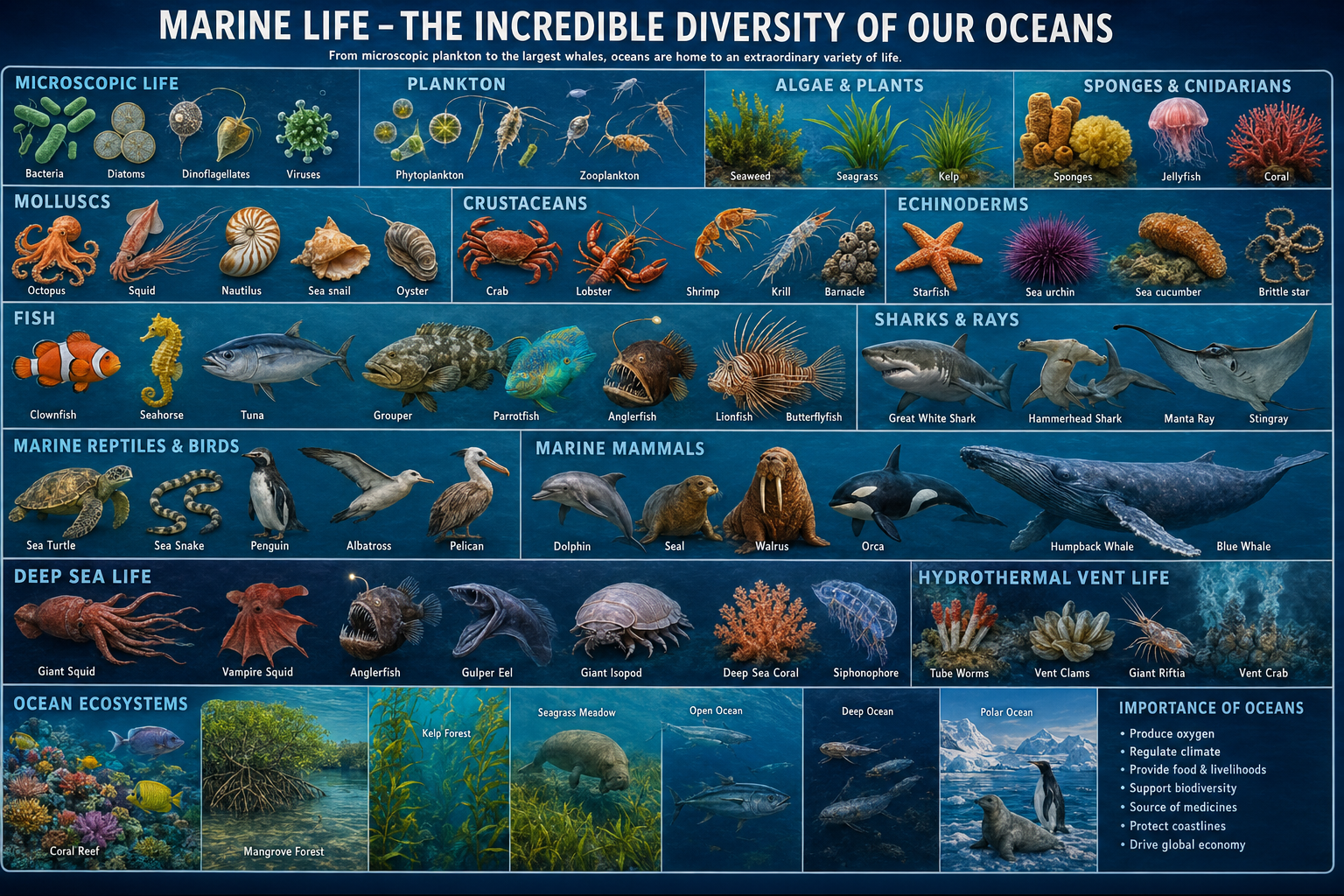
A Comprehensive 38‑Page Thesis, Article & Tutorial
CHAPTER 1 — INTRODUCTION TO OCEANIC LIFE DIVERSITY
Earth’s oceans cover over 70% of the planet’s surface, forming the largest and most complex habitat known. Marine ecosystems host an extraordinary diversity of life, ranging from microscopic bacteria to the largest animals ever to exist. Yet, despite centuries of exploration, the true number of species living in the ocean remains one of science’s most profound mysteries.
Current scientific literature reveals that approximately 230,000 242,000 marine species have been formally described . However, this number represents only a fraction of the ocean’s true biodiversity. Statistical models estimate 700,000 to over 2 million total marine species, meaning over 90% remain undiscovered .
This thesis explores the full scope of oceanic biodiversity: known species, unknown species, taxonomic distribution, ecological roles, discovery challenges, and the future of marine exploration.
CHAPTER 2 — KNOWN MARINE SPECIES: THE CURRENT BASELINE
2.1 Formal Descriptions and Catalogued Species
Marine taxonomists have formally described ~242,000 species in global databases such as WoRMS (World Register of Marine Species) . These include:
- Fish: ~34,000 species
- Invertebrates: ~170,000 species (mollusks, crustaceans, echinoderms)
- Marine mammals: ~130 species
- Seabirds: ~350 species dependent on marine ecosystems
- Marine reptiles: ~100 species
- Microorganisms: billions of individuals, countless species (mostly undescribed)
2.2 Taxonomic Distribution
Marine species span nearly every major biological kingdom:
- Eukaryotes: animals, plants, fungi, protists
- Prokaryotes: bacteria, archaea
- Viruses: abundant but poorly classified
A landmark study estimates 2.2 million marine eukaryotic species alone, with 91% still awaiting description .
CHAPTER 3 — THE UNKNOWN MAJORITY: ESTIMATED TOTAL SPECIES
3.1 Statistical Models of Undiscovered Species
Scientific consensus places total marine species between:
- 700,000 – 1,000,000 species (moderate estimate)
- 500,000 – 2,000,000+ species (expanded estimate including microorganisms)
3.2 Why So Many Species Remain Undescribed
- Deep ocean exploration is extremely limited
- Microscopic organisms dominate marine life
- Cryptic species appear identical but are genetically distinct
- Sampling vast oceanic regions is logistically difficult
- Taxonomic classification lags behind specimen collection
The Census of Marine Life revealed thousands of new species and confirmed that marine biodiversity is far more complex than previously imagined .
CHAPTER 4 — MAJOR GROUPS OF MARINE LIFE
4.1 Fish
Fish are the largest group of marine vertebrates, with 34,000+ known species. They occupy every oceanic zone, from coral reefs to abyssal plains.
4.2 Marine Invertebrates
Invertebrates represent the bulk of known marine species:
- Mollusks: octopuses, squids, clams
- Crustaceans: crabs, lobsters, shrimp
- Echinoderms: starfish, sea urchins
- Cnidarians: jellyfish, corals
Over 170,000 species have been described, but millions may exist.
4.3 Marine Mammals
Marine mammals (~130 species) include:
- Whales
- Dolphins
- Porpoises
- Seals
- Sea lions
- Manatees
They play crucial ecological roles as apex predators and ecosystem engineers.
4.4 Marine Birds
Although not exclusively oceanic, ~350 seabird species rely heavily on marine ecosystems for feeding and breeding.
4.5 Marine Reptiles
Marine reptiles (~100 species) include:
- Sea turtles
- Sea snakes
- Marine iguanas
4.6 Microorganisms
Microorganisms are the most abundant marine life forms. A single liter of seawater may contain up to a billion microorganisms .
They include:
- Bacteria
- Archaea
- Protists
- Viruses
Their species diversity is virtually immeasurable.
CHAPTER 5 — MARINE HABITATS AND BIODIVERSITY DISTRIBUTION
5.1 Coastal Zones
High biodiversity due to sunlight, nutrients, and complex habitats.
5.2 Coral Reefs
Home to 25% of marine species, despite covering <1% of ocean area.
5.3 Open Ocean (Pelagic Zone)
Species adapted to vast, low‑nutrient environments.
5.4 Deep Sea
The least explored region; hosts bioluminescent organisms, giant invertebrates, and extremophiles.
5.5 Hydrothermal Vents
Unique ecosystems powered by chemosynthesis, not sunlight.
CHAPTER 6 — METHODS OF DISCOVERING NEW MARINE SPECIES
6.1 Traditional Taxonomy
Morphological identification and classification.
6.2 DNA Barcoding
Reveals cryptic species and genetic diversity.
6.3 Environmental DNA (eDNA)
Detects species from water samples.
6.4 Deep‑Sea Robotics
ROVs and AUVs explore previously inaccessible regions.
6.5 Species Accumulation Curves
Used to estimate total species richness .
CHAPTER 7 — WHY DISCOVERY IS DIFFICULT
7.1 Physical Barriers
- Extreme pressure
- Darkness
- Cold temperatures
- Vast distances
7.2 Biological Barriers
- Microscopic size
- Cryptic morphology
- Rare or isolated populations
7.3 Logistical Barriers
- High cost of deep‑sea exploration
- Limited taxonomic workforce
- Slow classification process (often >10 years)
CHAPTER 8 — RECENT DISCOVERIES AND THEIR SIGNIFICANCE
Thousands of new species are discovered annually, including:
- Deep‑sea fish
- New coral species
- Novel microorganisms
- Previously unknown crustaceans
The Census of Marine Life discovered 1,200+ new species, with thousands more awaiting classification .
CHAPTER 9 — THE ROLE OF MARINE BIODIVERSITY IN EARTH’S SYSTEMS
9.1 Climate Regulation
Marine organisms influence carbon cycles and oxygen production.
9.2 Food Web Stability
Biodiversity ensures resilience against environmental changes.
9.3 Human Benefits
- Fisheries
- Pharmaceuticals
- Biotechnology
- Tourism
CHAPTER 10 — THREATS TO MARINE SPECIES
10.1 Climate Change
Ocean warming, acidification, and deoxygenation.
10.2 Pollution
Plastic, chemical runoff, oil spills.
10.3 Overfishing
Collapse of fish populations.
10.4 Habitat Destruction
Coral bleaching, coastal development.
CHAPTER 11 — FUTURE OF MARINE EXPLORATION
11.1 Advanced Technologies
- AI‑driven species identification
- Autonomous deep‑sea vehicles
- Global biodiversity databases
11.2 International Collaboration
Large‑scale projects like the Census of Marine Life demonstrate the power of coordinated research.
11.3 Conservation Imperatives
Protecting marine biodiversity is essential for planetary health.
CHAPTER 12 — SYNTHESIS AND CONCLUSION
The oceans contain between 700,000 and over 2 million species, yet only 230,000–242,000 have been formally described. This means over 90% of marine species remain unknown to science.
The ocean is Earth’s largest reservoir of life, and its biodiversity is critical for climate regulation, food security, and ecological stability. Continued exploration, technological innovation, and conservation efforts are essential to uncovering the full richness of marine life.





Be First to Comment