Introduction
In the intricate world of semiconductor manufacturing, where precision is measured in nanometers, the quest for smaller, faster, and more powerful microchips is relentless. At the heart of this pursuit lies a critical technology: photolithography. This process, akin to a highly advanced form of photography, uses light to etch complex circuit patterns onto silicon wafers. For decades, the workhorse of this industry has been the Deep Ultraviolet (DUV) light source machine, a marvel of engineering that generates the specialized light required to create the microchips that power our modern world. This article provides a comprehensive exploration of DUV light source machines, from their underlying technology and diverse applications to the key industry players and the future of this essential technology.
The Core of the Machine: Excimer Laser Technology
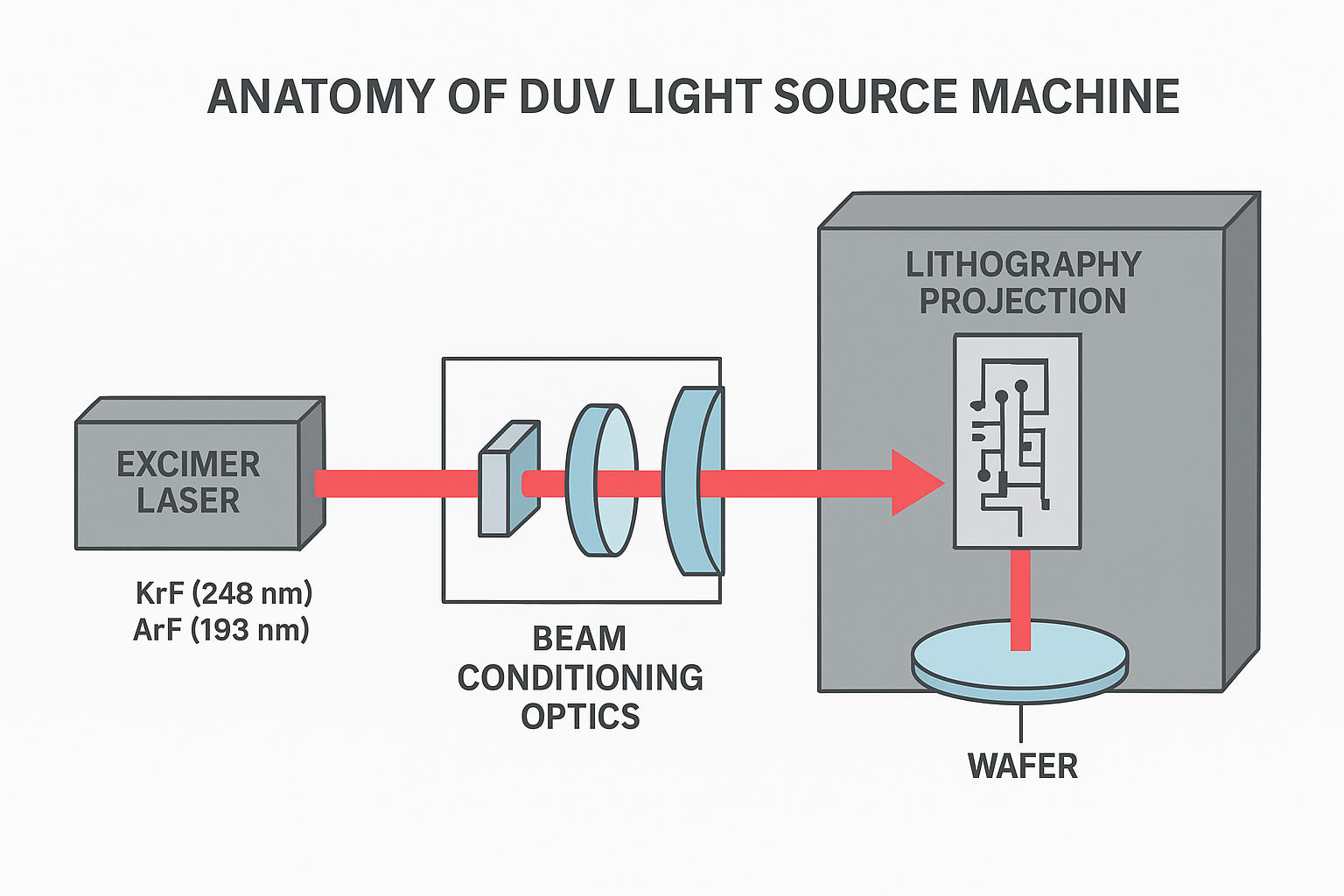
DUV light source machines are fundamentally powered by a specialized type of laser known as an excimer laser. The term “excimer” is a portmanteau of “excited dimer,” referring to a temporary molecule formed from two atoms that would not normally bond. In the context of DUV lasers, these are typically a noble gas (such as argon, krypton, or xenon) and a halogen gas (such as fluorine or chlorine). The process of generating DUV light is a fascinating display of physics in action:
1.Gas Mixture: A chamber within the laser is filled with a precise mixture of a noble gas and a halogen gas.
2.Electrical Excitation: A high-voltage electrical discharge is passed through the gas mixture, exciting the atoms and causing them to temporarily bond, forming excimer molecules.
3.Light Emission: These excimer molecules are in a high-energy, unstable state. They rapidly decay, releasing their excess energy in the form of a photon of UV light. This emission is what constitutes the laser beam.
4.Dissociation: After releasing the photon, the excimer molecule, now in its ground state, immediately dissociates back into its constituent atoms, ready for the cycle to repeat.
This process, repeated thousands of times per second, generates a high-intensity beam of UV light with a specific wavelength determined by the gases used. The two most common types of excimer lasers used in DUV lithography are Krypton-Fluoride (KrF) and Argon-Fluoride (ArF) lasers.
| Laser Type | Wavelength | Resolution Capability | Generation |
| KrF (Krypton-Fluoride) | 248 nm | Down to 80 nm | First Generation DUV |
| ArF (Argon-Fluoride) | 193 nm | Down to 38 nm | Second Generation DUV |
DUV Lithography Systems: Dry vs. Immersion
DUV lithography systems can be broadly categorized into two main types: dry systems and immersion systems. While both utilize DUV light, the introduction of immersion technology was a pivotal moment in the history of semiconductor manufacturing.
Dry Lithography
In a dry lithography system, there is a gap of air between the final lens of the lithography machine and the silicon wafer. The resolution of these systems is ultimately limited by the refractive index of air. While still widely used for less critical layers of a microchip due to their cost-effectiveness, dry systems have been surpassed by immersion technology for the most advanced chip features.
Immersion Lithography
Immersion lithography, a groundbreaking innovation pioneered by ASML, replaces the air gap with a layer of ultra-pure water. The higher refractive index of water allows the system to capture more light and project a finer image onto the wafer, significantly enhancing the resolution. This technique, based on a principle first discovered by Ernst Abbe in the 19th century, has been instrumental in extending the capabilities of DUV lithography, enabling the production of chips with features smaller than 40 nanometers.
Applications: Beyond the Semiconductor Fab
While the primary application of DUV light source machines is in semiconductor manufacturing, their unique properties have led to their adoption in a wide range of other fields:
•Medical: DUV lasers are used in vision correction surgery (LASIK), where their precise ablation capabilities are used to reshape the cornea. They are also being explored for applications in sterilization and disinfection due to the germicidal properties of UV light.
•Scientific Research: The narrow bandwidth and high intensity of DUV lasers make them invaluable tools in spectroscopy, materials science, and quantum technology research.
•Industrial: DUV light sources are used in micromachining, polymer curing, and the fabrication of other high-precision components.
The DUV Market Landscape
The market for DUV lithography systems is a multi-billion dollar industry dominated by a few key players. ASML, a Dutch company, is the undisputed market leader, providing the most advanced DUV and EUV (Extreme Ultraviolet) lithography systems to the world’s leading chipmakers. Other significant players include Canon and Nikon, both of which have a strong presence in the DUV market. The ecosystem also includes critical suppliers like ZEISS, which produces the high-precision optics used in these machines, and Cymer (an ASML subsidiary), which specializes in the DUV light sources themselves.
The Future of DUV Technology
Despite the advent of the even more advanced EUV lithography, DUV technology is far from obsolete. DUV systems remain the most cost-effective solution for producing many of the layers in a modern microchip. The industry continues to innovate, with ongoing research into more powerful and reliable DUV light sources. One of the most promising areas of development is the creation of solid-state DUV lasers. These lasers, which use crystals instead of gas to generate light, have the potential to be more compact, efficient, and coherent than traditional excimer lasers. While still in the early stages of development, solid-state DUV technology could represent the next chapter in the story of this remarkable technology.
Conclusion
DUV light source machines are a testament to human ingenuity, a technology that has enabled the relentless march of Moore’s Law for decades. From the intricate dance of atoms in an excimer laser to the mind-boggling precision of immersion lithography, these machines are the unsung heroes of the digital age. As we look to the future, DUV technology will continue to play a vital role in the creation of the microchips that will shape our world, a powerful reminder of the profound impact of the unseen light.





Be First to Comment