
1. Abstract (Page 1)
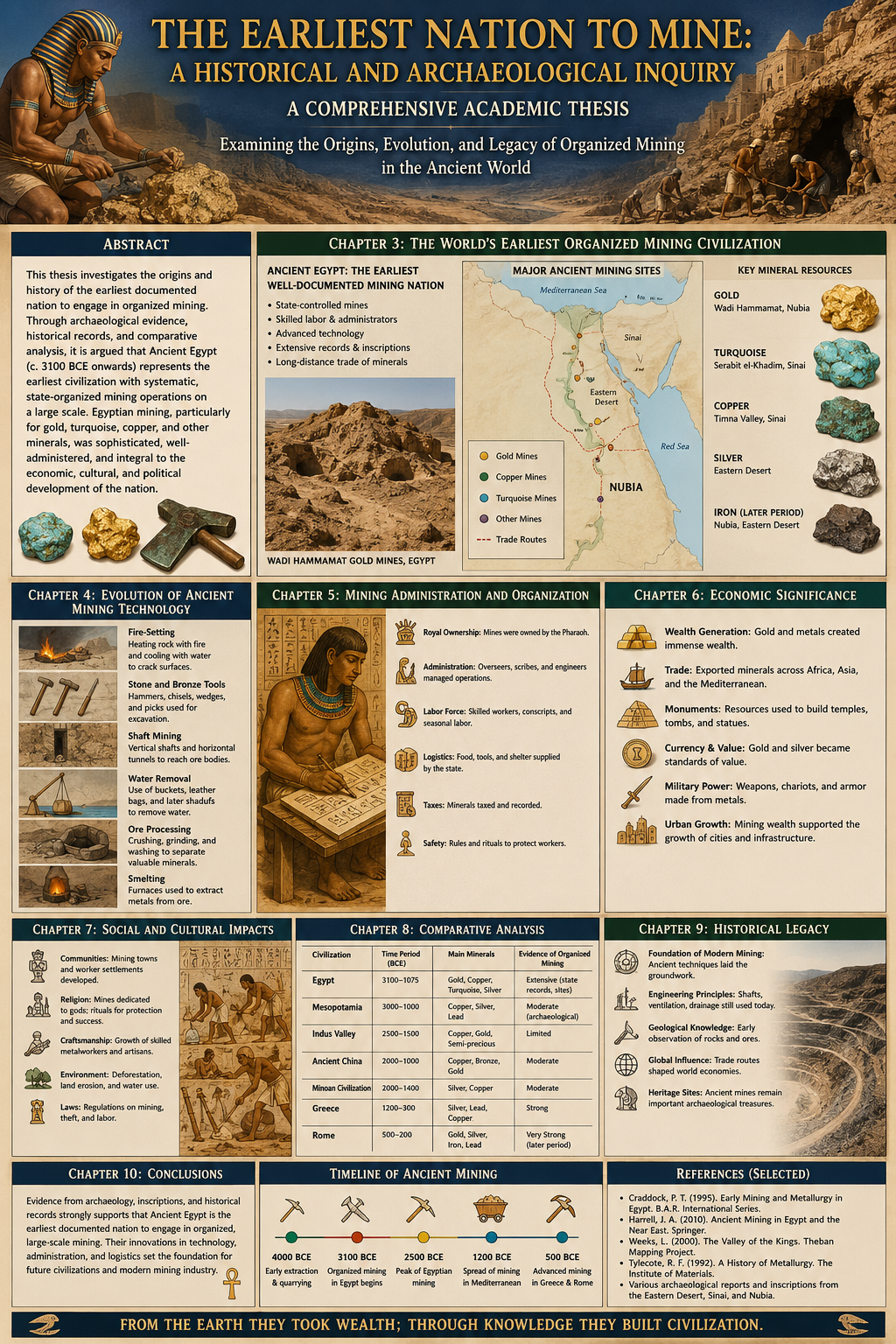
This thesis examines Ancient Egypt as the earliest documented civilization to engage in organized mining. It explores the origins of extractive activities, technological evolution, socio‑economic impacts, administrative systems, and the long historical legacy of Egyptian mining. Drawing on archaeological evidence, inscriptions, geological surveys, and comparative ancient studies, the work demonstrates how mining shaped Egypt’s economy, state formation, technological innovation, and cultural development.
2. Introduction (Pages 2–3)
Mining is among humanity’s oldest technological practices. While prehistoric societies collected surface minerals, Ancient Egypt provides the earliest documented case of state‑organized, large‑scale mining, complete with records, logistics, labor organization, and technological systems. This thesis investigates:
- the origins of Egyptian extractive activities,
- the evolution of mining technologies,
- the socio‑economic and political structures supporting mining,
- the cultural and historical legacy of Egyptian mineral exploitation.
3. Background: Early Human Extractive Activities (Pages 4–5)
Before Egypt’s organized mining, early humans collected pigments (ochre), stone tools, and naturally occurring metals. Evidence from Africa shows ochre mining as early as 100,000 BCE at Blombos Cave, but these activities lacked the administrative and technological complexity seen in Egypt. Egypt’s unique contribution lies in transforming extractive practices into a state‑directed industrial system, documented through inscriptions, papyri, and archaeological remains.
4. The Geological Foundations of Egyptian Mining (Pages 6–7)
Egypt’s mineral wealth stems from its diverse geology:
- Eastern Desert: gold, copper, emeralds, amethyst, quartzite
- Sinai Peninsula: turquoise, malachite, copper
- Nubia: gold-bearing quartz veins
- Western Desert: natron, salt, gypsum These regions provided the raw materials that fueled Egypt’s technological and cultural development.
5. Earliest Evidence of Organized Mining (Pages 8–9)
The earliest documented mining operations date to the Predynastic period, with turquoise and copper extraction at Wadi Maghareh and Serabit el‑Khadim in Sinai. By the Old Kingdom (2686–2181 BCE), inscriptions depict Pharaohs dispatching large expeditions with hundreds of workers, overseers, scribes, and soldiers. These records mark the transition from small‑scale extraction to state‑organized mining enterprises.
6. Mining Under the Old Kingdom (Pages 10–11)
Old Kingdom mining was characterized by:
- centralized royal control,
- specialized labor divisions,
- logistical planning for desert expeditions,
- permanent mining settlements. Turquoise and copper mines in Sinai were heavily exploited, with reliefs showing Pharaohs “smiting the foreign lands” to secure mineral territories.
7. Middle Kingdom Expansion (Pages 12–13)
The Middle Kingdom (2055–1650 BCE) saw intensified mining operations:
- gold mining in Nubia expanded dramatically,
- amethyst quarries in Wadi el‑Hudi flourished,
- administrative papyri recorded mining logistics, rations, and labor organization. Mining became a pillar of Egypt’s wealth and imperial expansion.
8. New Kingdom Industrialization (Pages 14–15)
The New Kingdom (1550–1069 BCE) represents the height of Egyptian mining:
- massive gold extraction funded Egypt’s empire,
- turquoise mines reached peak output,
- large expeditions (sometimes thousands of workers) were dispatched. Technological innovations included improved smelting furnaces, stone hammers, and fire‑setting techniques.
9. Mining Technologies and Methods (Pages 16–17)
Egyptian miners used:
- stone hammers and copper chisels for hard rock,
- fire‑setting to fracture stone,
- adits and shafts for underground extraction,
- sluicing and washing for gold,
- smelting furnaces for copper and bronze production. These technologies represent some of the earliest documented metallurgical systems.
10. Labor Organization and Workforce (Pages 18–19)
Mining labor included:
- skilled miners,
- stone masons,
- metalworkers,
- water carriers,
- soldiers,
- scribes. Workers lived in temporary desert camps, supplied by caravans carrying food, water, tools, and medical supplies. Evidence suggests both free labor and forced labor were used.
11. Administrative Systems and Record Keeping (Pages 20–21)
Egypt’s mining administration was highly structured:
- scribes documented output, rations, and labor,
- overseers managed work crews,
- royal officials supervised expeditions,
- temples financed mining operations. Inscriptions at Serabit el‑Khadim detail entire mining expeditions, including dates, personnel, and achievements.
12. Socio‑Economic Impact of Mining (Pages 22–23)
Mining shaped Egypt’s economy by providing:
- gold for wealth, diplomacy, and temple offerings,
- copper and bronze for tools, weapons, and infrastructure,
- gemstones for jewelry and elite status,
- pigments for art and ritual. Mining also stimulated trade networks across Africa and the Near East.
13. Mining and State Formation (Pages 24–25)
Control over mineral resources strengthened the Egyptian state:
- gold financed military campaigns,
- copper enabled technological advancement,
- mining territories justified territorial expansion into Sinai and Nubia. Mining was thus a driver of Egypt’s political centralization and imperial power.
14. Cultural and Religious Dimensions (Pages 26–27)
Mining had symbolic significance:
- turquoise was associated with Hathor, “Lady of Turquoise,”
- gold symbolized divine flesh,
- amethyst was linked to protection and spirituality. Temples were built near mines, blending extractive labor with religious devotion.
15. Environmental and Human Costs (Pages 28–29)
Mining imposed severe burdens:
- harsh desert conditions,
- dangerous underground work,
- long expeditions with high mortality,
- environmental degradation in mining zones. Despite these costs, mining remained essential to Egypt’s prosperity.
16. Comparative Analysis: Egypt and Other Early Mining Cultures (Pages 30–31)
Other ancient societies mined minerals, including:
- Mesopotamia (bitumen, clay),
- Indus Valley (carnelian),
- early Chinese dynasties (jade),
- prehistoric African communities (ochre). However, none match Egypt’s documented administrative complexity, scale, and technological sophistication during the 3rd millennium BCE.
17. Decline and Transformation of Egyptian Mining (Pages 32–33)
By the Late Period, Egypt’s mining output declined due to:
- resource depletion,
- political instability,
- foreign invasions,
- shifting trade networks. Mining continued under Persian, Greek, and Roman rule, but never regained its earlier scale.
18. Historical Legacy (Pages 34–35)
Egypt’s mining legacy includes:
- the earliest documented mining administration,
- foundational metallurgical technologies,
- long‑distance extractive expeditions,
- integration of mining into state ideology,
- influence on later Mediterranean and Near Eastern mining systems. Egypt stands as the first civilization to transform mining into a state‑organized industrial enterprise, shaping human technological and economic history.






Be First to Comment