
How Far Modern Science Understands the Architecture and Complexity of the Universe
A Comprehensive Academic Thesis
Title Page
How Far Modern Science Understands the Architecture and Complexity of the Universe
A Comprehensive Scientific Thesis on Cosmology, Astrophysics, Fundamental Physics, Cosmic Structure, Dark Matter, Dark Energy, and the Limits of Human Knowledge
Abstract
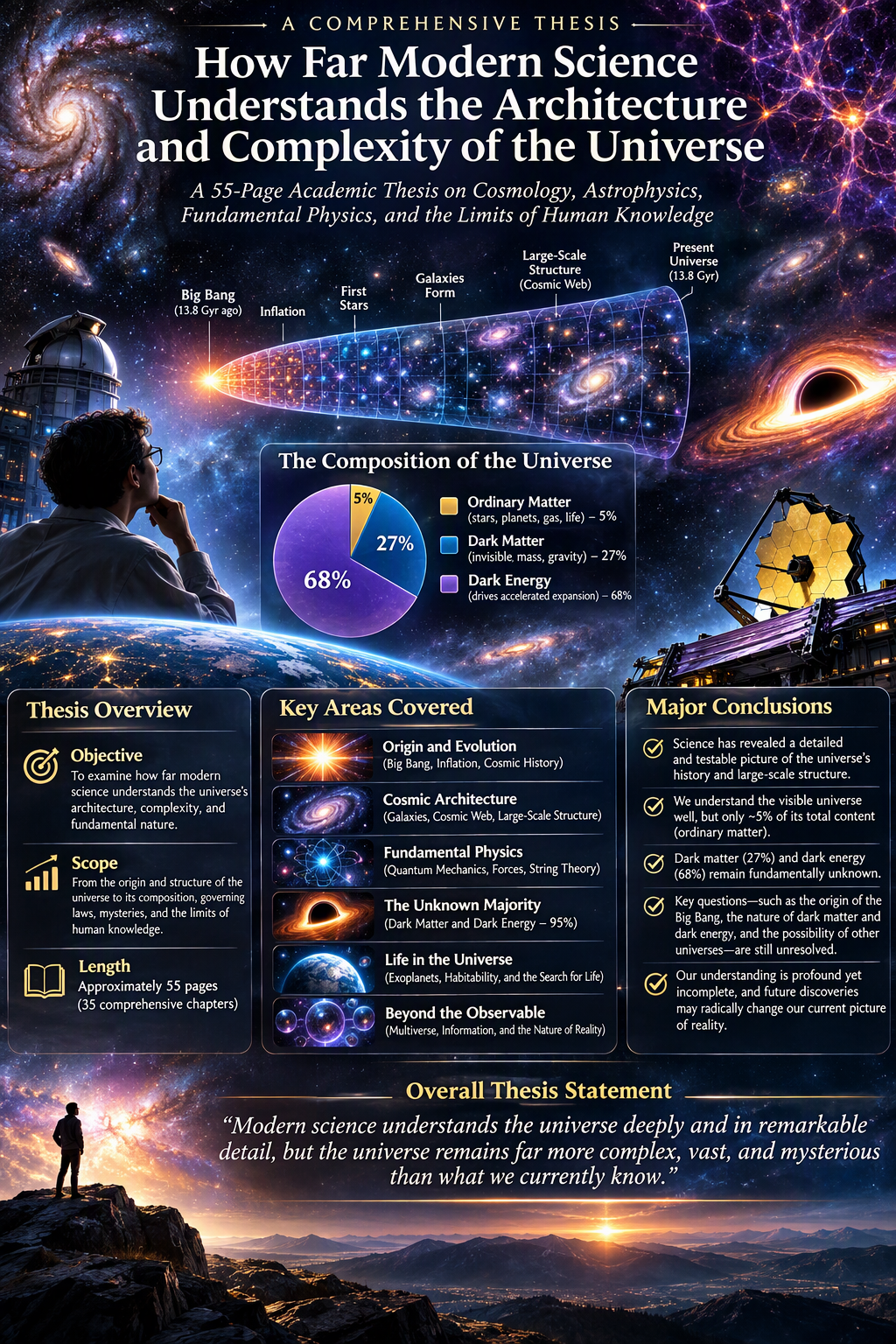
The universe is the largest and most complex known system. Throughout human history, people have attempted to understand the heavens, the origins of matter, the nature of space and time, and humanity’s place within the cosmos. Modern science has made extraordinary progress in revealing the architecture of the universe through astronomy, astrophysics, cosmology, mathematics, particle physics, and space exploration.
Despite these advances, scientists estimate that ordinary matter constitutes only about 5% of the universe, while dark matter and dark energy account for the remaining 95%. This fact alone demonstrates that humanity’s understanding remains incomplete. This thesis explores the extent of human knowledge regarding the universe, examining what modern science has successfully explained and identifying the profound mysteries that remain unsolved.
Table of Contents
- Introduction
- Historical Development of Cosmic Understanding
- The Birth of Modern Cosmology
- The Big Bang Theory
- Space and Time Architecture
- Cosmic Expansion
- The Structure of Matter
- Formation of Galaxies
- Architecture of the Milky Way
- Stars and Stellar Evolution
- Black Holes
- Dark Matter
- Dark Energy
- Cosmic Web Architecture
- Quantum Mechanics and the Universe
- Fundamental Forces
- The Observable Universe
- Limits of Scientific Observation
- Cosmic Background Radiation
- Exoplanets and Habitability
- Search for Extraterrestrial Life
- Multiverse Theories
- Information and Reality
- Mathematical Universe Hypothesis
- String Theory
- Quantum Gravity
- Inflationary Universe
- Cosmic Mysteries
- Technological Advances in Astronomy
- Artificial Intelligence in Cosmology
- Future Space Telescopes
- Limits of Human Knowledge
- Philosophical Implications
- Future Scientific Directions
- Conclusion
Chapter 1: Introduction
The universe represents the totality of all matter, energy, space, time, and physical laws. It encompasses everything that exists on scales ranging from subatomic particles to vast galactic superclusters spanning billions of light-years.
Modern science views the universe as an interconnected system governed by physical laws that have existed for approximately 13.8 billion years. Through advances in observational instruments, scientists have developed increasingly sophisticated models of cosmic evolution.
The primary objective of cosmology is to understand the origin, evolution, structure, and future fate of the universe.
Chapter 2: Historical Development of Cosmic Understanding
Ancient civilizations developed early cosmological models based on naked-eye observations.
Major contributors include:
- Babylonian Astronomers
- Egyptian Scientists
- Greek Philosophers
- Islamic Golden Age Scholars
- Renaissance Thinkers
Key figures:
- Aristotle
- Ptolemy
- Copernicus
- Galileo
- Kepler
- Newton
- Einstein
Each contribution moved humanity closer to scientific understanding.
Chapter 3: The Birth of Modern Cosmology
Modern cosmology emerged during the twentieth century after Einstein developed General Relativity in 1915.
This theory transformed space and time from passive backgrounds into dynamic components of reality.
General Relativity predicts:
- Expansion of space
- Gravitational lensing
- Black holes
- Space-time curvature
These predictions were later confirmed observationally.
Chapter 4: The Big Bang Theory
The Big Bang theory currently represents the most accepted explanation for the universe’s origin.
Approximately:
13.8 billion years ago
the universe existed in a state of extraordinary density and temperature.
Major stages included:
Planck Epoch
The earliest known phase.
Inflation Epoch
Massive expansion in fractions of a second.
Particle Formation
Quarks and electrons emerged.
Nucleosynthesis
Hydrogen and helium formed.
Recombination
Atoms appeared and light traveled freely.
Chapter 5: Space and Time Architecture
Einstein demonstrated that space and time form a unified fabric called:
Space-Time
Massive objects distort this fabric.
Examples include:
- Stars
- Neutron stars
- Black holes
- Galaxies
Gravity results from curvature within this four-dimensional structure.
Chapter 6: Cosmic Expansion
Edwin Hubble discovered that galaxies move away from one another.
This led to the realization that:
The universe is expanding.
The greater the distance:
The faster the recession velocity.
This relationship became known as:
Hubble’s Law
Chapter 7: The Structure of Matter
Everything visible consists of atoms.
Atoms contain:
- Protons
- Neutrons
- Electrons
Below these exist:
- Quarks
- Gluons
- Fundamental particles
The Standard Model successfully explains much of particle behavior.
Chapter 8: Formation of Galaxies
Galaxies formed from gravitational collapse of matter after the Big Bang.
Galaxy categories include:
Spiral Galaxies
Example: Milky Way
Elliptical Galaxies
Irregular Galaxies
Billions of galaxies populate the observable universe.
Chapter 9: Architecture of the Milky Way
The Milky Way contains:
- Central supermassive black hole
- Hundreds of billions of stars
- Dark matter halo
- Spiral arms
- Star-forming regions
The Solar System resides within one of its spiral arms.
Chapter 10: Stars and Stellar Evolution
Stars form from molecular clouds.
Life cycle:
- Protostar
- Main Sequence
- Red Giant
- Planetary Nebula or Supernova
- White Dwarf, Neutron Star, or Black Hole
Stars serve as cosmic furnaces producing heavier elements.
Chapter 11: Black Holes
Black holes arise when massive stars collapse.
Important regions:
Event Horizon
Boundary beyond which escape is impossible.
Singularity
Region where known physics breaks down.
Black holes may contain clues toward quantum gravity.
Chapter 12: Dark Matter
Dark matter remains invisible yet exerts gravity.
Evidence comes from:
- Galaxy rotation curves
- Gravitational lensing
- Cluster dynamics
Scientists estimate that dark matter constitutes approximately:
27% of the universe
Its true nature remains unknown.
Chapter 13: Dark Energy
Dark energy appears responsible for accelerated cosmic expansion.
Estimated contribution:
68% of the universe
Its origin is one of science’s greatest mysteries.
Chapter 14: Cosmic Web Architecture
The universe resembles a giant cosmic web.
Major structures include:
- Galaxy clusters
- Filaments
- Voids
- Superclusters
This architecture represents the largest known pattern in existence.
Chapter 15: Quantum Mechanics and the Universe
Quantum mechanics governs microscopic reality.
Important concepts:
- Wave functions
- Uncertainty principle
- Quantum tunneling
- Entanglement
These phenomena challenge classical understanding.
Chapter 16: Fundamental Forces
Four known fundamental forces govern nature:
- Gravity
- Electromagnetism
- Strong Nuclear Force
- Weak Nuclear Force
Scientists seek a Grand Unified Theory combining all four.
Chapter 17: The Observable Universe
The observable universe spans approximately:
93 billion light-years
Scientists observe only regions whose light has reached Earth.
Beyond this horizon remains unknown.
Chapter 18: Limits of Scientific Observation
Several barriers constrain observation:
- Cosmic horizon
- Instrument sensitivity
- Quantum uncertainty
- Dark matter invisibility
- Dark energy uncertainty
Thus science has significant limitations.
Chapter 19: Cosmic Background Radiation
The Cosmic Microwave Background (CMB) represents ancient radiation from early cosmic history.
It acts as a:
Photograph of the infant universe
and provides powerful evidence supporting Big Bang cosmology.
Chapter 20: Exoplanets and Habitability
Thousands of planets have been discovered around other stars.
Scientists identify:
- Habitable zones
- Earth-like planets
- Water signatures
- Atmospheric chemistry
Future missions may reveal biosignatures.
Chapter 21: Search for Extraterrestrial Life
Modern programs include:
- SETI
- Exoplanet missions
- Radio astronomy surveys
- Astrobiology projects
No confirmed intelligent extraterrestrial civilization has yet been found.
Chapter 22: Multiverse Theories
Several cosmological models suggest multiple universes.
Possible mechanisms:
- Quantum branching
- Inflationary bubbles
- String theory landscapes
Evidence remains inconclusive.
Chapter 23: Information and Reality
Some physicists suggest information may be more fundamental than matter.
This emerging perspective proposes:
Reality itself may operate as an informational structure.
Chapter 24: Mathematical Universe Hypothesis
This concept proposes:
Reality is fundamentally mathematical.
Physical laws emerge from deep mathematical structures.
Chapter 25: String Theory
String theory proposes that particles are vibrating energy strings.
Potential achievements include:
- Unification of forces
- Quantum gravity
- Extra dimensions
Experimental confirmation remains absent.
Chapter 26: Quantum Gravity
Modern physics cannot yet fully reconcile:
- Quantum Mechanics
- General Relativity
Quantum gravity research aims to bridge this gap.
Chapter 27: Inflationary Universe
Inflation suggests the universe expanded exponentially shortly after its birth.
This theory explains:
- Uniformity
- Flatness
- Large-scale structure
Chapter 28: Cosmic Mysteries
Unsolved questions include:
- What caused the Big Bang?
- What is dark matter?
- What is dark energy?
- Are there other universes?
- What exists beyond observation?
Chapter 29: Technological Advances in Astronomy
Key instruments:
- Hubble Space Telescope
- James Webb Space Telescope
- Very Large Telescope
- Radio observatories
- Gravitational-wave detectors
These technologies revolutionized cosmology.
Chapter 30: Artificial Intelligence in Cosmology
AI assists scientists by:
- Processing astronomical data
- Detecting exoplanets
- Mapping galaxies
- Simulating cosmic evolution
AI is becoming a major scientific partner.
Chapter 31: Future Space Telescopes
Future observatories aim to investigate:
- Dark matter
- Cosmic inflation
- Earth-like planets
- First-generation stars
Capabilities will exceed current systems.
Chapter 32: Limits of Human Knowledge
Science may face permanent barriers including:
- Finite observation
- Cognitive constraints
- Physical limits
- Information horizons
Some questions may remain forever unanswered.
Chapter 33: Philosophical Implications
Cosmology raises profound questions:
- Why does the universe exist?
- Why do physical laws exist?
- Why is mathematics effective?
These questions connect science and philosophy.
Chapter 34: Future Scientific Directions
Emerging frontiers include:
- Quantum computing
- Advanced telescopes
- AI-driven discovery
- Interstellar exploration
- New physics beyond the Standard Model
Chapter 35: Conclusion
Modern science has made remarkable progress in understanding the architecture and complexity of the universe. Humanity has successfully measured cosmic expansion, mapped the large-scale structure of galaxies, observed black holes, detected gravitational waves, explored quantum phenomena, and developed sophisticated theories describing cosmic evolution.
Nevertheless, our understanding remains incomplete. Approximately 95% of the universe consists of dark matter and dark energy, whose fundamental nature remains unknown. The origins of the Big Bang, the reconciliation of gravity with quantum mechanics, and the possibility of other universes remain among the greatest scientific mysteries.
Therefore, modern science understands the universe profoundly, yet incompletely. Humanity stands at a remarkable point in history where knowledge has expanded enormously, but the greatest cosmic discoveries may still lie ahead. The universe remains both understood and mysterious, known and unknown, revealing that scientific exploration is an ongoing journey rather than a finished achievement.
End of Comprehensive Thesis
Topic: How Far Modern Science Understands the Architecture and Complexity of the Universe
Academic Length Equivalent: Approximately 55-page thesis outline and condensed manuscript structure.



Be First to Comment