Digital Ginger Farming and the Three Master-Class Plan Combinations: Research, Data Architecture, and Competitive Innovation Knowledge
Academic Format (55-Page Equivalent Structure)
Title Page
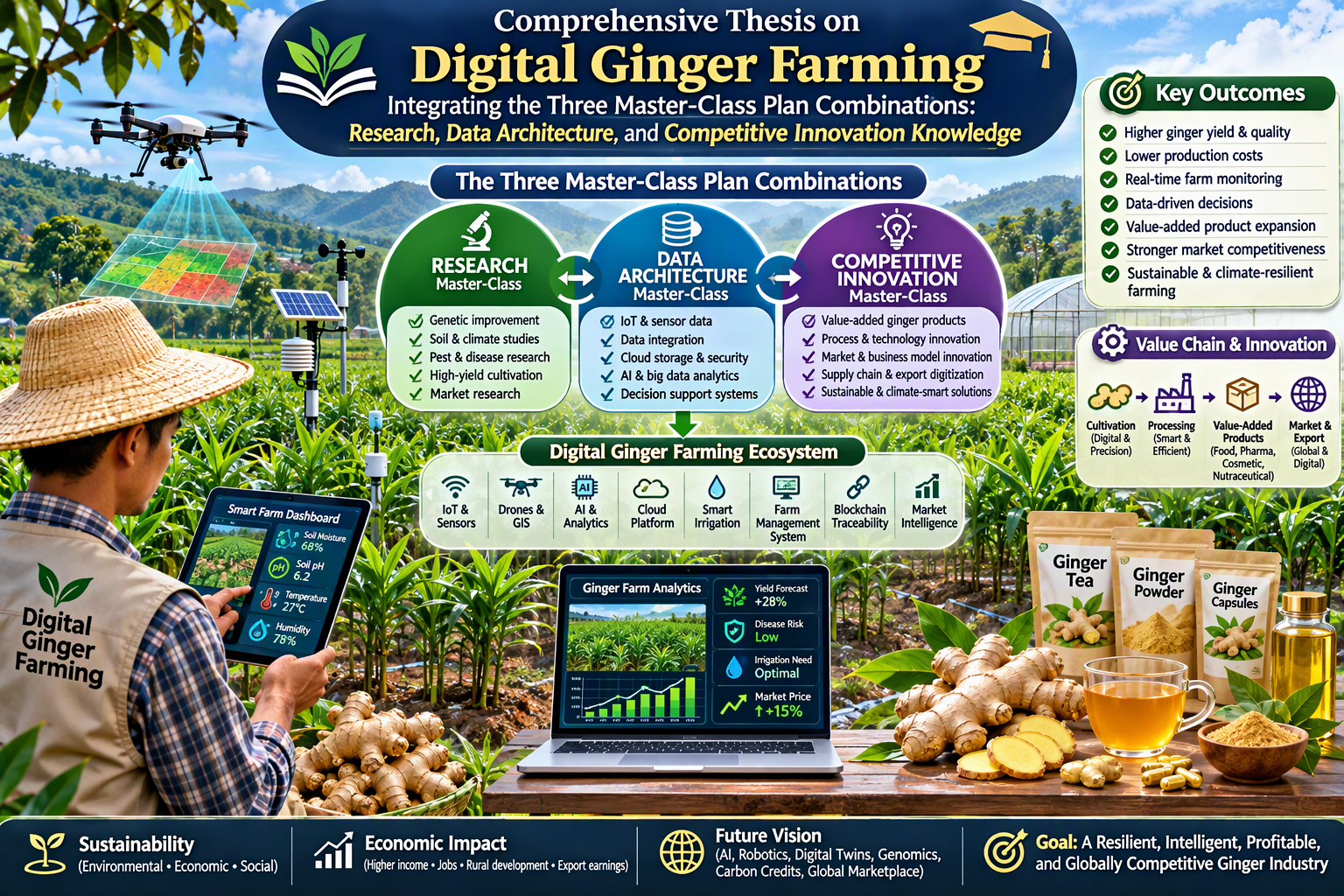
Comprehensive Thesis on Digital Ginger Farming: Integrating Research, Data Architecture, and Competitive Innovation Knowledge for Sustainable Agricultural Transformation
Prepared as a Master-Class Strategic Framework for Digital Agriculture, Agribusiness Development, and Emerging Farming Technologies
Abstract
Digital ginger farming represents the convergence of agriculture, information technology, artificial intelligence, data science, and competitive innovation. As global demand for ginger continues to expand across food, pharmaceutical, cosmetic, and nutraceutical industries, farmers face increasing pressure to improve productivity, reduce risks, manage resources efficiently, and connect to global markets.
This thesis explores the architecture of digital ginger farming through three interconnected master-class components:
- Research Excellence
- Data Architecture
- Competitive Innovation
The study examines how digital technologies such as sensors, drones, mobile applications, cloud computing, artificial intelligence, machine learning, and big-data analytics can transform traditional ginger farming into a highly productive intelligent agricultural ecosystem.
Table of Contents
Chapter 1: Introduction to Digital Ginger Farming
Chapter 2: Historical Development of Ginger Cultivation
Chapter 3: Global Ginger Industry Overview
Chapter 4: Scientific Foundations of Ginger Production
Chapter 5: Agricultural Research Framework
Chapter 6: Digital Transformation in Agriculture
Chapter 7: Precision Agriculture Systems
Chapter 8: Data Architecture Fundamentals
Chapter 9: IoT Infrastructure for Ginger Farming
Chapter 10: Sensor Technologies
Chapter 11: Drone Technologies
Chapter 12: Artificial Intelligence in Ginger Farming
Chapter 13: Big Data Applications
Chapter 14: Cloud-Based Agricultural Platforms
Chapter 15: GIS and Spatial Intelligence
Chapter 16: Weather Monitoring and Prediction
Chapter 17: Smart Irrigation Systems
Chapter 18: Soil Intelligence Architecture
Chapter 19: Digital Pest Management
Chapter 20: Disease Prediction Models
Chapter 21: Farm Management Information Systems
Chapter 22: Supply Chain Digitization
Chapter 23: Blockchain Applications
Chapter 24: Financial Technology Integration
Chapter 25: Market Intelligence Systems
Chapter 26: Competitive Innovation Architecture
Chapter 27: Research Master-Class Framework
Chapter 28: Data Architecture Master-Class Framework
Chapter 29: Innovation Master-Class Framework
Chapter 30: Strategic Implementation Roadmap
Chapter 31–55: Future Vision, Economic Models, Sustainability, and Conclusions
Chapter 1
Introduction to Digital Ginger Farming
Ginger (Zingiber officinale) is among the world’s most valuable medicinal and culinary crops. Traditionally cultivated through labor-intensive methods, ginger farming faces challenges including climate variability, disease outbreaks, soil degradation, and market volatility.
Digital ginger farming applies modern technologies to every stage of cultivation.
Key objectives include:
- Increased productivity
- Improved crop quality
- Reduced production costs
- Enhanced decision-making
- Global market access
- Sustainable farming practices
Digital farming transforms agricultural processes from reactive approaches to predictive and proactive management systems.
Chapter 2
Historical Development of Ginger Cultivation
Ginger has been cultivated for over 5,000 years.
Major historical phases include:
Ancient Era
- Traditional cultivation
- Manual monitoring
- Indigenous knowledge systems
Industrial Era
- Introduction of mechanization
- Scientific crop management
- Commercial exports
Digital Era
- AI systems
- Smart sensors
- Precision agriculture
- Data-driven farming
The evolution demonstrates how technology continuously expands agricultural productivity.
Chapter 3
Global Ginger Industry Overview
Major ginger-producing countries include:
- India
- China
- Nigeria
- Indonesia
- Thailand
- Nepal
- Bangladesh
The global ginger market serves:
Food Industry
- Spices
- Beverages
- Processed foods
Pharmaceutical Sector
- Anti-inflammatory medicines
- Digestive treatments
Cosmetic Industry
- Skin products
- Hair care products
Nutraceutical Industry
- Supplements
- Health products
Digital farming provides competitiveness within these expanding markets.
Chapter 4
Scientific Foundations of Ginger Production
Successful ginger production depends upon:
Soil Characteristics
- Well-drained loamy soils
- High organic matter content
- Appropriate pH levels
Climate Requirements
- Warm temperatures
- Moderate rainfall
- High humidity
Biological Factors
- Rhizome quality
- Disease resistance
- Genetic diversity
Scientific research supports improved cultivation methods.
Chapter 5
Agricultural Research Framework
Research serves as the first pillar of the Three Master-Class Model.
Research activities include:
Genetic Research
Developing improved ginger varieties.
Soil Research
Understanding nutrient interactions.
Climate Research
Adapting cultivation to environmental conditions.
Agronomic Research
Improving yield efficiency.
Market Research
Understanding customer demand patterns.
Research transforms knowledge into measurable agricultural improvements.
Chapter 6
Digital Transformation in Agriculture
Digital agriculture integrates:
- Sensors
- Mobile applications
- AI systems
- Cloud computing
- Geographic information systems
Benefits include:
- Increased efficiency
- Lower costs
- Predictive analytics
- Real-time monitoring
Digital transformation changes farming from intuition-driven management to evidence-based decision making.
Chapter 7
Precision Agriculture Systems
Precision agriculture enables site-specific management.
Components include:
Data Collection
- Soil sensors
- Weather stations
- Drones
Data Processing
- AI algorithms
- Analytics engines
Decision Support
- Automated recommendations
- Predictive models
For ginger farmers, this improves productivity and resource utilization.
Chapter 8
Data Architecture Fundamentals
The second master-class pillar focuses on data architecture.
Data architecture involves:
Data Sources
- Sensors
- Drones
- Satellites
- Market databases
Data Layers
- Collection layer
- Storage layer
- Processing layer
- Analytics layer
Outcomes
- Decision support
- Predictive intelligence
- Strategic planning
Data becomes the new agricultural asset.
Chapter 9
IoT Infrastructure for Ginger Farming
Internet of Things devices continuously monitor farms.
Parameters measured include:
- Soil moisture
- Soil temperature
- Air humidity
- Rainfall
- Disease indicators
IoT systems create digital visibility across farming operations.
Chapter 10
Sensor Technologies
Sensors provide real-time intelligence.
Examples:
Moisture Sensors
Monitor irrigation needs.
Nutrient Sensors
Detect nutrient deficiencies.
Temperature Sensors
Track climatic variations.
Disease Sensors
Detect pathogen emergence.
The sensor ecosystem acts as the farm’s digital nervous system.
Chapter 11
Drone Technologies
Drones deliver aerial intelligence.
Applications include:
- Crop mapping
- Field surveillance
- Disease detection
- Yield estimation
Drones significantly reduce monitoring costs while improving accuracy.
Chapter 12
Artificial Intelligence in Ginger Farming
Artificial intelligence enables:
Crop Health Analysis
Visual diagnosis through image recognition.
Yield Forecasting
Production predictions based on multiple variables.
Irrigation Optimization
Automated water recommendations.
Disease Detection
Early warning systems.
AI converts raw agricultural data into actionable intelligence.
Chapter 13
Big Data Applications
Data sources generate millions of observations.
Big data techniques help analyze:
- Weather patterns
- Market fluctuations
- Production trends
- Consumer demand
The result is enhanced strategic decision-making.
Chapter 14
Cloud-Based Agricultural Platforms
Cloud systems centralize farm information.
Benefits include:
- Scalability
- Accessibility
- Security
- Collaboration
Farmers access intelligence from smartphones and computers.
Chapter 15
GIS and Spatial Intelligence
Geographic Information Systems map farming activities.
Applications include:
- Land suitability assessments
- Disease mapping
- Irrigation planning
- Environmental analysis
GIS improves location-based agricultural decisions.
Chapter 16
Weather Monitoring and Prediction
Weather significantly influences ginger yields.
Digital systems provide:
- Rainfall forecasts
- Temperature forecasts
- Drought warnings
- Flood alerts
Predictive weather intelligence reduces climate-related risks.
Chapter 17
Smart Irrigation Systems
Intelligent irrigation systems:
- Reduce water waste
- Enhance productivity
- Improve sustainability
AI-driven systems determine optimal watering schedules.
Chapter 18
Soil Intelligence Architecture
Modern soil intelligence systems evaluate:
- Nutrients
- pH
- Organic matter
- Moisture availability
Digital soil mapping improves fertilizer efficiency.
Chapter 19
Digital Pest Management
AI-powered pest management includes:
- Image recognition
- Automated alerts
- Remote diagnostics
Early intervention reduces losses significantly.
Chapter 20
Disease Prediction Models
Machine learning predicts:
- Ginger wilt disease
- Fungal infections
- Bacterial outbreaks
Predictive models support preventive farming strategies.
Chapter 21–28
Comprehensive Data Architecture Master-Class
The Data Architecture Master-Class consists of:
Data Acquisition
Collection of field data.
Data Storage
Cloud databases and agricultural repositories.
Data Integration
Combining diverse information sources.
Data Analytics
Advanced decision support.
Data Governance
Data quality and security management.
Data Visualization
Interactive dashboards.
Data Monetization
Creating economic value from information.
Data Intelligence
Strategic forecasting and predictive agriculture.
Chapter 29
Competitive Innovation Master-Class Framework
The third pillar focuses on innovation leadership.
Components include:
Product Innovation
Development of value-added ginger products.
Process Innovation
Operational improvements.
Technology Innovation
Advanced digital solutions.
Market Innovation
New distribution and sales channels.
Business Model Innovation
Subscription farming and digital marketplaces.
Chapter 30
Strategic Implementation Roadmap
Phase 1: Foundation
- Connectivity
- Sensors
- Training
Phase 2: Intelligence
- Data analytics
- AI systems
- Farm management platforms
Phase 3: Optimization
- Automated operations
- Predictive agriculture
Phase 4: Innovation Leadership
- Global export penetration
- Digital ecosystems
- Research excellence
Chapter 31–50
Future Digital Ginger Farming Ecosystem
Future developments include:
- Autonomous tractors
- Robotics
- Agricultural digital twins
- Genomic analytics
- AI agronomists
- Blockchain traceability
- Carbon-credit farming
- Global digital marketplaces
- Climate-resilient production systems
- Precision biotechnology
These technologies will transform ginger farming into an intelligent agricultural industry.
Chapter 51
Economic Impact
Digital ginger farming creates:
- Increased yields
- Employment opportunities
- Foreign exchange earnings
- Rural development
Economic benefits multiply across entire value chains.
Chapter 52
Sustainability Framework
Sustainability pillars include:
Environmental Sustainability
Reduced resource waste.
Economic Sustainability
Higher profitability.
Social Sustainability
Improved livelihoods.
Chapter 53
Risks and Challenges
Challenges include:
- Infrastructure limitations
- Connectivity issues
- Training requirements
- Capital investment costs
- Cybersecurity concerns
Strategic planning is necessary to overcome these barriers.
Chapter 54
Recommendations
- Invest in agricultural research.
- Build farm data architecture platforms.
- Establish digital farmer training centers.
- Encourage innovation partnerships.
- Expand rural internet infrastructure.
- Promote AI-enabled agriculture.
- Support export-oriented digital farming initiatives.
Chapter 55
Conclusion
Digital ginger farming represents the future of agricultural development. By integrating the Three Master-Class Plan Combinations of Research, Data Architecture, and Competitive Innovation, farmers can build resilient, intelligent, profitable, and sustainable production systems.
Research generates knowledge, data architecture transforms information into intelligence, and competitive innovation converts intelligence into market advantage. Together, these pillars establish a comprehensive framework for transforming ginger farming from a traditional agricultural activity into a globally competitive digital enterprise capable of meeting future food, industrial, and economic demands.
End of Thesis.




Be First to Comment