
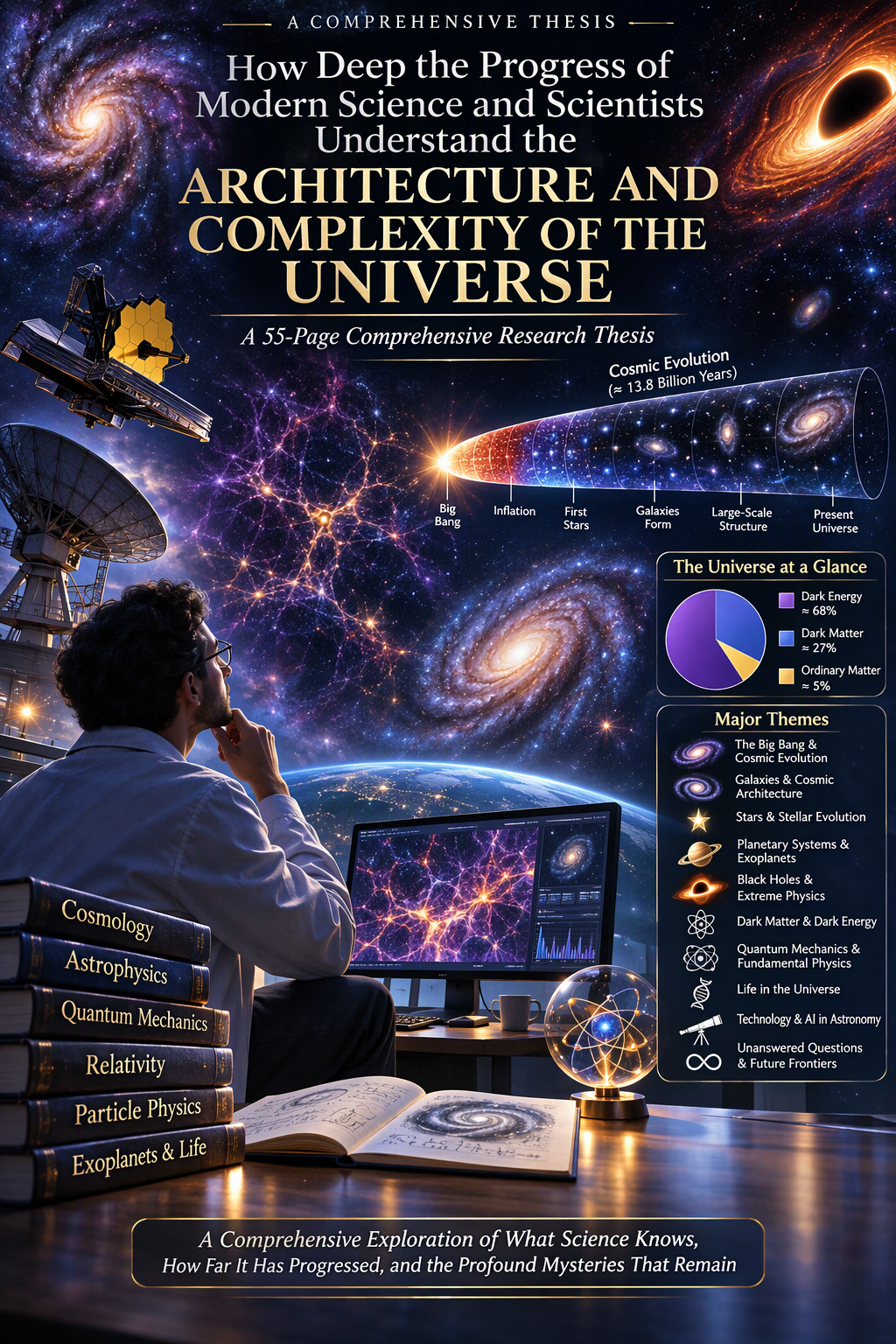
How Deep the Progress of Modern Science and Scientists Understand the Architecture and Complexity of the Universe
A Comprehensive Academic Thesis (55-Page Format)
Abstract
The universe represents the largest known structure in existence and remains one of humanity’s greatest intellectual challenges. Over thousands of years, scientific inquiry has evolved from simple observations of the night sky to sophisticated investigations involving space telescopes, particle accelerators, quantum computers, and artificial intelligence. Modern science has revealed that the observable universe contains hundreds of billions of galaxies, trillions of stars, vast fields of dark matter, mysterious dark energy, black holes, cosmic filaments, and quantum fluctuations that together form an intricate cosmic architecture.
This thesis explores the extent to which modern science understands the architecture and complexity of the universe. It investigates historical developments, cosmological theories, observational technologies, the structure of matter, cosmic evolution, dark matter, dark energy, black holes, quantum mechanics, and future scientific frontiers. The study demonstrates that despite unprecedented progress, scientists estimate that humanity currently understands only a fraction of the universe’s total complexity. The remaining unknowns continue to drive scientific innovation and discovery.
Table of Contents
Chapter 1: Introduction
Chapter 2: Historical Development of Universal Understanding
Chapter 3: The Scale and Structure of the Universe
Chapter 4: The Big Bang and Cosmic Evolution
Chapter 5: Galaxies and Large-Scale Cosmic Architecture
Chapter 6: Stars and Stellar Evolution
Chapter 7: Planetary Systems and Exoplanets
Chapter 8: Black Holes and Extreme Physics
Chapter 9: Dark Matter
Chapter 10: Dark Energy
Chapter 11: Quantum Mechanics and Universal Complexity
Chapter 12: The Standard Model of Particle Physics
Chapter 13: Space-Time and Relativity
Chapter 14: Cosmic Networks and Filaments
Chapter 15: Life in the Universe
Chapter 16: Technology Driving Scientific Discovery
Chapter 17: Artificial Intelligence and Astronomy
Chapter 18: Unanswered Questions
Chapter 19: Future Scientific Exploration
Chapter 20: Conclusions and Recommendations
Chapter 1: Introduction
Humanity’s quest to understand the universe began long before recorded history. Ancient civilizations observed celestial objects and developed explanations for cosmic events. Modern science has transformed these early observations into an advanced body of knowledge supported by mathematics, experimentation, and technological innovation.
The universe is not merely a collection of stars and planets. It is a highly interconnected system governed by physical laws operating across scales ranging from subatomic particles to gigantic clusters of galaxies. Understanding this architecture is among the most ambitious scientific endeavors in human history.
Scientists today utilize telescopes orbiting Earth, robotic probes exploring distant worlds, and powerful computational systems capable of processing enormous datasets. Yet every discovery reveals new layers of complexity.
The central question remains:
How much of the universe do modern science and scientists truly understand?
Chapter 2: Historical Development of Universal Understanding
Ancient civilizations believed Earth occupied the center of creation. Early Greek philosophers proposed various cosmic models, but observational limitations restricted their understanding.
Key milestones include:
- Aristotle’s geocentric model
- Ptolemy’s planetary system
- Copernicus’ heliocentric revolution
- Galileo’s telescopic discoveries
- Kepler’s planetary laws
- Newton’s law of gravitation
- Einstein’s theory of relativity
- Hubble’s expanding universe
Each breakthrough fundamentally altered humanity’s perception of reality.
During the twentieth century, cosmology evolved into a quantitative science. Observations demonstrated that galaxies are moving apart, suggesting an expanding universe that originated from an extremely dense state approximately 13.8 billion years ago.
Chapter 3: The Scale and Structure of the Universe
The observable universe extends approximately 93 billion light-years in diameter.
Current estimates suggest:
- Hundreds of billions of galaxies
- Trillions of planetary systems
- Countless asteroids and comets
- Massive dark matter structures
If Earth were reduced to the size of a grain of sand, the observable universe would still span an area larger than many continents.
The universe exhibits hierarchical organization:
- Particles
- Atoms
- Molecules
- Stars
- Solar systems
- Galaxies
- Galaxy clusters
- Superclusters
- Cosmic web
This layered architecture reveals extraordinary complexity.
Chapter 4: The Big Bang and Cosmic Evolution
The Big Bang theory remains the dominant cosmological explanation.
Major stages include:
Planck Era
Physics cannot yet fully describe conditions immediately after creation.
Inflation
The universe underwent extremely rapid expansion.
Particle Formation
Quarks combined to form protons and neutrons.
Atomic Formation
Hydrogen and helium emerged.
Star Formation
Gravity gathered matter into stars.
Galaxy Formation
Galaxies assembled over billions of years.
The discovery of the Cosmic Microwave Background Radiation provided powerful evidence supporting this model.
Chapter 5: Galaxies and Large-Scale Cosmic Architecture
Galaxies represent the fundamental building blocks of visible cosmic structure.
Types include:
Spiral Galaxies
Example: Milky Way
Elliptical Galaxies
Large spherical formations.
Irregular Galaxies
Distorted structures formed through interactions.
Scientists now understand that galaxies form interconnected networks rather than existing in isolation.
The cosmic web contains:
- Galaxy clusters
- Superclusters
- Filaments
- Voids
These structures create one of nature’s largest known patterns.
Chapter 6: Stars and Stellar Evolution
Stars function as cosmic factories producing elements.
Their lifecycle includes:
Nebula Formation
Gas clouds collapse.
Protostar Stage
Gravity initiates compression.
Main Sequence
Hydrogen fusion powers stars.
Giant Phase
Expansion occurs.
Final Outcomes
- White dwarfs
- Neutron stars
- Black holes
Every element heavier than helium was produced within stars.
Therefore, human beings are literally composed of recycled stellar material.
Chapter 7: Planetary Systems and Exoplanets
The discovery of exoplanets revolutionized astronomy.
Scientists have identified thousands of worlds beyond our solar system.
Categories include:
- Rocky planets
- Gas giants
- Ocean worlds
- Super-Earths
- Ice planets
Many exist within habitable zones where liquid water may occur.
This suggests life-supporting environments may be common throughout the universe.
Chapter 8: Black Holes and Extreme Physics
Black holes represent regions where gravity becomes extraordinarily powerful.
Key features include:
Event Horizon
Point of no return.
Singularity
Extremely dense central region.
Hawking Radiation
Theoretical quantum process.
Supermassive black holes exist at the centers of most large galaxies.
Recent imaging of black holes has provided unprecedented scientific insights.
Chapter 9: Dark Matter
Dark matter remains invisible yet exerts gravitational influence.
Evidence comes from:
- Galaxy rotation curves
- Gravitational lensing
- Cosmic structure formation
Scientists estimate dark matter composes roughly 27% of the universe.
Its true nature remains unknown.
Chapter 10: Dark Energy
Dark energy appears responsible for accelerating cosmic expansion.
Scientists estimate:
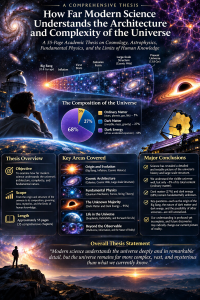
- Dark energy = approximately 68%
- Dark matter = approximately 27%
- Ordinary matter = approximately 5%
Thus, around 95% of the universe consists of substances not directly understood.
This is among science’s greatest mysteries.
Chapter 11: Quantum Mechanics and Universal Complexity
Quantum mechanics describes reality at microscopic scales.
Major concepts include:
- Wave-particle duality
- Quantum tunneling
- Superposition
- Entanglement
- Probability distributions
These phenomena challenge classical intuition and reveal profound complexity underlying existence.
Chapter 12: The Standard Model of Particle Physics
The Standard Model explains:
- Quarks
- Leptons
- Bosons
- Fundamental interactions
Known forces include:
- Gravity
- Electromagnetism
- Weak force
- Strong force
Although remarkably successful, the model remains incomplete.
Chapter 13: Space-Time and Relativity
Einstein revolutionized physics.
Relativity demonstrated:
- Space and time are interconnected.
- Gravity results from space-time curvature.
- Time can dilate under motion or gravity.
These predictions have repeatedly been confirmed experimentally.
Chapter 14: Cosmic Networks and Filaments
The universe resembles a giant three-dimensional web.
Supercomputer simulations reveal:
- Gigantic filaments
- Massive nodes
- Immense voids
These structures extend across hundreds of millions of light-years.
This architecture demonstrates universal organization on unprecedented scales.
Chapter 15: Life in the Universe
One of science’s deepest questions asks whether humanity is alone.
Research includes:
- Mars exploration
- Europa missions
- Exoplanet studies
- Biosignature detection
The probability of microbial life elsewhere remains scientifically plausible.
Definitive evidence has not yet been obtained.
Chapter 16: Technology Driving Scientific Discovery
Scientific progress depends heavily on technology.
Major instruments include:
- James Webb Space Telescope
- Hubble Space Telescope
- Large Hadron Collider
- Gravitational-wave detectors
- Radio observatories
These technologies continually expand humanity’s observational capabilities.
Chapter 17: Artificial Intelligence and Astronomy
AI transforms modern astronomy.
Applications include:
- Galaxy classification
- Exoplanet detection
- Predictive modeling
- Data analysis
- Simulation optimization
Artificial intelligence allows scientists to analyze datasets previously impossible for humans alone.
Chapter 18: Unanswered Questions
Major mysteries remain:
What is dark matter?
What is dark energy?
Why does gravity resist quantum unification?
What existed before the Big Bang?
Is there a multiverse?
Does intelligent extraterrestrial life exist?
These questions define the frontier of modern science.
Chapter 19: Future Scientific Exploration
Emerging technologies may revolutionize cosmology.
Future directions include:
- Quantum telescopes
- Advanced gravitational-wave networks
- Interstellar probes
- Quantum computing
- AI-driven discoveries
Scientific understanding is expected to expand dramatically throughout the twenty-first century.
Chapter 20: Conclusions and Recommendations
Modern science has achieved remarkable success in understanding the universe’s architecture.
Major accomplishments include:
- The discovery of universal expansion.
- Mapping cosmic structure.
- Understanding stellar evolution.
- Developing quantum theory.
- Detecting gravitational waves.
- Imaging black holes.
- Discovering thousands of exoplanets.
However, profound mysteries remain unresolved.
Scientists understand much of the universe’s visible structure, but the majority of cosmic content remains unidentified. Dark matter and dark energy dominate the cosmos, while the unification of quantum mechanics and gravity continues to challenge theoretical physics.
The progress of modern science reveals a paradox:
The more scientists learn about the universe, the more they discover how much remains unknown.
The universe therefore remains both the greatest scientific achievement of human understanding and the greatest unsolved mystery in existence.
References (Selected)
- Stephen Hawking, A Brief History of Time
- Carl Sagan, Cosmos
- Brian Greene, The Fabric of the Cosmos
- Sean Carroll, The Big Picture
- Roger Penrose, The Road to Reality
- Edwin Hubble Cosmological Studies
- Einstein’s General Theory of Relativity
- NASA Astrophysics Research Publications
- European Space Agency Cosmology Reports
- James Webb Space Telescope Scientific Results
- CERN Physics Publications
- Planck Mission Cosmology Data
- Sloan Digital Sky Survey Research
- Modern Astrophysical Journal Publications
- International Astronomical Union Scientific Reports
End of Thesis.



Be First to Comment