
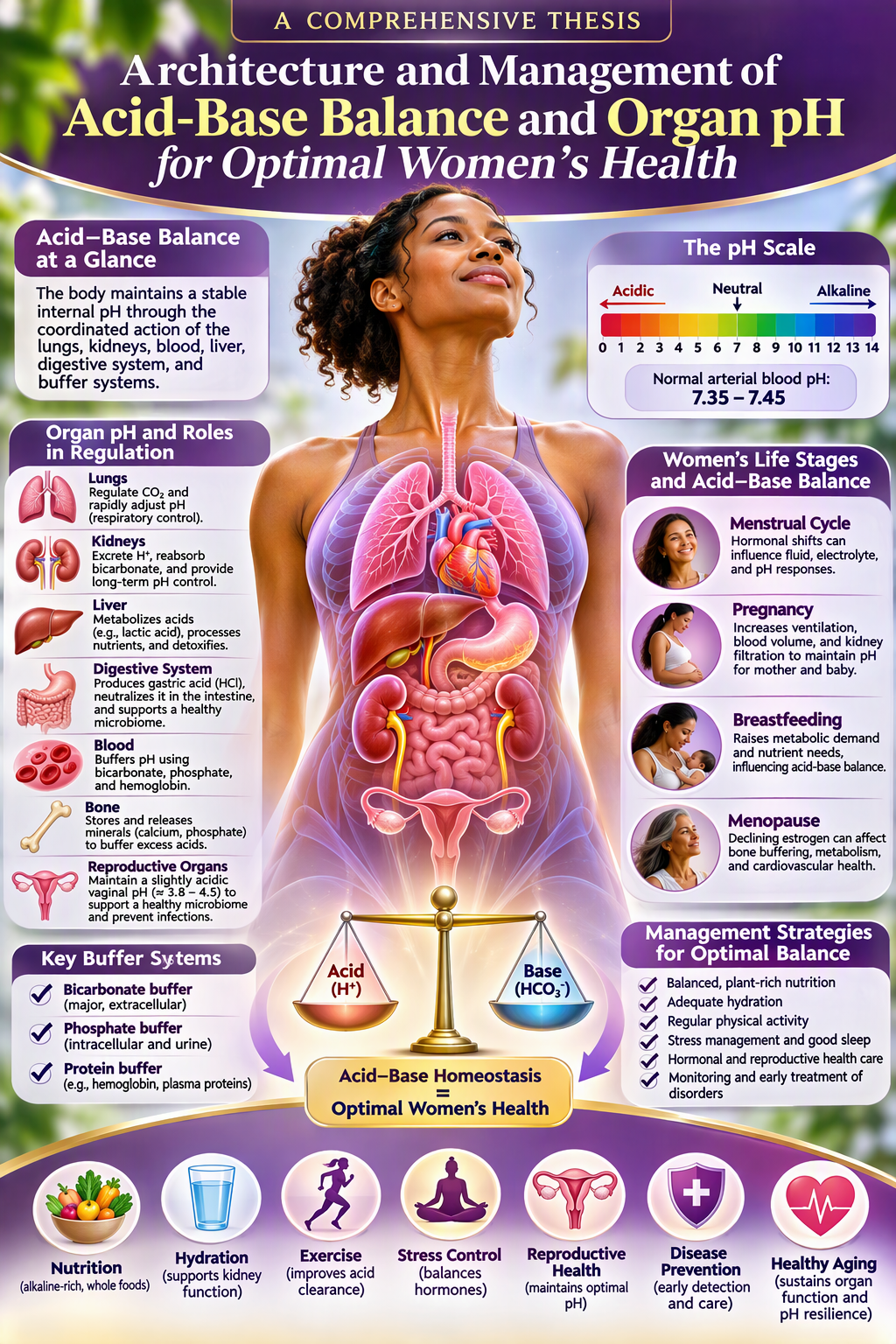
Architecture and Management of Acid-Base Balance and Organ pH for Optimal Women’s Health
Abstract
The maintenance of acid-base balance is one of the most fundamental physiological processes necessary for human survival. In women, proper regulation of body pH influences reproductive health, metabolic efficiency, hormonal balance, cardiovascular function, immune response, mental well-being, and healthy aging. The human body operates within a narrow pH range, where even minor deviations can significantly affect cellular metabolism and organ function. Various organ systems collaborate to maintain acid-base homeostasis, principally the lungs, kidneys, blood, liver, digestive system, skin, and endocrine glands.
This thesis explores the architecture and management of acid-base balance across the organs and tissues of the female body. It examines the physiological mechanisms involved in pH regulation, the relationship between acid-base disturbances and women’s health conditions, and strategies for maintaining optimal biochemical balance through nutrition, hydration, exercise, stress management, and preventive medicine.
Chapter 1: Introduction
Understanding Acid-Base Balance
Acid-base balance refers to the regulation of hydrogen ion concentration within body fluids. The measurement of acidity or alkalinity is expressed through the pH scale ranging from 0 to 14.
- pH below 7 = acidic
- pH 7 = neutral
- pH above 7 = alkaline
Healthy arterial blood maintains a pH between 7.35 and 7.45.
The body constantly produces acids through:
- Cellular metabolism
- Protein digestion
- Exercise
- Hormonal activity
- Immune defense reactions
Without regulatory systems, acid accumulation would rapidly become lethal.
Importance in Women’s Health
Women experience unique physiological challenges due to:
- Menstrual cycles
- Pregnancy
- Breastfeeding
- Menopause
- Hormonal fluctuations
Each stage influences fluid balance, electrolyte levels, and acid-base regulation.
Chapter 2: The Biological Architecture of pH Regulation
Multi-Organ Coordination
Maintaining pH balance involves multiple integrated physiological systems:
Respiratory System
Controls carbon dioxide removal.
Renal System
Regulates bicarbonate conservation and acid excretion.
Circulatory System
Transports buffers and nutrients.
Digestive System
Regulates nutrient absorption and acid secretion.
Endocrine System
Coordinates hormonal regulation.
Cellular System
Provides intracellular buffering mechanisms.
The body functions as a highly sophisticated biochemical network.
Chapter 3: The Chemistry of Acids and Bases
Definition of Acids
Acids release hydrogen ions (H⁺).
Examples:
- Hydrochloric acid
- Lactic acid
- Carbonic acid
Definition of Bases
Bases accept hydrogen ions.
Examples:
- Bicarbonate
- Phosphate compounds
- Protein buffers
Buffer Systems
Buffers prevent rapid pH fluctuations.
Major buffers include:
Bicarbonate Buffer
Primary extracellular buffer.
Phosphate Buffer
Important within cells and urine.
Protein Buffer
Includes hemoglobin and plasma proteins.
Chapter 4: Blood pH Architecture
Blood as the Central Transport Medium
Blood represents approximately 7-8% of body weight.
Functions include:
- Oxygen transport
- Nutrient delivery
- Waste removal
- Hormonal communication
- pH buffering
Hemoglobin Buffer System
Hemoglobin binds hydrogen ions generated during metabolism.
This buffering system protects tissues from acidosis.
Clinical Significance
Abnormal blood pH can result in:
- Fatigue
- Confusion
- Arrhythmias
- Respiratory distress
Chapter 5: Lung Architecture and Acid-Base Regulation
Respiratory pH Control
The lungs regulate carbon dioxide, which combines with water to form carbonic acid.
Reaction:
CO₂ + H₂O ↔ H₂CO₃ ↔ H⁺ + HCO₃⁻
Female Respiratory Physiology
Women’s respiratory function changes with:
- Menstrual cycle
- Pregnancy
- Aging
Progesterone increases respiratory drive during pregnancy, helping maintain fetal oxygen supply.
Respiratory Disorders
Examples include:
- Asthma
- COPD
- Sleep apnea
These disorders can impair acid-base balance.
Chapter 6: Kidney Architecture and pH Homeostasis
The Kidney as the Ultimate Regulator
The kidneys provide long-term pH control.
Functions include:
- Excretion of hydrogen ions
- Reabsorption of bicarbonate
- Production of ammonia buffers
- Electrolyte regulation
Nephron Structure
Each kidney contains roughly one million nephrons.
Components:
- Glomerulus
- Proximal tubule
- Loop of Henle
- Distal tubule
- Collecting duct
Women’s Kidney Health
Risk factors include:
- Recurrent urinary tract infections
- Pregnancy-related hypertension
- Diabetes
Chapter 7: Digestive System and Acid Production
Gastric Acid Secretion
The stomach produces hydrochloric acid.
Functions:
- Protein digestion
- Pathogen destruction
- Mineral absorption
Small Intestine
Neutralizes stomach acid through bicarbonate-rich pancreatic secretions.
Gut Microbiome
Beneficial microbes influence:
- Immune development
- Nutrient metabolism
- Inflammation control
A healthy microbiome contributes indirectly to balanced acid-base physiology.
Chapter 8: Liver Architecture and Metabolic Acidity
The Metabolic Processing Center
The liver:
- Converts nutrients
- Detoxifies wastes
- Produces proteins
- Regulates energy metabolism
Acid Management
The liver manages:
- Lactic acid metabolism
- Amino acid processing
- Ketone synthesis
Liver dysfunction can contribute to metabolic acidosis.
Chapter 9: Female Hormones and pH Regulation
Estrogen
Influences:
- Bone health
- Cardiovascular function
- Cellular hydration
Progesterone
Affects:
- Breathing rate
- Carbon dioxide elimination
Menstrual Cycle Effects
Hormonal fluctuations influence:
- Water retention
- Electrolyte balance
- Metabolic rate
These changes can alter acid-base responses temporarily.
Chapter 10: Pregnancy and Acid-Base Physiology
Maternal Adaptations
Pregnancy creates an additional metabolic burden.
Adaptations include:
- Increased ventilation
- Higher blood volume
- Enhanced kidney filtration
Fetal Considerations
Maintaining maternal blood pH ensures:
- Normal fetal growth
- Placental function
- Oxygen delivery
Chapter 11: Bone as a Mineral Buffer System
Bone Chemistry
Bone stores:
- Calcium
- Magnesium
- Phosphate
Buffering Function
During prolonged acidosis, minerals may be mobilized from bone to neutralize acids.
This can contribute to decreased bone density.
Women’s Bone Health
Postmenopausal women face increased osteoporosis risk due to declining estrogen levels.
Chapter 12: Electrolytes and pH Control
Key electrolytes include:
Sodium
Regulates fluid volume.
Potassium
Essential for cellular function.
Calcium
Supports nerve transmission and muscle contraction.
Magnesium
Acts in more than 300 enzymatic reactions.
Electrolyte disturbances often accompany acid-base disorders.
Chapter 13: Cellular Acid-Base Architecture
Intracellular Regulation
Cells continuously regulate:
- Hydrogen ions
- Electrolytes
- Energy production
Mitochondria
Mitochondria generate ATP.
Optimal pH supports:
- Cellular respiration
- Energy synthesis
- Tissue repair
Chapter 14: Nutrition for Optimal Acid-Base Balance
Alkaline-Producing Foods
Examples:
- Leafy vegetables
- Fruits
- Legumes
- Herbs
Acid-Producing Foods
Examples:
- Processed meat
- Refined sugars
- Excess alcohol
Nutritional Reality
Healthy kidneys and lungs maintain blood pH despite dietary variation.
However, nutritious diets reduce metabolic stress and inflammation.
Chapter 15: Hydration and pH Stability
Water supports:
- Kidney filtration
- Nutrient transport
- Waste elimination
- Temperature regulation
Women typically require consistent hydration to support overall metabolic function.
Chapter 16: Physical Activity and Acid Management
Exercise Physiology
High-intensity exercise increases:
- Lactic acid production
- Oxygen consumption
Adaptive Responses
Regular training improves:
- Oxygen delivery
- Mitochondrial efficiency
- Acid clearance
Chapter 17: Stress, Mental Health and Biochemical Balance
Stress Hormones
Chronic stress elevates:
- Cortisol
- Adrenaline
Metabolic Effects
Stress may contribute to:
- Inflammation
- Oxidative stress
- Sleep disruption
Effective stress management supports physiological stability.
Chapter 18: Acid-Base Disorders in Women
Metabolic Acidosis
Causes:
- Kidney disease
- Severe diarrhea
- Diabetic ketoacidosis
Metabolic Alkalosis
Causes:
- Vomiting
- Excess diuretic use
Respiratory Acidosis
Results from reduced ventilation.
Respiratory Alkalosis
Results from excessive ventilation.
Chapter 19: Menopause and pH Regulation
Menopause produces major hormonal transitions.
Potential consequences include:
- Reduced bone mass
- Increased cardiovascular risk
- Muscle loss
Healthy lifestyle interventions help maintain physiological balance.
Chapter 20: Cardiovascular Health and Acid-Base Homeostasis
The cardiovascular system distributes:
- Oxygen
- Nutrients
- Buffers
Proper circulation supports organ pH regulation and cellular viability.
Chapter 21: Immune Function and Organ pH
Immune cells operate within controlled biochemical environments.
Optimal pH supports:
- Infection defense
- Inflammation control
- Tissue repair
Chapter 22: Aging and Acid-Base Resilience
Aging is associated with:
- Reduced kidney function
- Lower muscle mass
- Increased oxidative stress
Preventive healthcare becomes increasingly important.
Chapter 23: Clinical Assessment Methods
Laboratory Tests
- Arterial blood gases
- Serum electrolytes
- Kidney function tests
- Urinalysis
These assessments help identify acid-base disorders.
Chapter 24: Public Health Implications
Improving acid-base health can contribute to:
- Reduced disease burden
- Better maternal outcomes
- Healthy aging
- Improved quality of life
Chapter 25: Future Research Directions
Emerging fields include:
- Precision medicine
- Genomic influences
- Microbiome science
- Artificial intelligence in metabolic monitoring
These technologies may improve individualized healthcare for women.
Conclusion
The architecture of acid-base balance represents one of the most sophisticated regulatory systems in human physiology. Through coordinated interactions among the lungs, kidneys, blood, liver, digestive tract, endocrine organs, and cellular buffering systems, the body maintains a remarkably stable internal environment. For women, this balance is particularly significant because of unique physiological stages such as menstruation, pregnancy, lactation, and menopause.
Optimal women’s health depends upon maintaining efficient organ function, balanced nutrition, adequate hydration, regular physical activity, stress management, and timely medical care. As scientific understanding advances, new opportunities will emerge to enhance personalized approaches to acid-base management, supporting longer, healthier, and more productive lives for women across all stages of life.
Selected Academic References
- Hall, J. E. Guyton and Hall Textbook of Medical Physiology.
- Boron, W. F., & Boulpaep, E. Medical Physiology.
- Koeppen, B. M. Renal Physiology.
- Ganong, W. F. Review of Medical Physiology.
- National Institutes of Health (NIH) publications on acid-base physiology.
- World Health Organization (WHO) Women’s Health Reports.
- American College of Obstetricians and Gynecologists (ACOG).
- Kidney Disease Improving Global Outcomes (KDIGO) Guidelines.
- Journal of Women’s Health.
- The Lancet Women’s Health Series.




Be First to Comment