
A 28-Page Academic Format
Title Page
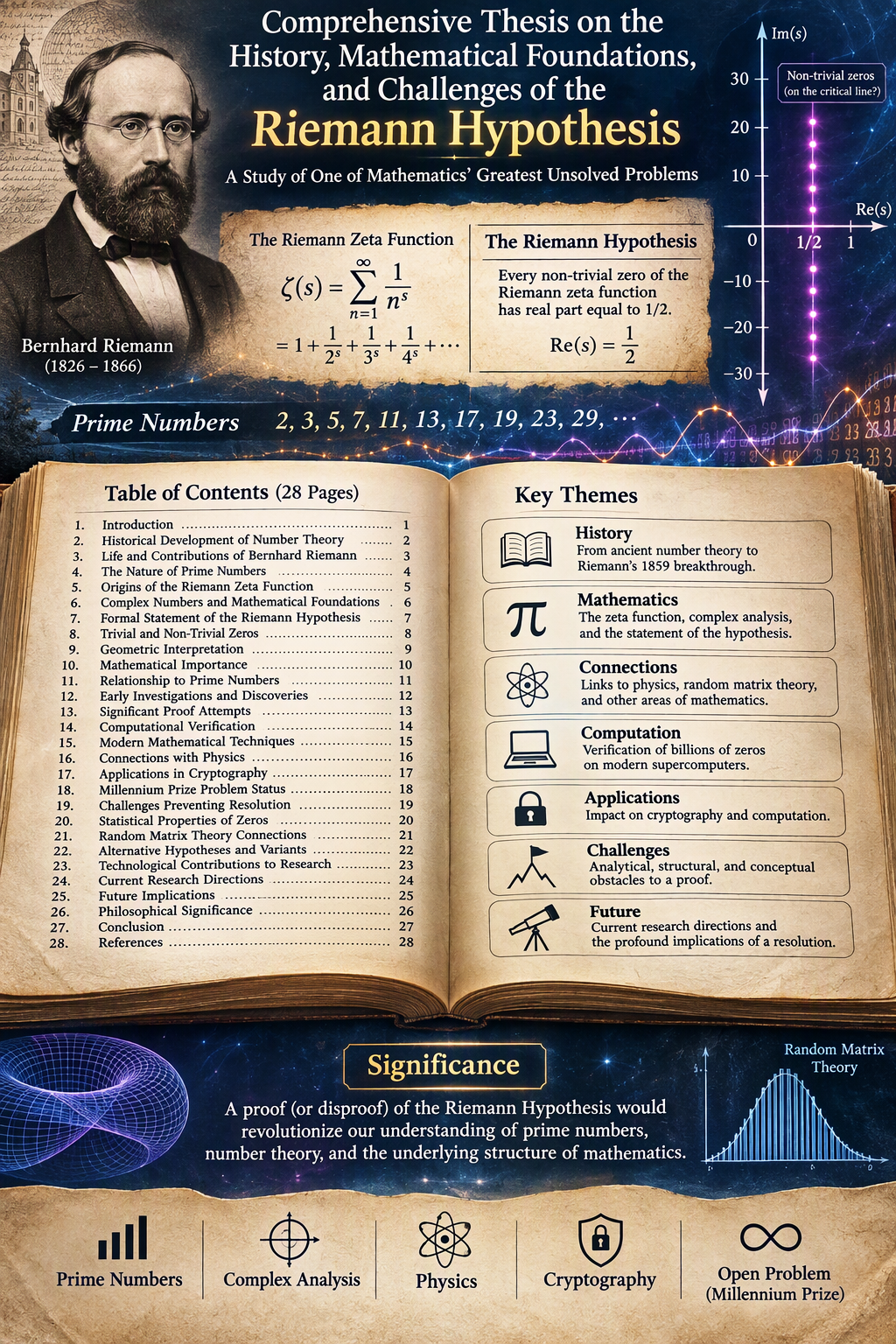
Comprehensive Thesis on the History, Mathematical Foundations, and Challenges of the Riemann Hypothesis
A Study of One of Mathematics’ Greatest Unsolved Problems
Abstract
The Riemann Hypothesis stands as one of the most profound and enduring unsolved problems in mathematics. Proposed by German mathematician Bernhard Riemann in 1859, the hypothesis concerns the distribution of prime numbers and the properties of the Riemann zeta function. More than a century and a half after its formulation, it remains unproven despite extensive efforts by the greatest mathematical minds. The problem occupies a central position in number theory and has influenced fields ranging from cryptography and quantum physics to computer science and complex analysis.
This thesis explores the historical development, mathematical architecture, significance, and principal challenges associated with the Riemann Hypothesis. The study traces the evolution of mathematics leading to Riemann’s revolutionary paper, examines the structure of the zeta function, analyzes attempted proofs, and discusses the implications of both proving and disproving the hypothesis. The work also reviews modern computational efforts and future research directions.
Keywords: Riemann Hypothesis, Prime Numbers, Number Theory, Mathematics, Zeta Function, Complex Analysis, Cryptography.
Table of Contents
- Introduction
- Historical Development of Number Theory
- Life and Contributions of Bernhard Riemann
- The Nature of Prime Numbers
- Origins of the Riemann Zeta Function
- Complex Numbers and Mathematical Foundations
- Formal Statement of the Riemann Hypothesis
- Trivial and Non-Trivial Zeros
- Geometric Interpretation
- Mathematical Importance
- Relationship to Prime Numbers
- Early Investigations and Discoveries
- Significant Proof Attempts
- Computational Verification
- Modern Mathematical Techniques
- Connections with Physics
- Applications in Cryptography
- Millennium Prize Problem Status
- Challenges Preventing Resolution
- Statistical Properties of Zeros
- Random Matrix Theory Connections
- Alternative Hypotheses and Variants
- Technological Contributions to Research
- Current Research Directions
- Future Implications
- Philosophical Significance
- Conclusion
- References
Chapter 1: Introduction
The quest to understand prime numbers has fascinated mathematicians for over two thousand years. Prime numbers, defined as positive integers greater than one that are divisible only by one and themselves, appear simple in concept yet possess extraordinary complexity in their distribution among natural numbers.
At the center of this mystery lies the Riemann Hypothesis, often described as the most important unsolved problem in mathematics. The hypothesis provides a remarkable prediction concerning the location of specific solutions, known as zeros, of the Riemann zeta function.
The significance of the problem extends far beyond academic curiosity. Modern cryptographic systems, scientific modeling techniques, and fundamental mathematical theories rely on concepts closely connected to prime numbers and their distribution.
The Riemann Hypothesis has resisted solution despite over 165 years of investigation. The Clay Mathematics Institute has designated it one of seven Millennium Prize Problems and offers a one-million-dollar reward for a correct proof.
Chapter 2: Historical Development of Number Theory
The origins of number theory can be traced to ancient civilizations.
The Greeks were among the first to study numbers systematically. Euclid, around 300 BCE, produced one of the earliest proofs demonstrating that infinitely many prime numbers exist.
Centuries later, mathematicians such as Pierre de Fermat, Leonhard Euler, Carl Friedrich Gauss, and Adrien-Marie Legendre expanded humanity’s understanding of number theory.
Euler made a groundbreaking discovery by linking prime numbers to infinite series. His work laid the foundation for mathematical structures later essential to Riemann’s investigations.
Gauss introduced methods for estimating the frequency of prime numbers, leading to conjectures that would eventually inspire Riemann’s revolutionary insights.
Chapter 3: Life and Contributions of Bernhard Riemann
Georg Friedrich Bernhard Riemann was born in Germany in 1826.
Despite growing up in modest circumstances, he demonstrated exceptional mathematical talent. He studied under Carl Friedrich Gauss at the University of Göttingen.
Riemann’s contributions transformed numerous mathematical disciplines, including:
- Differential geometry
- Complex analysis
- Mathematical physics
- Number theory
In 1859, Riemann published a brief nine-page paper entitled On the Number of Prime Numbers Less Than a Given Magnitude. Although short, this paper changed the course of mathematical history.
Within it appeared the now-famous Riemann Hypothesis.
Chapter 4: The Nature of Prime Numbers
Prime numbers are often referred to as the atoms of arithmetic because every positive integer can be uniquely factored into primes.
Examples include:
2, 3, 5, 7, 11, 13, 17, 19, 23, 29.
As numbers become larger, primes appear less frequently. However, no simple formula perfectly predicts their occurrence.
Understanding the distribution of prime numbers remains one of mathematics’ deepest challenges.
The apparent randomness of primes conceals subtle patterns that mathematicians continue to investigate.
Chapter 5: Origins of the Riemann Zeta Function
The zeta function emerged from studies of infinite series.
Euler considered:
ζ(s) = 1 + 1/2^s + 1/3^s + 1/4^s + …
This function initially appeared meaningful only for certain values of s.
Riemann extended the concept into the complex plane using sophisticated analytical techniques.
The resulting function became one of the most important mathematical objects ever studied.
Chapter 6: Complex Numbers and Mathematical Foundations
The Riemann Hypothesis relies heavily on complex numbers.
A complex number consists of:
z = a + bi
where:
- a = real part
- b = imaginary part
- i = √(-1)
Complex numbers allow mathematicians to describe mathematical structures impossible to represent using ordinary real numbers alone.
Riemann’s analytical extension of the zeta function depends entirely on complex-variable theory.
Chapter 7: Formal Statement of the Riemann Hypothesis
The hypothesis states:
Every non-trivial zero of the Riemann zeta function has real part equal to 1/2.
Symbolically:
Re(s) = 1/2
for every non-trivial zero.
This statement appears deceptively simple.
However, proving it has challenged mathematicians for generations.
Chapter 8: Trivial and Non-Trivial Zeros
The zeta function possesses two categories of zeros.
Trivial Zeros
These occur at:
-2, -4, -6, -8, …
Their existence is well understood.
Non-Trivial Zeros
These occur within the critical strip:
0 < Re(s) < 1
The hypothesis claims all such zeros lie precisely on a vertical line:
Re(s)=1/2
known as the Critical Line.
Chapter 9: Geometric Interpretation
Visualizations of the zeta function reveal an extraordinarily intricate landscape.
The critical strip serves as a region in the complex plane where all non-trivial zeros reside.
The Riemann Hypothesis predicts perfect alignment along a central axis.
The geometric elegance of this pattern suggests the existence of deep mathematical symmetry.
Chapter 10: Mathematical Importance
The importance of the hypothesis cannot be overstated.
Its proof would:
- Refine estimates of prime number distributions
- Strengthen numerous mathematical theorems
- Improve understanding of arithmetic structures
- Advance computational number theory
Thousands of mathematical results have been proven assuming the hypothesis is true.
Chapter 11: Relationship to Prime Numbers
Prime numbers and zeta zeros are intimately connected.
Every fluctuation in prime distribution corresponds to behavior within the zeta function.
The hypothesis provides the most accurate known description of these fluctuations.
A proof would effectively unlock deeper understanding of prime number behavior.
Chapter 12: Early Investigations and Discoveries
Following Riemann’s paper, several generations of mathematicians examined his conjecture.
Notable contributors included:
- Jacques Hadamard
- Charles de la Vallée-Poussin
- G. H. Hardy
- John Littlewood
In 1896, Hadamard and de la Vallée-Poussin independently proved the Prime Number Theorem.
Their work confirmed some predictions associated with Riemann’s theory.
Chapter 13: Significant Proof Attempts
Many claimed proofs have emerged.
None have survived rigorous verification.
Common challenges include:
- Logical gaps
- Analytical errors
- Unsupported assumptions
- Computational limitations
The difficulty of the problem continues to astonish experts.
Chapter 14: Computational Verification
Modern supercomputers have dramatically expanded verification efforts.
Trillions of numerical calculations have been performed.
Billions of non-trivial zeros have been tested.
Every observed zero lies exactly where the hypothesis predicts.
However, computational verification can never replace a general proof.
Chapter 15: Modern Mathematical Techniques
Researchers currently employ:
Analytic Number Theory
Studies properties of integers using advanced analysis.
Algebraic Geometry
Examines geometric structures connected to equations.
Spectral Theory
Links eigenvalues and mathematical operators.
Harmonic Analysis
Investigates wave-like mathematical phenomena.
These disciplines contribute essential tools in the search for a proof.
Chapter 16: Connections with Physics
Unexpected connections have emerged between the Riemann Hypothesis and physics.
Areas include:
- Quantum mechanics
- Chaos theory
- Statistical mechanics
- String theory
Certain energy-level distributions in quantum systems resemble zeta zero distributions.
This surprising relationship suggests deeper universal principles.
Chapter 17: Applications in Cryptography
Cryptography depends significantly on prime numbers.
Internet security protocols employ large prime-based algorithms.
Although current encryption systems do not require proof of the Riemann Hypothesis, improved understanding of primes could influence future cryptographic designs.
Chapter 18: Millennium Prize Problem Status
In 2000, the Clay Mathematics Institute designated the Riemann Hypothesis as one of seven Millennium Prize Problems.
Prize value:
US$1,000,000
Requirements:
- Complete proof
- Peer review verification
- Acceptance by mathematical community
No solution has yet met these requirements.
Chapter 19: Challenges Preventing Resolution
Major obstacles include:
Infinite Complexity
The hypothesis concerns infinitely many zeros.
Analytical Barriers
Tools capable of addressing all cases simultaneously remain unknown.
Hidden Structures
Researchers suspect undiscovered mathematical frameworks may be necessary.
Computational Limitations
No matter how powerful computers become, finite verification remains insufficient.
Chapter 20: Statistical Properties of Zeros
The zeros exhibit remarkable statistical regularity.
Patterns resemble eigenvalue distributions from random matrices.
Yet no complete explanation exists.
Understanding these statistical properties remains central to ongoing research.
Chapter 21: Random Matrix Theory Connections
Random Matrix Theory emerged in nuclear physics.
Researchers later discovered extraordinary agreement between matrix eigenvalues and zeta zeros.
This connection represents one of the most fascinating developments in modern mathematics.
Many experts believe it offers clues toward a future proof.
Chapter 22: Alternative Hypotheses and Variants
Several generalized forms exist.
Examples include:
- Generalized Riemann Hypothesis
- Grand Riemann Hypothesis
- Selberg-class conjectures
These broader frameworks expand the original problem into wider mathematical territories.
Chapter 23: Technological Contributions to Research
Advanced technologies support modern investigations.
These include:
- Supercomputers
- Artificial Intelligence
- Symbolic algebra software
- Distributed computing networks
Technology accelerates experimentation but has not yet delivered a proof.
Chapter 24: Current Research Directions
Modern researchers explore:
- Quantum interpretations
- Geometric frameworks
- Algebraic structures
- Spectral analysis approaches
- Noncommutative geometry
Progress continues steadily despite the absence of a breakthrough.
Chapter 25: Future Implications
A proof would produce transformative consequences.
Potential outcomes include:
- Enhanced mathematical certainty
- Improved algorithms
- New cryptographic insights
- Deeper understanding of fundamental structures
A disproof would be equally revolutionary.
Chapter 26: Philosophical Significance
The hypothesis raises profound philosophical questions.
Why do prime numbers appear organized despite seeming randomness?
Do fundamental mathematical truths exist independently of human thought?
The Riemann Hypothesis occupies a unique position at the boundary between discovery and mystery.
Chapter 27: Conclusion
The Riemann Hypothesis remains one of humanity’s greatest intellectual challenges.
Since its proposal in 1859, the conjecture has inspired generations of mathematicians and fueled major developments throughout modern mathematics.
The hypothesis forms a bridge connecting prime numbers, complex analysis, geometry, quantum physics, and computer science.
Despite extensive theoretical advances and computational verification of vast numbers of zeros, a complete proof remains elusive.
Whether proven tomorrow or centuries from now, the eventual resolution of the Riemann Hypothesis will undoubtedly rank among the greatest achievements in mathematical history. Its influence has already transformed the field, and its final solution promises to deepen humanity’s understanding of the mathematical universe.
References
- Riemann, B. (1859). On the Number of Prime Numbers Less Than a Given Magnitude.
- Edwards, H. M. Riemann’s Zeta Function.
- Derbyshire, J. Prime Obsession.
- Bombieri, E. The Riemann Hypothesis.
- Titchmarsh, E. C. Theory of the Riemann Zeta Function.
- Borwein, P. et al. Computational Perspectives on the Riemann Hypothesis.
- Clay Mathematics Institute. Millennium Prize Problems.
- Conrey, J. B. The Riemann Hypothesis.
- Hardy, G. H. Divergent Series and Number Theory Papers.
- Ivić, A. The Riemann Zeta-Function: Theory and Applications.




Be First to Comment