
Including AI Parameters, Components, Architectures & Full Historical Evolution
1. Executive Summary
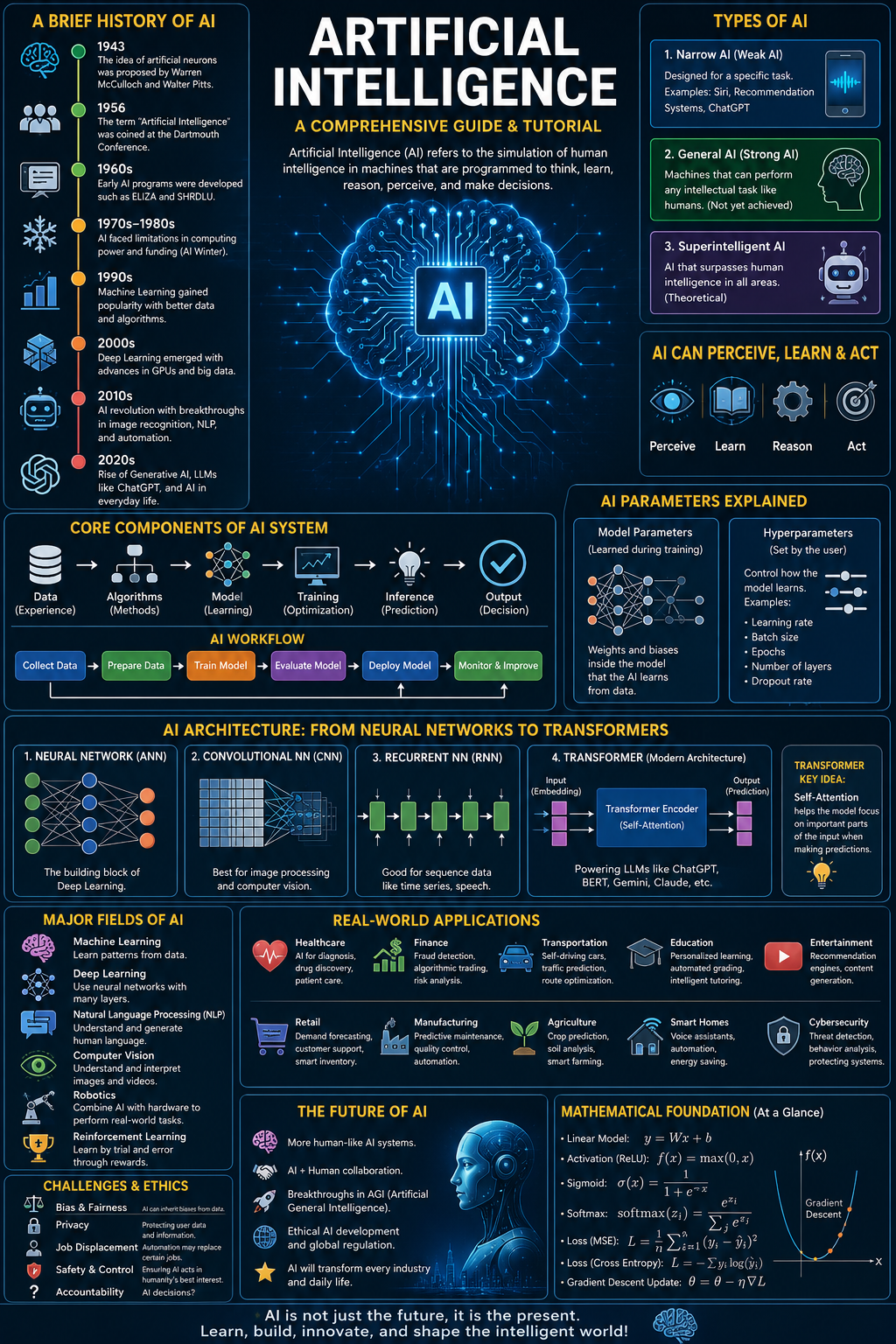
Artificial Intelligence (AI) is the science and engineering of building machines capable of performing tasks that typically require human intelligence. These tasks include reasoning, learning, perception, decision‑making, language understanding, and problem‑solving. Modern AI is powered by mathematical models, massive datasets, and computational architectures that allow machines to learn patterns and make predictions.
This article provides a complete, simplified yet comprehensive explanation of AI fundamentals, including:
- What AI is and how it works
- Key parameters and components
- AI system architecture
- Machine learning and deep learning
- Neural networks and model training
- Real‑world applications
- A full historical timeline from the 1940s to today
2. Introduction to Artificial Intelligence
Artificial Intelligence refers to systems designed to mimic human cognitive functions. At its core, AI is built on three pillars:
- Data — the information used to train the system
- Algorithms — the mathematical rules that process the data
- Computing Power — hardware that enables large‑scale calculations
AI is not a single technology but a collection of subfields:
- Machine Learning (ML)
- Deep Learning (DL)
- Natural Language Processing (NLP)
- Computer Vision (CV)
- Robotics
- Expert Systems
- Reinforcement Learning
3. Types of AI
3.1 Narrow AI (Weak AI)
Designed for a specific task (e.g., ChatGPT, Siri, Google Maps).
3.2 General AI (AGI)
A hypothetical AI that can perform any intellectual task a human can.
3.3 Superintelligent AI (ASI)
A theoretical AI that surpasses human intelligence in all domains.
4. AI Parameters: The Building Blocks of Intelligence
AI parameters are the internal numerical values that a model learns during training. They determine how the model behaves, predicts, and generalizes.
4.1 What Are Parameters?
Parameters are weights and biases inside a neural network. They adjust during training to reduce error.
4.2 Why Parameters Matter
- More parameters → more learning capacity
- Too many parameters → overfitting
- Too few parameters → underfitting
4.3 Examples of Parameter Counts
- Early models (2012): 60 million parameters
- GPT‑3 (2020): 175 billion parameters
- GPT‑4‑class models: estimated 1+ trillion parameters
4.4 Hyperparameters vs Parameters
- Parameters are learned automatically
- Hyperparameters are set manually (e.g., learning rate, batch size)
5. Core Components of an AI System
5.1 Data Pipeline
- Data collection
- Data cleaning
- Data labeling
- Data augmentation
- Data storage
5.2 Model Architecture
The structure of the neural network (layers, nodes, connections).
5.3 Training Process
- Forward propagation
- Loss calculation
- Backpropagation
- Optimization
5.4 Inference Engine
Runs the trained model to make predictions.
5.5 Evaluation Metrics
- Accuracy
- Precision
- Recall
- F1‑score
- ROC‑AUC
6. AI Architecture Explained (Simplified)
AI architecture refers to how the model is structured internally. Below are the major architectures.
6.1 Neural Networks (NNs)
Inspired by the human brain. Consist of:
- Input layer
- Hidden layers
- Output layer
Each layer contains neurons connected by weighted edges.
6.2 Convolutional Neural Networks (CNNs)
Used for images and video. They detect patterns like edges, shapes, and textures.
6.3 Recurrent Neural Networks (RNNs)
Used for sequences (text, speech, time‑series). Variants include LSTM and GRU.
6.4 Transformers (Modern AI Architecture)
The architecture behind ChatGPT, Gemini, Claude, etc.
Key features:
- Self‑attention mechanism
- Parallel processing
- Long‑range context understanding
Transformers revolutionized AI because they scale extremely well with data and computing power.
7. Machine Learning: The Engine of AI
Machine Learning (ML) is the method by which AI systems learn patterns from data.
7.1 Types of Machine Learning
- Supervised Learning — labeled data
- Unsupervised Learning — unlabeled data
- Reinforcement Learning — reward‑based learning
- Semi‑Supervised Learning — mix of labeled and unlabeled
- Self‑Supervised Learning — model generates its own labels
8. Deep Learning: The Modern Breakthrough
Deep Learning uses multi‑layer neural networks to learn complex patterns.
Why Deep Learning Works:
- Massive datasets
- Powerful GPUs/TPUs
- Advanced architectures (Transformers)
- Efficient optimization algorithms
Deep Learning powers:
- Chatbots
- Self‑driving cars
- Facial recognition
- Medical imaging
- Translation systems
9. Training an AI Model (Step‑by‑Step Tutorial)
Step 1: Collect Data
Images, text, audio, or numerical data.
Step 2: Preprocess Data
Normalize, clean, tokenize, or encode.
Step 3: Choose a Model Architecture
CNN, RNN, Transformer, etc.
Step 4: Initialize Parameters
Random weights and biases.
Step 5: Forward Pass
Model makes predictions.
Step 6: Compute Loss
Difference between prediction and truth.
Step 7: Backpropagation
Adjust parameters to reduce error.
Step 8: Optimization
Use algorithms like Adam, SGD.
Step 9: Evaluation
Test on unseen data.
Step 10: Deployment
Serve the model via API or embedded system.
10. Real‑World Applications of AI
10.1 Business & Finance
- Fraud detection
- Algorithmic trading
- Customer segmentation
10.2 Healthcare
- Disease diagnosis
- Drug discovery
- Medical imaging
10.3 Transportation
- Autonomous vehicles
- Route optimization
10.4 Communication
- Chatbots
- Translation
- Speech recognition
10.5 Creative Industries
- Music generation
- Image creation
- Video editing
11. Full History of AI (From Inception to Today)
1940s–1950s: Foundations
- Alan Turing proposes the idea of machine intelligence
- First neural network model (Perceptron)
- Dartmouth Conference (1956) — AI becomes a field
1960s–1970s: Symbolic AI
- Expert systems
- Logic‑based reasoning
1980s: Neural Network Revival
- Backpropagation discovered
- Increased interest in machine learning
1990s: Statistical AI
- Support Vector Machines
- Bayesian networks
2000s: Big Data Era
- Explosion of internet data
- Improved computing power
2012: Deep Learning Breakthrough
- AlexNet wins ImageNet competition
- Start of modern AI revolution
2017: Transformers Introduced
- Google publishes “Attention Is All You Need”
- Foundation of GPT, Claude, Gemini
2020s: Generative AI Era
- GPT‑3, GPT‑4
- Diffusion models (image generation)
- AI copilots and assistants
- Rapid global adoption
12. Future of AI
AI is moving toward:
- Autonomous decision‑making
- Human‑AI collaboration
- AGI research
- AI‑powered robotics
- Personalized AI assistants
13. Conclusion
Artificial Intelligence has evolved from simple logic‑based systems to trillion‑parameter models capable of understanding language, generating content, and solving complex problems. Its architecture, parameters, and components form a sophisticated ecosystem that continues to grow rapidly.
AI is no longer a futuristic concept — it is the backbone of modern innovation.
14. Optional: One‑Page Summary (For Your Executive Reports)
AI is the science of building machines that think and learn like humans. It relies on data, algorithms, and computing power. Modern AI uses neural networks and transformer architectures with billions of parameters. AI applications span healthcare, finance, transport, communication, and creativity. Its history stretches from Turing (1940s) to today’s generative AI revolution.



Be First to Comment