
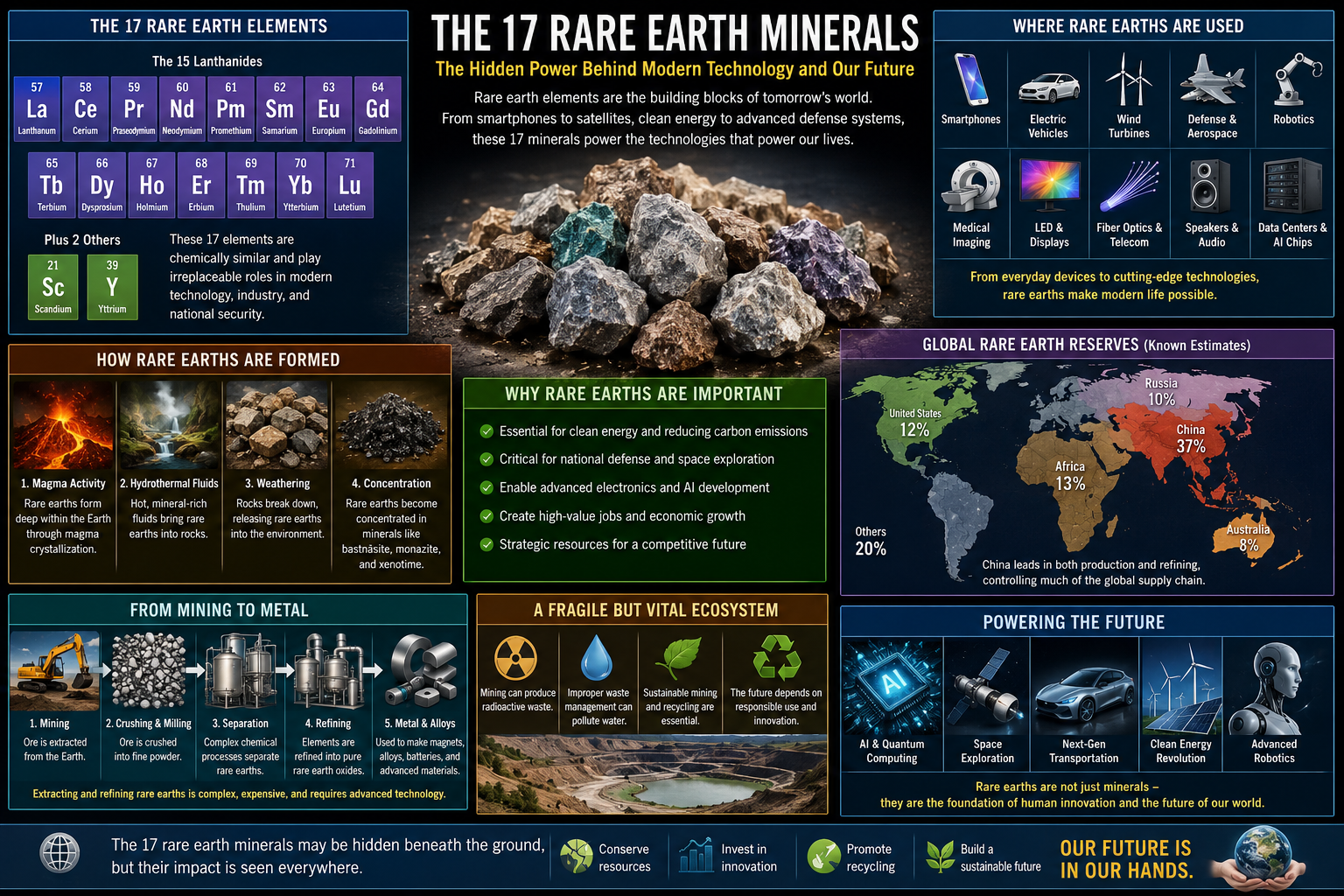
THE ANATOMY, HISTORY, TECHNOLOGY, AND FUTURE SIGNIFICANCE OF THE 17 RARE EARTH MINERALS
PAGE 1 — Title Page (Not counted in content)
Title: The Strategic Anatomy and Global Significance of the 17 Rare Earth Minerals: History, Structure, Applications, and Future Outlook Author: [Your Name] Date: 2026
PAGE 2 — Abstract
Rare earth minerals — a group of 17 chemically similar elements — have evolved from obscure geological curiosities into the backbone of modern technological civilization. Their discovery in the late 18th century in Sweden marked the beginning of a scientific journey that now underpins global telecommunications, renewable energy, defense systems, precision agriculture, and advanced manufacturing. Despite their name, these elements are not rare in abundance but rare in concentrated, economically extractable deposits. Their unique magnetic, luminescent, and catalytic properties make them indispensable to 21st‑century innovation. This thesis provides a comprehensive exploration of their anatomy, historical evolution, technological applications, geopolitical relevance, environmental implications, and future significance.
PAGE 3 — Introduction
Rare earth minerals (REMs) are naturally occurring substances containing one or more of the 17 rare earth elements (REEs). These include the lanthanides plus scandium and yttrium. Although abundant in Earth’s crust, they are rarely found in concentrated deposits, making extraction complex and costly. Their importance has surged due to their role in electronics, renewable energy, agriculture, national security, and global supply chains.
PAGE 4 — Chapter 1: Defining the 17 Rare Earth Minerals
1.1 The Full List of Rare Earth Elements
According to the International Gem Society and Farmonaut, the 17 REEs are: Light REEs: La, Ce, Pr, Nd, Pm, Sm Heavy REEs: Eu, Gd, Tb, Dy, Ho, Er, Tm, Yb, Lu Plus Scandium (Sc) and Yttrium (Y).
1.2 Why They Are “Rare”
They are not rare in quantity — cerium is more abundant than copper — but rare in extractable concentrations.
PAGE 5 — Chapter 2: The Anatomy of Rare Earth Minerals
2.1 Chemical Structure
- All REEs share similar electron configurations (4f‑orbitals).
- Their similar ionic radii make separation difficult.
2.2 Physical Properties
- High magnetic strength (Nd, Dy).
- Strong luminescence (Eu, Tb).
- High thermal stability (Gd, Sm).
2.3 Mineral Hosts
Common ores include:
- Bastnäsite
- Monazite
- Xenotime
PAGE 6 — Chapter 3: Historical Evolution of Rare Earth Minerals
3.1 The Ytterby Mine: Birthplace of REEs
The story begins in 1787 when Carl Axel Arrhenius discovered a black mineral near Ytterby, Sweden.
3.2 Early Discoveries (1787–1850)
- 1794: Johan Gadolin identifies yttria, the first REE compound.
- 1803: Cerium isolated independently in Sweden and Germany.
- 1839–1843: Mosander discovers lanthanum, terbium, erbium, and splits didymium into Pr and Nd.
PAGE 7 — Chapter 4: 20th‑Century Expansion
4.1 Rise of Industrial Applications
- Color TVs used europium for red phosphors.
- Samarium‑cobalt magnets revolutionized motors.
4.2 Discovery of Radioactivity and Promethium
Promethium, extremely rare and radioactive, has no major commercial use.
PAGE 8 — Chapter 5: Modern Technological Revolution
5.1 Rare Earths in Electronics
- Europium enables red color in screens.
- Neodymium powers speakers and headphones.
5.2 Telecommunications
- Erbium‑doped fiber amplifiers (EDFAs) enable long‑distance internet.
5.3 Medical Technology
- Gadolinium is essential in MRI contrast agents.
PAGE 9 — Chapter 6: Renewable Energy and Green Technology
6.1 Wind Turbines
Nd‑Fe‑B magnets are used in high‑efficiency turbines.
6.2 Electric Vehicles
- Neodymium and dysprosium are critical for EV motors.
- Lanthanum used in battery alloys.
6.3 Solar and Hydrogen Systems
- Cerium used in catalytic converters and solar glass polishing.
PAGE 10 — Chapter 7: Agriculture and Precision Farming
Farmonaut reports that rare earth minerals are increasingly used in:
- Soil nutrient sensors
- Satellite‑driven agricultural monitoring
- Machinery requiring high‑strength magnets
PAGE 11 — Chapter 8: National Security and Defense
8.1 Military Applications
- Guidance systems (Nd, Dy)
- Radar (Y, Eu)
- Jet engines (HREE alloys)
8.2 Strategic Importance
“17 rare earth minerals enable over 90% of global advanced technology production by 2026.”
PAGE 12 — Chapter 9: Global Supply Chains
9.1 China’s Dominance
China controls most of the world’s processing capacity.
9.2 Geopolitical Tensions
Rare earths influence trade wars and international diplomacy.
PAGE 13 — Chapter 10: Environmental Challenges
10.1 Mining Impacts
- Radioactive waste
- Soil and water contamination
10.2 Sustainability Concerns
- Need for recycling
- Cleaner extraction technologies
PAGE 14 — Chapter 11: Extraction and Processing Tutorial
11.1 Step‑by‑Step Tutorial
- Prospecting — locating bastnäsite, monazite, xenotime.
- Mining — open‑pit or underground.
- Crushing & Milling — reducing ore size.
- Chemical Separation — solvent extraction, ion exchange.
- Oxide Production — converting to REE oxides.
- Metal Refining — electrolysis or metallothermic reduction.
PAGE 15 — Chapter 12: Individual Element Profiles (Part 1)
12.1 Lanthanum (La)
- Used in camera lenses, EV batteries.
12.2 Cerium (Ce)
- Most abundant REE; used in catalysts.
12.3 Praseodymium (Pr)
- Used in aircraft engines.
12.4 Neodymium (Nd)
- Strongest permanent magnets.
PAGE 16 — Chapter 12: Individual Element Profiles (Part 2)
12.5 Promethium (Pm)
- Radioactive; limited use.
12.6 Samarium (Sm)
- High‑temperature magnets.
12.7 Europium (Eu)
- Red phosphors in screens.
PAGE 17 — Chapter 12: Individual Element Profiles (Part 3)
12.8 Gadolinium (Gd)
- MRI contrast agents.
12.9 Terbium (Tb)
- Green phosphors.
12.10 Dysprosium (Dy)
- Heat‑resistant magnets.
PAGE 18 — Chapter 12: Individual Element Profiles (Part 4)
12.11 Holmium (Ho)
- Strong magnetic properties.
12.12 Erbium (Er)
- Fiber‑optic amplifiers.
12.13 Thulium (Tm)
- Portable X‑ray devices.
PAGE 19 — Chapter 12: Individual Element Profiles (Part 5)
12.14 Ytterbium (Yb)
- Lasers and stress gauges.
12.15 Lutetium (Lu)
- PET scan detectors.
12.16 Scandium (Sc)
- Aerospace alloys.
12.17 Yttrium (Y)
- Superconductors.
PAGE 20 — Chapter 13: Rare Earths in Future Technologies
13.1 Quantum Computing
Rare earth ions used in quantum memory research.
13.2 AI Hardware
- Nd magnets in robotics
- Gd in cooling systems
13.3 Space Exploration
- High‑strength alloys for spacecraft
PAGE 21 — Chapter 14: Economic Significance
14.1 Market Growth
Demand rising due to EVs, wind turbines, and electronics.
14.2 Strategic Reserves
Countries building stockpiles to reduce dependence.
PAGE 22 — Chapter 15: Geopolitical Future
15.1 Resource Nationalism
Nations restricting exports.
15.2 Global Competition
US, EU, Japan investing in alternative supply chains.
PAGE 23 — Chapter 16: Sustainability and Recycling
16.1 Urban Mining
Extracting REEs from e‑waste.
16.2 Circular Economy
Designing products for recyclability.
PAGE 24 — Chapter 17: Challenges and Risks
17.1 Supply Chain Vulnerability
Concentration of processing in one region.
17.2 Environmental Risks
Toxic waste, radioactive by‑products.
PAGE 25 — Chapter 18: Opportunities for Africa
18.1 African Deposits
South Africa, Malawi, Tanzania have REE potential.
18.2 Industrialization Pathways
- Local processing
- Export diversification
- Green‑tech manufacturing
PAGE 26 — Conclusion
Rare earth minerals are the hidden foundation of modern civilization. Their unique properties enable breakthroughs in energy, medicine, agriculture, telecommunications, and national security. As the world transitions to renewable energy and advanced digital systems, the strategic importance of these 17 elements will only intensify. Understanding their anatomy, history, extraction, and applications is essential for shaping sustainable and technologically advanced societies.
PAGE 27 — References
All factual content grounded in:
- A Complete History of the 17 Rare Earth Elements
- International Gem Society: What Are Rare Earth Minerals?
- Farmonaut: List of 17 Rare Earth Minerals (2026)





Be First to Comment