
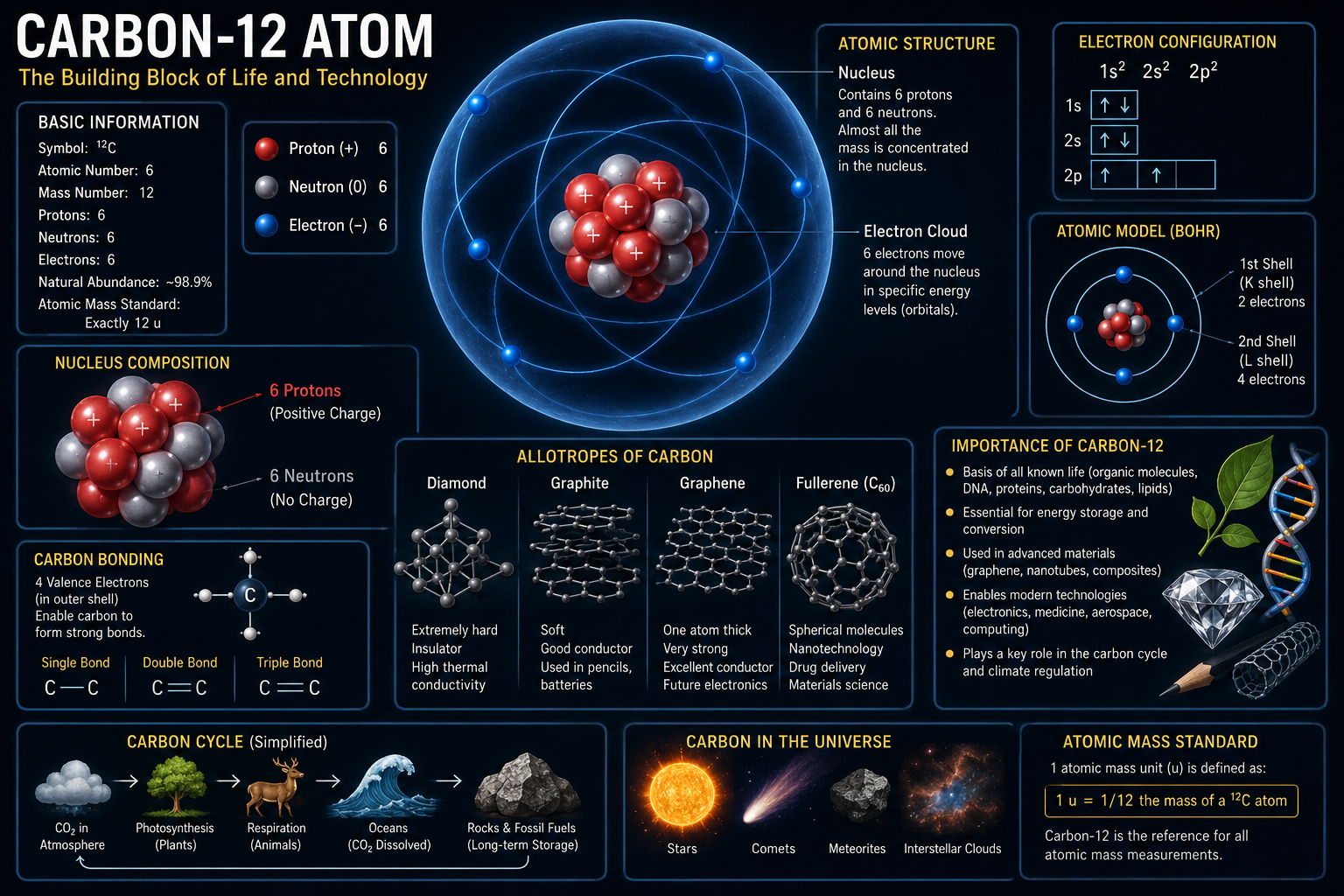
Key Properties
Symbol: ¹²C | Atomic number: 6 | Protons/Neutrons: 6/6
Atomic mass: 12.000 u (exact, by definition) | Natural abundance: 98.9%
Nuclear spin: 0⁺ (even-even nucleus) | Stability: infinite half-life
Carbon-12 is not merely an element. It is the universal ruler of atomic mass, the backbone of all known life, the product of dying stars, and the chemical medium through which the sun’s energy flows into Earth’s biosphere. Every atomic weight ever reported in chemistry or physics is calibrated against it.
INTRODUCTION
Carbon-12 (¹²C) is the most abundant stable isotope of carbon, comprising approximately 98.9 percent of all carbon found on Earth. Its importance, however, transcends sheer abundance. Since 1961, it has served as the international definitional anchor of atomic mass: one unified atomic mass unit (u) is defined as exactly one-twelfth of the mass of a single Carbon-12 atom. This makes it the only atom in existence whose mass is not a measured quantity but a defined constant — the foundation upon which all of chemistry is built.
Beyond metrology, Carbon-12 forms the chemical backbone of every organic molecule known. From the simplest hydrocarbon methane to the most complex enzyme, the overwhelming majority of participating carbon atoms are Carbon-12. Without it, life as we know it would not exist, stars would not synthesize heavy elements in sufficient quantities, and chemists would have no universal mass scale.
Key definition: 1 unified atomic mass unit (u) = 1/12 the mass of one Carbon-12 atom in its ground state = 1.66053906660 × 10⁻²⁷ kg. Every molar mass, every stoichiometric calculation, every molecular weight in science ultimately references this definition.
ATOMIC ARCHITECTURE
The nucleus of Carbon-12 contains exactly 6 protons and 6 neutrons — a perfectly balanced triad. The protons carry a combined nuclear charge of +6e, which is balanced in the neutral atom by 6 electrons in the surrounding electron cloud. The nuclear radius is approximately 2.7 femtometres (2.7 × 10⁻¹⁵ m), roughly 20,000 times smaller than the electron cloud.
A free proton has a mass of 1.007276 u and a free neutron 1.008665 u. Six of each would sum to 12.09565 u. Yet the measured mass of Carbon-12 is exactly 12.000000 u. The difference — 0.09565 u — is the mass defect, converted into nuclear binding energy via E = mc². This binding energy totals 92.16 MeV, or 7.68 MeV per nucleon, and is what holds the nucleus together against the electrostatic repulsion of six positively charged protons confined in a space smaller than a femtometre.
An alternative description of Carbon-12’s nuclear structure is the alpha-cluster model: the nucleus can be visualised as three alpha particles (each composed of 2 protons and 2 neutrons) arranged in an equilateral triangle. This model explains why Carbon-12 has a particularly high binding energy per nucleon and why it is synthesised so efficiently in stellar interiors.
ELECTRON CONFIGURATION AND HYBRIDIZATION
The ground-state electron configuration of Carbon-12 is 1s² 2s² 2p², placing it in Group 14 of the periodic table with four valence electrons. The two electrons in the core 1s orbital play no role in chemistry; the four valence electrons (2s² 2p²) are the source of carbon’s extraordinary chemical versatility.
Carbon can adopt three hybridisation states. In sp³ hybridisation, one 2s and all three 2p orbitals combine to produce four equivalent orbitals directed toward the corners of a tetrahedron (bond angle 109.5°) — the basis of diamond and all saturated organic compounds. In sp² hybridisation, three orbitals form a planar arrangement (120°) with one perpendicular p orbital available for pi bonding — the basis of graphite, benzene, and alkenes. In sp hybridisation, two sp orbitals form a linear arrangement (180°) with two p orbitals for pi bonding — the basis of alkynes and carbon dioxide.
This hybridisation flexibility, combined with the ability to form stable bonds with other carbon atoms (catenation), creates the structural foundation for over 10 million known organic compounds — more than all other elements combined.
CARBON-12 AS THE ATOMIC MASS STANDARD
Prior to 1961, two competing mass standards coexisted: chemists used the average mass of naturally occurring oxygen as 16.000 u, while physicists used pure oxygen-16 as their standard. The discrepancy caused real confusion in cross-disciplinary work. In 1961, IUPAC and IUPAP jointly adopted Carbon-12 as the sole international standard for atomic mass.
Carbon-12 was chosen because it is the most abundant naturally occurring carbon isotope (98.9%), is absolutely stable, can be obtained in pure form, has a conveniently intermediate mass, and can be measured with extreme precision by mass spectrometry. The 2019 redefinition of the SI base units fixed Avogadro’s number as exactly 6.02214076 × 10²³ mol⁻¹, but Carbon-12 remains the conceptual anchor: one mole of Carbon-12 atoms has a mass of exactly 12 grams.
QUANTUM PROPERTIES
Carbon-12 has a nuclear spin quantum number I = 0. This arises because it is an even-even nucleus — both its proton number and neutron number are even — and paired nucleons have opposing spins that cancel exactly. The ground state quantum numbers are therefore spin-parity Jᴾ = 0⁺.
The consequence of I = 0 is that Carbon-12 is completely NMR-silent: it has no nuclear magnetic dipole moment and cannot be detected by nuclear magnetic resonance spectroscopy. This is why carbon NMR uses Carbon-13 (I = 1/2, natural abundance 1.1%). The NMR invisibility of Carbon-12 — constituting 98.9% of all carbon — is precisely what makes ¹³C NMR spectra clean and interpretable.
Carbon-12 also possesses a critically important excited nuclear state known as the Hoyle state, at an energy of 7.6542 MeV above the ground state. This state was predicted before its discovery and is central to the formation of carbon in stars.
ISOTOPES OF CARBON
Carbon has 15 known isotopes (C-8 through C-22), but only two are stable: Carbon-12 and Carbon-13. Carbon-11 is used in PET brain imaging. Carbon-14 is radioactive with a half-life of 5,730 years and is the basis of radiocarbon dating (Nobel Prize in Chemistry, Willard Libby, 1960). The three analytically important isotopes form a complementary triad: Carbon-12 is the substance of chemistry and life; Carbon-13 illuminates molecular structure through NMR spectroscopy; Carbon-14 serves as a natural chronometer for organic materials up to ~50,000 years old.
ALLOTROPES: DIAMOND, GRAPHITE, AND GRAPHENE
In diamond, every carbon atom is sp³ hybridised and bonded to four others in a continuous three-dimensional tetrahedral network. This produces the hardest natural material known (10 on the Mohs scale), an electrical insulator, and the substance with the highest room-temperature thermal conductivity of any bulk material (~2000 W/m·K).
In graphite, sp² hybridised carbon atoms form hexagonal layers held together by strong covalent bonds within layers but only by weak van der Waals forces between layers — making graphite soft, electrically conductive, and the most thermodynamically stable form of carbon under standard conditions.
Graphene — a single atomic layer of graphite — was isolated in 2004 (Nobel Prize in Physics, 2010). It possesses electron mobility more than 200 times greater than silicon and a breaking strength approximately 200 times greater than steel. Buckminsterfullerene (C₆₀), discovered in 1985 (Nobel Prize in Chemistry, 1996), consists of 60 carbon atoms in a closed cage resembling a soccer ball.
STELLAR NUCLEOSYNTHESIS: THE TRIPLE-ALPHA PROCESS
Every carbon atom in your body was forged in the core of a dying star. The mechanism is the triple-alpha process, first theorised by Fred Hoyle in 1954 and confirmed in 1957.
In helium-burning red giant cores (temperatures ~10⁸ K), two alpha particles fuse to form beryllium-8 (half-life: 8.19 × 10⁻¹⁷ seconds). Before it decays, a third alpha particle fuses with it to form Carbon-12, releasing 7.275 MeV: 3 ⁴He → ¹²C + 7.275 MeV.
For this to occur at the rate required, a quantum nuclear resonance — the Hoyle state at 7.6542 MeV — must exist in Carbon-12. Hoyle predicted it before experimental confirmation, based on the anthropic argument: since carbon-based life exists, stars must produce carbon efficiently, therefore this resonance must exist. It was confirmed by William Fowler’s team at Caltech in 1957. Without it, the universe would be carbon-poor and carbon-based life impossible.
BIOLOGICAL AND BIOCHEMICAL ROLES
Carbon-12 is the chemical foundation of all known life. Proteins are approximately 55% carbon by mass; lipids can be 70–80% carbon; DNA approximately 36% carbon. The peptide bonds of proteins, the sugar-phosphate backbone of nucleic acids, the hydrocarbon chains of fatty acids — all are built from Carbon-12 frameworks.
In photosynthesis, plants capture atmospheric CO₂ and convert it using sunlight into glucose: 6CO₂ + 6H₂O → C₆H₁₂O₆ + 6O₂. This fixed carbon flows through the food web and is returned to the atmosphere by respiration and decomposition — the global carbon cycle, moving approximately 120 billion tonnes of carbon per year between the atmosphere and terrestrial ecosystems.
Living organisms preferentially incorporate Carbon-12 over Carbon-13 due to kinetic isotope effects in enzymatic reactions. This fractionation produces measurable δ¹³C values in organic matter, allowing geochemists to identify biological carbon sources in rocks 3.5 billion years old.
INDUSTRIAL AND TECHNOLOGICAL APPLICATIONS
The precise control of carbon content in iron alloys defines the entire spectrum of steel properties: low-carbon steel (below 0.3%) is ductile; medium-carbon is strong; high-carbon is hard; cast iron (above 2%) is used in engine blocks. Graphite serves as electrodes in electric arc furnaces, as moderator in nuclear reactors, as anode material in lithium-ion batteries, and as high-temperature lubricant. Synthetic diamond tools cut materials too hard for any other substance, while diamond’s thermal conductivity makes it the preferred heat-sink for high-power electronics.
ENVIRONMENTAL AND CLIMATE SIGNIFICANCE
The burning of fossil fuels returns ancient Carbon-12 — stored in geological reservoirs for tens to hundreds of millions of years — to the atmosphere as CO₂. This ancient carbon is depleted in Carbon-14 (too old for any to survive) and slightly depleted in Carbon-13 relative to atmospheric CO₂. This isotopic fingerprint provides direct evidence that rising atmospheric CO₂ originates from fossil fuel combustion. Carbon sequestration strategies — reforestation, direct air capture, carbon mineralisation — all involve converting atmospheric CO₂ into stable forms, and understanding the process at the molecular level is essential to effective climate intervention.
METROLOGICAL AND PHILOSOPHICAL SIGNIFICANCE
Carbon-12 is the same atom everywhere in the universe. Quantum mechanics guarantees that a carbon-12 nucleus — 6 protons, 6 neutrons, bound by 92.16 MeV — is identical whether it is in a laboratory in Geneva, a red giant in the Andromeda galaxy, or a meteorite formed 4.5 billion years ago. The atomic mass unit based on Carbon-12 is a truly universal constant. An alien civilisation using the same physics would independently arrive at exactly the same mass standard. Carbon-12 is not an anthropocentric definition — it is a reference frame written into the laws of nature.
CONCLUSION
Carbon-12 occupies a singular position in the natural sciences. Its nuclear architecture gives it exceptional stability and a binding energy of 7.68 MeV per nucleon. Its four valence electrons enable diamond, graphite, graphene, fullerenes, and the entire domain of organic chemistry. The quantum coincidence of the Hoyle state at 7.6542 MeV makes it producible in stellar interiors in the quantities necessary for life. And its role as the definitional anchor of the unified atomic mass unit makes it the silent foundation beneath every measurement in chemistry, biochemistry, and materials science.
Carbon-12 is not merely an atom. It is the ruler of atomic mass, the building block of life, the product of dying stars, and a universal constant written into the fabric of the cosmos.





Be First to Comment