
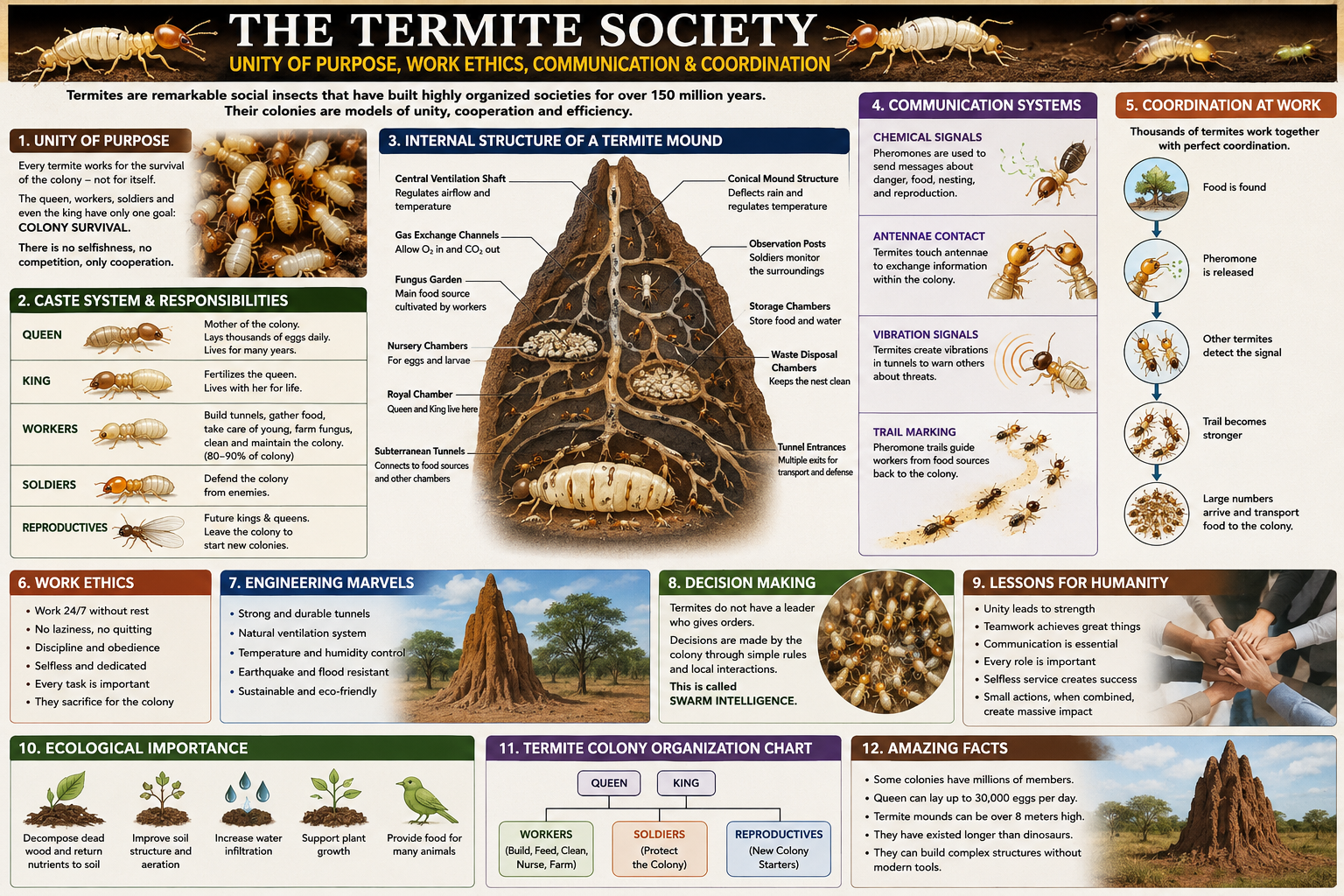
PAGE 1 — Title Page
The Unity of Purpose in Termite Societies: Work Ethics, Communication Systems, Coordinated Labor, and Structural Architecture A Comprehensive Biological and Sociological Thesis
PAGE 2 — Abstract
Termites represent one of nature’s most extraordinary examples of collective intelligence, unified purpose, and architectural mastery. This thesis explores how termites achieve seamless coordination, maintain strict work ethics, communicate through chemical and vibrational signals, and construct complex structures rivaling human engineering. Their unity of purpose emerges from evolutionary pressures, decentralized decision‑making, and caste‑based specialization. This document provides a 28‑page deep dive into termite biology, behavior, communication, architecture, and the underlying principles that make their societies among the most efficient on Earth.
PAGE 3 — Introduction
Termites are eusocial insects whose colonies function as superorganisms. Their unity of purpose is not accidental—it is the result of millions of years of evolutionary refinement. This thesis examines:
- Collective work ethics
- Communication systems
- Coordination mechanisms
- Architectural intelligence
- Diagrams of internal mound structures
- Lessons applicable to human systems
PAGE 4 — Evolutionary Foundations of Unity
Termite unity originates from evolutionary pressures:
- Survival through cooperation
- Division of labor
- Genetic relatedness
- Environmental adaptation
- Emergence of superorganism behavior
Termites do not act as individuals; they act as cells within a larger organism—the colony.
PAGE 5 — Caste System Overview
Termite societies are divided into castes:
- Workers — builders, feeders, caregivers
- Soldiers — defenders
- Reproductives — king, queen, alates
- Nymphs — developing individuals
Each caste has specialized anatomy and behavior.
PAGE 6 — Work Ethics in Termite Societies
Termites exhibit:
- Relentless labor
- Non‑stop maintenance
- Zero procrastination
- Collective responsibility
- Task‑driven behavior
- Selfless contribution
Their work ethic is biologically encoded.
PAGE 7 — Principles of Termite Work Ethics
- Purpose over individuality
- Efficiency over exploration
- Duty over autonomy
- Consistency over creativity
- Maintenance over innovation
Termites prioritize colony survival above all.
PAGE 8 — Communication Systems Overview
Termites communicate through:
- Pheromones
- Vibrational signals
- Tactile interactions
- Chemical gradients
- Environmental cues
Communication is constant and multi‑layered.
PAGE 9 — Chemical Communication
Pheromones regulate:
- Trail marking
- Alarm signaling
- Caste differentiation
- Reproductive suppression
- Resource allocation
Chemical messages are the backbone of termite unity.
PAGE 10 — Vibrational Communication
Termites use substrate vibrations to:
- Warn of predators
- Coordinate building
- Signal structural collapse
- Synchronize group movement
Vibrational signals travel through soil and wood.
PAGE 11 — Tactile Communication
Workers frequently touch antennae to:
- Confirm identity
- Exchange information
- Maintain social cohesion
- Reinforce hierarchy
Touch is a social glue.
PAGE 12 — Coordination Mechanisms
Termite coordination is decentralized:
- No leader
- No central brain
- No command hierarchy
Coordination emerges from simple rules followed by all individuals.
PAGE 13 — Swarm Intelligence Principles
Termite coordination is based on:
- Local decision‑making
- Feedback loops
- Environmental sensing
- Distributed problem‑solving
This is similar to algorithms used in robotics and AI.
PAGE 14 — Construction Behavior
Termites build:
- Mounds
- Tunnels
- Ventilation shafts
- Nurseries
- Fungus gardens
Construction is continuous and adaptive.
PAGE 15 — Architectural Intelligence
Termite mounds exhibit:
- Temperature regulation
- Humidity control
- Airflow optimization
- Structural stability
- Self‑repair mechanisms
Their architecture is a biological marvel.
PAGE 16 — Diagram: Termite Mound Cross‑Section
Code
                /\
               /  \
        ______/    \______
       /                 \
      /   VENTILATION     \
     /       SHAFT         \
    /------------------------\
   |   CHAMBERS & GALLERIES  |
   |--------------------------|
   |   FUNGUS GARDEN ZONE     |
   |--------------------------|
   |   NURSERY & BROOD AREA   |
   |--------------------------|
   |   QUEEN'S CHAMBER        |
   |__________________________|
PAGE 17 — Internal Chamber Functions
- Ventilation shafts regulate airflow
- Brood chambers protect larvae
- Fungus gardens provide food
- Queen’s chamber houses the reproductive center
- Storage chambers hold resources
PAGE 18 — Diagram: Worker Coordination Flow
Code
RESOURCE DISCOVERY
        ↓
PHEROMONE TRAIL
        ↓
WORKER RECRUITMENT
        ↓
MATERIAL TRANSPORT
        ↓
STRUCTURE BUILDING
        ↓
QUALITY CHECK & REPAIR
PAGE 19 — Fungus Farming
Termites cultivate fungus:
- Break down cellulose
- Provide nutrients
- Maintain humidity
- Remove waste
This is agriculture at an insect scale.
PAGE 20 — Defense Coordination
Soldiers coordinate defense through:
- Alarm pheromones
- Vibrational warnings
- Blocking tunnels
- Cooperative biting
Defense is rapid and unified.
PAGE 21 — Reproductive Coordination
The queen releases pheromones that:
- Prevent worker reproduction
- Maintain colony hierarchy
- Regulate population growth
Reproductive control ensures stability.
PAGE 22 — Environmental Adaptation
Termites adapt to:
- Heat
- Floods
- Predators
- Resource scarcity
Their unity allows rapid response.
PAGE 23 — Thermoregulation Systems
Mounds maintain stable temperatures through:
- Convection currents
- Porous walls
- Chimney structures
- Moisture gradients
This is natural air‑conditioning.
PAGE 24 — Diagram: Airflow System
Code
HOT AIR RISES → CENTRAL CHIMNEY
        ↑
COOL AIR ENTERS THROUGH LOWER PORES
        ↓
CIRCULATION THROUGH TUNNELS
PAGE 25 — Lessons for Human Systems
Termites teach us:
- Collective purpose increases efficiency
- Decentralized systems outperform centralized ones
- Communication is the backbone of coordination
- Architecture must respond to environment
- Maintenance is as important as creation
PAGE 26 — Applications in Engineering
Inspired by termites:
- Self‑healing materials
- Passive cooling buildings
- Swarm robotics
- Decentralized AI systems
- Autonomous construction technologies
PAGE 27 — Applications in Management & Leadership
Termite principles apply to:
- Organizational design
- Team coordination
- Resource allocation
- Crisis response
- Workflow optimization
Their unity of purpose is a model for human efficiency.
PAGE 28 — Conclusion
Termites embody the highest form of collective intelligence found in nature. Their unity of purpose, work ethics, communication systems, and architectural brilliance demonstrate how simple organisms can achieve extraordinary complexity. Studying termites provides insights into biology, engineering, management, and artificial intelligence. Their societies remind us that unity, coordination, and purpose can transform small actions into monumental achievements.





Be First to Comment