
Anatomy, Colonial Architecture, and the Frontiers of Discovery
1. Introduction: What Is a Siphonophore?
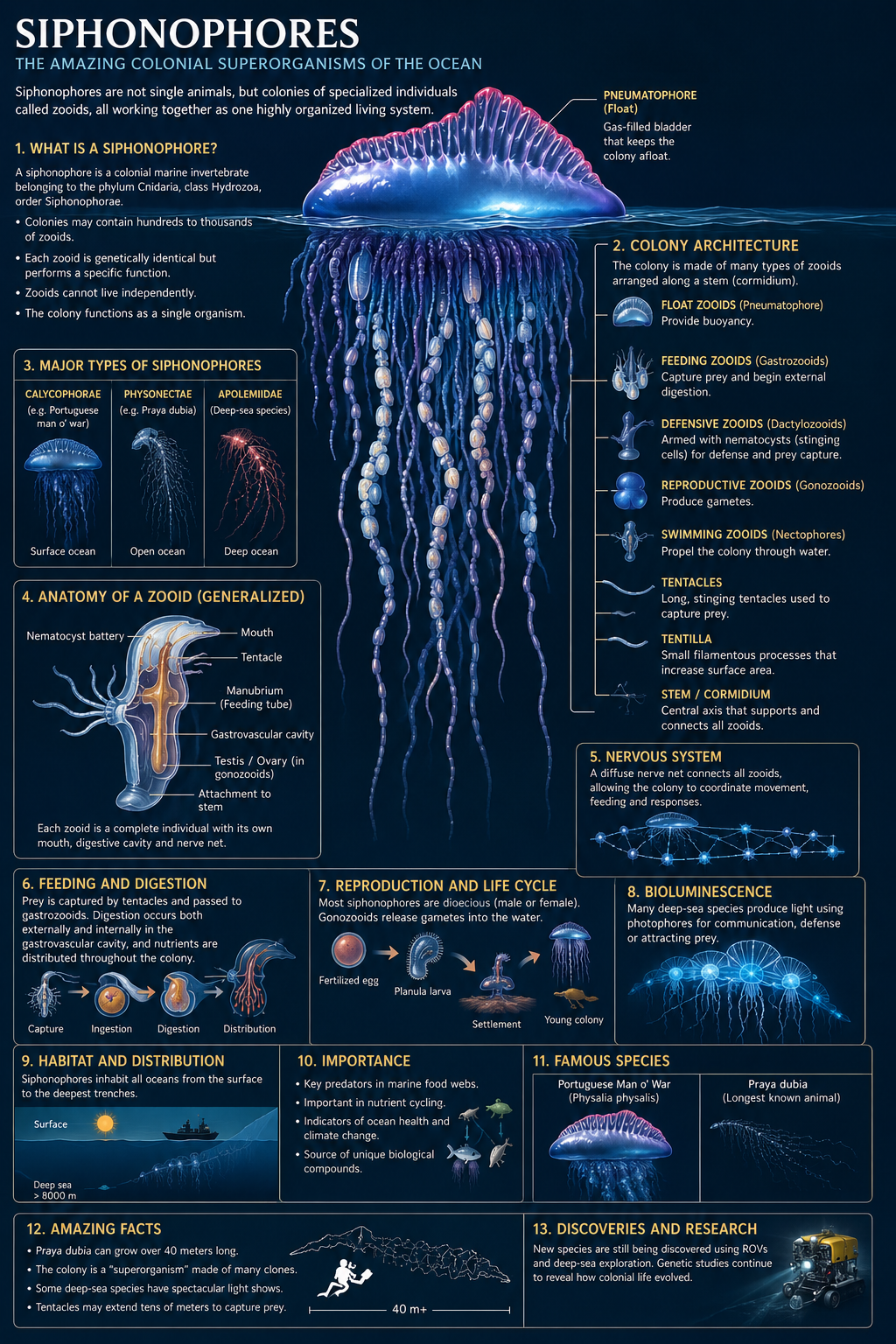
A siphonophore is not a single animal in the ordinary sense. It is a colony: a linear or branching assembly of many genetically identical, physically connected individuals called zooids, each specialised for one task — swimming, feeding, defence, or reproduction — yet none capable of independent survival. The colony as a whole behaves as a coordinated organism.
Siphonophores belong to the phylum Cnidaria and the class Hydrozoa, forming the order Siphonophorae. They occur throughout the world’s oceans, from the sunlit surface to the deep midwater, and rank among the most abundant gelatinous predators in the open sea.
Key idea: Every zooid in a siphonophore colony — float, swimming bell, feeding polyp, or stinging tentacle — is genetically identical, descended by budding from one founding larva.
2. Taxonomic Classification
| Rank | Taxon |
|---|---|
| Kingdom | Animalia |
| Phylum | Cnidaria |
| Class | Hydrozoa |
| Order | Siphonophorae |
| Families / Genera / Species | 16 families · ~65 genera · 175+ described species (rising with new surveys) |
Siphonophorae divides into three principal lineages by body plan: Cystonectae, Physonectae, and Calycophorae — detailed in Section 4.
3. The Colonial Principle: Zooids, Not Organs
A colony begins as a single fertilised egg developing into a larva called a protozooid. This founder buds asexually, repeatedly, producing genetically identical offspring zooids that remain permanently attached. Each zooid is a reduced polyp or medusa, modified to perform only one function for the colony’s benefit — all linked by a continuous, branching gastrovascular canal system that distributes nutrients colony-wide.
3.1 The Two Colony Regions
- Nectosome — the anterior region, bearing the pneumatophore (where present) and nectophores for locomotion.
- Siphosome — the often much longer posterior region, bearing repeating units called cormidia, each typically holding a gastrozooid, tentacle, bract, and gonophore(s).
4. The Three Basic Body Plans

4.1 Cystonectae
Typified by the Portuguese man o’ war (Physalia physalis): a large gas float, no nectophores, passive wind- and current-driven drift.
4.2 Physonectae
Small pneumatophore plus a series of muscular nectophores for active swimming, extending into a long siphosome of repeating cormidia. Includes Nanomia and the record-length Apolemia (Section 11).
4.3 Calycophorae
No gas float at all; buoyancy managed by tissue density and behaviour; locomotion via one or two well-developed nectophores. Includes Praya and Abylopsis.
5. General Colonial Architecture

6. Catalogue of Zooid Types
| Zooid type | Function | Notes |
|---|---|---|
| Pneumatophore | Gas-filled float; buoyancy, sometimes apical sensory organ | Absent in calycophorans |
| Nectophore | Muscular swimming bell; jet propulsion | Repeated along the nectosome |
| Bract | Protective covering | Often transparent/reflective |
| Gastrozooid | Feeding polyp; digestion and nutrient distribution | Each bears one tentacle |
| Tentacle / tentillum | Prey capture via nematocyst batteries | Taxonomically diagnostic |
| Palpon | Accessory feeding/defence zooid | Found in some physonects |
| Gonophore | Reproductive zooid | Clustered into gonodendra |
7. The Tentillum and Prey Capture
Side-branches called tentilla hang from each tentacle, bearing tightly coiled clusters of cnidocytes — the cnidoband, a battery of nematocysts. Tentillum structure varies enormously and is closely tied to prey type and size.

Each nematocyst holds a coiled, barbed tubule under high pressure that everts explosively on contact — one of the fastest cellular processes known — piercing prey and delivering venom within a fraction of a millisecond.
8. Coordination and Locomotion
There is no central brain. Zooids are linked by a continuous nerve net, often supplemented by giant axons that conduct signals rapidly along the colony, enabling coordinated, colony-wide responses.

Movement comes from pulsed jet propulsion: bell contraction expels water through the velum, producing thrust. Multiple nectophores can phase-coordinate to steer, accelerate, or perform daily vertical migrations of hundreds of metres.
9. Reproduction and Life Cycle
Colonies grow by asexual budding, while sexual reproduction occurs through gonophores, often clustered into gonodendra, releasing eggs or sperm. Fertilisation produces a protozooid larva that begins its own budding cascade — the origin of an entire new colony from one cell.
10. Bioluminescence
Many siphonophores produce light, often concentrated near gastrozooids or tentacles, potentially to startle predators, lure prey, or aid communication in dim or lightless deep water — an active area of ongoing behavioural research.
11. Notable and Record-Setting Species
11.1 Physalia physalis — The Portuguese Man o’ War
The best-known cystonect, long treated as one wind-dispersed global species — a picture overturned by 2025 genomic research (Section 13).
11.2 Apolemia — A Record-Length Colony
In April 2020, a giant Apolemia was documented in submarine canyons off Australia’s Ningaloo Coast in a spiral roughly 15 m in diameter, with an estimated total length near 47 m — among the longest animals ever recorded.
11.3 Nanomia bijuga — A Genomic Model Species
A physonect siphonophore now central to studying the molecular basis of zooid specialisation, following a full genome sequencing effort published in 2026.
12. History of Scientific Discovery
Copy timeline as text
| Period | Milestone |
|---|---|
| 1785 | Linnaeus provides the first formal description of a siphonophore (Physalia physalis). |
| 19th c. | Naturalists including Haeckel document diverse forms; specimens frequently damaged in collection. |
| Mid-20th c. | A. K. Totton describes 23 new species, shaping modern classification. |
| 20th c. overall | New species described at roughly ten per decade. |
| 2000s–2010s | Molecular phylogenetics reshapes classification; 2014 review recognises 175 valid species. |
| Apr 2020 | Schmidt Ocean Institute documents a giant Apolemia off Ningaloo, ~47 m long. |
| 2025 | Genomic study reveals Physalia comprises 4–5 distinct, reproductively isolated lineages. |
| Early 2026 | Blackwater diving surveys document Gulf Stream siphonophore diversity. |
| 2026 | Brazilian deep-sea expedition documents 31 new species incl. 7 siphonophores. |
| 2026 | Whole-genome sequencing of Nanomia bijuga published. |
13. Recent Scientific Discoveries (2025–2026)
13.1 The Portuguese Man o’ War Is at Least Four Species
Researchers from Yale University, the University of New South Wales, and Griffith University combined whole-genome sequencing of over 150 samples with citizen-science photo records, finding at least four to five genetically distinct, reproductively isolated Physalia lineages rather than one global species.
13.2 A Genome for a Colonial Animal
A 2026 PLOS One study presented a genome assembly for Nanomia bijuga, probing how one genome produces the colony’s many functionally distinct zooid types — insight relevant to the evolution of multicellular cooperation generally.
13.3 New Species from the Deep Sea off Brazil
A 2026 expedition used millimetre-scale 3D laser imaging of the ocean’s midwater off Brazil, cataloguing 31 new species including seven siphonophores; one, found near 552 m depth, may represent an undescribed genus.
13.4 Blackwater Diving and Gulf Stream Biodiversity
Night dives with downward-facing lights over deep water documented siphonophore diversity and ecology in the Gulf Stream off Florida — a minimally invasive approach well suited to these fragile animals.
These findings show siphonophore science is still actively rewriting basic facts about the group — from species counts to genome structure to record-breaking body size.
14. Ecological Role and Significance
Siphonophores are important predators of copepods, small fish, and other zooplankton throughout the water column, and are themselves prey for fish, sea turtles, and other tolerant predators. Deep-sea physonects rank among the most abundant gelatinous predators in midwater ecosystems. Because they are fragile and easily destroyed by conventional sampling, their true diversity has long been underestimated — a gap now closing thanks to ROV imaging, blackwater diving, and DNA-based identification.
15. Conclusion and Future Research
Siphonophores are a single genetic individual expressed as a cooperative colony of specialised zooids — one of evolution’s most elaborate solutions to building a large, mobile, multi-tasking body from repeated modular parts. Genomic tools, deep-sea expeditions, and population genetics are steadily revealing how much remains to be learned about this architecture, its evolutionary origins, and the true diversity hidden within the open ocean.





Be First to Comment