
Abstract
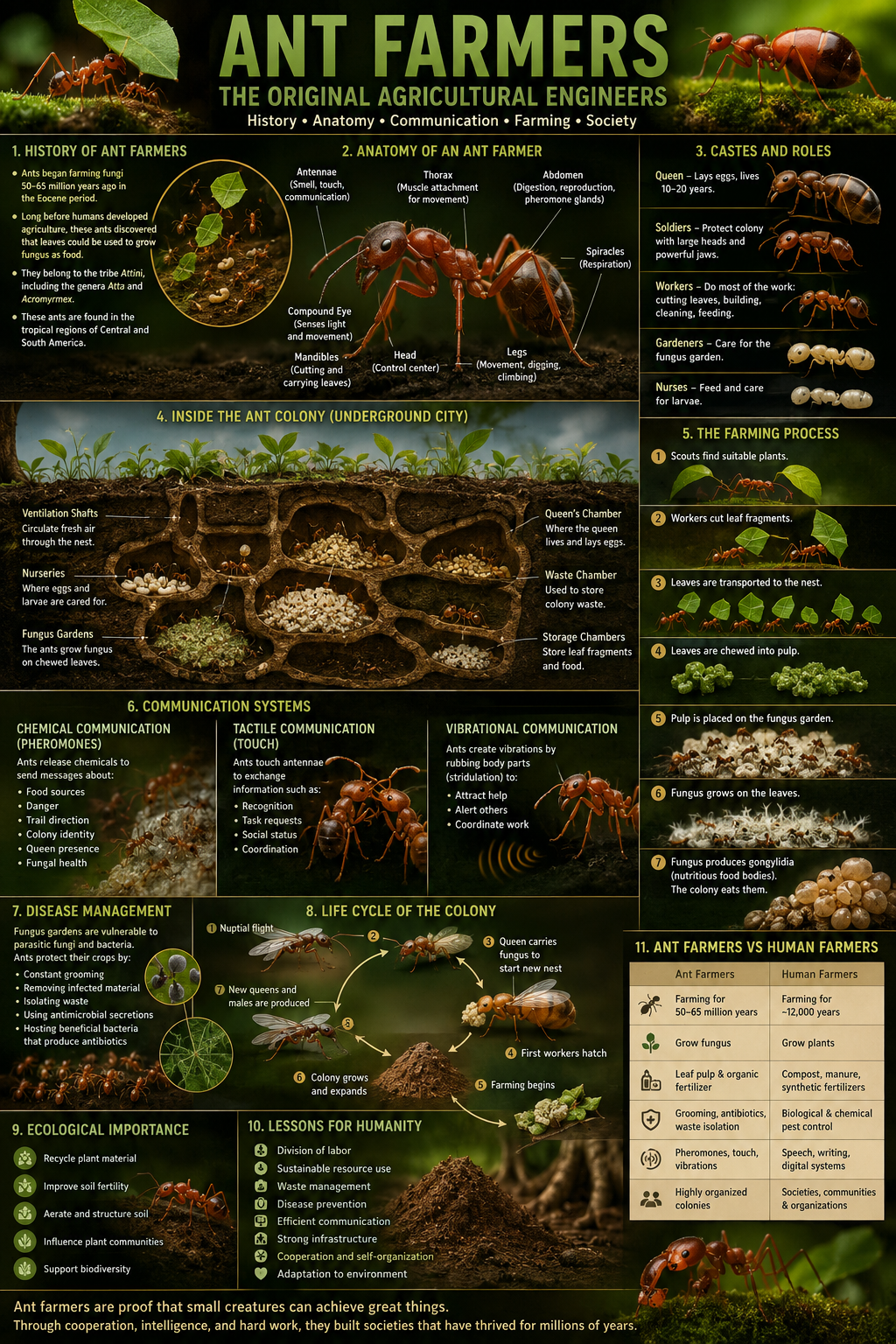
Ants are among Earth’s most successful organisms. Over 14,000 species have been identified, yet only about 250 species have developed one of nature’s most remarkable innovations: agriculture. Millions of years before humans cultivated wheat, maize, or rice, certain ants had already mastered farming by cultivating fungi as their primary food source. These “ant farmers,” particularly the leaf-cutter ants, maintain sophisticated agricultural systems, defend their crops from disease, remove weeds, fertilize fungal gardens, and communicate through advanced chemical and tactile languages.
1. Introduction


6
Ant farming represents one of evolution’s greatest achievements.
Humans developed agriculture approximately 12,000 years ago.
Ants began farming approximately:
- 55–65 million years ago
This means ants have practiced agriculture over 5,000 times longer than humans.
Today these remarkable insects inhabit:
- Central America
- South America
- Southern North America
- Tropical forests
- Grasslands
- Rainforests
The most famous farming ants belong to the genera:
- Atta
- Acromyrmex
2. Evolutionary History of Ant Farming
Scientists believe ancient ants originally consumed dead insects and organic debris.
Around sixty million years ago, changing climates created dense tropical forests where fungi thrived.
Some ants accidentally introduced fungal spores into their nests.
Eventually they discovered that:
- fresh leaves
- flower petals
- seeds
- grasses
could nourish fungi.
The fungi became their primary food source.
Natural selection favored colonies that became better farmers.
Generation after generation, agriculture became increasingly sophisticated.
Eventually ants became completely dependent upon their fungal crops.
3. Classification
Kingdom
Animalia
Phylum
Arthropoda
Class
Insecta
Order
Hymenoptera
Family
Formicidae
Tribe
Attini
Common name
Fungus-growing ants
4. Anatomy of an Ant Farmer


6
Every body part contributes to farming.
Head
Contains:
- eyes
- antennae
- mandibles
- brain
Antennae
The antennae function as:
- nose
- fingers
- communication devices
- navigation instruments
They detect:
- pheromones
- humidity
- fungal health
- danger
- colony identity
Mandibles
The jaws act as:
- scissors
- knives
- shovels
- transport hooks
Leaf-cutters use mandibles powerful enough to slice vegetation many times thicker than their bodies.
Thorax
Provides attachment for powerful muscles.
Supports:
- walking
- climbing
- carrying loads
Legs
Six legs equipped with tiny claws enable climbing across trees and fungal chambers.
Abdomen
Contains:
- digestive organs
- reproductive organs
- poison glands
- pheromone glands
5. Social Structure
Every colony resembles a highly organized nation.
Queen
Responsibilities:
- lays eggs
- founds colonies
- produces millions of offspring
One queen may live:
10–20 years.
Soldiers
Protect the colony.
They possess:
- enormous heads
- powerful jaws
Workers
Workers:
- cut leaves
- transport vegetation
- feed larvae
- clean fungus
- maintain tunnels
Gardeners
Some workers never leave the nest.
Their only duty is caring for fungal gardens.
Nurses
Feed larvae continuously.
6. Underground Architecture
Large colonies construct underground cities reaching:
- 6–8 meters deep
- over 1,000 chambers
The nest includes:
- fungus gardens
- nurseries
- queen chamber
- waste chambers
- ventilation shafts
- highways
- storage rooms
Some colonies move more soil than many vertebrate burrowing animals.
7. Farming Process
Agriculture follows several stages:
Step 1
Scouts locate suitable plants.
Step 2
Workers harvest leaf fragments.
Step 3
Leaf fragments are transported.
Step 4
Leaves are chewed into pulp.
Step 5
Pulp is fertilized.
Step 6
Fungus grows.
Step 7
Workers harvest nutritious fungal structures called gongylidia, which feed the colony.
8. Communication Systems
Ant farmers communicate using multiple methods.
Chemical Communication
The primary language is pheromones.
Messages include:
- food location
- danger
- colony identity
- queen presence
- trail direction
- fungus health
Touch Communication
Ants touch antennae to exchange information.
This tactile communication identifies:
- friend or enemy
- worker role
- food requests
- colony status
Vibrational Communication
Leaf-cutters produce vibrations by rubbing body parts together (stridulation).
These signals help coordinate work and attract assistance.
Cooperative Intelligence
No single ant directs the colony.
Instead, simple local interactions create complex collective behavior, often called swarm intelligence.
9. Disease Management
One of the greatest threats to the fungal crop is parasitic fungi.
Ants combat disease through:
- constant grooming
- removing infected material
- isolating waste
- applying antimicrobial secretions
Some species harbor beneficial bacteria on their bodies that produce antibiotics, protecting their fungal gardens.
10. Colony Life Cycle
- Nuptial flight
- Queen mates
- Queen carries a small piece of fungus in her mouth
- New nest established
- First workers hatch
- Farming begins
- Colony expands
- Mature colony produces new queens and males
11. Ecological Importance
Fungus-farming ants contribute to ecosystems by:
- recycling plant material
- aerating soil
- dispersing nutrients
- enhancing soil fertility
- influencing forest vegetation
- supporting biodiversity
12. Lessons for Human Society
Ant farming demonstrates principles valuable to human agriculture and engineering:
- Division of labor
- Sustainable resource use
- Waste management
- Disease prevention
- Infrastructure planning
- Efficient logistics
- Decentralized decision-making
- Environmental adaptation
13. Comparison Between Human and Ant Agriculture
| Feature | Ant Farmers | Human Farmers |
|---|---|---|
| Agriculture began | 55–65 million years ago | ~12,000 years ago |
| Main crop | Fungus | Diverse crops |
| Fertilizer | Leaf pulp and organic matter | Compost, manure, synthetic fertilizers |
| Pest control | Grooming, antibiotics, waste isolation | Biological and chemical methods |
| Communication | Pheromones, touch, vibrations | Speech, writing, digital systems |
| Labor | Specialized castes | Specialized professions |
14. Future Research
Current research explores:
- Swarm robotics inspired by ant coordination
- Decentralized artificial intelligence
- Sustainable farming techniques
- Natural antimicrobial compounds
- Climate resilience
- Ecosystem conservation
Conclusion
Fungus-farming ants are among nature’s most sophisticated agricultural engineers. Their societies combine advanced communication, specialized anatomy, collective intelligence, and sustainable farming practices into highly efficient systems that have endured for tens of millions of years. By cultivating fungi, maintaining hygienic gardens, coordinating labor without centralized control, and adapting to environmental challenges, these insects demonstrate that successful agriculture depends not only on cultivation but also on cooperation, resilience, and ecological balance. Their colonies continue to inspire research in biology, agriculture, engineering, and artificial intelligence, reminding us that some of the most advanced solutions to complex problems can be found in the smallest of Earth’s creatures.






Be First to Comment