
The Fundamental Building Blocks of Matter
- Origins and Ancient Philosophy
The concept of the atom is one of the oldest and most revolutionary ideas in the history of human thought. Long before the tools of modern science existed, ancient philosophers grappled with a profound question: if you were to divide matter again and again, would this process go on forever, or would you eventually reach an irreducible, indivisible unit? This question, deceptively simple on its surface, launched more than two millennia of inquiry, debate, and ultimately, scientific discovery that transformed our understanding of the physical universe.
The Greek philosophers Leucippus and his student Democritus are widely credited with formulating the first systematic atomic theory around 450 BCE. Democritus proposed that all matter is composed of tiny, indestructible, and indivisible particles he called atomos — from the Greek a (not) and tomos (cuttable), meaning “uncuttable” or “indivisible.” In his vision, these atoms were eternal, invisible to the naked eye, and infinite in number. They moved through an infinite void, colliding and clustering to form the macroscopic objects we perceive.
Democritus held that atoms differed in shape, size, and arrangement, and that these differences accounted for the diverse properties of matter. Fire atoms were small and round, enabling their rapid movement and penetrating heat; earth atoms were large and irregular, explaining the solidity and heaviness of stone and soil. While these ideas were not based on experimental evidence and contain much that modern science has superseded, their core philosophical intuition — that matter has a discrete, finite structure at its smallest scale — proved remarkably prescient.
Not everyone in antiquity accepted this view. Aristotle, whose intellectual authority dominated Western thought for centuries, rejected atomism categorically. He maintained that matter was continuous and infinitely divisible, and that all substances were composed of four fundamental elements: earth, water, air, and fire, with an additional fifth element, aether, comprising the celestial spheres. Aristotle’s framework, augmented by the concept of qualities such as hot, cold, wet, and dry, offered an apparently comprehensive cosmology that resonated with common observation.
The Epicureans, followers of the philosopher Epicurus, later adopted and expanded Democritus’s atomism, weaving it into a broader philosophy of nature, ethics, and the good life. The Roman poet Lucretius preserved Epicurean atomism in his extraordinary didactic poem De Rerum Natura (On the Nature of Things), composed in the first century BCE. This work would later prove enormously influential during the Renaissance and the Scientific Revolution, reintroducing atomic ideas to European thinkers.
In parallel, Indian philosophical traditions independently developed atomistic theories. The Vaisheshika school, attributed to the philosopher Kanada (circa 6th century BCE), proposed that all matter is composed of paramanu, indivisible eternal particles. This concept was more sophisticated than is often appreciated in Western histories of science, engaging with questions of atomic combination, motion, and the formation of composite objects. The Jain philosophical tradition similarly held that matter is composed of smallest particles called pudgala.
Key Ancient Atomic Thinkers- Leucippus (c. 490–430 BCE): Originator of the atomist school in Greece
- Democritus (c. 460–370 BCE): Developed the first comprehensive atomic theory
- Epicurus (341–270 BCE): Extended atomism into a full philosophical system
- Lucretius (c. 99–55 BCE): Preserved atomism in De Rerum Natura
- Kanada (c. 6th century BCE): Indian atomist philosopher, proposed paramanu
For nearly two thousand years after Aristotle, the atomic worldview languished on the margins of Western thought. The rediscovery of Lucretius’s poem in 1417 by the humanist scholar Poggio Bracciolini helped rekindle interest in atomism. Philosophers such as Pierre Gassendi in the seventeenth century championed a Christianized version of Epicurean atomism, arguing that God had created a finite number of eternal atoms at the moment of Creation. This revival laid important intellectual groundwork for the scientific revolution that was about to transform humanity’s understanding of the natural world.
✦ ✦ ✦
- The Birth of Modern Atomic Theory
The transformation of atomic philosophy into atomic science began in earnest in the late eighteenth and early nineteenth centuries, driven by systematic quantitative experimentation in chemistry. The pivotal figure in this transformation was the English chemist and school teacher John Dalton, whose meticulous measurements of the proportions in which elements combine led him to formulate the first modern atomic theory in the opening decade of the 1800s.
Before Dalton, Antoine Lavoisier had established the law of conservation of mass (1789), demonstrating that matter is neither created nor destroyed in chemical reactions. Joseph Proust formulated the law of definite proportions (1799), showing that elements in a chemical compound always combine in fixed mass ratios. These laws demanded an explanation, and Dalton provided one in his landmark work A New System of Chemical Philosophy (1808).
Dalton’s atomic theory rested on four central postulates. First, all matter is made of tiny, indivisible particles called atoms. Second, all atoms of a given element are identical in mass and properties, while atoms of different elements differ in mass and properties. Third, atoms cannot be created, divided, or destroyed in chemical reactions — they can only rearrange. Fourth, chemical compounds are formed when atoms of different elements combine in simple, fixed, whole-number ratios.
Dalton’s theory elegantly explained both the law of conservation of mass and the law of definite proportions. It also predicted a new law: the law of multiple proportions, which states that when two elements form more than one compound, the masses of one element that combine with a fixed mass of the other are in a ratio of small whole numbers. This prediction was confirmed experimentally, providing powerful support for Dalton’s framework.
"Matter is not continuous — it is granular, composed of discrete units whose combinations generate the entire material world."Dalton also constructed the first table of atomic weights, assigning hydrogen an atomic mass of 1 and calculating the relative masses of other elements. Although some of his mass values were inaccurate (in part because he incorrectly assumed water had the formula HO rather than H₂O), the conceptual framework was sound and transformative. Chemistry would never be the same.
The subsequent decades saw rapid progress. Amedeo Avogadro proposed in 1811 that equal volumes of gases at the same temperature and pressure contain equal numbers of particles (molecules), providing a crucial distinction between atoms and molecules. Jöns Jacob Berzelius introduced the modern system of chemical symbols and refined atomic weight measurements with extraordinary precision. Gay-Lussac’s law of combining volumes further supported the particulate nature of matter.
By the mid-nineteenth century, the atomic theory had achieved broad acceptance among chemists, even as many physicists and philosophers remained skeptical, insisting that atoms were merely convenient fictions rather than physical realities. This debate was not definitively resolved until the early twentieth century, when Einstein’s 1905 paper on Brownian motion provided a statistical explanation for the random motion of pollen grains in water — motion that could only be explained if those grains were being bombarded by real, discrete water molecules.
- Discovery of Subatomic Particles
Dalton’s atom was conceived as an indivisible unit — the ultimate irreducible particle of matter. The discovery, in the last decades of the nineteenth century, that atoms themselves have internal structure was one of the most profound revelations in the history of science. Far from being the ultimate building blocks, atoms turned out to be complex entities, harboring smaller constituents whose existence would demand entirely new theoretical frameworks.
The Electron
The first subatomic particle to be identified was the electron. In the 1890s, physicists were experimenting with cathode ray tubes — sealed glass tubes from which most of the air had been evacuated, with metal electrodes at each end. When a high voltage was applied, mysterious “cathode rays” emanated from the negative electrode (cathode). The nature of these rays was disputed: were they waves, like light, or streams of particles?
The English physicist J.J. Thomson resolved this question definitively in 1897. By applying electric and magnetic fields to cathode rays and measuring how they were deflected, Thomson was able to calculate the ratio of the particle’s charge to its mass (e/m). Crucially, this ratio was the same regardless of the material used for the electrodes or the gas in the tube. This universality meant the rays were composed of a fundamental particle common to all matter. Thomson had discovered the electron.
The electron’s charge-to-mass ratio was nearly two thousand times larger than that of hydrogen ions, indicating that the electron was either far lighter or far more highly charged than any known particle. The American physicist Robert Millikan resolved this ambiguity with his famous oil-drop experiment (1909–1913), precisely measuring the electron’s charge. Combined with the known e/m ratio, this allowed calculation of the electron’s mass: approximately 9.109 × 10⁻³¹ kilograms — about 1,836 times lighter than the hydrogen atom.
The Proton
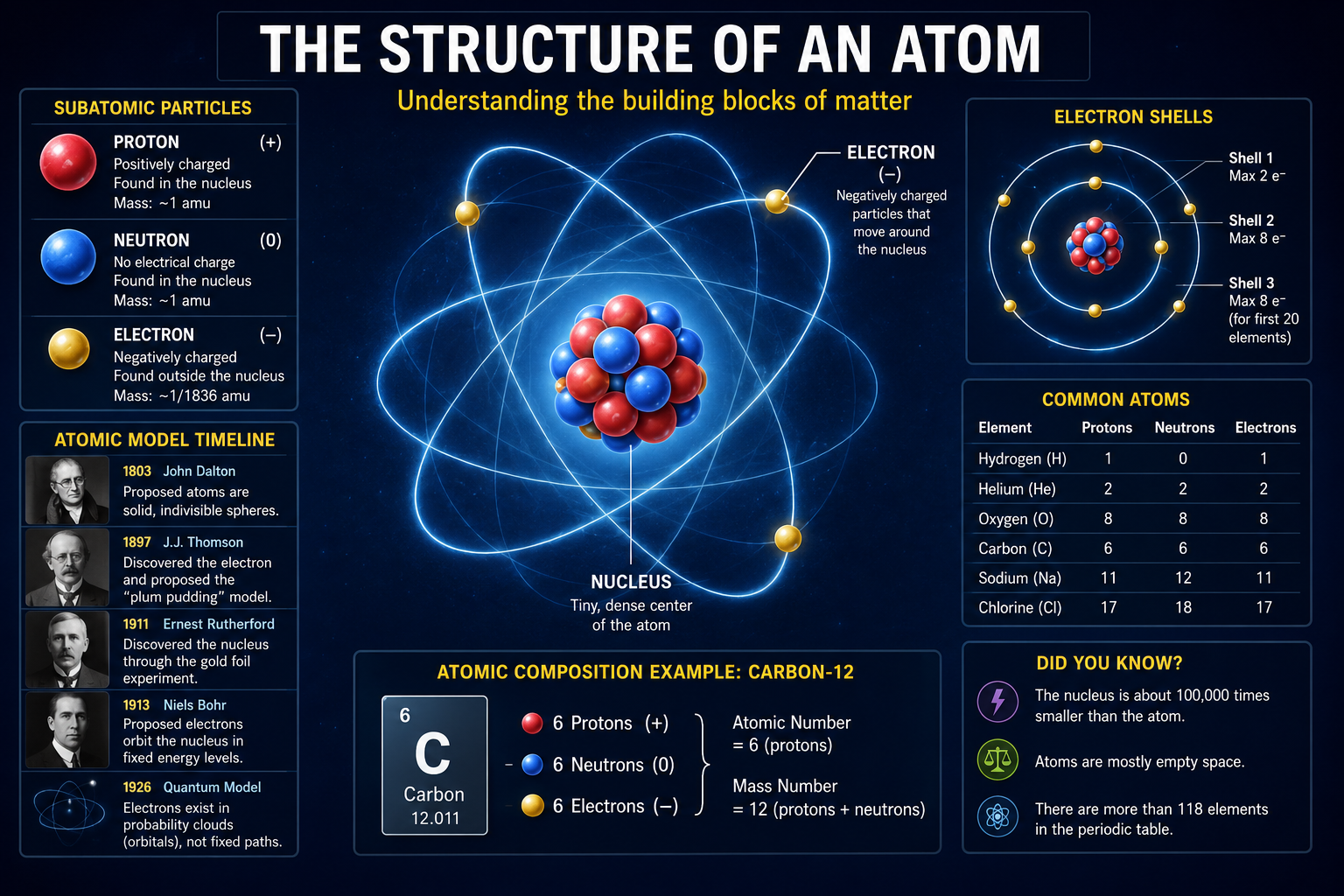
The discovery of the electron immediately posed a problem: atoms are electrically neutral, yet they contain negatively charged electrons. There must therefore be a counterbalancing positive charge within the atom. The quest for this positive charge led to the proton. Ernest Rutherford’s landmark gold foil experiment, conducted in 1909–1911 with Hans Geiger and Ernest Marsden, revealed that most of an atom’s positive charge — and most of its mass — is concentrated in a tiny, dense central nucleus.
Subsequent experiments demonstrated that hydrogen nuclei were fundamental constituents of larger nuclei. These hydrogen nuclei — each carrying a single positive charge equal in magnitude to the electron’s negative charge — were named protons by Rutherford in 1920. The proton’s mass is approximately 1.673 × 10⁻²⁷ kilograms, 1,836 times greater than the electron’s mass.
The Neutron
The nucleus posed another mystery: if a helium atom has two protons but a mass four times greater than hydrogen, and if the charge in the nucleus accounts for only half its mass, what carries the rest? Various hypotheses were proposed, including bound proton-electron pairs within the nucleus. The riddle was resolved in 1932 when the English physicist James Chadwick discovered a neutral particle of approximately the same mass as the proton — the neutron.
  Subatomic Particle Properties


          Particle
          Symbol
          Charge
          Mass (kg)
          Discovered


Electron    e⁻  −1.602 × 10⁻¹⁹ C    9.109 × 10⁻³¹   1897, Thomson

Proton  p⁺  +1.602 × 10⁻¹⁹ C    1.673 × 10⁻²⁷   1920, Rutherford

Neutron n   0   1.675 × 10⁻²⁷   1932, Chadwick
Chadwick’s discovery completed the classical picture of the atom: a nucleus containing protons and neutrons, surrounded by a cloud of electrons. The number of protons (the atomic number) defines the element; the number of neutrons distinguishes isotopes; and the electron configuration governs chemical behavior. This picture, while later substantially refined by quantum mechanics, remains the conceptual backbone of atomic science.
✦ ✦ ✦
- Atomic Models Through History
One of the most illuminating narratives in the history of science is the successive refinement of the atomic model — each iteration revealing new phenomena and opening new questions that the previous model could not address. From Thomson’s plum pudding to the sophisticated quantum mechanical model, the story of atomic models is a story of experimental surprise and theoretical ingenuity.
Thomson’s Plum Pudding Model (1904)
Having discovered the electron and knowing that atoms are electrically neutral, J.J. Thomson proposed in 1904 that an atom resembles a “plum pudding”: a diffuse sphere of positive charge (the “pudding”) within which electrons are embedded like raisins or plums, with the whole assembly being electrically neutral. This model successfully explained why atoms don’t simply fly apart — the electrons are held in place by the surrounding positive charge — and it predicted that electrons could be displaced, explaining phenomena like the photoelectric effect and ionization.
Rutherford’s Nuclear Model (1911)
The plum pudding model was shattered by the results of Rutherford, Geiger, and Marsden’s gold foil experiment. They directed a beam of positively charged alpha particles at an extremely thin sheet of gold foil and observed where the particles ended up using a circular screen coated with zinc sulphide, which flashed when struck. The plum pudding model predicted that most particles would pass straight through with only slight deflections, since the positive charge was spread thinly throughout the atom.
The results were astonishing. While most alpha particles did pass straight through, a small fraction — about 1 in 8,000 — were deflected by very large angles, some bouncing almost straight back. Rutherford famously described this as “almost as incredible as if you fired 15-inch shells at tissue paper and they came back and hit you.” The only explanation was that almost all of the atom’s positive charge, and most of its mass, was concentrated in an extremely small, dense central nucleus. The atom was mostly empty space.
Bohr’s Planetary Model (1913)
Rutherford’s nuclear model faced an immediate problem: according to classical electromagnetic theory, an electron orbiting a nucleus would continuously radiate energy and spiral inward, causing the atom to collapse in a fraction of a second. Clearly atoms are stable — so classical physics was inadequate. The Danish physicist Niels Bohr proposed a solution in 1913, incorporating the newly emerging quantum ideas of Max Planck and Albert Einstein.
Bohr postulated that electrons could only occupy certain specific orbits around the nucleus — allowed orbits in which they did not radiate energy. Each orbit corresponded to a specific energy level. Electrons could jump between energy levels by absorbing or emitting light of a specific frequency, with the energy of the photon exactly equal to the energy difference between the two levels. This model brilliantly explained the discrete spectral lines of hydrogen, providing specific numerical predictions that matched experimental data with extraordinary precision.
Despite its successes, the Bohr model had significant limitations. It could only accurately predict the spectrum of hydrogen and one-electron ions; it failed for multi-electron atoms. It could not explain the relative intensities of spectral lines, and it provided no explanation for the chemical bond. A more fundamental theoretical revolution was needed.
- The Quantum Mechanical Model
The quantum mechanical model of the atom, developed in the 1920s, represents one of the most profound intellectual achievements in human history. It replaced the deterministic, classical picture of electrons following definite orbits with a probabilistic description in which electrons occupy three-dimensional regions of space called orbitals, and their behavior is governed by the laws of quantum mechanics. This framework, while deeply counterintuitive, has proven to be the most accurate description of atomic reality ever devised.
Wave-Particle Duality
The foundations were laid by Louis de Broglie’s 1924 hypothesis that, just as light (which had been thought to be a wave) exhibited particle-like properties (as shown by Einstein’s explanation of the photoelectric effect), material particles like electrons should also exhibit wave-like properties. He proposed that a particle with momentum p has an associated wavelength λ = h/p, where h is Planck’s constant. This de Broglie wavelength was confirmed experimentally by the diffraction of electrons from crystal lattices.
The Schrödinger Equation
The Austrian physicist Erwin Schrödinger formalized wave mechanics in 1926 with his celebrated wave equation. The Schrödinger equation describes how the quantum state of a physical system — represented by a mathematical object called the wave function, ψ — evolves over time. The wave function itself does not correspond to any physical wave; rather, its square modulus |ψ|² gives the probability density for finding a particle at a given location. This probabilistic interpretation, championed by Max Born, was deeply troubling to many physicists, including Einstein, but it has withstood every experimental test.
Solving the Schrödinger equation for the hydrogen atom yields a set of discrete energy levels and corresponding wave functions called atomic orbitals. Each orbital is characterized by three quantum numbers: the principal quantum number (n), which determines the energy and overall size of the orbital; the angular momentum quantum number (l), which determines its shape; and the magnetic quantum number (mₗ), which determines its orientation in space. A fourth quantum number, the spin quantum number (mₛ), describes the intrinsic angular momentum of the electron and takes values of +½ or −½.
The Heisenberg Uncertainty Principle
Werner Heisenberg’s uncertainty principle, formulated in 1927, establishes a fundamental limit on the precision with which complementary physical properties can be simultaneously measured. The most famous form states that the uncertainty in a particle’s position (Δx) and the uncertainty in its momentum (Δp) must satisfy: Δx · Δp ≥ ℏ/2, where ℏ is the reduced Planck constant. This is not a limitation of our instruments — it is an intrinsic feature of quantum reality. An electron does not simultaneously have a definite position and a definite momentum.
"The uncertainty principle is not a statement about our ignorance — it is a statement about the irreducible fuzziness of the quantum world itself."The uncertainty principle explains atomic stability more deeply than Bohr’s postulates. An electron cannot be localized within the nucleus because doing so would confine it to an extremely small volume, which by the uncertainty principle would require an enormous momentum — and hence kinetic energy — that far exceeds the electrostatic attraction holding it there. The finite size of atoms is a direct consequence of quantum mechanics.
The Pauli Exclusion Principle
Wolfgang Pauli formulated his exclusion principle in 1925: no two electrons in an atom can have the same set of four quantum numbers. This principle, which has no classical analogue, governs the filling of atomic orbitals and is ultimately responsible for the structure of the periodic table, the diversity of chemical behavior, and the solidity of matter itself. Without the Pauli exclusion principle, all electrons would collapse into the lowest energy state, atoms would not form distinct shells, and the rich chemistry of life would be impossible.
✦ ✦ ✦
- Atomic Structure in Detail
To truly appreciate the atom, one must grapple with its extraordinary dimensions and the vast scales of emptiness and density it embodies. An atom is almost incomprehensibly small — a single hydrogen atom has a radius of approximately 53 picometres (53 × 10⁻¹² metres). If a hydrogen atom were enlarged to the size of a football stadium, the nucleus would be a small marble at the centre, and the electron would be an almost imperceptibly small speck orbiting somewhere in the upper tiers of the stands. The atom is overwhelmingly empty space.
Yet this emptiness is not a void in the classical sense. It is filled with the quantum mechanical probability distribution of the electron — a cloud of potential presence that defines the atom’s chemical character and physical extent. The dense nucleus at the centre, while occupying a volume roughly 10,000 to 100,000 times smaller than the atom itself, contains virtually all of the atom’s mass. Nuclear densities are extraordinary: matter in a typical atomic nucleus has a density of approximately 2 × 10¹⁷ kilograms per cubic metre — two hundred million billion times denser than water.
Atomic Dimensions
Atomic radii vary systematically across the periodic table, ranging from about 31 picometres for helium to about 298 picometres for caesium. These radii are not fixed boundaries but rather represent the most probable distance of the outermost electron from the nucleus, or in some contexts, half the distance between two adjacent atoms of the same element in a solid or molecule. Atomic radii generally decrease across a period (left to right) due to increasing nuclear charge pulling electrons closer, and increase down a group as electrons occupy higher principal energy levels.
Nuclear radii are far smaller, measured in femtometres (10⁻¹⁵ metres), also called fermis in honour of Enrico Fermi. The nuclear radius is approximately given by R = r₀A^(1/3), where A is the mass number and r₀ ≈ 1.2–1.3 fm. The nucleus of hydrogen (a single proton) has a radius of about 0.85 fm; the uranium nucleus, one of the heaviest naturally occurring nuclei, has a radius of roughly 7.4 fm.
- The Nucleus: Protons and Neutrons
The nucleus is the dense, positively charged core of the atom, containing protons and neutrons (collectively called nucleons). Despite occupying an almost negligibly small fraction of the atom’s volume, the nucleus determines the element’s identity, governs nuclear reactions, and accounts for the vast majority of the atom’s mass. Understanding the nucleus requires confronting forces far more powerful than electromagnetism — forces that operate on scales far smaller than those of everyday experience.
Protons and the Atomic Number
Each proton carries a positive electric charge equal in magnitude to the electron’s negative charge (1.602 × 10⁻¹⁹ coulombs). The number of protons in a nucleus — the atomic number, denoted Z — uniquely identifies an element. Hydrogen has Z = 1, carbon has Z = 6, gold has Z = 79, and uranium has Z = 92. A neutral atom has as many electrons as protons; removing or adding electrons creates ions.
Protons are not elementary particles — they are composite objects made of quarks, bound together by the strong nuclear force via particles called gluons. Each proton is composed of two up quarks (each with charge +2/3 e) and one down quark (charge −1/3 e), giving a total charge of +1 e. The strong force binding quarks within a proton is so powerful that quarks cannot exist in isolation under normal conditions — a phenomenon called confinement.
Neutrons and Mass Numbers
Neutrons are electrically neutral nucleons with a mass slightly greater than the proton’s (1.675 × 10⁻²⁷ kg versus 1.673 × 10⁻²⁷ kg). The total number of nucleons (protons plus neutrons) is the mass number, denoted A. The number of neutrons (N = A − Z) can vary for atoms of the same element, giving rise to isotopes. While protons repel each other through the electromagnetic force, the strong nuclear force — which acts between all nucleons, regardless of charge — overcomes this repulsion and holds the nucleus together.
A free neutron outside the nucleus is unstable, undergoing beta decay with a half-life of approximately 10.3 minutes, transforming into a proton, an electron, and an antineutrino. Within a stable nucleus, however, neutrons can persist indefinitely because the energy conditions that would allow decay are not met.
- Electrons and Orbital Theory
Electrons are the outermost constituents of atoms and the primary agents of chemical behavior. Unlike protons and neutrons, electrons appear to be elementary particles with no known internal structure — as far as current experiments can determine, the electron is a point particle. Its behavior is entirely governed by quantum mechanics, and its distribution around the nucleus — described by the wave function — determines how atoms interact with each other and with electromagnetic radiation.
Quantum Numbers and Atomic Orbitals
Each electron in an atom is described by a unique set of four quantum numbers. The principal quantum number (n = 1, 2, 3, …) defines the electron’s energy level and the average distance from the nucleus. The angular momentum quantum number (l = 0, 1, 2, …, n−1) determines the orbital’s shape: l = 0 gives spherical s orbitals; l = 1 gives dumbbell-shaped p orbitals; l = 2 gives the more complex d orbitals; l = 3 gives f orbitals. The magnetic quantum number (mₗ = −l to +l) specifies the orbital’s orientation. The spin quantum number (mₛ = +½ or −½) describes the electron’s intrinsic spin.
Atomic orbitals are not physical objects — they are mathematical probability distributions. The s orbital is spherically symmetric; the three p orbitals are oriented along the x, y, and z axes; the five d orbitals have more complex geometries with nodal planes; the seven f orbitals are more complex still. Nodes — surfaces where the probability of finding the electron is zero — divide the electron density into lobes and increase in number with higher quantum numbers.
Electron Configuration
The distribution of electrons among the available orbitals — the electron configuration — is determined by three principles: the Aufbau principle (electrons fill lower energy levels first), the Pauli exclusion principle (no two electrons share the same four quantum numbers), and Hund’s rule (electrons singly occupy all orbitals of equal energy before pairing up, and unpaired electrons have parallel spins). These rules generate the electronic configurations that underlie the periodic table’s structure.
  Orbital Capacity Summary


Subshell    l value Orbitals    Max Electrons

s   0   1   2

p   1   3   6

d   2   5   10

f   3   7   14
The electron configuration of an atom governs nearly everything that matters for chemistry: valence (the capacity to form bonds), electronegativity (the tendency to attract electrons in a bond), ionization energy (the energy required to remove an electron), and chemical reactivity. The remarkable diversity of chemistry — from the explosive reactivity of alkali metals to the complete inertness of noble gases — is entirely explained by electron configuration.
✦ ✦ ✦
- Isotopes and Radioactivity
Isotopes are atoms of the same element — with the same number of protons and hence the same chemical identity — but differing numbers of neutrons in the nucleus. Most elements in nature exist as mixtures of isotopes; carbon, for example, occurs primarily as carbon-12 (6 protons, 6 neutrons) and carbon-13 (6 protons, 7 neutrons), with a trace of carbon-14 (6 protons, 8 neutrons). The atomic mass listed in the periodic table is a weighted average of the masses of an element’s naturally occurring isotopes.
Stable and Unstable Isotopes
Some isotopes are stable — their nuclei persist indefinitely without change. Others are unstable (radioactive) — their nuclei spontaneously transform, emitting particles and/or electromagnetic radiation in a process called radioactive decay. The stability of a nucleus depends on the ratio of neutrons to protons and on nuclear shell effects. Nuclei with too many or too few neutrons relative to protons tend to be unstable. Among elements heavier than bismuth (Z = 83), all known isotopes are radioactive.
Types of Radioactive Decay
Alpha (α) decay involves the emission of an alpha particle (a helium-4 nucleus: 2 protons and 2 neutrons). It reduces the atomic number by 2 and the mass number by 4, transforming the parent element into a new daughter element. Alpha particles have low penetrating power and are stopped by a sheet of paper or a few centimetres of air, but are highly ionizing and dangerous if ingested or inhaled.
Beta (β) decay comes in two forms. In β⁻ decay, a neutron converts to a proton, emitting an electron and an antineutrino; the atomic number increases by 1. In β⁺ decay (positron emission), a proton converts to a neutron, emitting a positron and a neutrino; the atomic number decreases by 1. Beta particles are more penetrating than alpha particles but are stopped by aluminium foil or a few millimetres of wood.
Gamma (γ) decay involves the emission of high-energy photons from an excited nucleus transitioning to a lower energy state. No change in atomic or mass number occurs. Gamma radiation is highly penetrating, requiring thick lead or concrete shielding. Electron capture is another decay mode in which a proton captures an inner shell electron, converting to a neutron and emitting a neutrino.
Half-Life and Radioactive Dating
Radioactive decay is a random quantum mechanical process for any individual nucleus, but for large populations of nuclei, it follows a precise exponential decay law. The half-life (t½) is the time required for exactly half of a sample of radioactive atoms to decay. Half-lives span an enormous range: from 10⁻²³ seconds for extremely unstable isotopes to 4.47 × 10⁹ years for uranium-238 — longer than the age of the Earth.
Radioactive decay provides powerful tools for dating ancient materials. Carbon-14, produced continuously in the upper atmosphere by cosmic ray bombardment of nitrogen-14, is incorporated into living organisms through photosynthesis and the food chain. When an organism dies, it stops exchanging carbon with the environment, and the carbon-14 in its tissues begins to decay with a half-life of 5,730 years. By measuring the ratio of carbon-14 to carbon-12 in a sample, scientists can determine when the organism died — a technique called radiocarbon dating, which has revolutionised archaeology and palaeontology.
- The Periodic Table and Atomic Properties
The periodic table of the elements, one of the most celebrated intellectual achievements of chemistry, is a direct reflection of atomic structure. Dmitri Mendeleev published his periodic table in 1869, arranging the then-known elements in order of increasing atomic mass and noting that properties recurred at regular intervals (periods). His genius lay in leaving gaps for elements not yet discovered and predicting their properties from periodic trends — predictions later confirmed with striking accuracy for gallium, germanium, and scandium.
Modern understanding reveals that the periodicity in chemical properties is a consequence of the periodic recurrence of electron configurations — specifically, the filling of electron shells and subshells. Elements in the same group (vertical column) have the same number of valence electrons and hence similar chemical reactivity. The eight main groups range from the highly reactive alkali metals (group 1, one valence electron) to the chemically inert noble gases (group 18, full valence shells).
Periodic Trends
Atomic radius generally decreases across a period (as increasing nuclear charge pulls electrons closer) and increases down a group (as electrons occupy higher principal energy levels with greater average distances from the nucleus).
Ionization energy — the energy required to remove the outermost electron from a neutral atom in the gas phase — generally increases across a period and decreases down a group. Noble gases have the highest ionization energies; alkali metals have the lowest.
Electronegativity — the tendency of an atom to attract electrons in a chemical bond — increases across a period and decreases down a group. Fluorine is the most electronegative element (3.98 on the Pauling scale); francium is the least.
Electron affinity — the energy released when a neutral atom gains an electron — shows less regular trends but is generally most positive (most favourable) for halogens and least favourable for noble gases and alkaline earth metals.
Periodic Table Blocks and Their Electron Filling- s-block (Groups 1–2): Filling the s subshell — alkali and alkaline earth metals
- p-block (Groups 13–18): Filling the p subshell — main group metals, metalloids, nonmetals, halogens, noble gases
- d-block (Groups 3–12): Filling the d subshell — transition metals
- f-block (Lanthanides & Actinides): Filling the f subshell — inner transition elements
The periodic table now contains 118 confirmed elements, from hydrogen (Z=1) to oganesson (Z=118). Elements 1–94 occur naturally; elements 95–118 are synthetic, produced in particle accelerators or nuclear reactors. Superheavy elements beyond Z=104 are so unstable that their half-lives may be measured in milliseconds or even microseconds, yet their atomic properties can still be probed with sophisticated experimental techniques, and their measured properties generally confirm quantum mechanical predictions.
✦ ✦ ✦
- Chemical Bonding and Atomic Interactions
The extraordinary diversity of matter — from diamond to water, from proteins to semiconductors — arises from the ways atoms bond together, and these bonds are fundamentally electronic in nature. Chemical bonding is the consequence of atoms seeking to achieve lower energy states by sharing or transferring electrons. The branch of science that explains chemical bonding is quantum chemistry, which applies the principles of quantum mechanics to molecular systems.
Ionic Bonding
Ionic bonds form when one atom (typically a metal with low ionization energy) transfers one or more electrons to another atom (typically a non-metal with high electron affinity). The resulting oppositely charged ions attract each other electrostatically, forming an ionic compound. Sodium chloride (table salt) is the classic example: sodium donates its single valence electron to chlorine, yielding Na⁺ and Cl⁻ ions that arrange into a regular crystal lattice. Ionic compounds are typically hard, brittle, high-melting solids that conduct electricity when dissolved in water or melted.
Covalent Bonding
Covalent bonds form when atoms share electrons. In a shared electron pair, each electron experiences attractive forces from both atomic nuclei, and this mutual attraction is energetically favourable compared to the separated atoms. The degree of sharing depends on the electronegativities of the bonded atoms: in a bond between two identical atoms (as in H₂ or O₂), electrons are shared equally (nonpolar covalent bond); in bonds between different atoms, electrons are shared unequally, with the more electronegative atom carrying a partial negative charge (polar covalent bond).
Covalent bonds can be single (one shared pair), double (two shared pairs), or triple (three shared pairs), and these bond orders correspond to increasing bond strengths and decreasing bond lengths. Molecular orbital theory, which extends the atomic orbital concept to molecules, provides a rigorous quantum mechanical treatment of covalent bonding, explaining properties such as bond order, magnetic behaviour, and excited states of molecules.
Metallic Bonding
In metals, valence electrons are delocalized across the entire crystal structure, forming what is often described as a “sea of electrons” that permeates a lattice of positively charged metal ions. This delocalization accounts for metals’ characteristic properties: high electrical and thermal conductivity (mobile electrons carry charge and heat), malleability and ductility (the electron sea allows metal ions to slide past each other without disrupting the bond), and characteristic metallic lustre (mobile electrons interact readily with light across a wide frequency range).
Van der Waals Forces and Hydrogen Bonds
Beyond the primary bond types, atoms and molecules also interact through weaker, secondary forces. Van der Waals forces include London dispersion forces (arising from instantaneous fluctuations in electron distribution creating temporary dipoles), dipole-dipole interactions, and induced dipole forces. Though individually weak, these forces are collectively responsible for phenomena such as the condensation of noble gases and the high boiling point of large organic molecules.
Hydrogen bonds are a special type of dipole-dipole interaction occurring when hydrogen is bonded to a highly electronegative atom (oxygen, nitrogen, or fluorine) and the partially positive hydrogen is attracted to a lone pair on a nearby electronegative atom. Hydrogen bonds are crucial to the structure and function of water (explaining its anomalously high boiling point and heat capacity), DNA (maintaining the double helix structure), and proteins (governing folding and enzymatic function).
- Nuclear Forces and Binding Energy
The nucleus presents a profound physical puzzle: protons, packed into a volume of approximately 10⁻⁴⁵ cubic metres, repel each other with an electrostatic force of staggering magnitude. At nuclear distances, this repulsion is enormous — far greater than any force encountered in everyday experience. That nuclei are stable at all — that matter as we know it exists — is because of a more powerful force that operates at these scales: the strong nuclear force.
The Strong Nuclear Force
The strong nuclear force (also called the strong interaction or strong force) is the most powerful of the four fundamental forces of nature. It acts between all nucleons — protons and neutrons alike — regardless of their charge, and is attractive at short range (up to about 1–3 femtometres). At very short distances (less than 0.7 fm), it becomes repulsive, preventing nucleons from merging entirely. Beyond about 2.5 fm, it drops to zero, which is why the strong force does not affect everyday objects — it is a strictly nuclear-range force.
At a deeper level, the strong force is a residual manifestation of the fundamental colour force between quarks, mediated by gluons and described by the theory of quantum chromodynamics (QCD). The strong force between nucleons is somewhat analogous to the van der Waals force between atoms — a secondary effect of a deeper interaction that nonetheless gives rise to the rich, complex structure of nuclear physics.
Nuclear Binding Energy
The binding energy of a nucleus is the energy required to completely separate it into its constituent protons and neutrons. It can also be thought of as the energy released when those nucleons come together to form the nucleus — the “savings” in energy that nature achieves by having nucleons bound together rather than free. This binding energy is related to the mass defect: the actual mass of a nucleus is always slightly less than the sum of the masses of its constituent nucleons. Einstein’s famous equation E = mc² relates this mass defect to the binding energy.
The binding energy per nucleon — a measure of nuclear stability — peaks at iron-56 (Fe-56), which has a binding energy per nucleon of approximately 8.79 MeV. Nuclei lighter than iron can release energy by fusion (merging to form heavier nuclei), while nuclei heavier than iron can release energy by fission (splitting into lighter fragments). This explains why stars burn hydrogen and helium by fusion to release energy, and why nuclear reactors use the fission of uranium or plutonium.
"The mass of a nucleus is less than the sum of its parts — and it is precisely this deficit, transformed into energy, that powers the stars."✦ ✦ ✦
- Atomic Spectra and Energy Levels
When atoms absorb or emit electromagnetic radiation, they do so only at specific, characteristic frequencies — a property that gives each element a unique spectral “fingerprint” and provides one of the most powerful tools for probing atomic structure. The study of atomic spectra was instrumental in the development of quantum mechanics and continues to underpin technologies ranging from lasers to astronomical observation.
When white light passes through a sample of gaseous atoms, certain wavelengths are absorbed — the atoms absorb photons whose energy exactly matches the difference between two energy levels. The resulting dark lines in the spectrum (an absorption spectrum) are characteristic of the element. Conversely, when a gas is excited by heating or electrical discharge, atoms emit photons as electrons transition from higher to lower energy levels, producing bright lines at specific wavelengths (an emission spectrum).
The Hydrogen Spectrum
Hydrogen’s emission spectrum, the simplest of all elements, consists of several series of lines, each corresponding to transitions terminating at a specific energy level. The Lyman series (ultraviolet) corresponds to transitions to n=1; the Balmer series (visible) to n=2; the Paschen series (infrared) to n=3, and so on. Johann Balmer empirically discovered the formula for the visible hydrogen lines in 1885; Niels Bohr’s model explained these lines theoretically in 1913; and quantum mechanics provides the definitive explanation.
The energy of a photon emitted or absorbed in a transition between levels n₁ and n₂ in hydrogen is given by: E = 13.6 eV × (1/n₁² − 1/n₂²). This simple formula, derivable from the Schrödinger equation, reproduces the observed spectral line positions with astonishing accuracy and was one of quantum mechanics’ early triumphs.
Selection Rules and Transition Probabilities
Not all transitions between energy levels are equally likely. Quantum mechanics prescribes selection rules that govern which transitions are allowed and which are forbidden, based on conservation of angular momentum and other symmetry principles. Allowed electric dipole transitions must satisfy Δl = ±1 and Δmₗ = 0, ±1. Forbidden transitions can still occur (via magnetic dipole or electric quadrupole mechanisms) but at much lower rates, often resulting in emission of photons over much longer timescales.
The characteristic spectra of elements are exploited in spectroscopy — a suite of analytical techniques with applications ranging from medical diagnostics and environmental monitoring to the analysis of stellar atmospheres. By analysing the spectral lines in light from distant stars and galaxies, astronomers can determine their chemical composition, temperature, density, velocity, and magnetic field strength — all without physical access to these remote objects.
- Atoms in Quantum Field Theory
Quantum mechanics, as developed in the 1920s, provided a spectacularly successful framework for describing atoms and molecules. But it had limitations: it was not fully consistent with Einstein’s special theory of relativity, and it did not naturally describe the creation and destruction of particles. These shortcomings were addressed by quantum field theory (QFT), which represents our deepest current understanding of the fundamental constituents of matter and their interactions.
Quantum Electrodynamics
Quantum electrodynamics (QED), developed by Richard Feynman, Julian Schwinger, Sin-Itiro Tomonaga, and Freeman Dyson in the late 1940s, is the quantum field theory of electromagnetism. It describes the interaction between charged particles (like electrons) and photons (the quanta of the electromagnetic field) with extraordinary precision. QED correctly accounts for subtle effects in atomic spectra beyond the predictions of ordinary quantum mechanics, including the Lamb shift (a small splitting of certain energy levels in hydrogen) and the anomalous magnetic moment of the electron.
The QED prediction for the electron’s magnetic moment (g-factor) agrees with experiment to more than ten significant figures — making it the most precisely tested prediction in the history of physics. This extraordinary agreement is a testament to the correctness of quantum field theory as a description of electromagnetic interactions between electrons and photons.
Quantum Chromodynamics and the Quark Structure of Nucleons
Quantum chromodynamics (QCD) describes the strong force that binds quarks within protons and neutrons, and that ultimately holds nuclei together. In QCD, quarks carry a property called colour charge (analogous to electric charge, but with three varieties: red, green, and blue) and interact by exchanging gluons, the force-carrying particles of the strong force. The property of confinement — no free quarks are ever observed — arises from the unique feature of QCD that the strong force does not weaken with distance, unlike electromagnetism.
The Standard Model of particle physics, which unifies QED, QCD, and the electroweak theory (unifying electromagnetism and the weak nuclear force responsible for radioactive beta decay), is the most comprehensive theory of matter and forces ever constructed. While it does not incorporate gravity, it correctly describes all known phenomena at the subatomic level and has been tested to extraordinary precision in particle accelerator experiments.
✦ ✦ ✦
- Atoms in Technology and Medicine
The understanding of atomic structure and atomic phenomena has generated a cascade of technologies that define modern civilization. From the transistors in every smartphone to the MRI scanner in every major hospital, from the lasers used in communications and surgery to the nuclear reactors providing clean energy, the atom is not merely a scientific curiosity — it is the foundation of the technological world.
Nuclear Energy
Nuclear fission reactors harness the energy released when heavy nuclei (primarily uranium-235 or plutonium-239) split into lighter fragments upon absorbing a neutron, releasing two or three new neutrons and a large amount of energy — approximately 200 MeV per fission event, compared to a few eV for a typical chemical reaction. A controlled chain reaction, maintained at criticality in a reactor core, allows this energy to be extracted as heat and converted to electricity. As of the mid-2020s, nuclear power provides approximately 10% of global electricity generation, with minimal direct carbon emissions.
Nuclear fusion — the process that powers the Sun — promises even greater energy yields and essentially unlimited fuel from seawater deuterium. Achieving controlled thermonuclear fusion on Earth has been one of the most challenging scientific and engineering endeavours ever undertaken. The ITER project in France, and a new generation of private fusion companies, are working toward commercial fusion power, which could arrive within the coming decades.
Medical Applications
Radioisotopes are indispensable in modern medicine. Technetium-99m, produced in hospital generators and administered intravenously, is used in tens of millions of diagnostic scans annually, providing images of organ function with minimal radiation dose. Positron emission tomography (PET) uses short-lived positron-emitting isotopes (such as fluorine-18 in fluorodeoxyglucose) to image metabolic activity in the brain, heart, and tumours. Iodine-131 is used to treat thyroid cancer and hyperthyroidism. Radium-223 targets bone metastases in prostate cancer.
Magnetic resonance imaging (MRI), one of the most powerful diagnostic tools in medicine, exploits the quantum mechanical property of nuclear spin. Protons in the body (primarily in water molecules) have a spin of ½ and behave as tiny magnets. In a strong external magnetic field, these spins align and can be excited by radiofrequency pulses. The relaxation of the spins back to equilibrium emits radio signals that can be spatially encoded to reconstruct detailed three-dimensional images of soft tissue with no ionizing radiation.
Lasers and Photonics
Lasers (Light Amplification by Stimulated Emission of Radiation) are based directly on atomic physics: the stimulated emission of photons, predicted by Einstein in 1917 as the reverse of absorption. When an atom in an excited state encounters a photon whose energy matches a downward transition, it is stimulated to emit a second photon with identical wavelength, phase, and direction. By creating a population inversion (more atoms in an excited state than the ground state) and using optical feedback in a cavity, laser light of extraordinary coherence, monochromaticity, and directionality can be generated.
Lasers are ubiquitous: they transmit internet data through fibre optic cables, read and write optical discs, cut steel and perform eye surgery, measure distances with millimetre precision, and cool atoms to within billionths of a degree of absolute zero. Laser cooling, which exploits the momentum of photons to slow atoms, enabled the creation of Bose-Einstein condensates — a new state of matter predicted by quantum mechanics and first produced in 1995.
Semiconductors and the Digital Age
The entire digital revolution rests on the quantum mechanical properties of electrons in crystalline solids. In semiconductors such as silicon and germanium, the band structure — arising from the quantum mechanical behaviour of electrons in a periodic crystal lattice — creates an energy gap between the valence band (filled with electrons) and the conduction band (empty under normal conditions). By introducing impurity atoms (doping) in controlled concentrations, this band gap and the resulting electrical properties can be precisely engineered, enabling transistors, diodes, solar cells, and LEDs. The transistor, invented in 1947, is arguably the most transformative technological device ever created — a direct product of atomic physics.
- Atoms and the Origin of the Universe
The story of atoms is inseparable from the story of the universe itself. Modern cosmology, supported by overwhelming observational evidence, holds that the universe began approximately 13.8 billion years ago in a state of extraordinary density and temperature — the Big Bang. In the first fractions of a second, conditions were so extreme that even atomic nuclei could not exist; the universe was a seething plasma of quarks and gluons. The emergence of atoms — and ultimately of all the matter we see around us — is the story of the universe’s cooling and the progressive formation of structure from quantum fluctuations in the primordial plasma.
Big Bang Nucleosynthesis
In the first few minutes after the Big Bang, as the universe cooled to temperatures of about 10⁹ kelvin, protons and neutrons could combine to form the lightest atomic nuclei. This process, Big Bang nucleosynthesis, produced hydrogen (protons, about 75% by mass), helium-4 (about 25%), and trace amounts of deuterium, helium-3, and lithium-7. All heavier elements were absent — the raw material of the universe was overwhelmingly hydrogen and helium. This predicted primordial abundance is confirmed by observations of the oldest, most pristine stars and gas clouds, providing powerful evidence for the Big Bang model.
Stellar Nucleosynthesis
The heavier elements — carbon, oxygen, iron, and everything else in the periodic table — were forged inside stars through nuclear fusion and dispersed through space by stellar winds and supernova explosions. Stars spend most of their lives fusing hydrogen to helium in their cores; as they age, they fuse helium to carbon and oxygen; more massive stars continue to fuse carbon, neon, oxygen, and silicon, building up elements up to iron-56. Beyond iron, fusion no longer releases energy — instead, elements heavier than iron are produced by neutron capture processes (the slow s-process in red giant stars, and the rapid r-process in the extreme conditions of neutron star mergers and supernovae).
This means that every carbon atom in every living organism, every oxygen atom in every breath, every iron atom in every blood cell — all were synthesized inside stars that lived and died before the Solar System formed. The iron in your blood was forged in the core of a dying star; the calcium in your bones was expelled in a supernova explosion billions of years ago. Carl Sagan’s observation that “we are made of star stuff” is not metaphor — it is precise atomic chemistry.
Recombination and the Cosmic Microwave Background
Approximately 380,000 years after the Big Bang, the universe had cooled to about 3,000 kelvin — cool enough for protons to capture electrons and form neutral hydrogen atoms. This epoch, called recombination (somewhat misleadingly, as electrons and protons were combining for the first time), was transformative: the universe became transparent to electromagnetic radiation, which streamed freely for the first time. This primordial light is observed today as the cosmic microwave background radiation — the afterglow of the Big Bang, redshifted by the expansion of the universe to microwave wavelengths. The CMB’s existence and properties represent one of the most precise confirmations of modern cosmology.
✦ ✦ ✦
- Frontiers of Atomic Research
Despite more than a century of sustained investigation, the atom continues to yield new surprises, and the frontiers of atomic research remain among the most exciting in all of science. From the manipulation of individual atoms to the simulation of complex quantum systems, from the search for new elements to the development of atomic-scale computing, researchers today are pushing the boundaries of what is possible at the nanoscale.
Atomic-Scale Manipulation
The scanning tunnelling microscope (STM), invented by Gerd Binnig and Heinrich Rohrer in 1981 (Nobel Prize 1986), can image individual atoms on surfaces and even move them one by one. In a famous 1989 demonstration, IBM researchers spelled out “IBM” by repositioning 35 xenon atoms on a nickel surface — the smallest corporate logo in history and a proof of concept for atomic-scale engineering. Atomic force microscopy (AFM) extends these capabilities to non-conducting surfaces and biological molecules, enabling direct imaging of DNA, proteins, and cell membranes at near-atomic resolution.
Quantum Computing
Quantum computers exploit quantum mechanical properties — superposition (a quantum bit or “qubit” can represent 0 and 1 simultaneously) and entanglement (correlated quantum states between qubits) — to perform certain computations exponentially faster than classical computers. Several promising physical implementations of qubits use individual atoms or ions: trapped ion quantum computers trap individual atoms of ytterbium or calcium in electromagnetic fields, using laser pulses to perform gate operations; neutral atom quantum computers use laser tweezers to arrange and manipulate individual atoms of caesium or rubidium in optical lattices.
As of the mid-2020s, quantum computers with hundreds to thousands of qubits have been demonstrated, and the race to achieve “quantum advantage” — demonstrating a quantum computer solving a practically useful problem faster than any classical computer — is well underway. The implications for cryptography, drug discovery, materials simulation, and optimization are potentially transformative.
Ultra-Cold Atoms and Bose-Einstein Condensates
Laser cooling and evaporative cooling can reduce atomic samples to temperatures within billionths of a degree of absolute zero. At such extreme temperatures, a remarkable quantum phenomenon occurs for bosonic atoms: Bose-Einstein condensation, predicted by Satyendra Nath Bose and Albert Einstein in 1924–1925 and first achieved experimentally by Eric Cornell, Carl Wieman, and Wolfgang Ketterle in 1995 (Nobel Prize 2001). In a Bose-Einstein condensate (BEC), a macroscopic fraction of the atoms occupy the same quantum ground state, behaving as a single coherent quantum entity. BECs allow quantum phenomena — superfluid flow, quantum interference — to be observed at macroscopic scales and provide pristine laboratories for studying quantum many-body physics.
Attosecond Science
Attosecond science (1 attosecond = 10⁻¹⁸ seconds) uses ultrashort laser pulses — generated through high-harmonic generation, in which an intense laser pulse interacts with an atom to produce extreme ultraviolet light in bursts of attosecond duration — to observe and control electron dynamics in real time. As electrons move and rearrange on timescales of tens to hundreds of attoseconds, attosecond spectroscopy enables direct observation of charge migration in molecules, photoionization dynamics, and the making and breaking of chemical bonds. The 2023 Nobel Prize in Physics recognized the development of attosecond science by Pierre Agostini, Ferenc Krausz, and Anne L’Huillier.
New Elements and the Island of Stability
The synthesis of superheavy elements — those beyond fermium (Z=100) — requires particle accelerators to fuse lighter nuclei with heavy targets. The four most recently named elements (nihonium-113, moscovium-115, tennessine-117, and oganesson-118, named in 2016) complete the seventh period of the periodic table. Nuclear theorists predict that beyond the currently known superheavy elements, there may be an “island of stability” — a region centred around proton number 114 and neutron number 184 where nuclear shell effects would produce isotopes with half-lives potentially ranging from days to millions of years. Reaching this island represents one of the central goals of contemporary nuclear physics.
- Conclusion
The atom is one of humanity’s greatest intellectual discoveries — and unlike most discoveries, it is one whose implications have grown deeper, stranger, and more consequential with every passing decade. What began as a philosophical speculation about the ultimate constituents of matter became, through centuries of experimentation and theoretical innovation, one of the most precisely tested and practically consequential bodies of knowledge in human history.
We have traced the atom’s conceptual journey from the speculations of Democritus and the Indian atomists, through the chemical atomism of Dalton and the experimental discoveries of Thomson, Rutherford, and Chadwick, to the quantum mechanical revolution that revealed the atom’s true nature as a quantum system governed by probability amplitudes, wave functions, and irreducible uncertainty. We have explored the nucleus — that extraordinarily dense, extraordinarily small repository of matter and energy — and the electrons whose quantum states encode all of chemistry and much of biology. We have examined isotopes and radioactivity, atomic spectra and energy levels, nuclear forces and binding energies, and the quantum field theories that represent our deepest current understanding of matter.
The atom is, simultaneously, the product of some of the most violent and energetic processes in the universe — the nuclear furnaces of stars, the cataclysms of supernovae, the extreme densities of the Big Bang — and the foundation of the most delicate, intricate, life-enabling chemistry. Every atom in your body was created by nuclear reactions in stars that lived before the Solar System existed. Every heartbeat, every thought, every act of perception is the result of quantum mechanical interactions among atoms, orchestrated by billions of years of evolution. The atom is both cosmological and intimate, both ancient and continuously present.
The frontiers of atomic research remain among the most exciting in science. Quantum computing promises to harness quantum mechanics for computation. Attosecond science is giving us real-time movies of electrons in motion. Ultracold atom experiments are revealing new phases of quantum matter. The search for superheavy elements continues at the edge of the periodic table. And the dream of controlled nuclear fusion — the power of stars captured in a machine — has never been closer to realization.
The ancient philosophers who dreamed of the atom could not have imagined the reality science has uncovered: a universe built from quantum probability clouds, held together by four fundamental forces, shaped by the symmetries of spacetime. The atom is not the simple, billiard-ball object of Dalton’s imagination, nor even the planetary model of early twentieth-century physics. It is a quantum system of extraordinary richness and subtlety — one whose full implications we are still working to understand. In this sense, the story of the atom is also the story of science itself: an enterprise of perpetual discovery, perpetually revealing a universe more intricate, more beautiful, and more astonishing than any prior generation could have imagined.
"The atoms of our bodies are tracers that link us to the remanants of exploded stars, the chemistry of galaxies, and ultimately the Big Bang itself."— Lawrence M. Krauss





Be First to Comment