
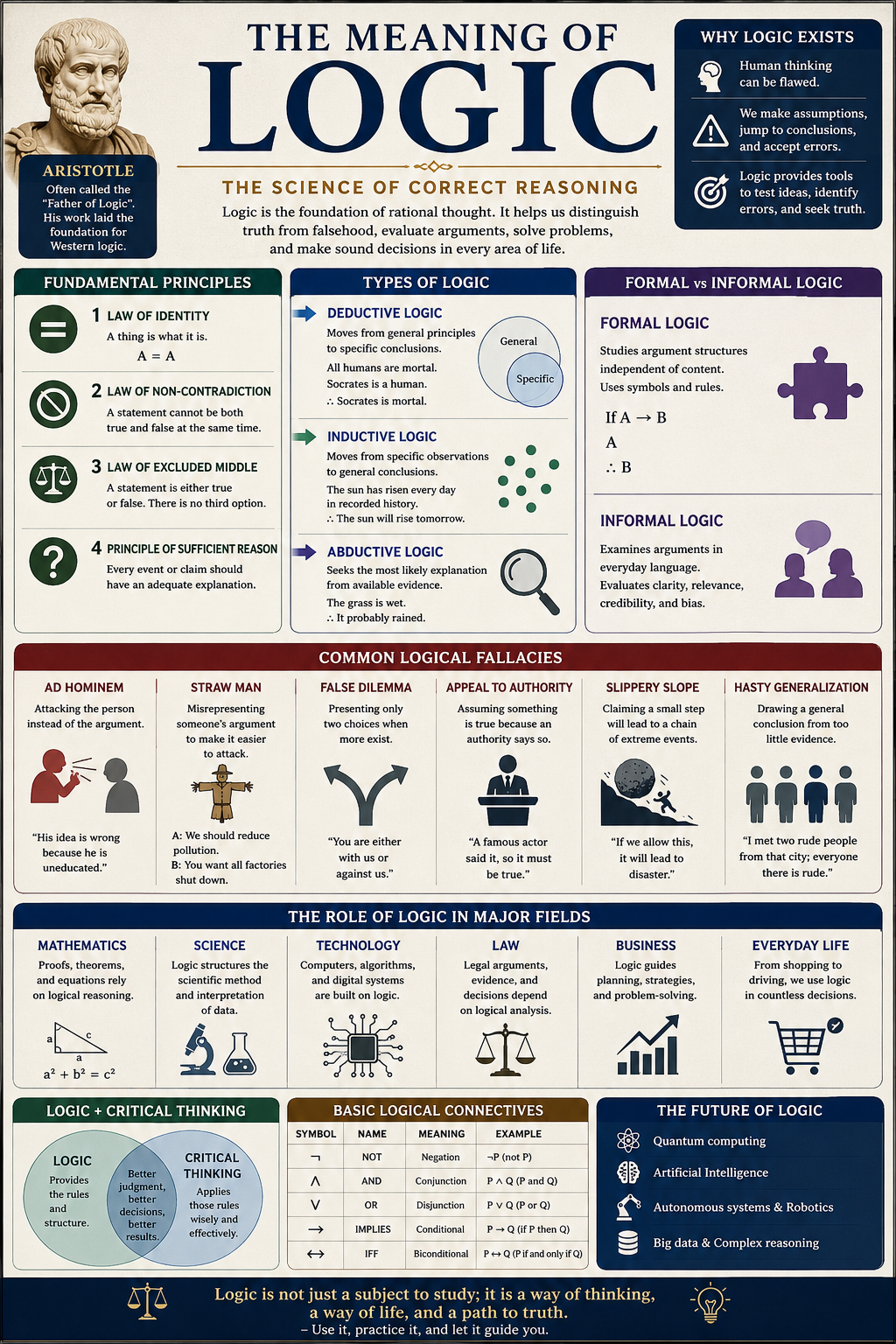
Section 01
Why Logic Matters
Every act of reasoning makes an implicit claim. When we conclude that the streets must be wet because it has been raining, or that a suspect could not have committed a crime because they were elsewhere, we assert that one thing follows from another.
Logic is the discipline that makes this notion of “following from” explicit, precise, and subject to scrutiny. It asks the deceptively simple question: under what conditions does a conclusion genuinely follow from its premises?
The word “logic” derives from the Greek logos, a term of remarkable richness that meant word, speech, account, reason, and principle. This etymology is instructive. For the Greeks, the capacity to give a reasoned account of things was inseparable from the capacity for ordered speech. Logic emerged as the study of the patterns that make discourse coherent and reasoning trustworthy.
The dual character of logic. From the outset, logic has worn two faces. On one side it is normative: it tells us how we ought to reason if we wish to preserve truth and avoid contradiction. On the other side it is descriptive and formal: it identifies the abstract structures shared by valid arguments regardless of their subject matter. These two aspects are connected but distinct, and much confusion about the meaning of logic dissolves once they are kept apart.
Core definition
Logic is the systematic study of the principles of valid inference and correct reasoning — the study of which conclusions are guaranteed, or rationally supported, by which premises, in virtue of their form rather than their specific content.
Section 02
The Central Concepts
A handful of concepts form the conceptual spine of the entire discipline, and grasping them precisely is half of understanding what logic means.
2.1Propositions, arguments, and inference
A proposition is the bearer of truth or falsity — the content expressed by a declarative sentence. “Snow is white” and “La neige est blanche” express the same proposition. An argument is a structured set of propositions in which some, the premises, are offered in support of another, the conclusion. Inference is the act of moving from premises to conclusion.
2.2Truth versus validity
The single most important distinction in all of logic is that between truth and validity. Truth is a property of individual propositions: a proposition is true if things are as it says they are. Validity is a property of arguments: an argument is valid if it is impossible for all its premises to be true while its conclusion is false. Validity concerns the relationship between premises and conclusion, not whether either is actually true.
A valid argument with false premises
P1 All metals are liquid at room temperature.
P2 Iron is a metal.
∴ Iron is liquid at room temperature.
This argument is perfectly valid — the conclusion follows inescapably — yet it is unsound because P1 is false. Validity is about structure; soundness adds the requirement that the premises be true.
2.3Logical consequence
At the heart of logic lies the relation of logical consequence: conclusion C is a logical consequence of premises P when the truth of P guarantees the truth of C in virtue of form alone. This relation can be characterised in two complementary ways. The semantic characterisation says C follows from P if every interpretation making all of P true also makes C true. The syntactic characterisation says C follows from P if C can be derived from P by accepted inference rules. The agreement of these two perspectives is one of the deepest results of modern logic.
2.4Form and topic-neutrality
Logic is distinguished by its formality. The validity of an argument depends not on what it is about but on its logical form. “All A are B; all B are C; therefore all A are C” is valid whether A, B, and C are mammals and animals, or numbers and sets. This topic-neutrality is what allows logic to serve as a common instrument across every domain of inquiry.
Section 03
A Brief History
The meaning of logic has been shaped by twenty-four centuries of refinement. What we now call “logic” is the cumulative achievement of several distinct traditions. Aristotle ~350 BCE Stoics ~300 BCE Medieval 1100–1400 Boole · Frege 1847–1879 Gödel · Turing 1929–1936 Modern The braid of traditions that enlarged the meaning of “logic.”
3.1Aristotle and the birth of formal logic
Logic as a formal discipline begins with Aristotle (384–322 BCE), whose collected logical works, the Organon, founded the subject. His central contribution was the theory of the syllogism, and with it the decisive discovery that validity is a matter of form. For nearly two thousand years, “logic” meant essentially Aristotelian logic.
3.2The Stoics and propositional reasoning
The Stoic logicians — above all Chrysippus — analysed arguments in terms of whole propositions connected by operators such as “if… then,” “and,” and “or,” anticipating modern propositional logic by more than two millennia.
3.3Medieval contributions
Medieval logicians in the Arabic and Latin traditions produced sophisticated theories of meaning and reference, analysed quantity and modality, and grappled with paradoxes of self-reference, sharpening the technical apparatus of logic.
3.4The nineteenth-century revolution
Logic was transformed more in the seventy years after 1847 than in the previous two thousand. George Boole cast reasoning as an algebra; Gottlob Frege, in his Begriffsschrift (1879), invented modern quantificational logic — variables, predicates, and quantifiers — finally allowing logic to capture the inferences of mathematics.
3.5The twentieth century
The twentieth century brought rigorous understanding of proof, computability, and semantics — and the great limitative theorems of Gödel, Church, Turing, and Tarski that revealed permanent boundaries to formal logic, giving it a self-knowledge no earlier science possessed.
Section 04
Deduction, Induction, Abduction
Reasoning comes in fundamentally different kinds, and the meaning of logic depends on recognising them.
4.1Deductive reasoning
In a valid deductive argument it is impossible for the premises to be true and the conclusion false. Deduction is truth-preserving and non-ampliative: it never delivers more than was implicit in the premises, but it delivers it with absolute certainty. Mathematics is its paradigm.
4.2Inductive reasoning
Induction moves from the observed to the unobserved. From the fact that every observed swan has been white, one might infer that all swans are white. Inductive arguments are ampliative — and for that reason not truth-preserving. The discovery of black swans in Australia makes the point: induction trades certainty for informativeness.
4.3Abductive reasoning
Abduction, or inference to the best explanation, reasons from an observation to the hypothesis that best accounts for it. A physician inferring a disease from symptoms reasons abductively, governed by criteria such as simplicity, scope, and coherence.
The three modes compared
Deduction — if the premises are true, the conclusion must be true. Certain but non-ampliative.
Induction — the premises make the conclusion probable. Ampliative but fallible.
Abduction — the conclusion is the best explanation of the premises. Ampliative, fallible, explanatory.
Strictly, formal logic in the classical sense is the theory of deductive consequence. Induction and abduction belong to the broader fields of inductive logic, confirmation theory, and the philosophy of science — but all three belong to logic in the wide sense of the theory of good reasoning.
Section 05
Propositional Logic
The simplest formal system that captures a substantial fragment of valid reasoning treats whole propositions as unanalysed units and studies how their truth values combine under connectives.
5.1The connectives
- Negation (not): reverses truth value.
- Conjunction (and): true only when both parts are true.
- Disjunction (or): true when at least one part is true.
- Conditional (if… then): false only when the antecedent is true and the consequent false.
- Biconditional (if and only if): true when both parts share the same truth value.
5.2Truth-functionality and truth tables
The defining feature of these connectives is truth-functionality: the truth value of a compound is fixed entirely by the truth values of its components. This makes the logical properties of any formula determinable mechanically, by a truth table — the first decision procedure in the history of logic, an algorithm that always terminates with a correct answer.
5.3Tautology, contradiction, contingency
A tautology is true under every assignment (“Either it is raining or it is not”); a contradiction is false under every assignment; a contingent formula is true under some and false under others. Logical truths are precisely the tautologies; an argument is valid exactly when the conditional from its premises to its conclusion is a tautology.
Why it matters
Despite its simplicity, propositional logic is the foundation of digital circuit design — connectives correspond to logic gates — and of automated reasoning, where the satisfiability problem (SAT) is central to computer science.
Section 06
Predicate Logic
Propositional logic cannot represent the validity of “All humans are mortal; Socrates is human; therefore Socrates is mortal,” because that argument turns on “all” and on the relationship between an individual and a property. Predicate logic, also called first-order logic, supplies the missing structure and is the central system of modern logic.
6.1Predicates, individuals, relations
Predicate logic analyses propositions into the individuals they are about and the properties and relations attributed to them. “Socrates is wise” applies the predicate is wise to the individual Socrates; “Paris is north of Madrid” applies a two-place relation to a pair of individuals.
6.2The quantifiers
The universal quantifier (“for all”) asserts that a condition holds of every individual; the existential quantifier (“there exists”) that it holds of at least one. With quantifiers and variables, predicate logic can express statements of great complexity and capture the inferential structure of essentially all classical mathematics.
6.3Expressive power
First-order logic strikes a remarkable balance: expressive enough to formalise arithmetic and set theory, yet well-behaved enough to possess a complete proof system. This is why “logic,” used without qualification by mathematicians, usually means first-order logic.
6.4Higher-order logic
Higher-order logic quantifies over properties and relations (“there is a property all great leaders share”), gaining expressive power but forfeiting clean metalogical properties — a recurring trade-off between what a system can say and how well its consequence relation can be controlled.
Section 07
Proof, Soundness, Completeness
Logic studies consequence from two angles — semantic and syntactic — and its meaning is illuminated by the precise relationship between them.
7.1Proof systems
A proof system specifies axioms and inference rules allowing conclusions to be derived by purely formal manipulation. Derivability is entirely syntactic: it concerns the shapes of formulae and the rules for transforming them, never their meaning.
7.2Semantic consequence
A conclusion is a semantic consequence of premises if every interpretation that makes the premises true also makes the conclusion true — the model-theoretic notion of following from, making no reference to proofs.
7.3The two pillars
Soundness: whatever can be proved is a genuine semantic consequence — a sound system never derives a falsehood from truths. Completeness: whatever is a genuine semantic consequence can be proved.
Gödel’s completeness theorem · 1929
For first-order logic, the syntactic and semantic notions of consequence coincide exactly: a conclusion is provable from premises if and only if it is a semantic consequence of them. Proof and truth-preservation, defined in utterly different ways, delineate the same relation — a supreme achievement and a vindication of the formal method.
Section 08
The Limits of Logic
The twentieth century discovered that formal systems are subject to precise and inescapable limitations — not failures of logic but among its profoundest insights.
8.1Gödel’s incompleteness theorems
In 1931, Kurt Gödel proved that any consistent formal system rich enough to express elementary arithmetic contains true statements it cannot prove, and that such a system cannot prove its own consistency. The dream of a single formal system capturing all mathematical truth was shown impossible in principle.
8.2The undecidability of logic
Alonzo Church and Alan Turing established that first-order logic is undecidable: no algorithm can determine, for every formula, whether it is valid. This result founded the theory of computation as a by-product of a question in pure logic.
8.3Tarski on truth
Alfred Tarski showed that truth for a sufficiently rich language cannot be defined within that language without contradiction; it must be approached from a richer metalanguage. His analysis diagnosed the liar paradox and supplied the first rigorous theory of truth under an interpretation.
Truth outruns proof, validity outruns mechanical decision, and no formal system can fully comprehend itself.The limitative theorems as logic’s self-knowledge
Section 09
Many Logics
If logic were a single fixed body of laws, there would be one logic. In fact there are many. Classical logic rests on specific assumptions — bivalence, explosion, truth-functional conditionals — and questioning each generates a non-classical system.
9.1Modal logic
Extends classical logic with operators for necessity and possibility, illuminating metaphysics, knowledge and belief (epistemic logic), obligation (deontic logic), and the behaviour of programs over time (temporal logic).
9.2Intuitionistic logic
Arising from constructivism, it rejects the unrestricted law of excluded middle and reinterprets the connectives in terms of proof rather than truth — and corresponds exactly to computation, a connection central to theoretical computer science.
9.3Many-valued and fuzzy logics
Admit truth values beyond the classical two, accommodating vagueness and degrees of truth. Fuzzy logic underlies control systems in countless devices and frameworks for reasoning with imprecise concepts like “tall” or “warm.”
9.4Relevance and paraconsistent logics
Classical logic holds that a contradiction entails everything (explosion). Relevance logics require a genuine connection of meaning; paraconsistent logics tolerate contradictions without collapsing into triviality — vital wherever information sources may be inconsistent.
The pluralist lesson
We no longer ask simply “what is the logic?” but “which logic is appropriate for which purpose?” Logic is a family of rigorous systems, each making explicit a different conception of consequence.
Section 10
Logic in Application
Logic is among the most consequential applied sciences of the modern era, silently underwriting the technologies that define contemporary life.
10.1Mathematics and its foundations
Logic provides the standard of rigour for proof and the framework — axiomatic set theory in first-order logic — within which essentially all mathematics is now understood to be formalisable.
10.2Computer science and computation
The connection is historical, not incidental. Propositional logic is the theory of digital circuits; predicate logic underlies databases and formal verification. The Curry–Howard correspondence reveals that proofs and programs are, at a deep level, the same thing: to prove a proposition is to construct a program of a corresponding type.
10.3Linguistics and natural language
Formal semantics analyses meaning using predicate and modal logic, explaining how the meaning of a sentence is composed from the meanings of its parts.
10.4Artificial intelligence
Logic supplied the founding paradigm of AI: knowledge represented in formal languages, conclusions derived by automated inference. Even as statistical and neural methods dominate, logical methods remain essential wherever transparency, verifiability, and guaranteed correctness are required — and in the emerging effort to make machine reasoning accountable and explainable.
10.5Critical thinking and public discourse
Beyond technical disciplines, logic equips citizens to evaluate arguments, recognise fallacies, and distinguish genuine support from rhetorical manipulation — skills indispensable to a functioning democratic culture.
Section 11
The Philosophy of Logic
Having surveyed what logic does, we confront the deepest question about its meaning: what is the source and status of logical truth?
11.1Discovered or invented?
One tradition holds that logical laws describe objective, mind-independent features of reality or an abstract realm — the law of non-contradiction holds whether or not anyone thinks it. A rival tradition holds that they are conventions of language or constructions of the mind. The debate connects to the broadest questions about the reality of abstract objects.
11.2The normativity of logic
Logic seems to tell us how we ought to reason. Yet that a conclusion follows from beliefs one holds does not straightforwardly oblige one to accept it — one might instead abandon a premise. Clarifying how logic bears on rational belief is an active area of philosophy.
11.3Pluralism and monism
Is one logic uniquely correct (monism), are several equally legitimate (pluralism), or is the choice a matter of convenience (instrumentalism)? This thesis defends a disciplined pluralism: different logics make precise different but coherent notions of consequence, and which is appropriate depends on domain and purpose.
11.4The inescapability of logic
It appears impossible to argue against logic without using it: any attempt to refute valid inference must itself employ inference. This self-supporting character suggests logic is not one theory among others but a precondition of theorising as such.
The reflexive depth of logic
Logic is the only discipline whose subject matter includes the very tools used to study it. To reason about reasoning is to apply logic to itself — and the limitative theorems show this reflexivity has rigorous, surprising consequences. Logic is reasoning becoming conscious of its own form.
Section 12
Conclusion
At its core, logic is the systematic study of logical consequence — the relation by which the truth of premises guarantees, or rationally supports, the truth of a conclusion in virtue of form rather than content. This single idea organises the whole field.
From that core radiate the discipline’s many dimensions. Historically, logic is the cumulative achievement of Aristotelian, Stoic, medieval, and modern mathematical traditions. Formally, it comprises propositional and predicate logic, the apparatus of proof, and the metatheorems linking proof to truth. At its boundaries, the limitative theorems reveal that truth outruns proof and that no formal system can fully comprehend itself — results that humbled the foundations of mathematics and gave birth to computer science.
The proliferation of non-classical logics teaches that there is not one logic but a family of rigorous systems. This pluralism sharpens the question from “what is the logic?” to “which logic suits which purpose?” And in application, logic is the hidden architecture of mathematics, computation, language analysis, and artificial intelligence, as well as the practical instrument of clear thinking in every walk of life.
Three conclusions deserve emphasis. First, logic is best understood as the science of consequence, not a fixed list of rules. Second, logic is simultaneously formal and normative. Third, logic is uniquely reflexive: it is reasoning turned upon itself, the only discipline that must employ its own subject matter in its every investigation.
Logic is the grammar of reason itself — the study of how, from what we already accept, we may responsibly move to what we have not yet affirmed.
⊢ End of Thesis
The Meaning of Logic · A Comprehensive Thesis · Reason, Form, and the Architecture of Valid Thought



Be First to Comment