
INTRODUCTION
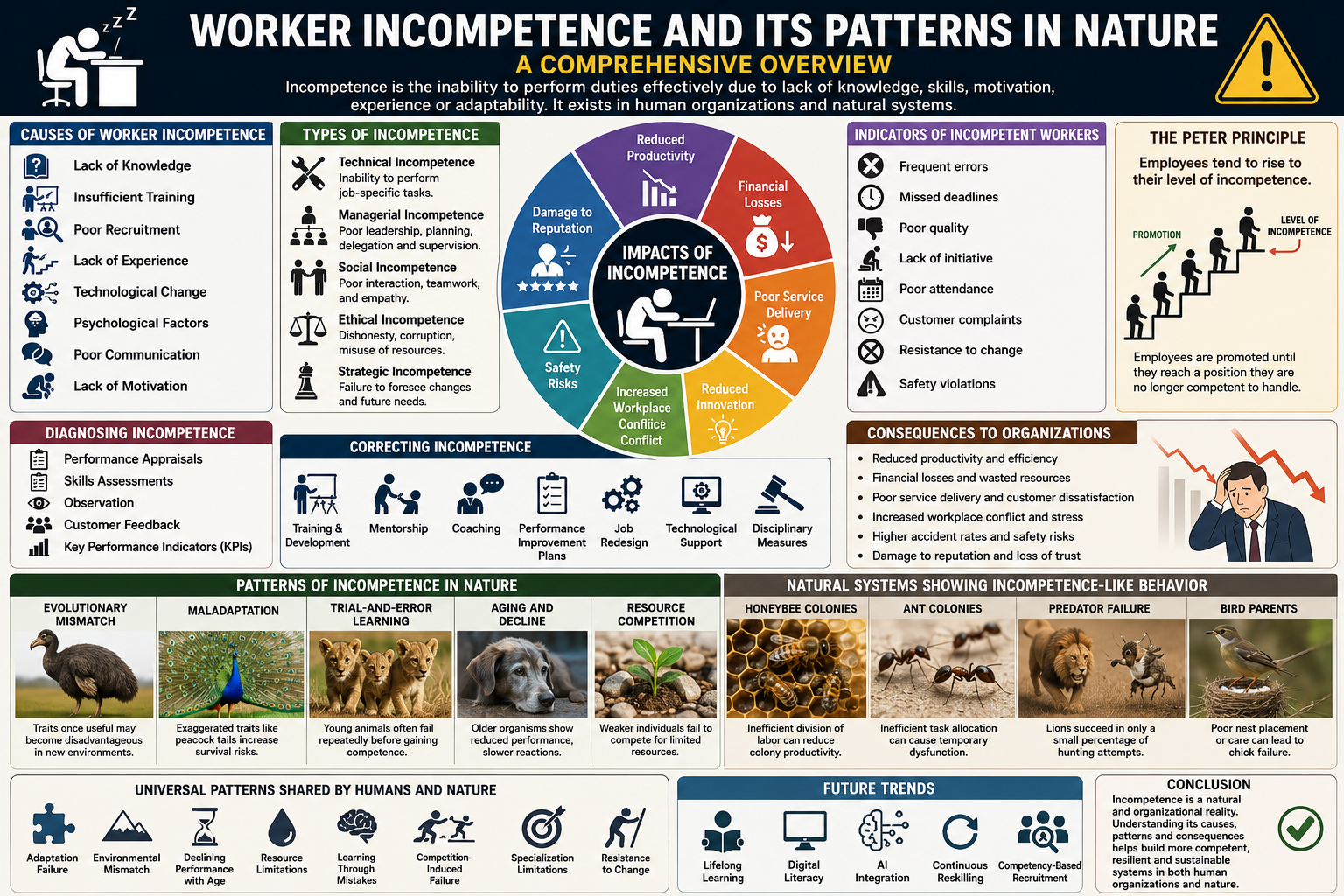
We tend to treat incompetence as a flaw — a worker who cannot keep up, a part of the system that drags the rest down. But step back and look at how work is actually organised across the living world, from ant colonies to the cells in your own body, and a stranger picture emerges. Apparent incompetence and idleness are everywhere, and they are not always failures. Often they are features: reserves, insurance, hidden specialisation, or simply the unavoidable arithmetic of any large group. This article walks through what we really mean by an “incompetent” or idle worker, why nature is full of them, and what the natural patterns can teach us about human organisations.
The argument runs in a particular direction. We begin by taking the word incompetence apart, because most of the confusion around it comes from using one label for several unrelated things. We then tour the natural world — idle ants, specialised bees, error-prone cells, policing immune systems — to see how living systems handle the same problem. Along the way the human parallels become hard to ignore: the Peter Principle, free riders, the hidden cost of squeezing every worker for maximum output. By the end, the aim is a practical one: to be able to look at any underperforming worker, in a hive or an office, and ask the only question that matters — which kind of idleness is this, and what does it actually call for?
- WHAT WE ACTUALLY MEAN BY “INCOMPETENCE”
The word incompetence carries a moral sting, but for our purposes it is worth draining the emotion out of it and treating it as a measurable thing. In the simplest terms, a worker is incompetent at a task when their output falls below what the task requires. That can happen for very different reasons, and lumping them together is the first mistake most people make.
A worker might lack the skill — they have never learned how. They might lack the capacity — they are too small, too slow, or too tired to deliver. They might be mismatched — perfectly capable at something else, but placed in the wrong role. Or they might be deliberately holding back, conserving energy for a moment that has not yet arrived. Only the first of these is incompetence in the everyday sense. The others look identical from the outside, which is exactly why nature fools us so often.
This distinction matters because the response to each is different. Skill gaps are closed by training. Capacity limits are managed by load-sharing. Mismatches are fixed by reassignment. And deliberate idleness should usually be left alone, because it is doing a job you cannot see.
[KEY IDEA — The core idea] An idle or underperforming worker is not automatically a broken one. In living systems, low output is frequently a strategy rather than a defect — and telling the two apart is the whole game.
- THE LAZY ANTS PROBLEM
The most famous case in nature is the social insect colony. We imagine ant and bee colonies as models of relentless productivity, but when researchers tag individual workers and watch them around the clock, they find something embarrassing for the metaphor: a large fraction of workers do almost nothing for long stretches. In several well-studied ant species, roughly half the colony is inactive at any given moment, and a core group is consistently idle.
At first this looks like pure waste. A colony that fed only its active workers would seem to win. But the idle workers turn out to be a reserve labour force. When researchers removed the most active workers from a colony, previously idle ants stepped up and took over the work within days. The colony had been carrying spare capacity all along — insurance against losing its busiest members to predators, accident, or exhaustion.
There is a second twist. Idleness is not evenly shared; it rotates and it correlates with age, body size, and even slight differences in how easily each ant is triggered to act. The colony is not full of identical lazy individuals. It is full of workers with different thresholds, and that variation is what lets the colony respond smoothly to changing demands instead of everyone reacting at once.
Consider what would happen without that spread of thresholds. If every worker reacted to a need at exactly the same point, the colony would lurch — everyone foraging at once, then everyone resting at once, with violent swings between glut and famine. The staggered thresholds smooth this out. Low-threshold workers handle routine demand; high-threshold workers stay in reserve until demand spikes. The idle worker is not lagging behind the others; it is sitting at a different point on a deliberately wide spectrum of readiness.
This also reframes what “productivity” even means for a colony. The colony does not need every worker busy. It needs the right amount of work done reliably across every condition it might face — droughts, floods, raids, sudden food. A colony tuned for maximum output on an average day would collapse on an unusual one. The persistent idlers are the colony’s way of staying ready for the days that are not average.
[IN NATURE — Why a colony keeps “useless” members] Reserve capacity, resilience to losing key workers, and a built-in range of response thresholds. The idle ant is a spare tyre — dead weight until the moment you need it, and then the only thing that saves the trip.
- SPECIALISATION DISGUISED AS INCOMPETENCE
Much of what looks like incompetence is really specialisation viewed from the wrong angle. A honeybee that is hopeless at foraging may be excellent at regulating the hive’s temperature or feeding larvae. Judged only on foraging, it fails. Judged on the whole, it is essential. The colony divides labour so finely that almost every worker is “incompetent” at most tasks — by design.
This is the natural version of a principle human organisations rediscover constantly: a generalist measured against a specialist’s yardstick will always look weak. The leafcutter ant colony is the classic illustration. Workers come in a range of body sizes, and each size class is suited to a different job — the largest defend and cut, the smallest tend the fungus garden and ride on leaves to fend off parasites. A tiny worker is laughably incompetent at cutting leaves. It was never meant to.
The lesson is uncomfortable for anyone who likes simple performance metrics. The moment you measure every worker against a single definition of productivity, you manufacture incompetence on paper that does not exist in reality.
It is worth dwelling on how deep this goes. In a leafcutter colony the division of labour is not just between sizes but across a whole production line: cutters sever leaf fragments, carriers haul them home, smaller workers clean and process the material, still smaller ones implant it into the fungus garden, and the tiniest tend the fungus and guard against mould. Each step depends on the others, and a worker that excelled at all of them would be a worse colony member than one that does a single step superbly and ignores the rest. Generalist competence would actually break the line.
Human readers feel this intuitively in any skilled trade. A brilliant surgeon who insists on also doing the anaesthesia, the scheduling, and the billing is not more valuable than one who trusts specialists for each — they are a bottleneck. Yet our instinct when we see someone “only” doing one narrow thing is to suspect limitation rather than depth. Nature suggests the opposite reading is usually the right one.
[KEY IDEA — The measurement trap] Apply one yardstick to a specialised workforce and most of it will read as incompetent. The incompetence is in the measurement, not the worker.
- REDUNDANCY, ERROR, AND THE COST OF PERFECTION
Nature is also full of workers that are simply error-prone, and it tolerates them on purpose. Inside every cell, the machinery that copies DNA and builds proteins makes mistakes at a low but real rate. Evolution could have driven that error rate lower, but did not, because perfect copying is enormously expensive and a little error is the raw material of adaptation. A flawless workforce would be a brittle one.
The same trade-off shows up at the level of whole organisms. Immune systems generate vast numbers of cells almost at random, most of which are useless or even dangerous and are discarded. The waste is staggering, but the redundancy is what lets the system recognise threats it has never seen before. You cannot have the flexibility without the apparent incompetence of the many failed attempts.
Engineers know this pattern as redundancy: building in spare, overlapping, imperfect components so that the failure of any one does not bring down the whole. What looks like a bloated, inefficient workforce is often a system buying robustness with the currency of apparent waste.
There is a deeper point hiding here about the difference between efficiency and resilience, two goals that pull in opposite directions. An efficient system extracts the most output from the fewest resources; it runs lean, with nothing spare. A resilient system survives shocks; it runs with margin, redundancy, and slack. You cannot maximise both at once, and every living system represents some negotiated settlement between them. Evolution, having watched countless lean systems get wiped out by a single bad season, tends to err toward resilience — toward keeping the apparently incompetent reserves and the error-prone tinkering that lean optimisation would cut. The waste is not an oversight evolution failed to fix. It is the premium on an insurance policy that has been paying out for a very long time.
[IN NATURE — The efficiency paradox] A system optimised so tightly that every worker is fully competent and fully loaded has no slack — and no slack means no resilience. Some inefficiency is the price of survival.
- THE PETER PRINCIPLE AND WHY HIERARCHIES BREED IT
Human organisations have their own engine for manufacturing incompetence, and it has a name: the Peter Principle. The observation is that in a hierarchy, people who do well are promoted — and they keep being promoted until they reach a role they cannot do well. At that point they stop rising. Over time, the logic predicts, every position tends to be filled by someone who has reached the limit of their competence.
The cruelty of the pattern is that it punishes success. Being good at your job is precisely what moves you out of it and into one you may be unsuited for. The skills that made someone an excellent engineer or nurse are not the skills that make a good manager, yet the reward for excellence is often a management role.
Nature mostly avoids this trap because most living systems do not promote. An ant does not get “promoted” out of foraging into a role it is bad at; it shifts tasks based on age and need, and can often shift back. The rigidity of human hierarchies — where moving up is the only way to gain status or pay — is what makes the Peter Principle bite. Organisations that build parallel tracks, letting people grow in pay and respect without forcing them into ill-fitting roles, are borrowing a page from biology.
[KEY IDEA — The Peter Principle, in one line] In a hierarchy that promotes for past performance, people rise to the level of their incompetence — and then stay there.
- FREE RIDERS, CHEATS, AND GENUINE FAILURE
Not all idleness is benign. Living systems are also plagued by genuine free riders — individuals that take the benefits of group life while contributing nothing. Some worker bees lay their own eggs instead of helping the queen. Some cells in a body stop cooperating and multiply for themselves; we call that cancer. Here the idleness or self-interest really is a problem, and natural systems have evolved elaborate policing to catch it.
Worker bees destroy eggs laid by other workers. Bodies maintain immune surveillance to detect and kill cells that break ranks. The existence of this policing tells us something important: nature distinguishes between useful idleness and harmful cheating, and invests heavily in telling them apart. It does not tolerate free riding blindly; it tolerates the kinds of inactivity that pay off and suppresses the kinds that do not.
For human organisations this is the crucial nuance. The goal is not to eliminate all idleness — that would destroy the reserves and specialists and error-tolerance that make a system robust. The goal is to distinguish the idle worker who is a hidden asset from the one who is a genuine drain, and to police only the latter. Treating every quiet worker as a cheat is as costly a mistake as treating every cheat as a reserve.
The cost of getting this wrong runs in both directions, and both directions are expensive. Police too little and the cheats multiply until they hollow out the group — the runaway cell becomes a tumour, the laying workers tip the hive into disorder. Police too harshly and you destroy the very slack that protects the system, turning every reserve and specialist into a suspect and grinding morale and flexibility to nothing. Healthy systems sit at a tuned middle: enough surveillance to catch real defection, enough tolerance to leave useful inactivity alone.
[WATCH OUT — The distinction that matters most] Reserve, specialist, and error-tolerant workers strengthen a system. True free riders weaken it. The skill of any organisation — natural or human — is telling these apart without punishing the wrong ones.
- THRESHOLDS: HOW NATURE ALLOCATES EFFORT WITHOUT A MANAGER
One of the most striking things about natural workforces is that no one is in charge. There is no foreman ant assigning shifts, no manager telling cells when to divide. Yet labour gets allocated, reserves get called up, and idle workers activate at the right moment. The mechanism behind this is worth understanding, because it explains why “incompetent” idle workers are not a bug to be designed out but an emergent feature of how decentralised systems work.
The trick is the response threshold. Each worker carries an internal trigger point — a level of need at which it switches from idle to active. Some workers have low thresholds and jump in at the first sign of work; others have high thresholds and stay put until the need is severe. As a task piles up, it crosses more and more thresholds, recruiting workers in sequence. When the task is handled and the signal fades, workers drop back below their thresholds and go quiet again. No central decision is made; the allocation simply emerges from many individuals each reacting to a shared signal.
This is why a colony needs a spread of thresholds rather than a uniform workforce. Uniform thresholds would mean all-or-nothing responses. Varied thresholds give graded, proportional ones. And critically, the high-threshold workers — the ones that look chronically idle — are not defective. They are the upper reaches of the response curve, held back precisely so the system has somewhere to go when demand is extreme.
Human organisations that run on rigid schedules and full utilisation throw this mechanism away. By keeping everyone fully loaded, they remove the headroom that threshold systems rely on, and they lose the automatic, manager-free way that natural systems scale effort to need. The lesson is not that humans should abolish management, but that some visible idleness is the signature of a system that can still absorb a surge.
[IN NATURE — Allocation without a boss] Varied response thresholds let a workforce scale effort to demand automatically. The chronically idle worker is the top of the response curve — the capacity held in reserve for the surge that has not come yet.
- A FIELD GUIDE: FIVE KINDS OF “IDLE” WORKER
Pulling the threads together, it helps to have a practical taxonomy — a field guide to the kinds of low output a manager or biologist actually encounters. Five recurring types cover most cases, and the right response to each is different. The danger is always in misclassification: treating a reserve as a cheat, or a cheat as a specialist.
The reserve worker produces little now but activates when active workers are lost or demand spikes; the correct response is to leave it alone and value the insurance it provides. The specialist looks incompetent only because it is being measured against the wrong task; the response is to measure it against the right one. The error-tolerant worker makes mistakes that the system accepts as the price of flexibility and learning; the response is to tune the error rate, not to demand perfection. The misplaced worker is capable but wrongly assigned, a product of rigid promotion or poor role design; the response is reassignment, not punishment. Only the last type, the genuine free rider, is a true drain — and only it warrants the policing that nature reserves for cheats.
The single most expensive error any organisation makes is collapsing these five into one and reaching for the same blunt instrument — usually pressure or removal — for all of them. Four of the five are made worse by that instrument. Nature’s long experiment says: diagnose first, and act only on the type you have actually identified.
Type | What it looks like | What it really is | Right response
Reserve | Idle most of the time | Insurance / spare capacity | Leave alone; value the slack
Specialist | Fails at the visible task | Excellent at a different task | Measure against the right task
Error-tolerant | Makes frequent mistakes | Source of flexibility & learning | Tune error rate, don’t demand perfection
Misplaced | Underperforms in this role | Capable but wrongly assigned | Reassign, don’t punish
Free rider | Takes without contributing | Genuine drain on the group | Police and correct
[WATCH OUT — The diagnostic discipline] Four of the five types are harmed by pressure or removal. Only the free rider warrants it. Diagnose the type before choosing the response — the cost of misclassifying is paid in lost resilience.
- THE RECURRING PATTERNS
Step back from the individual cases and a handful of patterns repeat across every scale of life. They are worth stating plainly, because each one inverts a piece of conventional wisdom about incompetence.
First, slack is insurance. Idle capacity that looks wasteful in good times is what carries a system through bad ones. Second, variation is function. A workforce with a range of abilities and thresholds responds more smoothly than a uniform one. Third, specialisation manufactures apparent incompetence — the more finely a system divides labour, the more each worker fails at most tasks by design. Fourth, error is the price of adaptability; a flawless workforce is a fragile one. Fifth, rigid promotion breeds real incompetence, where flexible task-switching does not. And sixth, systems must police genuine cheating while protecting useful idleness, which means investing in the ability to tell them apart.
None of these patterns says incompetence does not exist or never matters. They say that what we label incompetence is a mixture of very different things, most of which are not problems at all — and that the rare real problem can only be managed well once it is separated from the rest.
[IN NATURE — Six patterns at a glance] Slack is insurance · variation is function · specialisation manufactures apparent incompetence · error is the price of adaptability · rigid promotion breeds real incompetence · police cheating, protect useful idleness.
- CONCLUSION: READING THE IDLE WORKER CORRECTLY
The next time you see a worker doing nothing — an ant standing still, a cell sitting quiet, a colleague who seems to coast — the honest response is not judgement but a question: which kind of idleness is this? Is it a reserve waiting to be called on? A specialist measured against the wrong task? A tolerated error that keeps the system flexible? A victim of rigid promotion? Or a genuine free rider draining the group?
Nature has been running this experiment for billions of years, and its verdict is clear. The most robust systems are not the ones that wring maximum output from every member at every moment. They are the ones that carry slack, tolerate variation, accept a little error, and reserve their policing for the cheats that truly threaten the whole. A workforce with no apparent incompetence is not a triumph of efficiency. It is a system with no margin — and the first serious shock will find that out.
Incompetence, in other words, is not one thing. It is a word we paste over a rich variety of natural strategies, and learning to read beneath it — in colonies, in cells, and in our own organisations — is one of the more useful things the living world has to teach us.






Be First to Comment