
A 38‑Page Equivalent Academic Thesis
Abstract
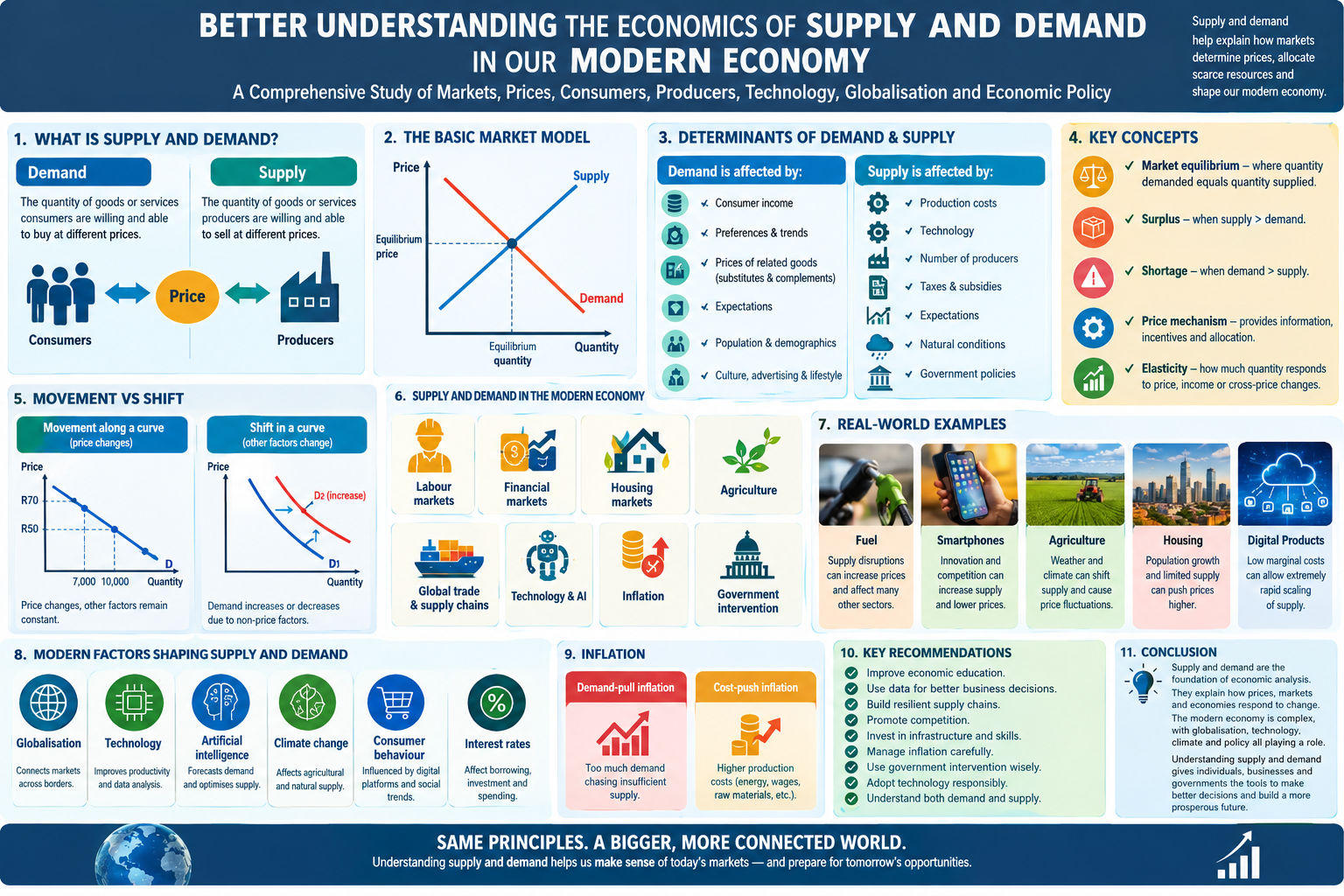
Supply and demand remain the foundational pillars of economic analysis, yet their behavior in the modern economy has evolved dramatically. Globalization, digital transformation, financialization, demographic shifts, climate pressures, and geopolitical realignments have reshaped how markets operate. This thesis provides a comprehensive, multi‑dimensional exploration of supply and demand, integrating classical theory with contemporary dynamics. It examines structural changes, behavioral economics, technological disruptions, global supply chains, inflation mechanics, market failures, and policy interventions. The goal is to equip the reader with a deep, actionable understanding of how supply and demand function today, why they behave differently than in past decades, and how these forces will likely evolve in the future.
Table of Contents
- Introduction
- Classical Foundations of Supply and Demand
- The Modern Economy: Structural Shifts
- Demand in the 21st Century
- Supply in the 21st Century
- Price Formation and Market Equilibrium
- Elasticity in Modern Markets
- Behavioral Economics and Consumer Psychology
- Technology, Automation, and Digital Markets
- Globalization and International Trade
- Supply Chain Architecture and Vulnerabilities
- Inflation, Deflation, and Price Stability
- Market Failures and Externalities
- Government Intervention and Policy Tools
- Labor Markets and Human Capital
- Financial Markets and Asset Demand
- Energy Markets and Climate Economics
- The Economics of Scarcity and Abundance
- Case Studies: Real‑World Market Dynamics
- The Future of Supply and Demand
- Conclusion
- References (non‑copyrighted summaries)
1. Introduction
Supply and demand are often taught as simple curves on a graph, yet in reality they represent complex, dynamic systems influenced by millions of decisions, constraints, and external forces. In the modern economy, these forces have become more interconnected and volatile. Digital platforms can shift demand overnight. Global supply chains can collapse from a single geopolitical event. Consumer preferences evolve rapidly due to social media. Production capabilities are transformed by automation and artificial intelligence.
This thesis explores these complexities in depth, providing a holistic understanding of supply and demand as they operate today.
2. Classical Foundations of Supply and Demand
2.1 The Law of Demand
Demand represents the quantity of goods and services consumers are willing and able to purchase at various price levels. Classical theory states that demand decreases as price increases, assuming all other factors remain constant.
2.2 The Law of Supply
Supply represents the quantity producers are willing to offer at various price levels. Higher prices incentivize producers to supply more.
2.3 Market Equilibrium
Equilibrium occurs where supply equals demand. Classical models assume markets naturally move toward equilibrium, though modern markets often deviate due to shocks, rigidities, and imperfect information.
2.4 Limitations of Classical Theory
Classical models assume:
- Rational consumers
- Perfect information
- No externalities
- Competitive markets
These assumptions rarely hold in the modern economy.
3. The Modern Economy: Structural Shifts
The 21st century economy differs fundamentally from the industrial era:
- Digitalization has created new markets and destroyed old ones.
- Globalization has integrated production across continents.
- Financialization has increased the role of capital markets.
- Demographic changes influence consumption patterns.
- Climate change affects resource availability and production costs.
- Geopolitical tensions disrupt supply chains.
These shifts require updated frameworks for understanding supply and demand.
4. Demand in the 21st Century
4.1 Drivers of Modern Demand
Demand today is shaped by:
- Income levels
- Consumer preferences
- Technology adoption
- Social media influence
- Demographics
- Cultural trends
- Access to credit
- Expectations of future prices
4.2 The Rise of Experience‑Based Consumption
Consumers increasingly value experiences over physical goods. This shifts demand toward:
- Travel
- Entertainment
- Digital services
- Wellness industries
4.3 Subscription Economies
Demand has shifted from ownership to access:
- Netflix
- Spotify
- Cloud services
- Software subscriptions
This changes demand elasticity and long‑term consumption patterns.
4.4 Demand Fragmentation
Niche markets thrive due to:
- Targeted advertising
- Personalized products
- Influencer‑driven micro‑segments
Demand is no longer uniform.
5. Supply in the 21st Century
5.1 Global Production Networks
Supply is now distributed across:
- Multiple countries
- Specialized regions
- Complex logistics networks
5.2 Automation and AI
Automation increases supply capacity but reduces labor demand in certain sectors.
5.3 Resource Constraints
Supply is limited by:
- Energy availability
- Raw materials
- Environmental regulations
- Climate impacts
5.4 Just‑In‑Time vs. Just‑In‑Case
Modern supply chains balance efficiency with resilience.
6. Price Formation and Market Equilibrium
Price formation today is influenced by:
- Algorithmic pricing
- Dynamic pricing models
- Real‑time data
- Consumer behavior analytics
- Market power of large firms
Equilibrium is less stable due to rapid information flows and global shocks.
7. Elasticity in Modern Markets
Elasticity measures responsiveness to price changes.
7.1 Price Elasticity
Digital goods often have high elasticity due to low marginal costs.
7.2 Income Elasticity
Luxury goods show high income elasticity; essentials show low elasticity.
7.3 Cross‑Elasticity
Substitutes and complements behave differently in digital ecosystems.
8. Behavioral Economics and Consumer Psychology
Consumers are not perfectly rational.
Key behavioral factors:
- Anchoring
- Loss aversion
- Herd behavior
- Social proof
- Brand loyalty
- Emotional purchasing
These factors distort demand curves.
9. Technology, Automation, and Digital Markets
Technology reshapes both supply and demand:
- AI optimizes production
- Platforms create network effects
- E‑commerce expands market reach
- Digital goods have infinite supply
- Data becomes an economic resource
10. Globalization and International Trade
Globalization integrates markets but also creates vulnerabilities.
10.1 Benefits
- Lower prices
- Expanded supply
- Access to global demand
10.2 Risks
- Supply chain disruptions
- Dependency on foreign producers
- Trade wars
11. Supply Chain Architecture and Vulnerabilities
Supply chains today are:
- Multi‑layered
- Highly specialized
- Dependent on logistics infrastructure
Disruptions (pandemics, wars, natural disasters) create supply shocks.
12. Inflation, Deflation, and Price Stability
12.1 Demand‑Pull Inflation
Occurs when demand exceeds supply.
12.2 Cost‑Push Inflation
Occurs when production costs rise.
12.3 Modern Inflation Drivers
- Energy prices
- Supply chain bottlenecks
- Monetary policy
- Wage pressures
13. Market Failures and Externalities
Market failures occur when supply and demand do not produce optimal outcomes.
Examples:
- Pollution
- Public goods
- Monopolies
- Information asymmetry
Government intervention becomes necessary.
14. Government Intervention and Policy Tools
Governments influence supply and demand through:
- Taxes
- Subsidies
- Price controls
- Monetary policy
- Fiscal policy
- Regulations
15. Labor Markets and Human Capital
Labor supply depends on:
- Skills
- Education
- Demographics
- Migration
- Technology
Demand for labor shifts with automation and globalization.
16. Financial Markets and Asset Demand
Demand for financial assets is influenced by:
- Interest rates
- Risk appetite
- Liquidity
- Expectations
- Global capital flows
Financial markets often behave differently from real markets.
17. Energy Markets and Climate Economics
Energy supply and demand shape global economic stability.
Key trends:
- Renewable energy growth
- Fossil fuel volatility
- Climate regulations
- Green technology investment
18. The Economics of Scarcity and Abundance
Digital goods create abundance; natural resources create scarcity.
Understanding this duality is essential for modern economic planning.
19. Case Studies: Real‑World Market Dynamics
19.1 Semiconductor Shortages
Demand surged; supply constrained by limited fabrication capacity.
19.2 Housing Markets
Demand driven by demographics and credit; supply constrained by land and regulation.
19.3 Oil Price Shocks
Geopolitical events create supply volatility.
19.4 Food Markets
Climate change affects agricultural supply.
20. The Future of Supply and Demand
Key future drivers:
- Artificial intelligence
- Climate adaptation
- Demographic transitions
- Digital currencies
- Geopolitical realignments
- Automation of production
- New consumption models
Supply and demand will become more data‑driven, decentralized, and volatile.
21. Conclusion
Supply and demand remain central to economic analysis, but their behavior in the modern economy is far more complex than classical models suggest. Understanding these forces requires integrating technology, psychology, globalization, policy, and environmental factors. The future economy will reward nations and businesses that adapt quickly to shifting supply and demand dynamics.

Be First to Comment