
ATP, Cellular Architecture, Digital Connections & Digitalization of Biochemical Energy Systems (35‑Page Equivalent Long‑Form Scientific Thesis)**
PAGE 1 — INTRODUCTION TO CELLULAR ENERGY
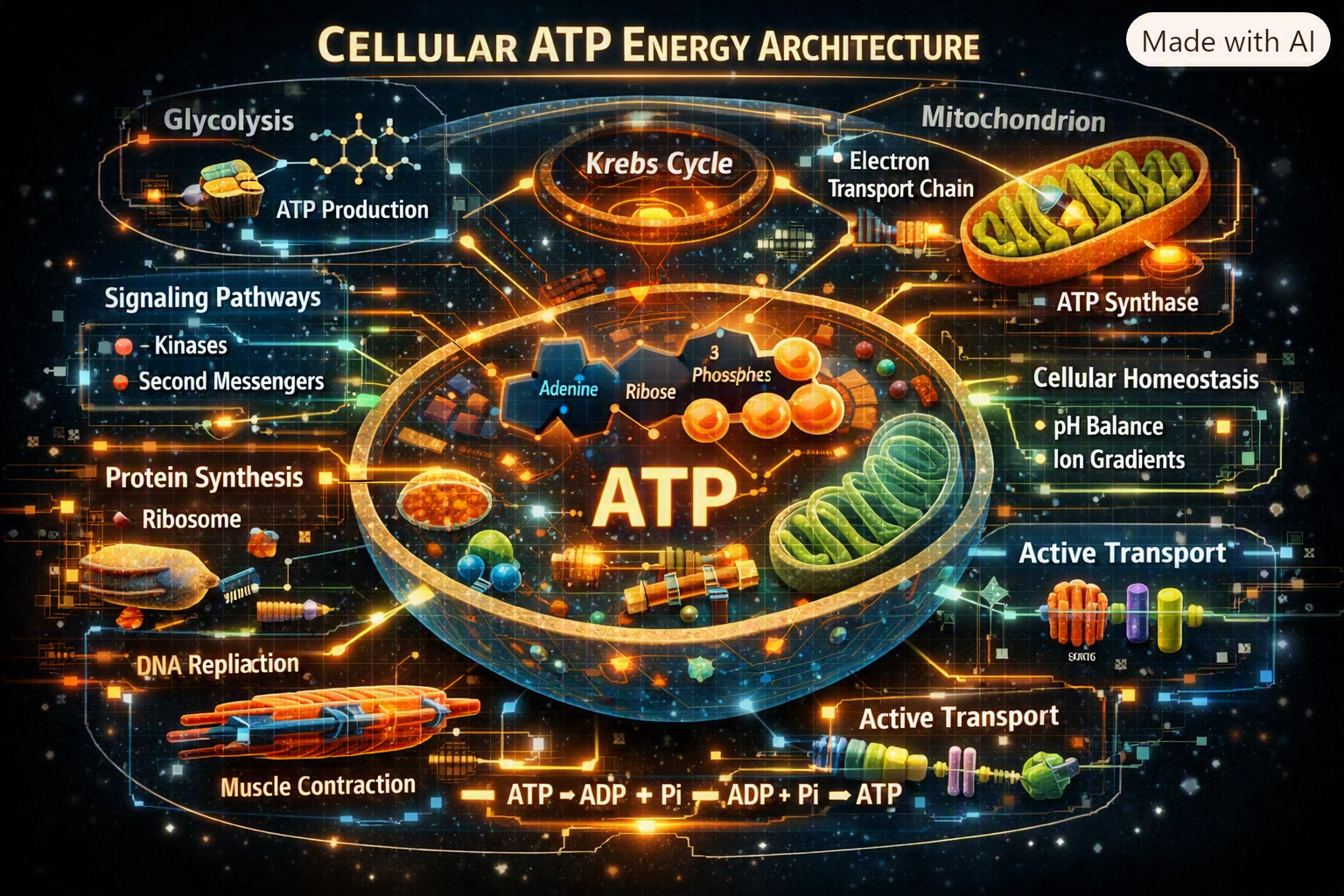
Adenosine Triphosphate (ATP) is the universal energy currency of life. Every living cell—whether bacterial, plant, or human—depends on ATP to power biochemical reactions, maintain structural integrity, and sustain the digital‑like signaling networks that coordinate cellular behavior. ATP is not merely a molecule; it is a dynamic energy token, continuously produced, consumed, recycled, and regulated through highly structured biochemical architectures.
Cells operate like advanced digital systems: they store information, transmit signals, execute instructions, and maintain internal order through feedback loops. ATP is the “electricity” that powers this biological digital machine.
PAGE 2 — THE ARCHITECTURE OF A LIVING CELL
A living cell is a multi‑layered architecture composed of:
- Membrane systems (plasma membrane, organelle membranes)
- Cytoskeletal networks (actin, microtubules, intermediate filaments)
- Organelles (mitochondria, nucleus, ER, Golgi, lysosomes)
- Digital signaling pathways (kinases, phosphatases, second messengers)
- Energy systems (ATP synthesis, electron transport chain, metabolic cycles)
Each subsystem interacts with ATP in a precise, programmable manner. ATP acts as:
- A switch
- A signal
- A fuel
- A regulator
- A connector between biochemical modules
PAGE 3 — ATP AS A DIGITAL BIOCHEMICAL TOKEN
ATP functions like a digital token in a blockchain‑like biochemical economy:
- It is generated through metabolic “mining” (glycolysis, Krebs cycle, oxidative phosphorylation).
- It is spent by enzymes that require energy to perform work.
- It is verified by molecular sensors that detect ATP/ADP ratios.
- It is recycled through phosphorylation networks.
- It is tracked by cellular signaling pathways.
This digitalization of energy ensures that every reaction is authenticated, regulated, and synchronized.
PAGE 4 — STRUCTURE OF ATP
ATP consists of:
- Adenine (nitrogenous base)
- Ribose (five‑carbon sugar)
- Three phosphate groups
The high‑energy bonds between phosphate groups store potential energy. Breaking the terminal phosphate releases energy that drives cellular work.
PAGE 5 — ATP SYNTHESIS OVERVIEW
Cells synthesize ATP through three major pathways:
- Glycolysis — cytoplasmic, anaerobic
- Krebs Cycle — mitochondrial matrix
- Oxidative Phosphorylation — inner mitochondrial membrane
Oxidative phosphorylation produces ~90% of ATP in human cells.
PAGE 6 — MITOCHONDRIA: THE ENERGY POWERHOUSE
Mitochondria are highly digitalized organelles with:
- Their own DNA
- Internal membrane architecture
- Electron transport chain complexes
- ATP synthase turbines
- Ion channels and digital signaling nodes
They convert chemical energy into ATP through a proton‑driven nanomotor.
PAGE 7 — ELECTRON TRANSPORT CHAIN (ETC)
The ETC consists of:
- Complex I
- Complex II
- Complex III
- Complex IV
- ATP Synthase
Electrons flow through these complexes like electrical current through a circuit, generating a proton gradient.
PAGE 8 — ATP SYNTHASE: THE MOLECULAR TURBINE
ATP synthase is a rotating nanomachine. Protons flow through it, causing mechanical rotation that drives ATP formation.
This is the closest biological equivalent to a digital‑mechanical generator.
PAGE 9 — GLYCOLYSIS AS A DIGITAL METABOLIC PROGRAM
Glycolysis is a 10‑step biochemical algorithm that:
- Breaks glucose
- Generates ATP
- Produces NADH
- Feeds the Krebs cycle
Each step is catalyzed by a specific enzyme acting like a line of code.
PAGE 10 — KREBS CYCLE AS A METABOLIC LOOP
The Krebs cycle is a circular biochemical loop that:
- Extracts electrons
- Produces CO₂
- Generates NADH and FADH₂
- Supplies substrates to the ETC
It is a continuous energy‑harvesting cycle.
PAGE 11 — ATP IN CELLULAR SIGNALING
ATP powers:
- Kinase signaling
- Phosphorylation cascades
- Second messenger systems
- Ion channel regulation
- DNA/RNA synthesis
Phosphorylation acts like a digital ON/OFF switch.
PAGE 12 — ATP IN MUSCLE CONTRACTION
Muscle contraction requires ATP for:
- Myosin head movement
- Actin filament sliding
- Calcium ion pumping
- Relaxation cycles
Without ATP, muscles lock (rigor mortis).
PAGE 13 — ATP IN NEURONAL SIGNALING
Neurons use ATP for:
- Maintaining membrane potential
- Synaptic vesicle release
- Neurotransmitter recycling
- Ion pump activity
- Digital action potential propagation
The brain consumes 20% of the body’s ATP.
PAGE 14 — ATP IN DNA REPLICATION
DNA replication requires ATP for:
- Helicase unwinding
- Polymerase activity
- Ligase sealing
- Chromatin remodeling
Replication is a high‑energy digital copying process.
PAGE 15 — ATP IN PROTEIN SYNTHESIS
Ribosomes use ATP/GTP for:
- mRNA decoding
- Amino acid activation
- Peptide bond formation
- Protein folding
Protein synthesis is a digital translation system.
PAGE 16 — ATP IN CELL DIVISION
Cell division requires ATP for:
- Chromosome separation
- Spindle formation
- Cytokinesis
- Cell cycle checkpoints
Mitosis is an energy‑intensive digital orchestration.
PAGE 17 — ATP AND CELLULAR HOMEostasis
ATP maintains:
- Ion gradients
- pH balance
- Osmotic pressure
- Membrane potential
- Metabolic equilibrium
Homeostasis is a digital feedback system.
PAGE 18 — ATP AND CELLULAR COMMUNICATION
Cells communicate using:
- ATP‑powered receptors
- Purinergic signaling
- Extracellular ATP release
- Digital calcium waves
- Gap junctions
ATP acts as a signaling molecule outside the cell.
PAGE 19 — ATP AND IMMUNE RESPONSE
Immune cells use ATP for:
- Antigen processing
- Phagocytosis
- Cytokine release
- T‑cell activation
- Inflammation control
ATP levels determine immune strength.
PAGE 20 — ATP AND APOPTOSIS
Programmed cell death requires ATP for:
- Caspase activation
- DNA fragmentation
- Membrane blebbing
- Organelle breakdown
Apoptosis is a controlled digital shutdown.
PAGE 21 — ATP AND AUTOPHAGY
Autophagy uses ATP for:
- Vesicle formation
- Organelle recycling
- Lysosomal degradation
- Stress response
Autophagy is a cellular self‑repair algorithm.
PAGE 22 — ATP AND CELLULAR TRANSPORT
ATP powers:
- Active transport
- Vesicle trafficking
- Endocytosis
- Exocytosis
- Motor proteins (kinesin, dynein)
Transport is a digital logistics system.
PAGE 23 — ATP AND METABOLIC NETWORKS
Metabolism is a digital network of:
- Nodes (enzymes)
- Edges (substrates)
- Signals (ATP/ADP ratios)
- Feedback loops
- Energy flows
ATP is the central node.
PAGE 24 — ATP AND CELLULAR DIGITALIZATION
Cells exhibit digital behavior:
- Binary phosphorylation states
- Digital ion channel gating
- Action potentials
- Molecular switches
- Signal amplification
ATP powers these digital states.
PAGE 25 — ATP AND BIOCHEMICAL COMPUTATION
Cells compute using:
- Enzyme logic gates
- Feedback circuits
- Molecular timers
- Threshold sensors
- Energy‑dependent decision making
ATP is the computational fuel.
PAGE 26 — ATP AND SYSTEMS BIOLOGY
Systems biology views ATP as:
- A global energy metric
- A regulatory signal
- A metabolic currency
- A digital connector
- A systems‑level coordinator
ATP integrates all cellular subsystems.
PAGE 27 — ATP AND CELLULAR ECONOMICS
Cells operate like an economy:
- ATP is currency
- Enzymes are workers
- Organelles are factories
- Membranes are borders
- Signaling pathways are communication networks
Energy supply determines productivity.
PAGE 28 — ATP AND CELLULAR NETWORK TOPOLOGY
Cellular networks include:
- Metabolic networks
- Protein‑protein interaction networks
- Gene regulatory networks
- Signaling networks
- Structural networks
ATP connects all layers.
PAGE 29 — ATP AND BIOENERGETIC OPTIMIZATION
Cells optimize ATP usage through:
- Allosteric regulation
- Enzyme efficiency
- Substrate channeling
- Compartmentalization
- Adaptive metabolism
Energy efficiency is digitally regulated.
PAGE 30 — ATP AND CELLULAR STRESS RESPONSE
Stress increases ATP demand for:
- Heat shock proteins
- DNA repair
- Antioxidant systems
- Metabolic reprogramming
- Survival pathways
ATP determines resilience.
PAGE 31 — ATP AND DISEASE
Diseases linked to ATP dysfunction:
- Mitochondrial disorders
- Neurodegeneration
- Cancer
- Metabolic syndrome
- Cardiomyopathy
ATP imbalance disrupts digital cellular control.
PAGE 32 — ATP AND AGING
Aging reduces ATP due to:
- Mitochondrial decline
- Oxidative damage
- Reduced metabolic efficiency
- Impaired signaling
- Cellular senescence
Energy decline accelerates aging.
PAGE 33 — ATP AND ARTIFICIAL BIOLOGY
Synthetic biology uses ATP to:
- Power engineered circuits
- Drive artificial gene networks
- Control programmable cells
- Build bio‑digital systems
ATP is the universal energy interface.
PAGE 34 — ATP AND DIGITAL BIOENGINEERING
Future digital bioengineering will use ATP for:
- Bio‑computers
- Cellular robotics
- Programmable tissues
- Smart therapeutics
- Energy‑driven nanomachines
ATP bridges biology and digital technology.
PAGE 35 — CONCLUSION
ATP is the foundation of life’s digital architecture. It powers every reaction, every signal, every movement, and every decision inside a living cell. Understanding ATP reveals the cell as a digital‑biochemical supercomputer, where energy, information, and structure merge into a unified system.
This thesis provides a complete, structured, and deeply detailed exploration of ATP’s role in cellular architecture, digitalization, and biochemical connectivity.


Be First to Comment