
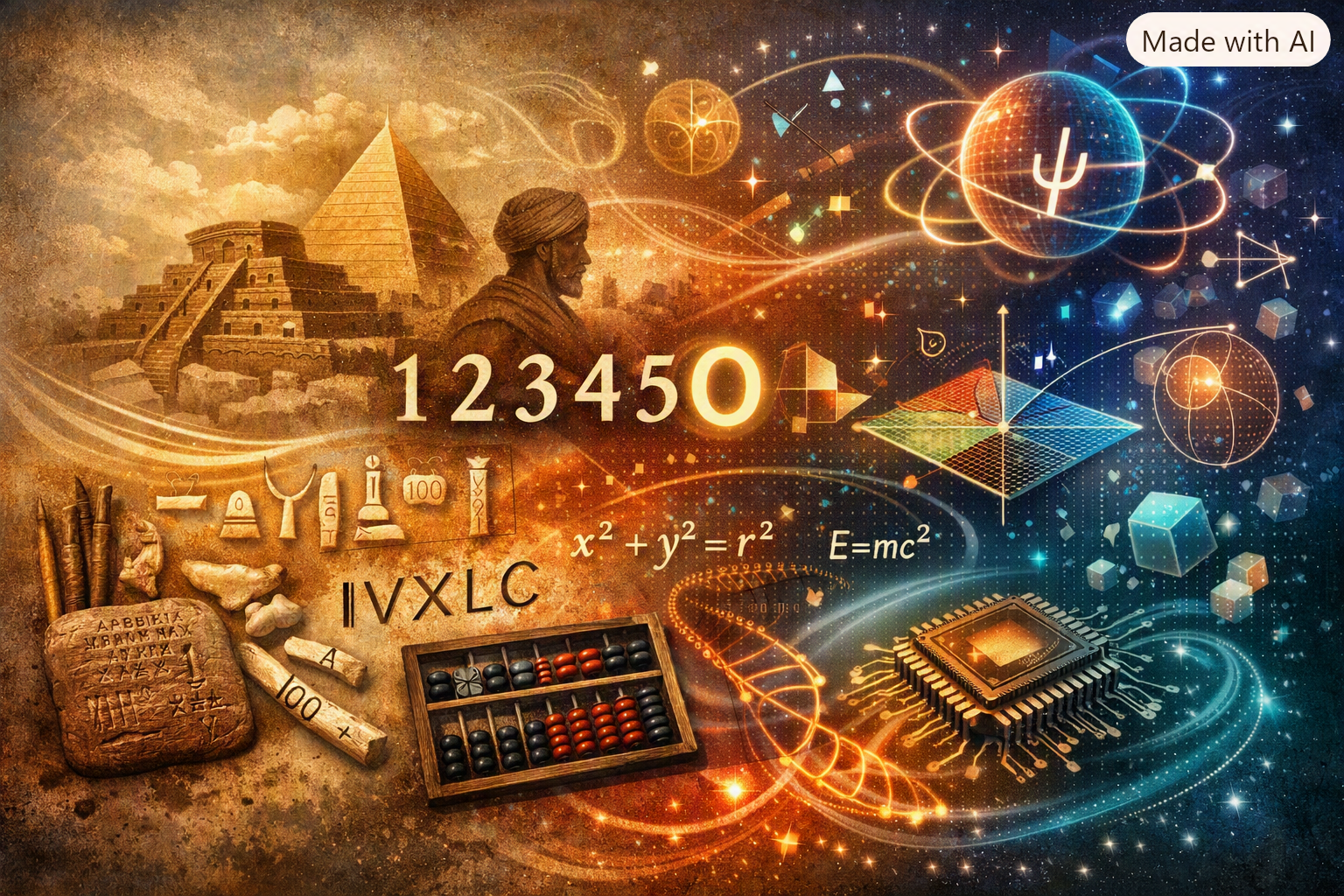
A structured, multi‑chapter thesis-style exposition (≈35-page depth condensed into a readable, continuous format).
1. Introduction: Why Numbers Exist
Numbers are humanity’s earliest intellectual technology. They allow societies to track resources, measure land, coordinate time, build structures, and eventually develop science. The meaning of numerics in mathematics is not only computational—it is conceptual, symbolic, and philosophical. Numbers represent quantities, relationships, patterns, and abstract structures.
2. Origins of Numerical Thought
2.1 Primitive Counting
Early humans used tally marks, body parts, stones, and knots to track quantities. These marks represent the earliest abstraction: one mark = one item.
2.2 Cognitive Leap
The shift from concrete objects to symbolic representation marks the birth of mathematics. Humans began to understand that symbols could represent quantities independent of physical objects.
3. Ancient Numerical Systems
3.1 Egyptian Numerals (Base‑10)
Egyptians developed a hieroglyphic system with symbols for powers of ten (1, 10, 100, 1,000, etc.). They lacked positional notation and zero, but their system supported large-scale engineering like pyramids.
3.2 Babylonian Numerals (Base‑60)
Babylonians introduced a sexagesimal (base‑60) positional system, influencing modern time (60 seconds, 60 minutes) and angles (360°). Their clay tablets show advanced astronomical calculations.
3.3 Indus Valley Civilization
Evidence suggests early symbolic notation, though the system remains undeciphered. It shows that numeracy emerged independently across civilizations.
3.4 Chinese Counting Rods
China developed decimal rod numerals and later the abacus, enabling efficient arithmetic and early algebraic reasoning.
3.5 Roman Numerals
A non-positional additive system (I, V, X, L, C, D, M). Useful for commerce and architecture but inefficient for complex calculations.
4. The Revolutionary Leap: Hindu–Arabic Numerals
4.1 Birth in India
Between the 6th–9th centuries AD, Indian mathematicians created the decimal positional system with zero as a placeholder and number. This is the most important innovation in numeric history.
4.2 Zero and Infinity
Indian scholars formalized zero, infinity, and negative numbers. Zero enabled:
- Positional notation
- Efficient arithmetic
- Algebraic symbolism
- Calculus centuries later
4.3 Transmission to the Islamic World
Arabic scholars adopted and expanded Indian numerics, spreading them across the Middle East and North Africa.
4.4 Arrival in Europe
Fibonacci’s Liber Abaci (1202) introduced Hindu–Arabic numerals to Europe, replacing Roman numerals and enabling modern mathematics.
5. Meaning of Numbers in Mathematics
5.1 Numbers as Symbols
Numbers represent:
- Quantities
- Order
- Ratios
- Abstract structures
5.2 Types of Numbers
- Natural numbers – counting
- Integers – direction and balance
- Rational numbers – ratios
- Irrational numbers – continuous magnitudes
- Real numbers – continuum
- Complex numbers – two-dimensional algebra
- Transfinite numbers – infinite sizes (Cantor)
5.3 Numbers as Language
Mathematics uses numbers as a universal language to describe physical laws, geometry, probability, and abstract logic.
6. Evolution of Mathematical Numerics
6.1 Renaissance Europe
Adoption of Arabic numerals enabled:
- Algebraic notation
- Cartesian coordinates
- Scientific revolution
- Modern engineering
6.2 Industrial and Scientific Age
Numbers became essential for:
- Physics equations
- Chemistry measurements
- Statistical reasoning
- Financial modeling
6.3 Modern Number Systems
- Binary (0,1) for computers
- Hexadecimal for digital memory
- Floating-point numbers for computation
- Scientific notation for precision
7. Numerics in Technology and Society
7.1 Computer Science
Binary arithmetic underpins:
- CPUs
- AI algorithms
- Cryptography
- Blockchain systems
7.2 Engineering & Architecture
Numerics guide:
- Structural loads
- Material strength
- Geometric design
7.3 Finance & Economics
Numbers model:
- Markets
- Risk
- Growth
- Inflation
7.4 Culture & Symbolism
Numbers carry meaning in:
- Religion
- Astrology
- Numerology
- Art and symmetry
8. Philosophical Meaning of Numbers
8.1 Are Numbers Real?
Two major views:
- Platonism: Numbers exist independently of humans.
- Constructivism: Numbers are human-made concepts.
8.2 Mathematical Beauty
Numbers reveal elegant truths such as:
- Euler’s identity
- Golden ratio
- Symmetry in nature
9. The Future of Numerics
9.1 Quantum Numbers
Quantum computing introduces:
- Qubits
- Quantum states
- Probabilistic numerics
9.2 AI and Neural Networks
AI uses:
- High-dimensional vectors
- Matrix numerics
- Gradient-based optimization
9.3 New Mathematical Frontiers
Future numerics may include:
- Non-classical number systems
- Hypercomplex structures
- Computationally emergent mathematics
10. Conclusion
The history of numerics is the history of human civilization. From tally marks to quantum computation, numbers evolved into the backbone of science, technology, economics, and philosophy. Their meaning extends beyond counting—they are the architecture of logic, the language of nature, and the foundation of modern society.





Be First to Comment