
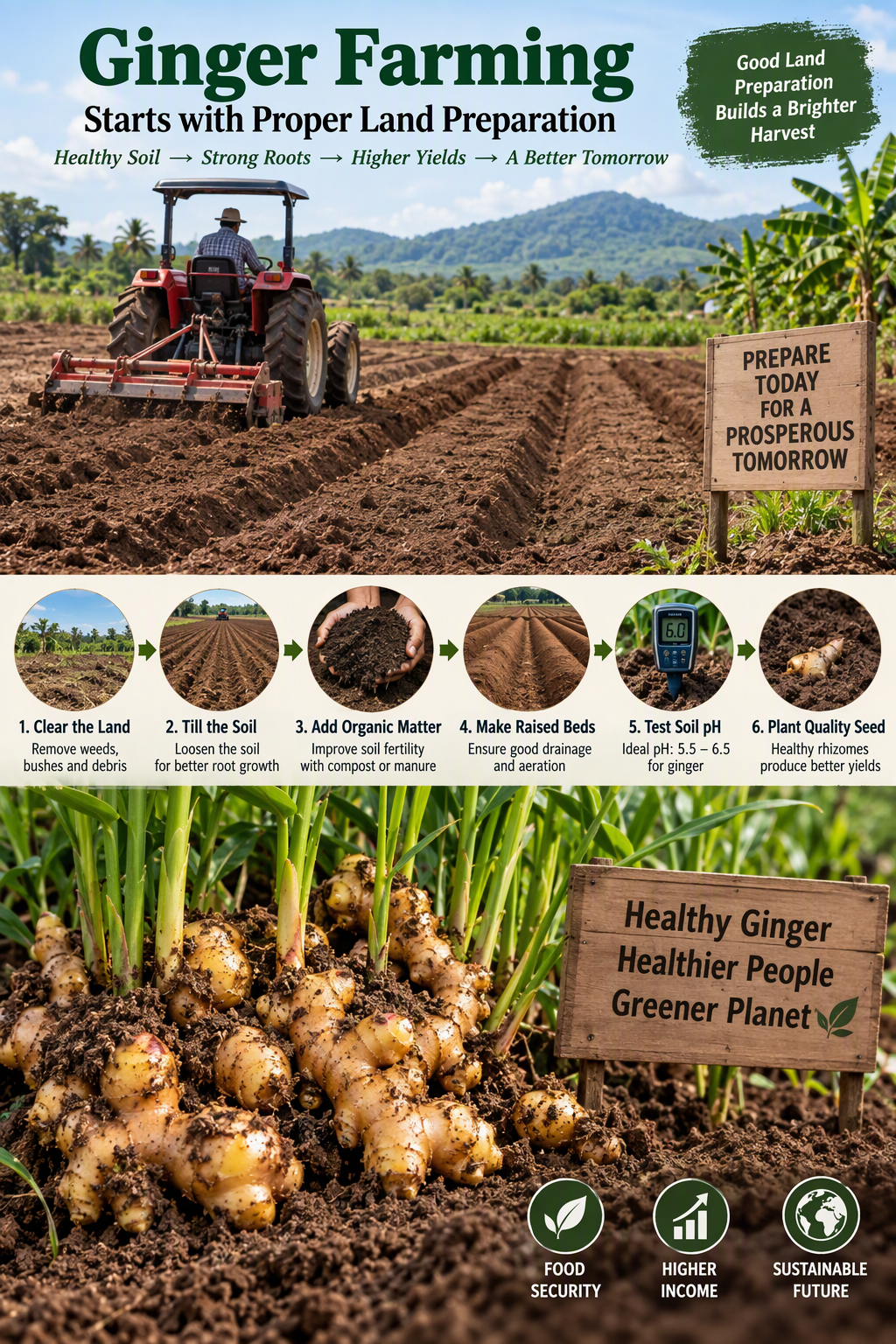
Knowledge and Significance of Preparing Land for Ginger Farming in the Modern World
A Comprehensive 28-Page Academic Format
Abstract
Ginger (Zingiber officinale) is one of the world’s most important spice and medicinal crops, valued for its culinary, pharmaceutical, cosmetic, and industrial applications. The success of ginger cultivation depends heavily on proper land preparation, which forms the foundation for healthy root development, disease prevention, water management, and increased productivity. In the modern agricultural world, land preparation has become an essential component of sustainable farming systems aimed at improving food security, environmental conservation, and economic development. This thesis examines the knowledge, methods, significance, challenges, and future prospects of preparing land for ginger farming. It explores both traditional and modern techniques, highlighting their importance in maximizing yield, improving soil health, reducing production costs, and promoting sustainable agriculture.
Keywords: Ginger farming, land preparation, agriculture, sustainability, soil management, crop production, food security.
Chapter 1: Introduction
1.1 Background of the Study
Agriculture remains one of the most significant sectors contributing to human survival and economic development. Among high-value agricultural commodities, ginger occupies a prominent position due to its wide applications in food processing, medicine, cosmetics, and beverage production.
The increasing global demand for ginger has encouraged farmers worldwide to adopt scientific farming practices. One of the most critical practices is proper land preparation. The quality of land preparation directly influences root formation, nutrient absorption, disease resistance, and overall crop productivity.
In modern agriculture, land preparation is not merely about clearing vegetation. It involves soil analysis, drainage design, tillage operations, organic matter incorporation, weed management, and environmental conservation measures.
1.2 Problem Statement
Many farmers continue to experience low ginger yields due to poor land preparation practices. Inadequate soil management, poor drainage systems, soil compaction, and insufficient nutrient availability significantly affect ginger production.
1.3 Objectives of the Study
The study aims to:
- Examine the importance of land preparation in ginger farming.
- Analyze modern methods used in preparing land.
- Investigate the relationship between soil quality and ginger productivity.
- Evaluate environmental and economic benefits of proper land preparation.
- Explore future innovations in ginger cultivation.
Chapter 2: Historical Development of Ginger Farming
2.1 Origin of Ginger
Ginger originated in Southeast Asia and has been cultivated for thousands of years. Ancient civilizations in India, China, and Arabia widely used ginger for culinary and medicinal purposes.
2.2 Spread of Ginger Cultivation
Through international trade routes, ginger spread to:
- Africa
- Europe
- South America
- North America
- Oceania
The global market continues expanding due to increasing awareness of ginger’s health benefits.
2.3 Evolution of Land Preparation Techniques
Traditional farming methods focused on:
- Manual clearing
- Hand tillage
- Organic manure application
Modern techniques now incorporate:
- Mechanized plowing
- Precision agriculture
- Soil testing technologies
- GPS-guided farming systems
Chapter 3: Botanical Characteristics of Ginger
3.1 Scientific Classification
| Classification | Name |
|---|---|
| Kingdom | Plantae |
| Family | Zingiberaceae |
| Genus | Zingiber |
| Species | officinale |
3.2 Growth Requirements
Ginger requires:
- Warm temperatures (20°C-35°C)
- Well-drained soil
- Adequate moisture
- Partial shade
- Rich organic matter
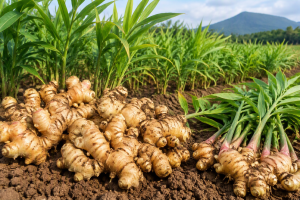
3.3 Rhizome Development
The ginger rhizome is the commercially valuable portion of the plant. Proper land preparation promotes larger and healthier rhizomes.
Chapter 4: Concepts of Land Preparation
4.1 Definition
Land preparation refers to all physical, chemical, and biological activities conducted before planting to create optimal soil conditions.
4.2 Importance
Proper preparation:
- Improves root penetration
- Enhances water infiltration
- Increases nutrient availability
- Reduces pest infestation
- Promotes healthy crop growth
Chapter 5: Site Selection
5.1 Importance of Location
Selecting suitable land determines crop success.
Factors include:
- Soil fertility
- Water availability
- Climate suitability
- Accessibility
5.2 Topography
Flat or gently sloping land is preferred because it:
- Reduces erosion
- Enhances drainage
- Facilitates mechanization
Chapter 6: Soil Analysis and Testing
6.1 Soil Sampling
Soil testing helps determine:
- pH levels
- Nitrogen content
- Phosphorus availability
- Potassium concentration
6.2 Ideal Soil Conditions
Best soil pH:
5.5 to 6.5
Suitable soils include:
- Sandy loams
- Loamy soils
- Organic-rich soils
Chapter 7: Land Clearing
7.1 Purpose
Land clearing removes:
- Bushes
- Trees
- Weeds
- Rocks
7.2 Modern Approaches
Modern equipment includes:
- Bulldozers
- Excavators
- Mechanical slashers
These increase efficiency and save labor.
Chapter 8: Tillage Operations
8.1 Primary Tillage
Primary tillage breaks compacted soil layers.
Benefits include:
- Improved aeration
- Better water movement
- Enhanced root growth
8.2 Secondary Tillage
Secondary tillage creates fine seedbeds suitable for planting ginger rhizomes.
Chapter 9: Raised Bed Preparation
Raised beds improve:
- Drainage
- Aeration
- Root expansion
Standard dimensions:
- Width: 1 meter
- Height: 20-30 cm
- Length: According to farm size
Chapter 10: Drainage Management
Poor drainage causes:
- Root rot
- Fungal infections
- Yield losses
Drainage systems include:
- Surface drains
- Subsurface drains
- Raised ridges
Chapter 11: Organic Matter Incorporation
Organic materials improve:
- Soil structure
- Water retention
- Nutrient availability
Examples include:
- Compost
- Farmyard manure
- Green manure
Chapter 12: Soil Fertility Improvement
Essential nutrients:
Macronutrients
- Nitrogen
- Phosphorus
- Potassium
Micronutrients
- Zinc
- Boron
- Iron
Balanced fertility supports vigorous growth.
Chapter 13: Weed Management
Effective weed control:
- Reduces competition
- Conserves nutrients
- Improves yields
Methods include:
- Mulching
- Herbicides
- Mechanical cultivation
Chapter 14: Pest and Disease Prevention
Land preparation helps reduce:
- Nematodes
- Rhizome rot
- Bacterial wilt
- Fungal diseases
Healthy soils strengthen plant immunity.
Chapter 15: Water Management
Ginger requires consistent moisture.
Land preparation assists by:
- Improving infiltration
- Preventing runoff
- Conserving soil moisture
Chapter 16: Sustainable Ginger Farming
Sustainability involves:
- Soil conservation
- Biodiversity protection
- Reduced chemical usage
Modern consumers increasingly demand sustainably produced ginger.
Chapter 17: Economic Importance
Benefits include:
- Employment creation
- Export earnings
- Farm income growth
- Rural development
Countries producing ginger generate millions of dollars through exports.
Chapter 18: Environmental Significance
Proper preparation:
- Prevents erosion
- Improves carbon sequestration
- Supports microbial activity
- Conserves ecosystems
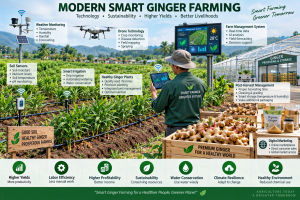
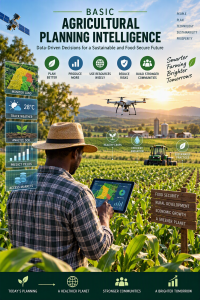
Chapter 19: Modern Technologies in Land Preparation
Technologies include:
- GPS mapping
- Drones
- AI-based soil analysis
- Precision irrigation
These innovations optimize resource utilization.
Chapter 20: Climate Change and Ginger Farming
Challenges include:
- Irregular rainfall
- Drought
- Flooding
- Extreme temperatures
Prepared land enhances resilience against climatic disturbances.
Chapter 21: Mechanization
Modern equipment:
- Tractors
- Rotary tillers
- Bed formers
- Laser levelers
Mechanization improves productivity and reduces labor costs.
Chapter 22: Challenges Facing Land Preparation
Major challenges:
- High costs
- Limited machinery
- Soil degradation
- Climate variability
- Lack of technical knowledge
Chapter 23: Case Studies
India
World’s leading ginger producer.
Success factors:
- Soil management
- Irrigation systems
- Farmer training
Nigeria
Expanding ginger exports through improved land preparation methods.
Chapter 24: Future Trends
Future farming may involve:
- AI-driven soil diagnostics
- Autonomous tractors
- Smart sensors
- Precision nutrient management
Chapter 25: Socioeconomic Benefits
Improved land preparation contributes to:
- Poverty reduction
- Food security
- Income generation
- Community development
Chapter 26: Policy Implications
Governments should:
- Promote farmer training
- Support mechanization
- Encourage soil conservation
- Increase research funding
Chapter 27: Recommendations
Farmers should:
- Conduct regular soil testing.
- Utilize organic amendments.
- Adopt raised-bed systems.
- Improve drainage infrastructure.
- Integrate modern technologies.
Agricultural institutions should increase extension services to educate farmers on best practices.
Chapter 28: Conclusion
Preparing land for ginger farming is one of the most critical determinants of agricultural success in the modern world. Proper land preparation enhances soil fertility, improves drainage, promotes root development, reduces disease prevalence, and increases crop yields. As global demand for ginger continues to grow, farmers must adopt scientific and sustainable land management practices to remain competitive.
The significance of land preparation extends beyond productivity. It contributes to environmental protection, climate resilience, food security, and economic development. Modern technologies, including precision agriculture, artificial intelligence, and mechanization, are transforming traditional farming systems and creating new opportunities for sustainable ginger production.
Ultimately, the future of ginger farming depends on integrating traditional knowledge with modern agricultural innovation. Through effective land preparation, farmers can maximize productivity, improve profitability, and contribute meaningfully to sustainable global food systems.
References
- Food and Agriculture Organization (FAO).
- World Bank Agricultural Development Reports.
- International Journal of Agricultural Sciences.
- Journal of Soil Science and Plant Nutrition.
- International Institute of Tropical Agriculture (IITA).
- Agricultural Extension and Rural Development Publications.
- Sustainable Agriculture Research Journal.
- United Nations Food Security Reports.
- International Ginger Production Studies.
- Precision Agriculture and Smart Farming Research Publications.



Be First to Comment