
Title Page
Biometric Data: Foundations, Applications, Challenges, and Future Implications in the Digital Era
Comprehensive Academic Thesis
Abstract
Biometric data has become one of the most valuable forms of digital identity in the modern world. Unlike passwords, identification cards, and security tokens that can be lost or stolen, biometric identifiers are uniquely associated with individuals and therefore offer a highly secure means of authentication. As governments, businesses, healthcare institutions, and security agencies increasingly adopt biometric systems, understanding biometric data has become essential. This thesis explores the concept of biometric data, its technologies, applications, benefits, limitations, ethical implications, security concerns, and future developments. The study demonstrates that biometric technologies are transforming digital security and identity management while simultaneously raising significant privacy and ethical challenges that require careful governance and regulation.
Chapter 1: Introduction
Biometric data refers to measurable biological and behavioral characteristics used to identify or verify an individual’s identity. The word “biometric” originates from the Greek words bios (life) and metron (measure).
Traditional identification systems rely on something a person knows, such as a password, or something a person possesses, such as a card or token. Biometrics, however, rely on something a person is.
Modern society increasingly relies upon accurate identification systems due to rising cybersecurity threats, identity theft, fraud, and unauthorized access to sensitive information. Biometric technologies provide an efficient solution by using unique human characteristics that are difficult to duplicate or forge.
The rapid growth of artificial intelligence, machine learning, cloud computing, and mobile devices has accelerated biometric adoption worldwide. Smartphones, border control systems, banking services, healthcare applications, and law enforcement agencies now depend heavily on biometric authentication.
This thesis investigates various components of biometric data and evaluates its significance in contemporary society.
Chapter 2: Understanding Biometric Data
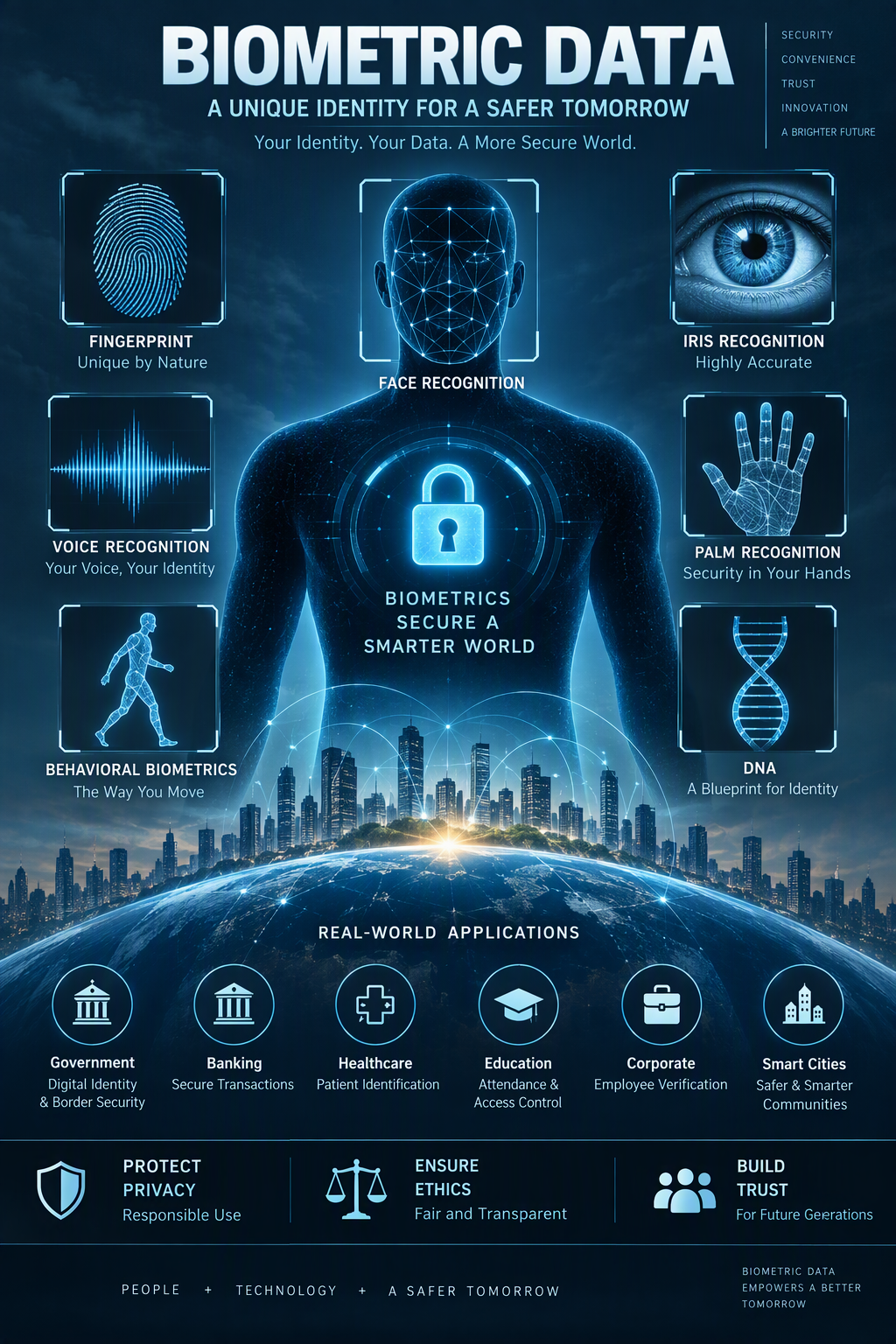
Biometric data consists of physical or behavioral characteristics that can uniquely identify an individual.
Physical Biometrics
Physical biometrics are based on physiological traits.
Examples include:
- Fingerprints
- Facial features
- Iris patterns
- Retina structures
- Palm prints
- DNA
- Hand geometry
- Vein patterns
These characteristics generally remain stable throughout a person’s life.
Behavioral Biometrics
Behavioral biometrics focus on actions and behaviors.
Examples include:
- Voice patterns
- Gait recognition
- Typing rhythm
- Signature dynamics
- Mouse movement patterns
- Touchscreen interaction patterns
Behavioral biometrics change slightly over time but remain sufficiently unique for identification purposes.
Chapter 3: History and Evolution of Biometrics
Biometric identification has existed for thousands of years.
Ancient civilizations used fingerprints and physical descriptions for identification.
Historical Milestones
Ancient China
Fingerprints were used on legal documents and seals.
19th Century
Sir Francis Galton developed fingerprint classification systems.
Early 20th Century
Law enforcement agencies adopted fingerprint databases.
Late 20th Century
Computerized biometric systems emerged.
21st Century
Artificial intelligence and machine learning revolutionized biometric recognition accuracy.
Today, biometric systems have become a global standard in digital security and identification.
Chapter 4: Major Types of Biometric Technologies
Fingerprint Recognition
Fingerprint recognition analyzes ridge structures present on fingertips.
Advantages:
- Highly unique
- Cost-effective
- Fast processing
- Widely accepted
Applications:
- Mobile phones
- Employee attendance systems
- Banking authentication
Facial Recognition
Facial recognition uses geometric measurements and image analysis.
Key features include:
- Distance between eyes
- Nose shape
- Jaw structure
- Facial contours
Applications:
- Airport security
- Social media tagging
- Smart devices
Iris Recognition
The iris contains highly unique patterns.
Benefits:
- Extremely accurate
- Difficult to duplicate
- Stable throughout life
Common uses:
- Border control
- National identification systems
Retina Recognition
Retinal scanning examines blood vessel patterns inside the eye.
Advantages:
- Exceptional security
Limitations:
- Expensive equipment
- User discomfort
Chapter 5: Collection and Processing of Biometric Data
The biometric identification process consists of several stages.
Step 1: Data Capture
Biometric sensors collect data from an individual.
Examples include:
- Cameras
- Fingerprint scanners
- Microphones
- Iris scanners
Step 2: Feature Extraction
System algorithms extract unique biometric characteristics.
Step 3: Template Creation
Extracted features are converted into digital templates.
Step 4: Storage
Templates are securely stored in databases.
Step 5: Matching
Future scans are compared against stored templates.
Step 6: Authentication
The system grants or denies access.
This process typically occurs within seconds.
Chapter 6: Applications of Biometric Data
Government Applications
Governments use biometrics for:
- National identity programs
- Voter registration
- Border management
- Passport verification
Banking Sector
Financial institutions employ biometrics for:
- Digital banking login
- Mobile payments
- Fraud prevention
- Account verification
Healthcare
Biometrics improves:
- Patient identification
- Medical record protection
- Access control
Education
Educational institutions use biometrics for:
- Student attendance tracking
- Examination security
- Campus access management
Corporate Security
Businesses utilize biometrics for:
- Employee verification
- Secure facility access
- Time management systems
Chapter 7: Advantages of Biometric Data
Biometric technologies provide numerous benefits.
Enhanced Security
Biometric traits are difficult to steal or duplicate.
Improved Convenience
Users no longer need to remember numerous passwords.
Fraud Prevention
Identity fraud is significantly reduced.
Increased Accuracy
Modern biometric systems achieve high recognition rates.
Accountability
Organizations can accurately track access and activities.
Faster Identification
Authentication occurs rapidly, often in seconds.
Chapter 8: Privacy and Ethical Concerns
Despite its benefits, biometric technology raises serious ethical issues.
Privacy Risks
Biometric data represents deeply personal information.
Unauthorized collection may infringe individual privacy rights.
Surveillance Concerns
Large-scale facial recognition systems may enable mass surveillance.
Consent Challenges
Individuals may not fully understand how their data is collected, stored, or shared.
Data Ownership
Questions arise regarding who owns biometric information.
Possible stakeholders include:
- Individuals
- Governments
- Corporations
Discrimination Risks
Algorithmic bias may affect certain demographic groups disproportionately.
Chapter 9: Security Risks and Threats
Biometric systems are not immune to cyber threats.
Database Breaches
Hackers may target biometric databases.
Unlike passwords, biometrics cannot be changed easily.
Spoofing Attacks
Attackers may attempt to fool systems using:
- Fake fingerprints
- Photographs
- Recorded voices
Insider Threats
Employees with system access may misuse biometric information.
Deepfake Technologies
Artificial intelligence-generated identities create new authentication challenges.
Organizations must implement strong cybersecurity measures to protect biometric systems.
Chapter 10: Legal and Regulatory Frameworks
Many countries have introduced laws governing biometric data.
Key Principles
- Transparency
- Accountability
- Data minimization
- User consent
- Purpose limitation
Organizations must ensure compliance with applicable regulations.
Failure to protect biometric data can result in legal consequences, financial penalties, and reputational damage.
Governments worldwide continue developing more comprehensive biometric governance frameworks.
Chapter 11: Artificial Intelligence and Biometrics
Artificial intelligence has dramatically enhanced biometric capabilities.
Machine Learning Applications
AI improves:
- Pattern recognition
- Facial analysis
- Voice authentication
- Behavioral monitoring
Deep Learning
Deep neural networks increase accuracy and reduce error rates.
Predictive Identification
AI can recognize identities under changing conditions such as:
- Age progression
- Facial expressions
- Lighting variations
The integration of AI and biometrics is transforming digital identity management.
Chapter 12: Future Trends in Biometrics
Several emerging trends are shaping the future.
Contactless Biometrics
Post-pandemic environments encourage touch-free authentication.
Examples include:
- Facial recognition
- Iris scanning
- Voice recognition
Multimodal Biometrics
Combining multiple biometric traits improves security.
Example:
- Fingerprint + Face + Voice
Continuous Authentication
Systems continuously verify users throughout a session.
Behavioral Intelligence
Advanced AI analyzes behavioral patterns in real time.
Wearable Biometrics
Smartwatches and health devices collect biometric data continuously.
Chapter 13: Biometric Data in Smart Cities
Future smart cities will heavily depend on biometric technologies.
Applications include:
- Transportation systems
- Public safety management
- Smart healthcare services
- Automated government services
Biometrics can enhance urban efficiency while improving citizen experiences.
However, governments must balance innovation with civil liberties and privacy protection.
Chapter 14: Challenges in Global Implementation
Several barriers hinder widespread biometric adoption.
High Costs
Advanced systems require substantial investment.
Infrastructure Requirements
Reliable digital infrastructure is necessary.
Public Resistance
Privacy concerns generate opposition.
Technical Errors
False positives and false negatives remain challenges.
Regulatory Differences
International standards vary significantly.
Addressing these obstacles is essential for successful implementation.
Chapter 15: Conclusion and Recommendations
Biometric data has emerged as one of the most important technological resources of the twenty-first century. Its ability to uniquely identify individuals has revolutionized security, authentication, and identity management across numerous sectors.
From fingerprint recognition and facial authentication to behavioral analytics and AI-powered identification systems, biometric technologies continue to shape modern society. Governments, businesses, healthcare providers, and educational institutions increasingly rely on biometric systems to improve security, efficiency, and convenience.
Despite these benefits, significant concerns remain regarding privacy, surveillance, cybersecurity, ethical practices, and legal compliance. Organizations must adopt responsible biometric governance to ensure trust and protect individual rights.
Recommendations
- Strengthen biometric data protection laws.
- Implement advanced encryption technologies.
- Increase transparency regarding data usage.
- Require informed user consent.
- Develop international biometric standards.
- Reduce algorithmic bias through inclusive datasets.
- Invest in cybersecurity infrastructure.
- Promote ethical AI development.
- Establish independent oversight bodies.
- Encourage public education about biometric technologies.
In conclusion, biometric data will continue playing a central role in the future digital ecosystem. When implemented responsibly and ethically, biometric systems can provide secure, efficient, and trustworthy identity verification solutions that benefit individuals, organizations, and society as a whole.
References
- Jain, A. K., Ross, A., & Prabhakar, S. (Biometrics and Recognition Systems).
- International Organization for Standardization (ISO) Biometric Standards.
- National Institute of Standards and Technology (NIST) Biometric Research Publications.
- European Data Protection Board Guidelines on Biometric Data.
- World Bank Digital Identification Framework.
- Academic Journals on Artificial Intelligence and Biometrics.
- Cybersecurity and Privacy Research Reports.
- Government Digital Identity Policy Documents.
- IEEE Transactions on Biometrics, Behavior, and Identity Science.
- Contemporary Research on Smart Cities and Digital Identity Systems.





Be First to Comment