
Abstract
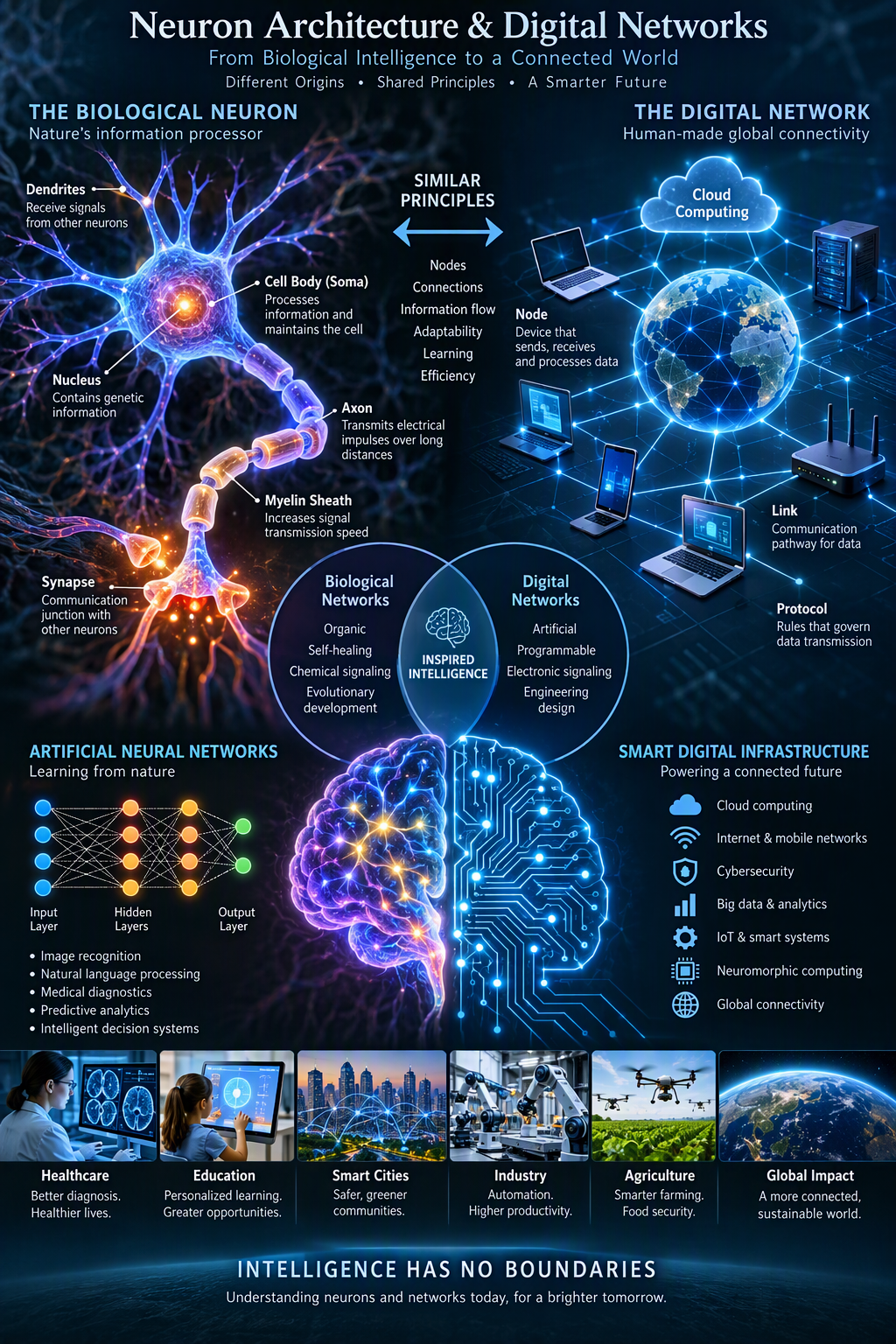
Neuron architecture and digital networks represent two of the most transformative systems in modern science and technology. Biological neurons form the foundation of intelligence in living organisms, while digital networks enable the exchange of information across computers, devices, and artificial intelligence systems. The convergence of neuroscience and digital networking has created a new era where artificial neural networks, machine learning systems, and intelligent digital infrastructures mimic biological processes to solve complex global challenges. This thesis examines the structure, functions, principles, and future developments of neuron architecture and digital networks, highlighting their significance in scientific innovation, communication technologies, artificial intelligence, healthcare, economics, and societal transformation.
Chapter 1: Introduction
1.1 Background
The human brain is composed of approximately 86 billion neurons interconnected through trillions of synapses. These biological structures form one of the most sophisticated information-processing systems known to humanity. Simultaneously, digital networks connect billions of computers, smartphones, sensors, and intelligent devices across the globe, enabling unprecedented communication and information exchange.
The study of neuron architecture provides insights into learning, memory, perception, and decision-making. Likewise, digital networks enable data transmission, cloud computing, artificial intelligence, and global collaboration. Together, these fields contribute to the development of intelligent technologies capable of transforming industries and societies.
1.2 Purpose of the Study
This thesis investigates:
- Biological neuron architecture
- Neural communication mechanisms
- Digital network structures
- Artificial neural networks
- Network intelligence systems
- Future intelligent infrastructures
1.3 Research Objectives
The objectives are:
- Examine neuron architecture.
- Analyze digital network frameworks.
- Explore artificial intelligence integration.
- Identify technological challenges.
- Propose future development strategies.
Chapter 2: Understanding Biological Neurons
2.1 Definition of a Neuron
A neuron is a specialized cell responsible for transmitting information throughout the nervous system.
Neurons perform three primary functions:
- Receiving information
- Processing information
- Transmitting signals
2.2 Components of a Neuron
Dendrites
Dendrites receive signals from neighboring neurons.
Functions include:
- Signal reception
- Information integration
- Communication coordination
Cell Body (Soma)
The soma contains:
- Nucleus
- Organelles
- Genetic information
Functions:
- Metabolism
- Signal processing
- Cellular maintenance
Axon
The axon transmits electrical impulses.
Features include:
- Long-distance data transfer
- Rapid communication
- Connectivity with target cells
Synapse
The synapse acts as a communication junction.
Functions:
- Signal transmission
- Learning enhancement
- Memory formation
Chapter 3: Neuron Communication Systems
3.1 Electrical Signaling
Neurons communicate through electrical impulses called action potentials.
Characteristics include:
- Speed
- Precision
- Reliability
3.2 Chemical Signaling
Neurotransmitters facilitate communication between neurons.
Important neurotransmitters include:
- Dopamine
- Serotonin
- Acetylcholine
- Glutamate
- GABA
3.3 Neural Circuits
Neural circuits consist of interconnected neuron groups performing specific tasks.
Examples:
- Motor control
- Language processing
- Visual recognition
- Memory storage
Chapter 4: Network Principles in the Human Brain
4.1 Neural Connectivity
Brain functionality depends on extensive connectivity.
Types include:
Local Networks
Responsible for:
- Specialized processing
- Rapid reactions
- Local computations
Global Networks
Responsible for:
- Integrated cognition
- Consciousness
- Problem solving
4.2 Information Flow
Information processing involves:
- Input acquisition
- Signal analysis
- Pattern recognition
- Decision making
- Response generation
Chapter 5: Digital Network Foundations
5.1 Definition of Digital Networks
Digital networks connect computing devices to exchange information.
Examples:
- Internet
- Mobile networks
- Enterprise networks
- Cloud infrastructures
5.2 Network Components
Nodes
Devices connected within a network.
Examples:
- Computers
- Smartphones
- Servers
- Routers
Links
Communication pathways carrying data.
Protocols
Rules governing communication.
Examples:
- TCP/IP
- HTTP
- FTP
- HTTPS
Chapter 6: Network Topologies
6.1 Star Topology
All devices connect to a central node.
Advantages:
- Reliability
- Easy maintenance
- Scalability
6.2 Bus Topology
Devices share a common communication line.
Advantages:
- Simplicity
- Cost-effectiveness
6.3 Ring Topology
Devices form a circular communication structure.
Benefits include:
- Predictable transmission
- Efficient communication
6.4 Mesh Topology
Every node connects with multiple nodes.
Benefits:
- High redundancy
- Fault tolerance
- Reliability
Chapter 7: Comparing Biological and Digital Networks
Similarities
Both systems contain:
- Nodes
- Connections
- Information flow
- Adaptability
- Learning capabilities
Differences
| Biological Networks | Digital Networks |
|---|---|
| Organic | Artificial |
| Self-healing | Programmable |
| Chemical signaling | Electronic signaling |
| Evolutionary development | Engineering design |
Chapter 8: Artificial Neural Networks
8.1 Introduction
Artificial Neural Networks (ANNs) simulate biological neural structures.
Applications include:
- Image recognition
- Natural language processing
- Medical diagnostics
- Financial forecasting
8.2 Structure
Components include:
Input Layer
Receives data.
Hidden Layers
Perform analysis.
Output Layer
Produces results.
Chapter 9: Deep Learning Architectures
Convolutional Neural Networks (CNN)
Applications:
- Computer vision
- Facial recognition
- Medical imaging
Recurrent Neural Networks (RNN)
Applications:
- Language processing
- Time-series prediction
Transformers
Applications:
- Generative AI
- Large Language Models
- Advanced analytics
Chapter 10: Digital Communication Systems
Digital communication networks consist of:
- Wireless systems
- Fibre-optic systems
- Satellite networks
- Cloud networks
Key benefits include:
- Speed
- Reliability
- Global accessibility
Chapter 11: Internet Architecture
The internet functions as a vast digital network.
Major layers include:
Physical Layer
Hardware infrastructure.
Network Layer
Routing mechanisms.
Transport Layer
Reliable communication.
Application Layer
User services.
Chapter 12: Cloud Computing Networks
Cloud systems utilize distributed digital networks.
Models include:
- Infrastructure as a Service
- Platform as a Service
- Software as a Service
Benefits:
- Scalability
- Cost reduction
- Accessibility
Chapter 13: Intelligent Network Systems
Intelligent networks utilize:
- AI algorithms
- Automated decision systems
- Machine learning engines
Applications:
- Traffic management
- Cybersecurity
- Healthcare analytics
- Smart agriculture
Chapter 14: Neuro-Inspired Computing
Neuromorphic computing seeks to emulate brain functionality.
Objectives:
- Energy efficiency
- Adaptive learning
- Real-time intelligence
Examples:
- Spiking neural networks
- Neuromorphic chips
Chapter 15: Network Intelligence
Network intelligence involves:
- Automated optimization
- Self-learning systems
- Predictive maintenance
- Resource management
Chapter 16: Brain-Computer Interfaces
Brain-computer interfaces connect neural networks directly with computers.
Applications include:
- Medical rehabilitation
- Assistive communication
- Human-machine collaboration
Chapter 17: Cybersecurity in Digital Networks
Challenges:
- Malware
- Data breaches
- Cyberattacks
- Identity theft
Solutions:
- Encryption
- AI monitoring
- Authentication systems
Chapter 18: Machine Learning and Data Networks
Machine learning enhances:
- Pattern recognition
- Data classification
- Predictive modeling
- Decision support
Chapter 19: Big Data and Neural Analytics
Large-scale neural-inspired systems analyze:
- Consumer behavior
- Healthcare records
- Scientific discoveries
- Financial markets
Chapter 20: Smart Cities and Digital Networks
Smart cities integrate:
- Sensors
- AI systems
- Digital infrastructure
- IoT networks
Benefits:
- Energy efficiency
- Urban planning
- Public safety
Chapter 21: Healthcare Applications
Neuron-inspired systems support:
- Disease diagnosis
- Imaging analysis
- Drug discovery
- Personalized medicine
Chapter 22: Education and Knowledge Networks
Digital educational systems utilize:
- Intelligent tutoring
- Adaptive learning
- Knowledge graphs
- AI-assisted teaching
Chapter 23: Industrial Applications
Applications include:
- Manufacturing automation
- Robotics
- Supply chain optimization
- Quality control
Chapter 24: Agricultural Intelligence Networks
Smart agriculture employs:
- Sensor networks
- AI analytics
- Precision farming
- Resource optimization
Chapter 25: Economic Impact
Digital neural technologies create:
- New industries
- Employment opportunities
- Innovation ecosystems
- Global productivity gains
Chapter 26: Challenges and Limitations
Major challenges include:
- Data privacy
- Energy consumption
- Ethical concerns
- Infrastructure costs
Chapter 27: Ethical Considerations
Areas of concern:
- AI bias
- Privacy protection
- Human autonomy
- Responsible innovation
Chapter 28: Future Neural Technologies
Emerging developments include:
- Brain-inspired processors
- Digital twins
- Autonomous systems
- Quantum neural networks
Chapter 29: Quantum Information Networks
Quantum technologies may revolutionize:
- Computing
- Encryption
- Communication
- Scientific modeling
Chapter 30: Global Innovation Perspectives
Neuron architecture and digital networks are central to:
- Fourth Industrial Revolution
- AI transformation
- Knowledge economies
- Sustainable development
Chapter 31: Emerging Research Opportunities
Future research directions:
- Neural simulation
- Cognitive computing
- Human-AI integration
- Adaptive intelligence systems
Chapter 32: Sustainable Intelligent Networks
Goals:
- Reduced energy usage
- Green computing
- Resource optimization
- Sustainable innovation
Chapter 33: Vision of Future Intelligence Systems
Future systems may feature:
- Autonomous reasoning
- Continuous learning
- Global connectivity
- Real-time adaptation
Chapter 34: Strategic Framework for Implementation
Pillar 1: Infrastructure
Robust digital connectivity.
Pillar 2: Intelligence
Advanced AI integration.
Pillar 3: Security
Comprehensive protection mechanisms.
Pillar 4: Sustainability
Environmentally responsible development.
Pillar 5: Governance
Ethical and regulatory oversight.
Chapter 35: Conclusion
Neuron architecture and digital networks constitute the foundations of biological intelligence and digital technology. The remarkable similarities between neural systems and modern communication networks have inspired revolutionary advances in artificial intelligence, deep learning, cloud computing, and intelligent infrastructures. As humanity enters an increasingly interconnected digital age, understanding the principles governing neurons and networks becomes essential for innovation, economic growth, healthcare advancement, education transformation, and sustainable development.
The future of intelligent systems will depend on the successful integration of neuroscience, computer science, network engineering, and artificial intelligence. Organizations, governments, researchers, and innovators must collaborate to develop secure, ethical, adaptive, and sustainable neural-inspired digital ecosystems capable of addressing the world’s most complex challenges while enhancing human potential and global prosperity.
References
- Kandel, E. R. Principles of Neural Science.
- Haykin, S. Neural Networks and Learning Machines.
- Russell, S., & Norvig, P. Artificial Intelligence: A Modern Approach.
- Goodfellow, I., Bengio, Y., & Courville, A. Deep Learning.
- Stallings, W. Computer Networking with Internet Protocols.
- LeCun, Y., Bengio, Y., & Hinton, G. Deep Learning Research.
- IEEE Publications on Neural Computing and Digital Networks.
- ACM Digital Library Research Papers.
- World Economic Forum Reports on AI and Digital Transformation.
- International Telecommunication Union (ITU) Digital Network Studies.





Be First to Comment