
Abstract
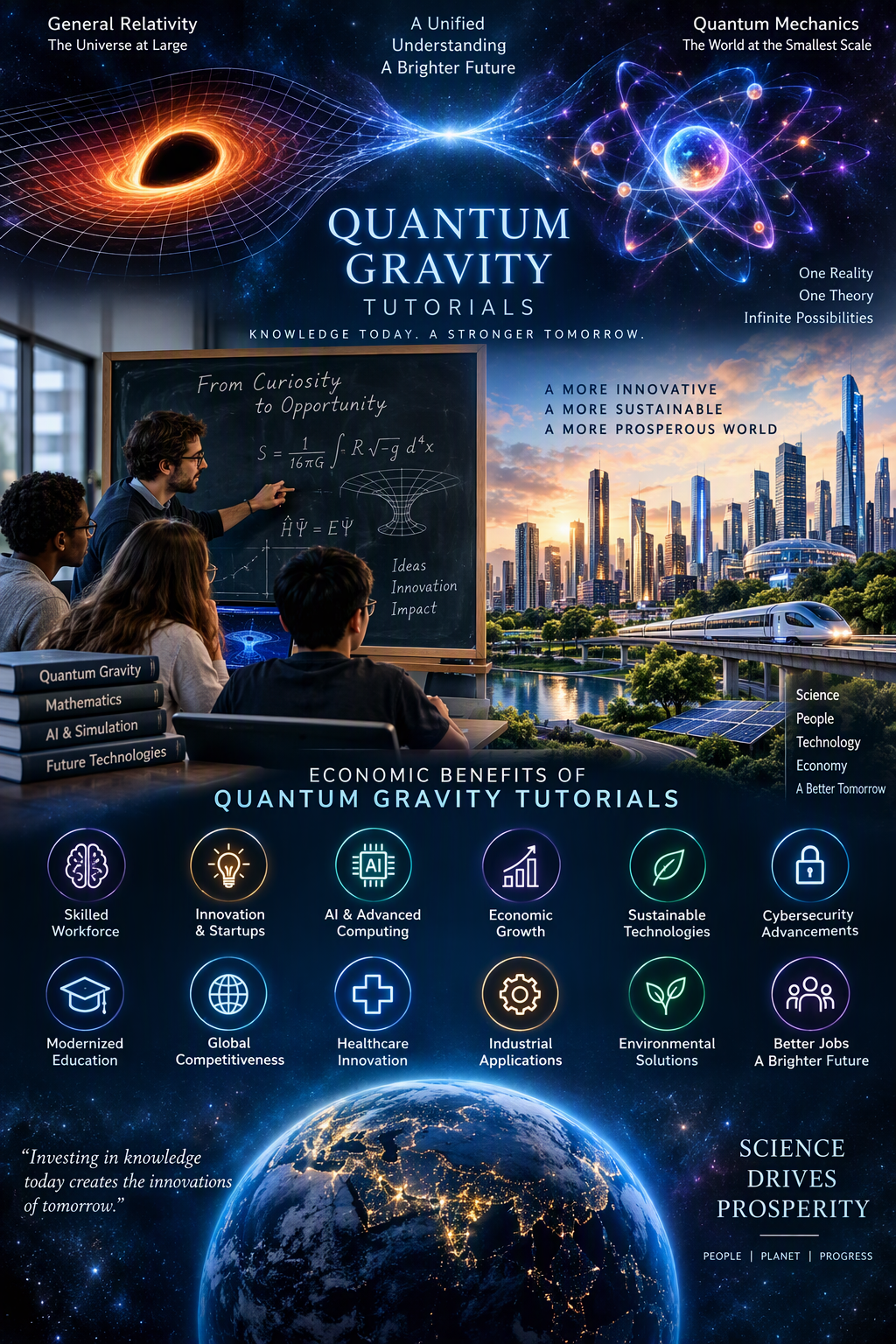
Quantum gravity represents one of the most ambitious scientific pursuits in modern physics. It seeks to unite the principles of quantum mechanics and general relativity into a single framework capable of explaining the fundamental nature of space, time, matter, and energy. While quantum gravity remains largely theoretical, education and tutorials in this field provide significant economic, technological, and intellectual benefits. This thesis explores how quantum gravity tutorials contribute to workforce development, scientific innovation, technological advancement, economic competitiveness, artificial intelligence, cybersecurity, education systems, and long-term industrial transformation. The study argues that investing in quantum gravity education today can produce substantial economic returns tomorrow through knowledge creation, innovation ecosystems, and advanced technological capabilities.
Chapter 1: Introduction
1.1 Background
The global economy increasingly depends upon knowledge-intensive industries. Scientific understanding has become a key driver of innovation and economic growth. Among the most advanced frontiers of science is quantum gravity, a discipline seeking to unify the microscopic quantum world with the large-scale structure of the universe.
Quantum gravity tutorials provide structured educational pathways that enable students, researchers, engineers, policymakers, and innovators to engage with complex scientific concepts.
1.2 Purpose of the Study
The primary objective of this thesis is to investigate the economic and societal benefits of quantum gravity tutorials and educational programs.
1.3 Research Objectives
The study aims to:
- Explain quantum gravity fundamentals.
- Explore educational benefits.
- Evaluate economic impacts.
- Analyze innovation potential.
- Assess future industry implications.
Chapter 2: Understanding Quantum Gravity
2.1 Definition
Quantum gravity is a theoretical framework attempting to reconcile:
- Quantum Mechanics
- General Relativity
into a unified description of nature.
2.2 The Need for Quantum Gravity
Current scientific theories successfully describe different aspects of reality but become incompatible under extreme conditions such as:
- Black holes
- Early universe conditions
- Singularities
Quantum gravity attempts to solve these inconsistencies.
2.3 Major Approaches
String Theory
Proposes fundamental vibrating strings instead of point particles.
Loop Quantum Gravity
Suggests spacetime consists of discrete quantum units.
Causal Dynamical Triangulation
Models spacetime as evolving geometric structures.
Emergent Gravity
Views gravity as an emergent phenomenon arising from information theory.
Chapter 3: Quantum Gravity Tutorials and Education
3.1 Educational Foundations
Quantum gravity tutorials introduce learners to:
- Advanced mathematics
- Quantum field theory
- Relativity
- Computational physics
3.2 Knowledge Development
Students develop:
- Logical reasoning
- Analytical thinking
- Abstract problem-solving abilities
3.3 Interdisciplinary Learning
Quantum gravity integrates:
- Physics
- Mathematics
- Computer science
- Engineering
- Artificial Intelligence
Chapter 4: Human Capital Development
4.1 Knowledge Economy
Modern economies rely heavily on brainpower rather than raw materials.
Quantum gravity tutorials cultivate highly skilled professionals.
4.2 Advanced Workforce Skills
Participants gain competencies in:
- Complex modeling
- Data analysis
- Algorithm design
- Scientific computation
4.3 Productivity Enhancement
Scientific literacy improves decision-making and workplace problem-solving.
Chapter 5: Innovation and Creativity
5.1 Innovation Ecosystems
Educational programs stimulate innovation networks involving:
- Universities
- Research institutions
- Technology companies
5.2 Scientific Creativity
Quantum gravity requires unconventional thinking and innovative approaches.
5.3 Breakthrough Thinking
Tutorials train individuals to tackle unsolved problems, promoting innovation across multiple sectors.
Chapter 6: Quantum Gravity and Artificial Intelligence
6.1 Shared Computational Principles
Quantum gravity research often employs machine learning and AI systems.
6.2 AI Applications
Benefits include:
- Pattern recognition
- Large-scale simulations
- Scientific discovery acceleration
6.3 Economic Value
AI-enhanced research tools contribute to productivity gains in numerous industries.
Chapter 7: Quantum Computing Synergies
7.1 Relationship with Quantum Computing
Quantum gravity education supports understanding of future quantum technologies.
7.2 Commercial Potential
Applications include:
- Drug discovery
- Financial modeling
- Logistics optimization
7.3 Workforce Preparation
Tutorials prepare future professionals for quantum-enabled industries.
Chapter 8: Research and Development Benefits
8.1 Scientific Infrastructure
Developing quantum gravity expertise strengthens research institutions.
8.2 Economic Spillovers
Scientific discoveries often generate unexpected commercial innovations.
8.3 National Competitiveness
Countries investing in advanced sciences enhance long-term competitiveness.
Chapter 9: Digital Transformation
9.1 Advanced Modeling
Quantum gravity research encourages development of sophisticated computational tools.
9.2 Big Data Applications
Research methodologies benefit industries such as:
- Finance
- Healthcare
- Telecommunications
9.3 Digital Economy
Knowledge generated contributes to future digital innovations.
Chapter 10: Knowledge-Based Economic Growth
10.1 Intellectual Capital
Knowledge has become a strategic economic asset.
10.2 Scientific Learning as Investment
Education creates long-term economic returns through innovation.
10.3 Future Readiness
Quantum gravity tutorials prepare societies for emerging technologies.
Chapter 11: Entrepreneurship Opportunities
11.1 Technology Spin-Offs
Fundamental research often creates commercial opportunities.
11.2 Startup Development
Scientific expertise supports:
- Deep-tech ventures
- AI firms
- Quantum computing startups
11.3 Innovation Markets
New knowledge generates new products and services.
Chapter 12: Economic Impact on Education
12.1 Curriculum Modernization
Quantum gravity tutorials encourage educational reform.
12.2 STEM Excellence
Promotes interest in:
- Science
- Technology
- Engineering
- Mathematics
12.3 Lifelong Learning
Supports continuous professional development.
Chapter 13: Government and Public Policy
13.1 Strategic Investments
Governments increasingly invest in frontier sciences.
13.2 Economic Development Planning
Scientific literacy contributes to national development goals.
13.3 Innovation Policy
Quantum gravity education supports research-driven economies.
Chapter 14: Global Competitiveness
14.1 International Research Collaboration
Promotes international knowledge exchange.
14.2 Talent Attraction
Strong scientific programs attract global talent.
14.3 Economic Leadership
Scientific leadership influences economic leadership.
Chapter 15: Industrial Applications
Although quantum gravity itself remains theoretical, related technologies influence:
- Aerospace
- Telecommunications
- Energy systems
- Computing
Chapter 16: Advanced Mathematics Development
Learning quantum gravity enhances expertise in:
- Tensor calculus
- Differential geometry
- Topology
- Linear algebra
These skills are valuable across industries.
Chapter 17: Scientific Problem Solving
Complex scientific challenges develop resilience and analytical capability.
These qualities enhance business performance and innovation.
Chapter 18: Economic Value of Curiosity-Driven Research
Historically, curiosity-driven research produced:
- The Internet
- GPS
- Semiconductors
- Medical imaging
Quantum gravity research may generate similar future breakthroughs.
Chapter 19: Cybersecurity Implications
Quantum research strengthens understanding of future security technologies.
Benefits include:
- Encryption systems
- Secure communications
- Advanced computing defenses
Chapter 20: Financial Sector Benefits
Advanced computational methods improve:
- Risk assessment
- Portfolio management
- Predictive modeling
Chapter 21: Healthcare Innovation
Research techniques support:
- Data analytics
- Medical simulations
- Drug development
Chapter 22: Environmental Applications
Scientific computing contributes to:
- Climate modeling
- Resource optimization
- Sustainable development
Chapter 23: Transportation Systems
Advanced mathematical models improve:
- Traffic optimization
- Logistics networks
- Supply chain systems
Chapter 24: Energy Sector Applications
Research methodologies support:
- Smart grids
- Renewable energy optimization
- Fusion research
Chapter 25: Workforce Transformation
Future employment increasingly rewards advanced analytical skills.
Quantum gravity tutorials support workforce readiness.
Chapter 26: Economic Risks and Challenges
Challenges include:
- High educational costs
- Research uncertainty
- Long development timelines
However, long-term benefits often outweigh costs.
Chapter 27: Investment Considerations
Public and private funding can accelerate innovation ecosystems.
Strategic investments yield future economic dividends.
Chapter 28: Future Technology Convergence
Future convergence may involve:
- AI
- Quantum computing
- Advanced simulations
- Quantum networks
Chapter 29: Global Scientific Leadership
Nations fostering advanced scientific education strengthen geopolitical influence.
Chapter 30: Case Studies of Scientific Success
Examples include:
- CERN
- NASA
- International Space Station
- Human Genome Project
These initiatives demonstrate the value of advanced scientific investment.
Chapter 31: The Future of Quantum Gravity Education
Educational platforms increasingly utilize:
- AI tutors
- Virtual laboratories
- Interactive simulations
Chapter 32: Strategic Benefits for Developing Economies
Developing nations can leverage scientific education for:
- Skills development
- Innovation growth
- Economic diversification
Chapter 33: Long-Term Economic Vision
Quantum gravity education should be viewed as a strategic investment extending over decades.
Chapter 34: Recommendations
Educational Institutions
- Expand advanced physics programs.
- Develop interdisciplinary curricula.
- Support research initiatives.
Governments
- Increase research funding.
- Promote STEM scholarships.
- Foster innovation ecosystems.
Private Sector
- Collaborate with universities.
- Support scientific research.
- Invest in future technologies.
Chapter 35: Conclusion
Quantum gravity tutorials represent far more than an academic exercise. They cultivate intellectual capital, strengthen innovation ecosystems, enhance workforce capabilities, and prepare societies for future technological revolutions. While direct commercial applications of quantum gravity remain largely exploratory, the educational processes surrounding the field generate valuable skills, discoveries, and economic opportunities.
In the modern economy, where knowledge is increasingly the primary driver of growth, investment in advanced scientific education such as quantum gravity tutorials can yield substantial long-term benefits. By fostering critical thinking, computational expertise, interdisciplinary collaboration, and technological innovation, quantum gravity education contributes meaningfully to economic resilience, national competitiveness, and sustainable development. The future prosperity of nations may depend not only on the technologies they build but also on the advanced scientific knowledge they choose to cultivate today.

Be First to Comment