Abstract
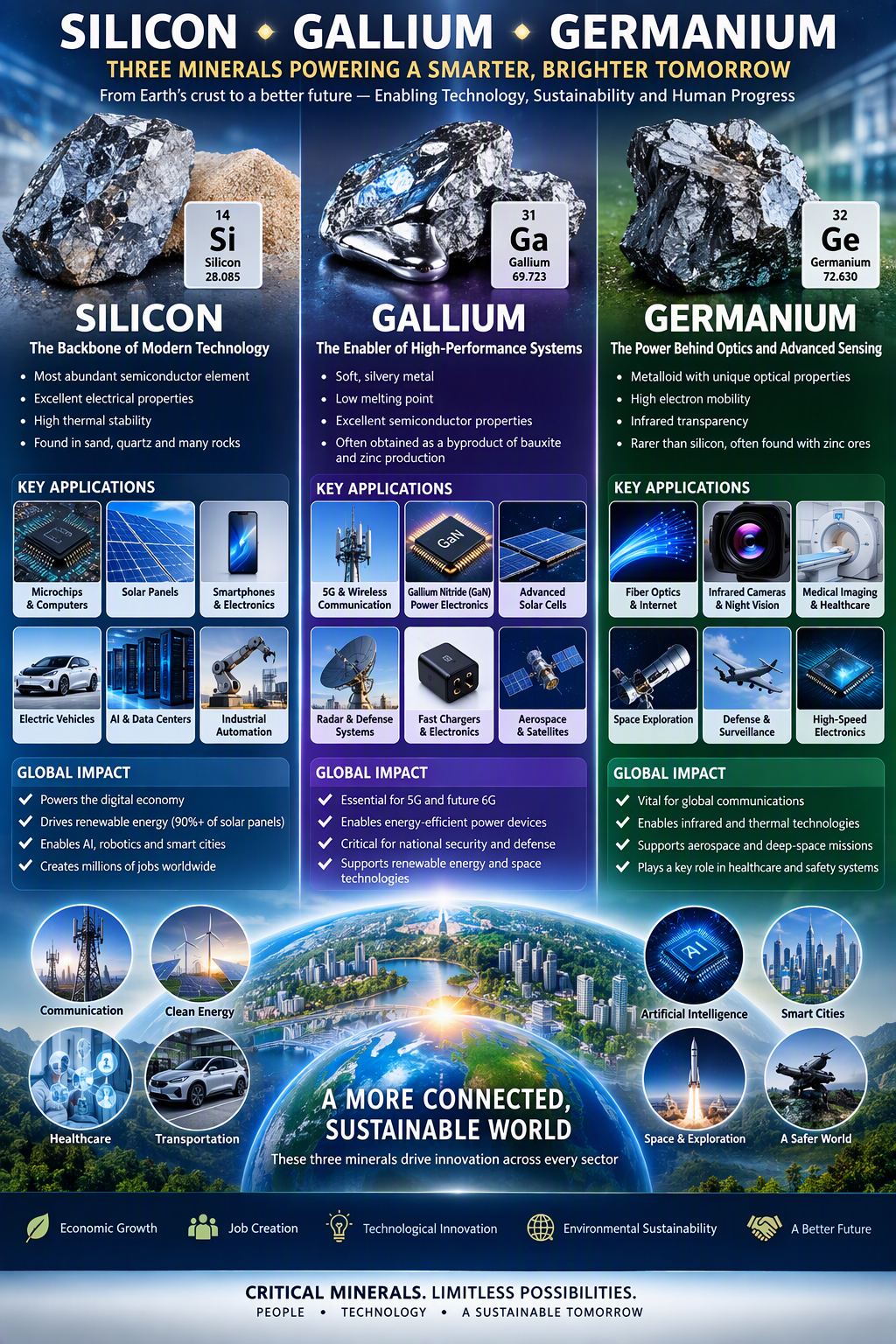
Silicon, Gallium, and Germanium are among the most strategically important minerals and semiconductor materials in modern civilization. These elements have transformed communication, computing, energy systems, healthcare, transportation, defense technologies, and artificial intelligence. From the microchips powering smartphones and supercomputers to advanced solar cells and high-frequency communication systems, these minerals form the foundation of the Fourth Industrial Revolution. This thesis explores their properties, historical development, industrial applications, economic significance, technological contributions, environmental implications, and future prospects.
Chapter 1: Introduction
The modern technological age is largely defined by humanity’s ability to manipulate materials at microscopic and atomic levels. Among the materials that have made this possible, Silicon, Gallium, and Germanium occupy a special position.
These three minerals serve as building blocks for semiconductor technologies that enable:
- Computers
- Smartphones
- Artificial Intelligence
- Renewable Energy
- Telecommunications
- Aerospace Systems
- Medical Equipment
- Defense Technologies
The global digital economy depends heavily on the continuous supply and innovation of these strategic minerals.
Chapter 2: Understanding Silicon
2.1 Definition
Silicon is a chemical element with the symbol Si and atomic number 14.
It is the second most abundant element in the Earth’s crust after oxygen.
2.2 Physical Characteristics
Silicon possesses:
- High thermal stability
- Semiconductor properties
- Excellent electrical control
- Strong mechanical strength
- Corrosion resistance
2.3 Sources of Silicon
Major sources include:
- Quartz
- Sand
- Granite
- Feldspar
Silicon is extracted through industrial refinement processes involving silica reduction.
Chapter 3: Significance of Silicon
3.1 Foundation of Modern Electronics
Silicon powers:
- Microprocessors
- Memory chips
- Sensors
- Integrated circuits
Every smartphone contains billions of silicon transistors.
3.2 Driving Artificial Intelligence
AI systems rely on silicon-based processors for:
- Machine learning
- Deep learning
- Neural networks
- Big data processing
Without silicon, artificial intelligence would not exist at today’s scale.
3.3 Silicon in Computing
Silicon enables:
- Personal computers
- Cloud computing
- Data centers
- Quantum computing research
Modern computational performance is largely built upon silicon architecture.
Chapter 4: Silicon and Renewable Energy
4.1 Solar Energy Revolution
Over 90% of global solar panels use silicon cells.
Benefits include:
- Clean energy generation
- Reduced emissions
- Lower dependence on fossil fuels
4.2 Role in Sustainability
Silicon contributes to:
- Climate change mitigation
- Green technology development
- Sustainable industrialization
Chapter 5: Economic Importance of Silicon
Silicon industries generate:
- Trillions of dollars in economic activity
- Millions of jobs worldwide
- Significant technological exports
Major industries dependent on silicon include:
- Electronics
- Robotics
- Aerospace
- Telecommunications
Chapter 6: Understanding Gallium
6.1 Definition
Gallium is a soft metallic element with the symbol Ga and atomic number 31.
It is commonly obtained as a byproduct of:
- Bauxite processing
- Zinc production
6.2 Key Characteristics
Gallium exhibits:
- High conductivity
- Low melting point
- Semiconductor capabilities
- Excellent thermal performance
Chapter 7: Gallium’s Technological Significance
7.1 Gallium Nitride (GaN)
Gallium Nitride has become one of the most important materials for:
- Fast chargers
- Power electronics
- 5G communication systems
Benefits
- Higher efficiency
- Smaller device size
- Lower energy loss
Chapter 8: Gallium in Telecommunications
Gallium-based semiconductors support:
- 5G networks
- Satellite communications
- Wireless technology
- Radar systems
The rapid growth of global connectivity heavily depends on gallium technologies.
Chapter 9: Gallium and National Security
Gallium is critical for:
- Military radar
- Missile guidance systems
- Electronic warfare
- Aerospace navigation
Many governments classify gallium as a strategic mineral.
Chapter 10: Gallium in Renewable Energy
Gallium is used in:
- High-efficiency solar panels
- Space-based solar systems
- Satellite energy technologies
Gallium-enhanced cells outperform traditional systems in specialized applications.
Chapter 11: Economic Importance of Gallium
The gallium market supports:
- Semiconductor manufacturing
- Telecommunications sectors
- Defense industries
- Renewable energy expansion
Demand continues to rise with global digital transformation.
Chapter 12: Understanding Germanium
12.1 Definition
Germanium is a metalloid element with symbol Ge and atomic number 32.
It was one of the earliest semiconductor materials used in electronic devices.
12.2 Important Properties
Germanium offers:
- Superior electron mobility
- Infrared transparency
- High semiconductor efficiency
- Optical performance advantages
Chapter 13: Historical Role of Germanium
Germanium enabled:
- First-generation transistors
- Early radios
- Initial semiconductor research
Its development paved the way for the modern electronics era.
Chapter 14: Germanium in Fiber Optics
Germanium is essential for:
- Optical fibers
- Internet infrastructure
- Global communications
Billions of people rely on Germanium-enhanced fiber optic systems daily.
Chapter 15: Germanium in Space Technology
Applications include:
- Satellite systems
- Deep-space exploration
- Solar power systems
- Advanced imaging technologies
Germanium improves efficiency in extreme environments.
Chapter 16: Germanium and Infrared Technology
Germanium plays a critical role in:
- Night vision systems
- Thermal cameras
- Security monitoring
- Medical imaging
These technologies contribute to public safety and healthcare.
Chapter 17: Germanium in Defense Systems
Major applications include:
- Target acquisition
- Infrared sensors
- Surveillance systems
- Aerospace defense
The military value of Germanium continues to increase.
Chapter 18: Comparison of Silicon, Gallium, and Germanium
| Property | Silicon | Gallium | Germanium |
|---|---|---|---|
| Abundance | Very High | Moderate | Low |
| Semiconductor Use | Excellent | Excellent | Excellent |
| Renewable Energy | High | High | Medium |
| Telecommunications | High | Very High | High |
| Defense Applications | High | Very High | Very High |
| AI Systems | Very High | High | Medium |
Chapter 19: Strategic Importance in Artificial Intelligence
AI requires:
- Data Processing
- Memory Storage
- High-Speed Communication
- Energy Efficiency
All three minerals contribute significantly to these requirements.
Chapter 20: Role in Supercomputing
Supercomputers rely on:
- Silicon processors
- Gallium power electronics
- Germanium optical communication
Together they enable unprecedented computational capabilities.
Chapter 21: Importance in Medical Technology
Applications include:
- MRI systems
- Medical sensors
- Diagnostic imaging
- Remote healthcare technologies
These minerals improve healthcare quality worldwide.
Chapter 22: Role in Smart Cities
Smart cities utilize technologies powered by these materials for:
- Traffic management
- Public security
- Communication networks
- Energy optimization
Chapter 23: Contribution to Industry 4.0
Industry 4.0 depends on:
- Robotics
- AI
- IoT Devices
- Smart Manufacturing
Silicon, Gallium, and Germanium support all these innovations.
Chapter 24: Contributions to Green Technology
Environmental applications include:
- Solar power
- Energy-efficient electronics
- Smart grids
- Sustainable transportation
Chapter 25: Silicon, Gallium, and Germanium in Quantum Technologies
Emerging quantum technologies require advanced semiconductor materials for:
- Quantum sensors
- Quantum communication
- Quantum computing platforms
Chapter 26: Supply Chain Challenges
Key challenges include:
- Limited production sources
- Geopolitical risks
- Growing demand
- Strategic competition
Secure supply chains have become national priorities.
Chapter 27: Environmental Considerations
Responsible mining is necessary to:
- Reduce ecosystem damage
- Protect biodiversity
- Improve sustainability
- Promote recycling
Chapter 28: Recycling Technologies
Advanced recycling methods recover:
- Semiconductor waste
- Solar panel materials
- Electronic components
Improving circular economies.
Chapter 29: Future Demand Trends
Future growth drivers include:
- AI expansion
- Electric vehicles
- Robotics
- Renewable energy
Demand is expected to increase significantly.
Chapter 30: Role in Global Digital Transformation
Digital transformation relies on semiconductor infrastructure powered by these strategic materials.
Chapter 31: Silicon and Semiconductor Leadership
Silicon remains the dominant semiconductor material due to:
- Abundance
- Cost efficiency
- Manufacturing maturity
Chapter 32: Gallium’s Emerging Dominance
Gallium-based technologies are increasingly replacing traditional silicon in high-performance applications.
Chapter 33: Germanium’s Strategic Niche
Germanium remains indispensable for:
- Optics
- Infrared systems
- Aerospace technologies
Chapter 34: Impact on National Development
Countries mastering semiconductor technologies achieve:
- Economic growth
- Security advantages
- Technological independence
Chapter 35: Global Innovation Ecosystems
Innovation ecosystems depend heavily on access to strategic semiconductor minerals.
Chapter 36: Scientific Research Opportunities
Future research areas include:
- Advanced semiconductor design
- Nanotechnology
- Quantum systems
- Photonics
Chapter 37: Economic Development Opportunities
These minerals enable:
- High-value manufacturing
- Industrial diversification
- Job creation
Chapter 38: Educational Significance
Universities increasingly emphasize semiconductor science and engineering.
Chapter 39: Challenges and Risks
Important risks include:
- Resource concentration
- Supply disruptions
- Technological obsolescence
Chapter 40: Opportunities for Developing Nations
Developing countries can benefit through:
- Mineral processing
- Technology partnerships
- Research investments
Chapter 41: Innovation Potential
Future innovations may include:
- AI chips
- Advanced solar systems
- Autonomous technologies
Chapter 42: Sustainability Perspectives
Sustainable resource management will be essential for long-term growth.
Chapter 43: Global Economic Impacts
These minerals influence:
- International trade
- Manufacturing competitiveness
- Strategic industries
Chapter 44: Future Technological Civilization
The future digital civilization will continue to depend heavily on semiconductor materials.
Chapter 45: Conclusion
Silicon, Gallium, and Germanium represent the foundation of the modern technological era. Silicon remains the backbone of conventional electronics, Gallium drives advanced telecommunications and power technologies, while Germanium supports optical, infrared, and aerospace applications. Together, they power artificial intelligence, renewable energy systems, digital communication networks, healthcare innovations, defense infrastructure, and future quantum technologies.
Their significance extends beyond industrial applications; they are strategic resources that influence economic prosperity, national security, scientific advancement, and global competitiveness. As humanity advances toward a more connected, intelligent, and sustainable future, the importance of Silicon, Gallium, and Germanium will continue to grow. Investment in research, responsible mining, recycling, and technological innovation will ensure these critical minerals remain central to human progress throughout the twenty-first century and beyond.



Be First to Comment