
Abstract
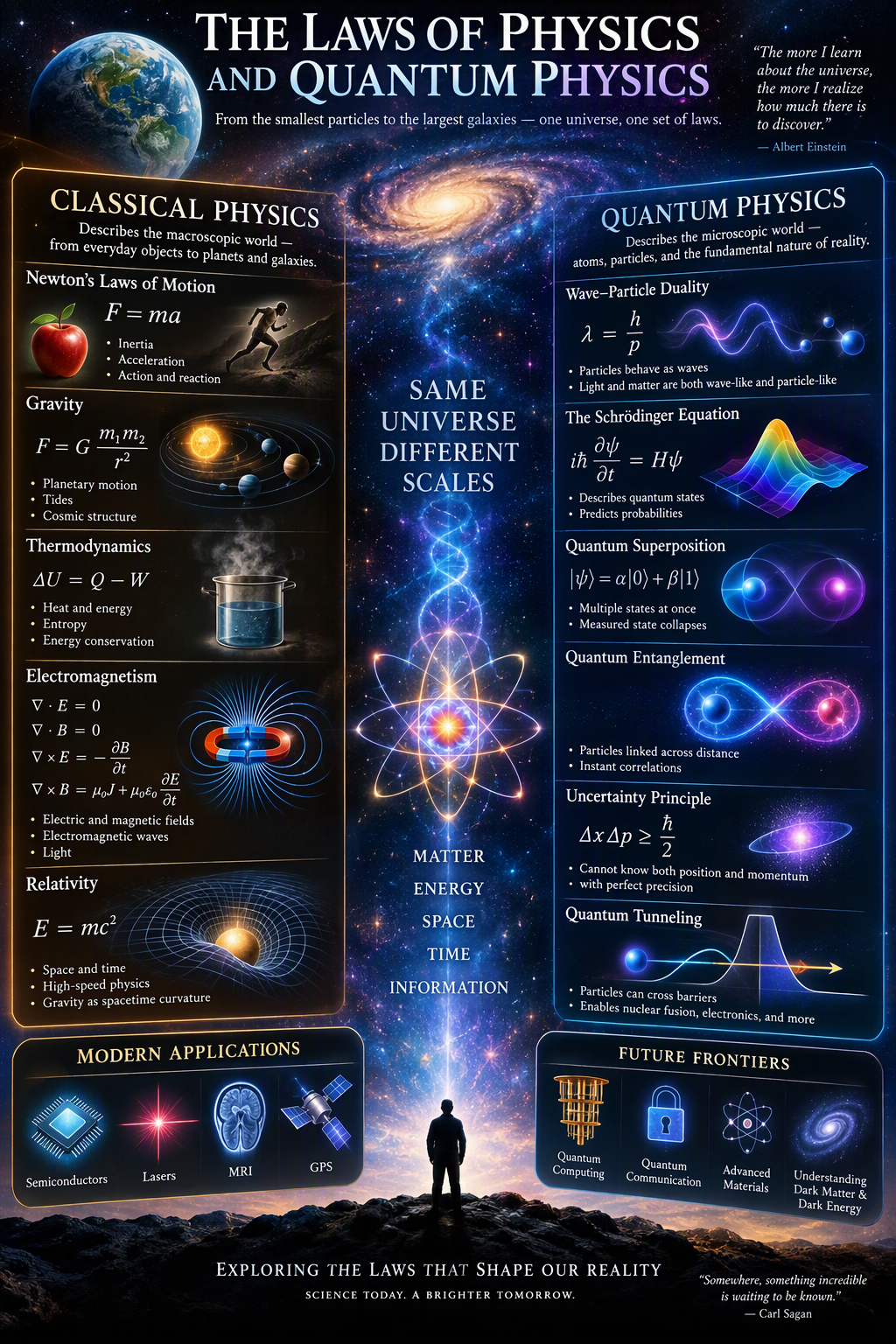
The laws of physics govern the behavior of matter, energy, space, and time throughout the universe. Classical physics provides a framework for understanding the macroscopic world, while quantum physics explains the behavior of particles at atomic and subatomic scales. This comprehensive tutorial explores the foundations, principles, applications, and future implications of both classical and quantum physics, illustrating how these scientific disciplines have transformed human understanding of reality.
Table of Contents
- Introduction to Physics
- Historical Development of Physical Laws
- Understanding Matter and Energy
- Newton’s Laws of Motion
- Gravity and Universal Gravitation
- Conservation Laws
- Thermodynamics
- Electromagnetism
- Waves and Light
- Relativity
- Birth of Quantum Physics
- Quantum Theory Fundamentals
- Wave-Particle Duality
- Quantum States
- The Schrödinger Equation
- Quantum Superposition
- Quantum Entanglement
- Heisenberg’s Uncertainty Principle
- Quantum Tunneling
- Quantum Fields
- Elementary Particles
- The Standard Model
- Quantum Electrodynamics
- Quantum Chromodynamics
- Quantum Gravity
- Quantum Computing
- Quantum Communication
- Quantum Sensors
- Quantum Biology
- Quantum Physics in Modern Technology
- Experimental Physics
- Challenges in Modern Physics
- Future Research Directions
- Philosophical Implications
- Conclusion
Chapter 1: Introduction to Physics
Physics is the fundamental science that seeks to understand the universe’s behavior. It investigates matter, energy, forces, space, and time through observation, experimentation, and mathematical modeling.
The primary goal of physics is to establish laws that universally describe natural phenomena. From planetary motions to the behavior of electrons, physical laws provide predictive power and practical applications.
Physics can be divided into two broad categories:
Classical Physics
Classical physics describes macroscopic phenomena, including:
- Motion
- Gravity
- Thermodynamics
- Electricity
- Magnetism
Modern Physics
Modern physics includes:
- Relativity
- Quantum Mechanics
- Particle Physics
- Cosmology
Together these fields provide humanity’s most complete description of nature.
Chapter 2: Historical Development of Physical Laws
The understanding of physical laws evolved through centuries of scientific inquiry.
Ancient Contributions
Greek philosophers such as:
- Aristotle
- Democritus
- Pythagoras
attempted to explain natural phenomena through reasoning.
Scientific Revolution
Key contributors included:
Galileo Galilei
Established experimental science and kinematics.
Johannes Kepler
Discovered planetary motion laws.
Isaac Newton
Unified terrestrial and celestial mechanics.
Modern Era
Scientists such as:
- Albert Einstein
- Max Planck
- Niels Bohr
- Erwin Schrödinger
introduced revolutionary concepts that transformed physics.
Chapter 3: Understanding Matter and Energy
Matter consists of atoms, molecules, and subatomic particles.
Energy exists in various forms:
- Kinetic energy
- Potential energy
- Thermal energy
- Chemical energy
- Nuclear energy
- Electromagnetic energy
Einstein demonstrated that matter and energy are interchangeable through:E=mc2
This equation revealed one of the most profound relationships in science.
Chapter 4: Newton’s Laws of Motion
First Law
An object remains at rest or moves with constant velocity unless acted upon by an external force.
Inertia
This resistance to change in motion is called inertia.
Second Law
F=ma
Force equals mass multiplied by acceleration.
Third Law
For every action there is an equal and opposite reaction.
Applications include:
- Rocket propulsion
- Walking
- Swimming
- Aircraft operation
Chapter 5: Gravity and Universal Gravitation
Newton proposed that every object attracts every other object.F=Gr2m1m2
Gravity governs:
- Planetary orbits
- Star formation
- Tides
- Galaxy structures
Einstein later refined gravity through General Relativity.
Chapter 6: Conservation Laws
Nature obeys powerful conservation principles.
Conservation of Energy
Energy cannot be created or destroyed.
Conservation of Momentum
Total momentum remains constant in isolated systems.
Conservation of Charge
Electrical charge is conserved in all interactions.
These laws serve as foundations for modern physics.
Chapter 7: Thermodynamics
Thermodynamics studies heat and energy transfer.
First Law
Energy is conserved.
Second Law
Entropy increases in isolated systems.
Third Law
Absolute zero cannot be perfectly achieved.
Applications include:
- Engines
- Refrigerators
- Industrial systems
- Power generation
Chapter 8: Electromagnetism
James Clerk Maxwell unified electricity and magnetism.
The four Maxwell equations describe:
- Electric fields
- Magnetic fields
- Electromagnetic waves
Electromagnetism powers:
- Motors
- Computers
- Telecommunications
- Medical equipment
Chapter 9: Waves and Light
Light behaves as an electromagnetic wave.
Wave properties include:
- Wavelength
- Frequency
- Amplitude
- Phase
Phenomena include:
- Reflection
- Refraction
- Diffraction
- Interference
Chapter 10: Relativity
Special Relativity
Introduced in 1905 by Einstein.
Key concepts:
- Constant speed of light
- Time dilation
- Length contraction
- Mass-energy equivalence
General Relativity
Gravity becomes curvature of spacetime.
Predictions:
- Black holes
- Gravitational waves
- Time warping
Chapter 11: Birth of Quantum Physics
Classical physics could not explain:
- Blackbody radiation
- Photoelectric effect
- Atomic spectra
Max Planck introduced quantized energy:E=hf
This initiated quantum physics.
Chapter 12: Quantum Theory Fundamentals
Quantum mechanics studies microscopic particles.
Important features include:
- Probabilities
- Discrete energy levels
- Wave functions
- Observers
Quantum predictions have been experimentally verified with remarkable precision.
Chapter 13: Wave-Particle Duality
Louis de Broglie proposed that matter exhibits wave-like behavior.
Electrons display:
- Interference
- Diffraction
Light behaves as both:
- Particle
- Wave
This duality is central to quantum theory.
Chapter 14: Quantum States
A quantum state completely describes a quantum system.
It contains information about:
- Energy
- Momentum
- Spin
- Position probabilities
States are represented mathematically by wave functions.
Chapter 15: The Schrödinger Equation
The Schrödinger Equation governs quantum evolution.iℏ∂t∂ψ=Hψ
It predicts:
- Atomic structures
- Molecular behavior
- Quantum probabilities
It serves as the foundation of non-relativistic quantum mechanics.
Chapter 16: Quantum Superposition
Quantum objects can exist in multiple states simultaneously.
Example:
An electron can occupy several possible positions before measurement.
The famous Schrödinger’s Cat thought experiment illustrates this concept.
Chapter 17: Quantum Entanglement
Entangled particles share linked properties.
Measuring one instantly influences correlations with the other regardless of distance.
Applications include:
- Quantum cryptography
- Quantum networks
- Quantum teleportation
Einstein referred to this phenomenon as “spooky action at a distance.”
Chapter 18: Heisenberg Uncertainty Principle
Werner Heisenberg discovered that certain quantities cannot be simultaneously measured with perfect precision.ΔxΔp≥2ℏ
This limitation is fundamental to nature itself.
Chapter 19: Quantum Tunneling
Particles can pass through barriers they classically should not cross.
Applications:
- Semiconductor electronics
- Nuclear fusion
- Scanning tunneling microscopes
Quantum tunneling is essential to modern technology.
Chapter 20: Quantum Fields
Modern physics describes particles as excitations of quantum fields.
Examples:
- Electron field
- Photon field
- Quark fields
Quantum field theory unifies quantum mechanics and special relativity.
Chapter 21: Elementary Particles
Fundamental particles include:
Fermions
- Quarks
- Electrons
- Neutrinos
Bosons
- Photons
- Gluons
- W and Z Bosons
- Higgs Boson
These particles form the building blocks of matter.
Chapter 22: The Standard Model
The Standard Model successfully explains:
- Electromagnetism
- Weak interaction
- Strong interaction
Achievements:
- Predicting the Higgs boson
- Explaining particle interactions
Limitations remain regarding gravity and dark matter.
Chapter 23: Quantum Electrodynamics
Quantum Electrodynamics (QED) explains interactions between light and charged particles.
QED predictions agree with experiments to extraordinary accuracy.
It represents one of science’s most successful theories.
Chapter 24: Quantum Chromodynamics
Quantum Chromodynamics (QCD) describes the strong nuclear force.
Key concepts:
- Quarks
- Gluons
- Color charge
QCD explains:
- Proton structure
- Neutron structure
- Nuclear stability
Chapter 25: Quantum Gravity
One of physics’ greatest challenges is combining:
- General Relativity
- Quantum Mechanics
Proposed approaches include:
String Theory
Matter consists of vibrating strings.
Loop Quantum Gravity
Spacetime has discrete quantum structure.
Research continues worldwide.
Chapter 26: Quantum Computing
Quantum computers use quantum bits called qubits.
Capabilities:
- Massive parallel computation
- Quantum algorithms
- Complex optimization
Potential applications:
- Drug discovery
- Artificial intelligence
- Climate modeling
Chapter 27: Quantum Communication
Quantum communication enables secure information exchange.
Methods include:
- Quantum key distribution
- Entangled communication networks
Security relies on fundamental quantum laws.
Chapter 28: Quantum Sensors
Quantum sensors achieve extraordinary precision.
Applications:
- Navigation
- Medical imaging
- Geological exploration
- Fundamental physics experiments
They are among the fastest-growing quantum technologies.
Chapter 29: Quantum Biology
Emerging evidence suggests quantum effects may influence:
- Photosynthesis
- Bird navigation
- Enzyme reactions
Quantum biology remains an exciting frontier field.
Chapter 30: Quantum Physics in Modern Technology
Technologies relying on quantum physics include:
- Lasers
- Semiconductors
- Transistors
- MRI scanners
- GPS systems
Modern civilization depends heavily upon quantum principles.
Chapter 31: Experimental Physics
Scientists test theories using:
- Particle accelerators
- Telescopes
- Detectors
- Quantum laboratories
The Large Hadron Collider is among the world’s most advanced experimental facilities.
Chapter 32: Challenges in Modern Physics
Major unanswered questions include:
- What is dark matter?
- What is dark energy?
- How does quantum gravity work?
- Why does the universe exist?
These mysteries motivate future scientific exploration.
Chapter 33: Future Research Directions
Future breakthroughs may arise from:
- Quantum computing
- Fusion energy
- Advanced materials
- AI-assisted scientific discovery
- Space exploration
Physics remains one of humanity’s most dynamic sciences.
Chapter 34: Philosophical Implications
Quantum physics challenges traditional ideas about:
- Reality
- Determinism
- Causality
- Observation
Debates continue regarding the interpretation of quantum mechanics.
Major interpretations include:
- Copenhagen Interpretation
- Many-Worlds Interpretation
- Pilot-Wave Theory
Chapter 35: Conclusion
The laws of physics reveal the underlying order governing the cosmos, from subatomic particles to galactic superclusters. Classical physics provides a powerful framework for understanding everyday phenomena, while quantum physics unveils the remarkable behaviors occurring at microscopic scales.
Together, these fields form the foundation of modern science and technology. Advances in quantum mechanics have revolutionized computing, communication, medicine, and materials science, while ongoing research seeks to answer profound questions concerning dark matter, dark energy, quantum gravity, and the ultimate structure of reality.
As humanity continues exploring the universe, physics remains our most powerful tool for understanding existence itself. The integration of classical laws, relativity, and quantum theory offers a continually evolving picture of nature, inspiring innovation, discovery, and a deeper appreciation for the extraordinary complexity and beauty of the cosmos.
References
- Isaac Newton, Philosophiæ Naturalis Principia Mathematica
- Albert Einstein, Relativity: The Special and General Theory
- Max Planck, Theory of Heat Radiation
- Erwin Schrödinger, Collected Papers on Wave Mechanics
- Richard Feynman, QED: The Strange Theory of Light and Matter
- Stephen Hawking, A Brief History of Time
- Niels Bohr, Atomic Theory and the Description of Nature
- Paul Dirac, Principles of Quantum Mechanics
- David Griffiths, Introduction to Quantum Mechanics
- Leonard Susskind, Quantum Mechanics: The Theoretical Minimum




Be First to Comment