
Abstract
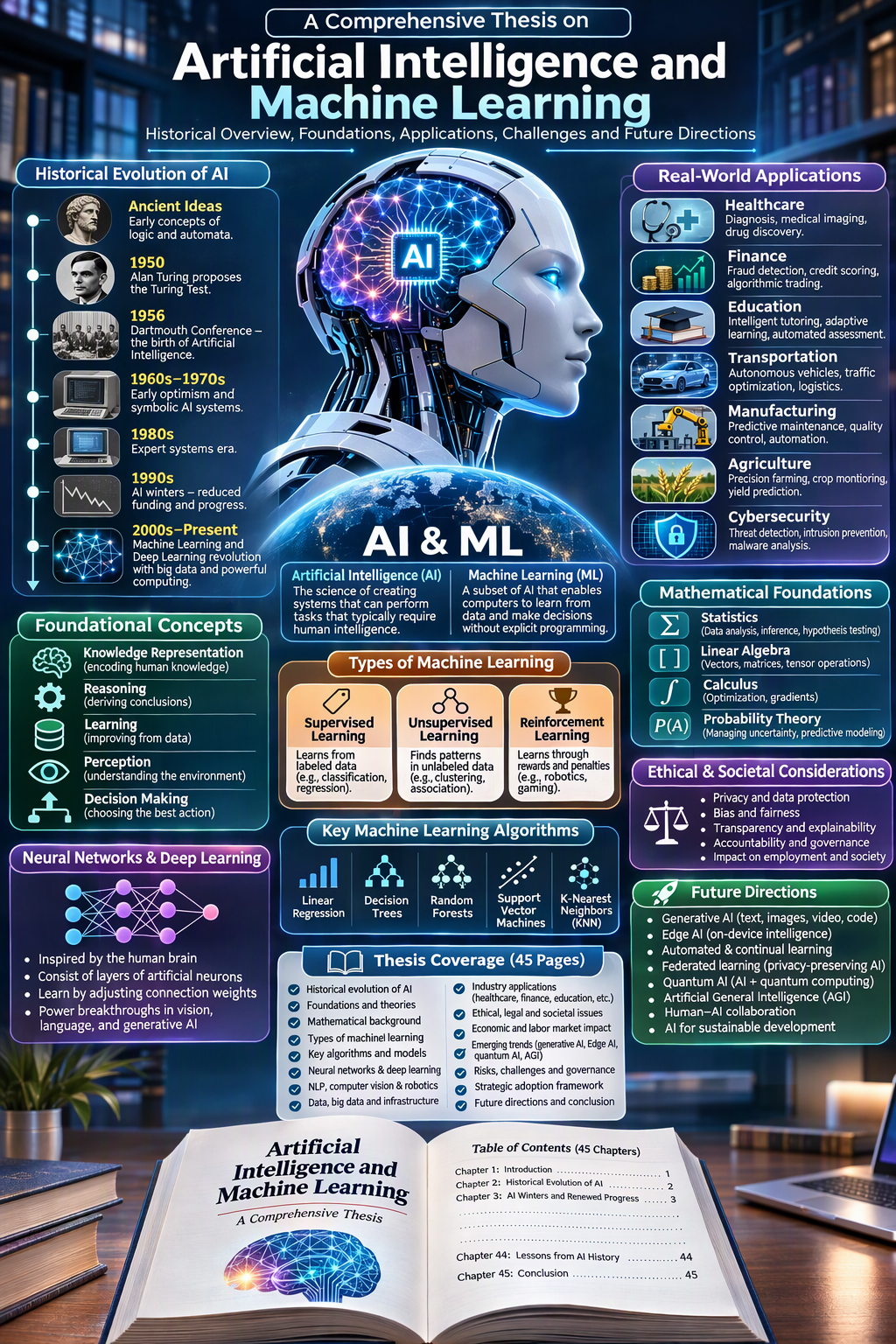
Artificial Intelligence (AI) and Machine Learning (ML) have emerged as transformative technologies of the twenty-first century, reshaping industries, economies, governance systems, scientific research, and everyday human experiences. From simple rule-based systems to advanced neural networks capable of generating text, images, and scientific discoveries, AI represents one of humanity’s most significant technological achievements. This thesis examines the historical evolution, theoretical foundations, architectures, methodologies, applications, opportunities, challenges, and future directions of Artificial Intelligence and Machine Learning. It provides a structured academic exploration suitable for higher education, research, and professional development purposes.
Keywords: Artificial Intelligence, Machine Learning, Deep Learning, Neural Networks, Data Science, Automation, Computing, Innovation.
Chapter 1: Introduction
1.1 Background
Human beings have always sought to create tools capable of extending intellectual abilities. The invention of calculators enhanced arithmetic capabilities, while computers revolutionized information processing. Artificial Intelligence represents the next stage in this evolution by enabling machines to simulate human cognitive functions such as learning, reasoning, problem-solving, perception, and decision-making.
Artificial Intelligence is a broad field within computer science dedicated to creating systems capable of performing tasks that typically require human intelligence. Machine Learning is a subset of AI that enables computers to learn from data without explicit programming.
The rise of big data, cloud computing, advanced processors, and sophisticated algorithms has accelerated AI development dramatically since the beginning of the twenty-first century.
1.2 Research Objectives
This thesis seeks to:
- Examine the historical development of AI.
- Understand the theoretical foundations of Machine Learning.
- Explore major AI architectures and methodologies.
- Analyze practical applications across industries.
- Investigate ethical and societal implications.
- Evaluate future opportunities and challenges.
1.3 Scope of Study
The study covers:
- Historical evolution of AI.
- Mathematical foundations.
- Learning methodologies.
- Neural network architectures.
- Industrial and societal applications.
- Emerging future trends.
Chapter 2: Historical Evolution of Artificial Intelligence
2.1 Early Philosophical Foundations
The dream of intelligent machines predates modern computing. Ancient Greek philosophers contemplated mechanical reasoning and automated systems. Throughout history, inventors designed automata that mimicked human actions.
Philosophers including Aristotle laid foundations for formal logic that would eventually influence computer science.
2.2 Alan Turing and Modern Foundations
The modern AI era began with British mathematician Alan Turing.
In 1950, Turing published:
“Computing Machinery and Intelligence”
He proposed the famous Turing Test, designed to determine whether a machine could exhibit intelligent behavior indistinguishable from a human.
2.3 The Dartmouth Conference (1956)
The official birth of Artificial Intelligence occurred in 1956 at Dartmouth College.
Researchers including:
- John McCarthy
- Marvin Minsky
- Claude Shannon
- Nathan Rochester
introduced the term:
Artificial Intelligence
The conference established AI as a formal scientific discipline.
2.4 Early Optimism (1956-1970)
Early AI systems demonstrated:
- Problem solving
- Mathematical reasoning
- Symbolic logic processing
Researchers believed human-level intelligence would soon be achievable.
Chapter 3: AI Winters and Renewed Progress
3.1 First AI Winter
Expectations exceeded technological capabilities.
Limitations included:
- Insufficient computing power
- Limited memory capacity
- Inadequate datasets
Funding declined significantly.
3.2 Expert Systems Era
The 1980s saw growth in Expert Systems.
These systems encoded expert knowledge into rule-based programs capable of providing recommendations and decision support.
Examples included:
- Medical diagnosis systems
- Financial advisory systems
- Industrial troubleshooting systems
3.3 Second AI Winter
Expert systems faced scalability challenges.
Knowledge acquisition became expensive and difficult.
Funding again declined.
3.4 Machine Learning Revolution
The availability of large datasets and powerful computers led to a renaissance in AI research.
Machine Learning replaced rigid rule-based approaches with adaptive systems capable of learning directly from data.
Chapter 4: Foundations of Artificial Intelligence
4.1 Definition of Artificial Intelligence
Artificial Intelligence refers to computational systems capable of performing activities associated with intelligent behavior.
These activities include:
- Learning
- Planning
- Perception
- Decision making
- Language understanding
4.2 Categories of AI
Narrow AI
Designed for specific tasks.
Examples:
- Search engines
- Recommendation systems
- Voice assistants
General AI
Theoretical systems possessing human-like intelligence across various domains.
Superintelligent AI
A hypothetical future AI exceeding human intellectual capabilities.
4.3 Components of AI Systems
Major components include:
- Knowledge representation
- Reasoning engines
- Learning mechanisms
- Sensory processing
- Decision frameworks
Chapter 5: Understanding Machine Learning
5.1 Definition
Machine Learning is the science of enabling computers to learn patterns from data and make decisions without explicit programming.
5.2 Core Principle
Traditional programming:
Input + Rules → Output
Machine Learning:
Input + Output → Learning Algorithm → Rules
5.3 Why Machine Learning Matters
Machine Learning enables:
- Prediction
- Classification
- Optimization
- Pattern recognition
- Automation
Chapter 6: Mathematical Foundations
6.1 Statistics
Statistics provides mechanisms for:
- Data analysis
- Probability estimation
- Hypothesis testing
6.2 Linear Algebra
Machine learning relies heavily on:
- Vectors
- Matrices
- Tensor operations
6.3 Calculus
Calculus enables optimization through gradient calculations.
6.4 Probability Theory
Probability supports uncertainty management and predictive modeling.
Chapter 7: Types of Machine Learning
7.1 Supervised Learning
Uses labeled datasets.
Applications:
- Fraud detection
- Medical diagnosis
- Email spam classification
Algorithms:
- Linear Regression
- Logistic Regression
- Decision Trees
- Random Forests
7.2 Unsupervised Learning
Uses unlabeled data.
Applications:
- Market segmentation
- Pattern discovery
Methods:
- Clustering
- Association analysis
7.3 Reinforcement Learning
Agents learn through rewards and penalties.
Applications:
- Robotics
- Gaming
- Autonomous vehicles
Chapter 8: Machine Learning Algorithms
8.1 Linear Regression
Predicts numerical outcomes.
8.2 Decision Trees
Hierarchical decision structures.
8.3 Random Forests
Collections of multiple decision trees.
8.4 Support Vector Machines
Powerful classification algorithms.
8.5 K-Nearest Neighbors
Classifies data based on nearby observations.
Chapter 9: Neural Networks
9.1 Biological Inspiration
Neural networks mimic human brain structures.
9.2 Artificial Neurons
Neurons receive inputs, perform computations, and generate outputs.
9.3 Layers
- Input Layer
- Hidden Layers
- Output Layer
9.4 Learning Process
Networks learn through adjustment of connection weights.
Chapter 10: Deep Learning Revolution
10.1 Definition
Deep Learning employs multi-layer neural networks.
10.2 Breakthrough Factors
- Powerful GPUs
- Massive datasets
- Improved algorithms
10.3 Applications
- Speech recognition
- Language translation
- Medical imaging
- Autonomous systems
Chapter 11: Natural Language Processing
11.1 Introduction
Natural Language Processing enables machines to understand human language.
11.2 Functions
- Translation
- Summarization
- Sentiment analysis
- Question answering
11.3 Large Language Models
Modern systems utilize billions of parameters to understand and generate human-like language.
Chapter 12: Computer Vision
12.1 Definition
Computer Vision enables machines to interpret visual information.
12.2 Major Tasks
- Image recognition
- Object detection
- Facial recognition
- Medical imaging
12.3 Applications
Healthcare, agriculture, security, and transportation.
Chapter 13: Robotics and Intelligent Systems
Robotics combines:
- Mechanical engineering
- Electronics
- Artificial intelligence
Applications include:
- Manufacturing
- Healthcare
- Space exploration
- Military operations
Chapter 14: Data Architecture in Machine Learning
Machine Learning success depends heavily on data quality.
Components include:
- Data collection
- Data storage
- Data integration
- Data governance
- Data pipelines
Chapter 15: Big Data and AI
Big Data characteristics:
- Volume
- Velocity
- Variety
- Veracity
- Value
AI converts raw data into actionable insights.
Chapter 16: AI in Healthcare
Applications:
- Disease diagnosis
- Medical imaging
- Drug discovery
- Personalized medicine
Benefits:
- Improved accuracy
- Faster diagnosis
- Reduced costs
Chapter 17: AI in Finance
Functions include:
- Fraud detection
- Credit scoring
- Algorithmic trading
- Risk assessment
Chapter 18: AI in Education
Capabilities include:
- Intelligent tutoring
- Adaptive learning
- Automated assessment
- Personalized education
Chapter 19: AI in Transportation
Applications:
- Autonomous vehicles
- Traffic optimization
- Fleet management
- Logistics planning
Chapter 20: AI in Manufacturing
Industry 4.0 technologies utilize AI for:
- Predictive maintenance
- Quality control
- Automation
- Productivity improvement
Chapter 21: AI in Agriculture
Uses:
- Precision farming
- Crop monitoring
- Yield prediction
- Pest management
Chapter 22: AI and Cybersecurity
Applications include:
- Threat detection
- Intrusion prevention
- Malware analysis
- Security monitoring
Chapter 23: Ethical Considerations
Issues include:
- Privacy
- Transparency
- Accountability
- Fairness
Organizations must establish responsible AI frameworks.
Chapter 24: Bias and Fairness
Bias may arise from:
- Historical data
- Algorithm design
- Human decisions
Solutions include:
- Diverse datasets
- Model audits
- Inclusive governance
Chapter 25: AI Governance
Governance frameworks establish:
- Standards
- Policies
- Compliance requirements
Chapter 26: Economic Impact
AI contributes to:
- Productivity growth
- Innovation acceleration
- New business models
- Employment transformation
Chapter 27: Labor Market Transformation
Some roles become automated while new opportunities emerge in:
- Data science
- AI engineering
- Digital innovation
Chapter 28: AI and Human Creativity
AI supports:
- Music generation
- Art creation
- Writing assistance
- Design enhancement
Chapter 29: Explainable AI
Explainable AI promotes transparency in decision-making models.
Benefits:
- Trust
- Compliance
- Accountability
Chapter 30: Edge AI
AI processing occurs near devices rather than centralized cloud systems.
Benefits include:
- Reduced latency
- Improved privacy
- Faster decisions
Chapter 31: Generative AI
Generative AI creates:
- Text
- Images
- Video
- Audio
- Software code
Chapter 32: AI Research Methodologies
Research approaches include:
- Experimental studies
- Simulation
- Observational analysis
- Comparative evaluation
Chapter 33: AI Infrastructure
Infrastructure consists of:
- Data centers
- Cloud platforms
- Accelerators
- Distributed computing systems
Chapter 34: Future of Machine Learning
Future advances include:
- Automated machine learning
- Continual learning
- Federated learning
Chapter 35: Quantum AI
Quantum computing may enhance AI capabilities through unprecedented computational power.
Chapter 36: Artificial General Intelligence
Researchers continue exploring systems capable of broader human-like reasoning.
AGI remains largely theoretical.
Chapter 37: Human-AI Collaboration
The future emphasizes augmentation rather than replacement.
Humans and AI will collaborate to solve complex challenges.
Chapter 38: AI in Scientific Discovery
AI accelerates:
- Drug development
- Climate modeling
- Astronomy research
- Biological discoveries
Chapter 39: Global AI Competition
Nations invest heavily in AI to strengthen:
- Economic performance
- National security
- Scientific leadership
Chapter 40: AI and Sustainable Development
AI contributes toward:
- Smart cities
- Environmental monitoring
- Energy efficiency
- Resource optimization
Chapter 41: Risks and Challenges
Key concerns:
- Cyber threats
- Job displacement
- Misinformation
- Ethical misuse
Chapter 42: Responsible Innovation
Responsible innovation requires balancing:
- Progress
- Ethics
- Safety
- Human welfare
Chapter 43: Strategic Framework for AI Adoption
Organizations should develop:
- AI Vision
- Data Strategy
- Technology Infrastructure
- Talent Development
- Governance Systems
Chapter 44: Lessons from AI History
Historical lessons show:
- Technological breakthroughs emerge gradually.
- Excessive expectations create setbacks.
- Sustainable innovation requires realistic goals.
Chapter 45: Conclusion
Artificial Intelligence and Machine Learning represent revolutionary developments in human history. From their origins in philosophy and logic to the sophisticated neural networks of today, AI technologies continue transforming society at unprecedented speed. Machine Learning has enabled machines to learn from vast amounts of data, creating opportunities across healthcare, finance, education, transportation, manufacturing, and scientific research.
Despite remarkable achievements, important challenges remain regarding ethics, governance, transparency, privacy, and workforce transformation. The future of AI will depend not only on technological advancement but also on humanity’s ability to guide innovation responsibly.
As AI systems become increasingly powerful, the ultimate objective should remain clear: to augment human intelligence, improve quality of life, accelerate discovery, strengthen economies, and promote sustainable global development for future generations.
References
- Turing, A. M. (1950). Computing Machinery and Intelligence.
- Russell, S., & Norvig, P. Artificial Intelligence: A Modern Approach.
- Goodfellow, I., Bengio, Y., & Courville, A. Deep Learning.
- Mitchell, T. Machine Learning.
- Bishop, C. Pattern Recognition and Machine Learning.
- McCarthy, J. Foundations of Artificial Intelligence.
- World Economic Forum Reports on Artificial Intelligence.
- IEEE Artificial Intelligence Standards Publications.
- Association for Computing Machinery (ACM) AI Research Papers.
- Contemporary peer-reviewed journals in AI, Machine Learning, Data Science, and Computer Engineering.


Be First to Comment