
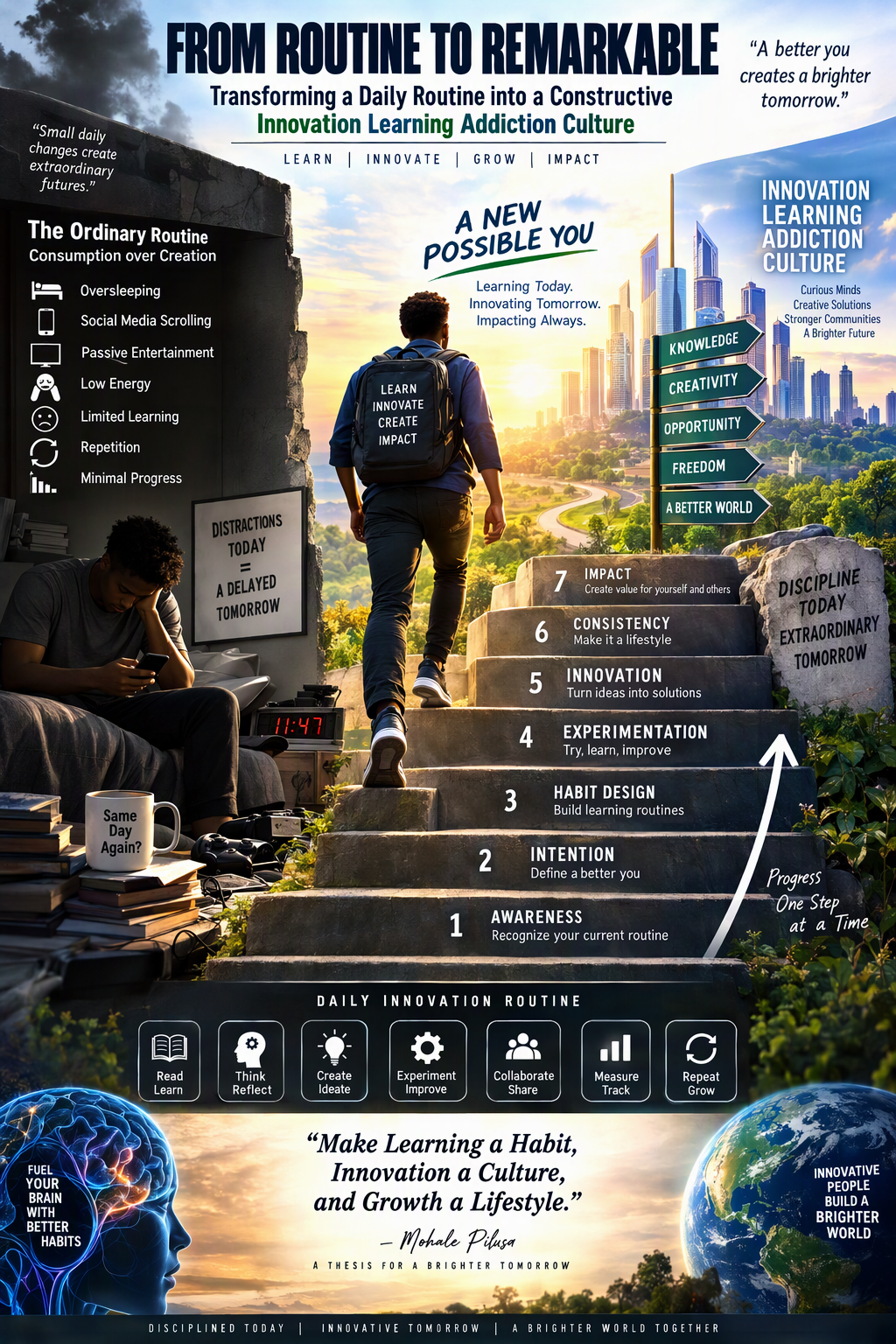
Transforming a Daily Routine into a Constructive Innovation Learning Addiction Culture
Abstract
The modern world is characterized by rapid technological, economic, scientific, and social change. Individuals who continuously learn and innovate are increasingly positioned to thrive in both professional and personal environments. However, many people remain trapped in repetitive routines that prioritize consumption over creation, reaction over initiative, and comfort over growth. This thesis explores how an ordinary daily routine can be transformed into a constructive innovation learning addiction culture. The concept of a “learning addiction culture” refers to a positive and sustainable behavioral system in which learning, creativity, innovation, experimentation, and self-improvement become deeply integrated habits.
The study examines behavioral psychology, neuroscience, organizational innovation, educational methodologies, strategic planning, and cultural development. It proposes a practical framework for transforming ordinary habits into innovation-driven behaviors. The thesis argues that innovation is not merely a talent possessed by a select few but a disciplined process that can be cultivated through systematic daily practices. Through structured routines, environments, feedback systems, and continuous learning exposure, individuals, organizations, and societies can develop an enduring culture of constructive innovation.
Chapter 1: Introduction
1.1 Background
Throughout human civilization, progress has been driven by individuals who challenged conventional thinking. From the invention of the wheel to artificial intelligence, innovation has emerged from persistent curiosity and disciplined learning.
Yet most people do not intentionally cultivate innovation. Their routines often consist of repetitive patterns centered on survival, work, entertainment, and rest. While such routines provide stability, they frequently suppress creative growth and intellectual development.
Innovation culture requires deliberate daily reinforcement. Every major inventor, entrepreneur, scientist, engineer, artist, and leader developed routines that encouraged exploration, observation, experimentation, and reflection.
The challenge of the twenty-first century is therefore not merely access to information but developing habits that transform information into innovation.
1.2 Problem Statement
Many individuals consume enormous quantities of information daily but produce little innovation. Social media scrolling, passive entertainment, and non-productive activities consume time that could otherwise be invested in learning and creativity.
This creates a gap between knowledge acquisition and innovation implementation.
The question becomes:
How can daily routines be transformed into a constructive innovation learning addiction culture that continuously generates growth and value?
1.3 Research Objectives
The objectives are:
- To understand daily routine structures.
- To examine learning psychology.
- To investigate innovation methodologies.
- To establish behavior transformation frameworks.
- To create practical models for innovation habit formation.
- To recommend systems for sustaining lifelong learning cultures.
1.4 Research Questions
- What is innovation culture?
- How are habits formed?
- Why do people resist learning?
- How can curiosity become habitual?
- What routines promote innovation?
- What systems sustain constructive learning addiction?
Chapter 2: Understanding Daily Routines
2.1 Definition of Routine
A routine is a sequence of behaviors repeated regularly.
Daily routines shape:
- Thinking patterns
- Emotional responses
- Productivity
- Creativity
- Health
- Learning capacity
Every repeated action gradually becomes part of personal identity.
2.2 Routine Architecture
A routine consists of:
Trigger
An event initiating behavior.
Examples:
- Alarm clock
- Notifications
- Daily schedules
Action
The behavior performed after the trigger.
Reward
The outcome reinforcing repetition.
Repeated cycles create habits.
2.3 The Power of Repetition
Neuroscience demonstrates that repeated actions strengthen neural pathways.
The brain progressively automates frequent activities.
Therefore:
Repeated learning creates learning habits.
Repeated innovation creates innovation habits.
Chapter 3: Psychology of Constructive Addiction
3.1 Understanding Addiction
Addiction is commonly viewed negatively.
However, positive addictions exist.
Examples include:
- Reading
- Exercise
- Creativity
- Scientific exploration
- Research
Positive addiction channels energy toward growth.
3.2 Constructive Learning Addiction
Constructive learning addiction refers to an irresistible desire for:
- Knowledge
- Discovery
- Experimentation
- Improvement
Characteristics include:
- Curiosity
- Persistence
- Discipline
- Continuous self-development
3.3 Motivation Systems
Learning addiction relies upon:
Intrinsic Motivation
Learning for enjoyment.
Extrinsic Motivation
Learning for rewards.
Research consistently shows intrinsic motivation generates stronger long-term innovation.
Chapter 4: Neuroscience of Innovation
4.1 The Learning Brain
Learning physically changes brain structure.
Neuroplasticity enables:
- New thinking patterns
- New skills
- New capabilities
Every new idea creates neural connections.
4.2 Dopamine and Innovation
Dopamine is associated with:
- Reward
- Curiosity
- Exploration
Each successful learning experience reinforces future learning behavior.
Innovation therefore becomes self-reinforcing.
4.3 Habit Loop Formation
The Innovation Habit Loop:
Curiosity → Learning → Application → Achievement → Motivation → Curiosity
This cycle continuously strengthens itself.
Chapter 5: Building an Innovation Mindset
5.1 Growth Mindset
Individuals with growth mindsets believe abilities can be developed.
Characteristics:
- Embracing challenges
- Learning from failure
- Persistence
- Continuous improvement
5.2 Curiosity Development
Questions stimulate innovation.
Examples:
- Why?
- How?
- What if?
- Why not?
Innovation begins with curiosity.
5.3 Opportunity Recognition
Innovators view problems as opportunities.
Every inconvenience becomes a potential invention.
Every inefficiency becomes a potential improvement.
Chapter 6: Transforming Morning Routines
6.1 The Innovation Morning
The first hour determines mental direction.
Recommended structure:
20 Minutes Reading
Knowledge acquisition.
20 Minutes Reflection
Idea generation.
20 Minutes Planning
Innovation objectives.
6.2 Daily Learning Targets
Learn:
- One concept daily
- One new skill weekly
- One project monthly
Small improvements accumulate.
Chapter 7: Deep Learning Systems
7.1 Deliberate Practice
Focused effort produces mastery.
Requirements:
- Specific goals
- Immediate feedback
- Continuous improvement
7.2 Active Learning
Active learners:
- Write notes
- Conduct experiments
- Teach concepts
Passive learning produces limited retention.
7.3 Knowledge Integration
New knowledge should connect with existing knowledge.
Innovation occurs when multiple disciplines intersect.
Chapter 8: Innovation Through Reading
8.1 Reading as a Learning Accelerator
Reading provides access to centuries of human knowledge.
Innovators commonly read:
- Science
- Technology
- Business
- Psychology
- History
8.2 Daily Reading Habit
Thirty pages daily equals thousands annually.
Knowledge compounds over time.
8.3 Building a Personal Knowledge Library
Maintain:
- Books
- Notes
- Research papers
- Journals
These become intellectual capital.
Chapter 9: Innovation Journaling
9.1 Purpose
Writing clarifies thinking.
9.2 Daily Innovation Log
Record:
- Observations
- Ideas
- Problems
- Solutions
9.3 Reflection
Reflection transforms experiences into wisdom.
Chapter 10: Creative Thinking Systems
Innovation requires:
- Divergent thinking
- Convergent thinking
- Critical reasoning
- Imaginative exploration
Brainstorming practices significantly increase creative output.
Chapter 11: Learning Through Experimentation
Every innovation begins as an experiment.
Experimentation reduces uncertainty.
Key principle:
Test quickly, learn quickly, improve quickly.
Chapter 12: Failure and Innovation
Failure is information.
Constructive innovators ask:
- What happened?
- Why did it happen?
- What can improve?
Failure becomes a learning asset.
Chapter 13: Time Management for Innovators
Allocate daily time to:
- Learning
- Thinking
- Creating
- Reviewing
Schedule innovation intentionally.
Chapter 14: Technology as a Learning Partner
Use digital tools for:
- Research
- Collaboration
- Simulation
- Knowledge management
Technology should support creativity rather than distract from it.
Chapter 15: Innovation Environment Design
Environment influences behavior.
Create spaces supporting:
- Reading
- Thinking
- Experimentation
- Collaboration
Innovation-friendly environments increase productivity.
Chapter 16: Social Learning Ecosystems
Learning accelerates within communities.
Surround yourself with:
- Mentors
- Experts
- Innovators
- Researchers
Networks multiply innovation.
Chapter 17: Innovation Leadership
Leaders create cultures.
Innovation leaders encourage:
- Questions
- Exploration
- Experiments
- Improvement
Chapter 18: Continuous Improvement Culture
The Japanese concept of Kaizen emphasizes small daily improvements.
Incremental progress eventually creates transformational outcomes.
Chapter 19: Measuring Innovation Growth
Track:
- Books read
- Courses completed
- Ideas generated
- Projects launched
- Problems solved
Measurement drives improvement.
Chapter 20: Innovation and Human Capital
Knowledge increases personal value.
Innovation increases societal value.
Human capital represents the most important economic asset.
Chapter 21: Future-Oriented Learning
Emerging fields include:
- Artificial Intelligence
- Biotechnology
- Robotics
- Quantum Computing
- Renewable Energy
Continuous learning ensures adaptability.
Chapter 22: Building the 365-Day Innovation Habit
Daily activities:
- Learn
- Observe
- Think
- Create
- Reflect
Consistency creates transformation.
Chapter 23: Innovation Culture in Organizations
Organizations should establish:
- Training systems
- Research initiatives
- Idea management programs
- Continuous improvement frameworks
Chapter 24: Innovation Culture in Communities
Communities thrive when innovation becomes socially valued.
Investment in learning produces long-term prosperity.
Chapter 25: The Constructive Innovation Learning Addiction Model
Stage 1
Curiosity
Stage 2
Learning
Stage 3
Application
Stage 4
Experimentation
Stage 5
Innovation
Stage 6
Impact
Stage 7
Continuous Renewal
The cycle repeats indefinitely.
Conclusion
Transforming a daily routine into a constructive innovation learning addiction culture is not achieved through isolated acts of motivation but through systematic habit formation. Learning must evolve from an occasional activity into a central component of personal identity.
Innovation flourishes where curiosity is encouraged, experimentation is accepted, knowledge is continuously acquired, and reflection guides improvement. By redesigning daily routines around growth-oriented behaviors, individuals can create self-sustaining systems of innovation that enhance productivity, creativity, competitiveness, and societal development.
The ultimate goal is to become a lifelong learner whose routine naturally generates ideas, solutions, and opportunities. When learning becomes habitual and innovation becomes cultural, extraordinary achievements emerge from ordinary daily actions.





Be First to Comment