
Understanding the Molecular Communication Network of Human Life
Abstract
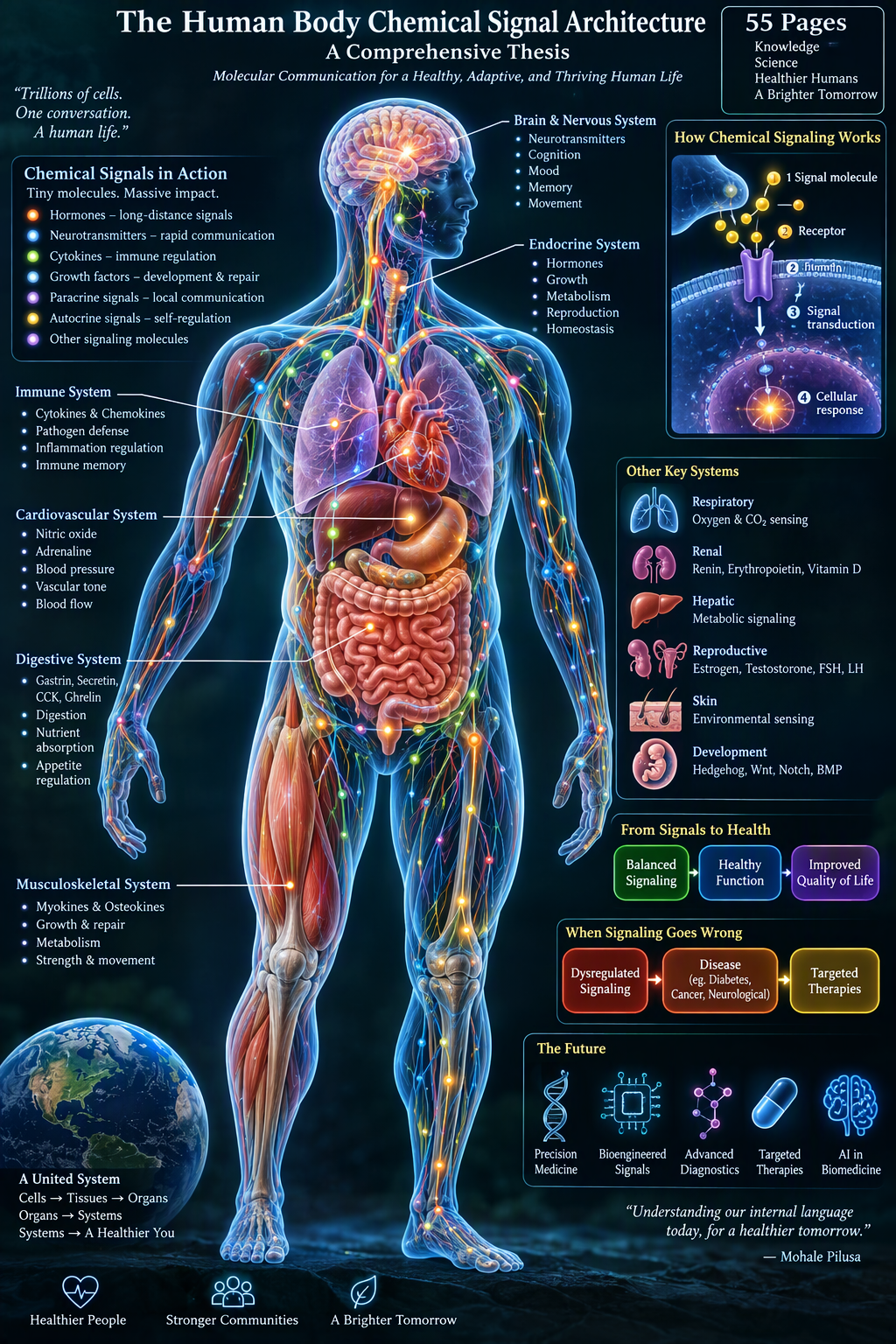
The human body is an extraordinarily sophisticated biological system whose survival depends upon the continuous exchange of chemical information among trillions of cells. This communication system, known as the chemical signaling architecture of the human body, coordinates growth, metabolism, immunity, reproduction, cognition, movement, and homeostasis. Chemical signals serve as biological messages that travel across microscopic and macroscopic distances, enabling cells, tissues, organs, and organ systems to function as a unified organism.
This thesis examines the architecture, mechanisms, pathways, and significance of human chemical signaling. It explores the molecular foundations of communication, the role of hormones, neurotransmitters, cytokines, growth factors, intracellular messengers, receptor systems, and signal transduction networks. Additionally, it investigates how chemical signaling contributes to health, disease prevention, adaptation, and survival.
Table of Contents
Chapter 1: Introduction to Human Chemical Signaling
Chapter 2: Historical Discovery of Cellular Communication
Chapter 3: Architecture of Cellular Signaling Systems
Chapter 4: Chemical Messengers in Human Physiology
Chapter 5: Endocrine Signaling Network
Chapter 6: Nervous System Chemical Communication
Chapter 7: Neurotransmitters and Brain Signaling
Chapter 8: Hormones and Their Functional Architecture
Chapter 9: Cellular Receptors and Signal Detection
Chapter 10: Intracellular Signal Transduction
Chapter 11: Second Messenger Systems
Chapter 12: Immune Chemical Signaling
Chapter 13: Cytokines and Chemokines
Chapter 14: Growth Factors and Tissue Development
Chapter 15: Genetic Regulation Through Chemical Signaling
Chapter 16: Chemical Signaling in the Cardiovascular System
Chapter 17: Respiratory System Signaling
Chapter 18: Digestive System Signaling
Chapter 19: Liver Communication Networks
Chapter 20: Kidney Chemical Regulation
Chapter 21: Musculoskeletal Signaling Systems
Chapter 22: Skin as a Chemical Sensor
Chapter 23: Endocrine Glands Architecture
Chapter 24: Reproductive Signaling Networks
Chapter 25: Embryonic Development Signaling
Chapter 26: Metabolic Signaling Pathways
Chapter 27: Stress Signaling Mechanisms
Chapter 28: Pain Signaling Architecture
Chapter 29: Aging and Signal Deterioration
Chapter 30: Chemical Signaling Disorders
Chapter 31: Cancer and Aberrant Signaling
Chapter 32: Future Medical Technologies
Chapter 33: Artificial Biological Communication
Chapter 34: Precision Medicine and Signal Monitoring
Chapter 35: Conclusion
Chapter 1: Introduction to Human Chemical Signaling
Human existence depends upon communication. While humans communicate through language and technology, cells communicate through chemical signals. Every second, billions of molecular messages travel throughout the body, informing cells when to divide, rest, migrate, repair damage, or die.
Chemical signaling forms the invisible architecture that unites approximately 37 trillion cells into a single living organism. Without this communication system, organs would operate independently and survival would be impossible.
The signaling system functions similarly to a global telecommunications network. Hormones act as long-distance broadcasts, neurotransmitters provide rapid local communication, and intracellular messengers relay information within individual cells.
Chapter 2: Historical Discovery of Cellular Communication
The scientific understanding of chemical signaling emerged during the nineteenth and twentieth centuries.
Major discoveries include:
- Claude Bernard’s concept of the internal environment.
- Walter Cannon’s homeostasis theory.
- Discovery of hormones by Bayliss and Starling.
- Identification of neurotransmitters.
- Development of molecular biology.
- Discovery of receptor proteins.
- Mapping of cellular signaling pathways.
Modern technologies now reveal signaling processes occurring at nanometer scales.
Chapter 3: Architecture of Cellular Signaling Systems
The architecture consists of four major components:
Signal Source
Produces the message.
Examples:
- Endocrine glands
- Neurons
- Immune cells
- Tissue cells
Signal Molecule
Carries information.
Examples:
- Insulin
- Dopamine
- Cortisol
- Histamine
Receptor
Receives and interprets signals.
Response Machinery
Executes cellular actions.
Examples:
- Protein synthesis
- Metabolic activation
- Cell movement
Chapter 4: Chemical Messengers in Human Physiology
Chemical messengers include:
Hormones
Long-range communication molecules.
Neurotransmitters
Rapid nervous-system messengers.
Cytokines
Immune-system regulators.
Growth Factors
Development and repair molecules.
Paracrine Signals
Local signaling molecules.
Autocrine Signals
Self-regulating cellular signals.
Chapter 5: Endocrine Signaling Network
The endocrine system functions as the body’s broadcasting network.
Major endocrine organs:
- Hypothalamus
- Pituitary gland
- Thyroid gland
- Adrenal glands
- Pancreas
- Gonads
Hormones released into bloodstreams influence distant target organs.
Examples include:
- Insulin
- Glucagon
- Cortisol
- Thyroxine
- Growth hormone
Chapter 6: Nervous System Chemical Communication
Neurons communicate through electrochemical signals.
Process:
- Electrical impulse generated.
- Neurotransmitter released.
- Receptor activated.
- Signal interpreted.
- Response produced.
This architecture allows human thought, memory, movement, and learning.
Chapter 7: Neurotransmitters and Brain Signaling
Major neurotransmitters include:
Dopamine
Reward and motivation.
Serotonin
Mood regulation.
Acetylcholine
Memory and muscle control.
GABA
Inhibitory control.
Glutamate
Learning and cognition.
Abnormal neurotransmission contributes to neurological disorders.
Chapter 8: Hormones and Their Functional Architecture
Hormones influence virtually every physiological process.
Characteristics:
- High specificity
- Long-distance travel
- Low concentration effectiveness
- Feedback regulation
Hormonal systems maintain balance through negative feedback loops.
Chapter 9: Cellular Receptors and Signal Detection
Receptors are biological antennas.
Types:
Membrane Receptors
Detect external signals.
Nuclear Receptors
Detect intracellular hormones.
Enzyme-Linked Receptors
Activate biochemical cascades.
Ion Channel Receptors
Control cellular electrical activity.
Chapter 10: Intracellular Signal Transduction
Signal transduction converts external information into biological action.
Stages:
- Reception
- Amplification
- Transmission
- Response
A single molecule can activate millions of intracellular molecules.
Chapter 11: Second Messenger Systems
Important second messengers include:
- Cyclic AMP (cAMP)
- Cyclic GMP (cGMP)
- Calcium ions
- Inositol triphosphate (IP3)
- Diacylglycerol (DAG)
These molecules amplify incoming signals.
Chapter 12: Immune Chemical Signaling
Immune cells constantly exchange molecular information.
Functions include:
- Pathogen detection
- Inflammation regulation
- Tissue repair
- Immune memory formation
Chemical communication ensures coordinated defense.
Chapter 13: Cytokines and Chemokines
Cytokines direct immune responses.
Examples:
- Interleukins
- Interferons
- Tumor necrosis factors
Chemokines guide immune cell migration toward infection sites.
Chapter 14: Growth Factors and Tissue Development
Growth factors regulate:
- Cell division
- Tissue growth
- Wound healing
- Organ development
Important growth factors include:
- EGF
- VEGF
- PDGF
- NGF
Chapter 15: Genetic Regulation Through Chemical Signaling
Chemical signals influence gene expression.
Signals activate transcription factors that regulate DNA activity.
Examples:
- Steroid hormones
- Growth factors
- Cytokines
Gene regulation allows cells to adapt to changing environments.
Chapter 16: Cardiovascular System Signaling
Important signaling molecules include:
- Nitric oxide
- Endothelin
- Adrenaline
- Noradrenaline
These regulate:
- Heart rate
- Blood pressure
- Vascular tone
- Blood flow
Chapter 17: Respiratory System Signaling
Chemical sensors monitor:
- Oxygen levels
- Carbon dioxide
- Blood pH
Signaling triggers respiratory adjustments necessary for survival.
Chapter 18: Digestive System Signaling
The digestive system employs extensive chemical communication.
Examples:
- Gastrin
- Secretin
- Cholecystokinin
- Ghrelin
These regulate digestion and appetite.
Chapter 19: Liver Communication Networks
The liver acts as a metabolic communication hub.
It responds to:
- Insulin
- Glucagon
- Growth factors
- Inflammatory cytokines
The liver adjusts metabolism accordingly.
Chapter 20: Kidney Chemical Regulation
Kidneys participate in hormonal communication through:
- Renin
- Erythropoietin
- Vitamin D activation
These regulate blood pressure and blood cell production.
Chapter 21: Musculoskeletal Signaling Systems
Muscles and bones communicate through signaling proteins called myokines and osteokines.
These molecules influence:
- Growth
- Repair
- Metabolism
- Physical performance
Chapter 22: Skin as a Chemical Sensor
The skin constantly monitors the environment.
Signaling functions include:
- Immune responses
- Pain detection
- Temperature regulation
- Healing processes
Chapter 23: Endocrine Glands Architecture
The endocrine system functions as an integrated communication hierarchy.
Hypothalamus → Pituitary → Peripheral Glands → Target Organs
This forms one of the body’s most important signaling axes.
Chapter 24: Reproductive Signaling Networks
Reproductive communication relies upon:
- Estrogen
- Progesterone
- Testosterone
- Follicle-stimulating hormone
- Luteinizing hormone
These coordinate fertility and development.
Chapter 25: Embryonic Development Signaling
Embryo formation depends on molecular instructions.
Key pathways:
- Hedgehog
- Wnt
- Notch
- BMP
These pathways determine body structure formation.
Chapter 26: Metabolic Signaling Pathways
Metabolism is regulated through:
- Insulin signaling
- Glucagon signaling
- mTOR pathway
- AMPK pathway
These pathways balance energy production.
Chapter 27: Stress Signaling Mechanisms
Stress activates:
Hypothalamus → Pituitary → Adrenal Axis
This produces cortisol and adrenaline that prepare the body for adaptive responses.
Chapter 28: Pain Signaling Architecture
Pain signaling involves:
- Nociceptors
- Neurotransmitters
- Spinal pathways
- Brain interpretation centers
Pain serves as a protective mechanism.
Chapter 29: Aging and Signal Deterioration
Aging gradually alters communication systems.
Effects include:
- Reduced receptor sensitivity
- Hormonal decline
- Cellular signaling errors
- Slower biological responses
Chapter 30: Chemical Signaling Disorders
Examples include:
- Diabetes
- Thyroid disorders
- Parkinson’s disease
- Alzheimer’s disease
Each disorder involves signaling dysfunction.
Chapter 31: Cancer and Aberrant Signaling
Cancer often arises from uncontrolled signaling.
Mutated pathways include:
- Ras
- PI3K
- MAPK
- EGFR
These drive abnormal growth and division.
Chapter 32: Future Medical Technologies
Emerging technologies include:
- Molecular diagnostics
- Biosensors
- Personalized medicine
- Signal-targeted therapies
These technologies improve disease detection.
Chapter 33: Artificial Biological Communication
Scientists are developing systems capable of:
- Synthetic signaling
- Engineered cells
- Smart therapeutics
- Bioelectronic medicine
These innovations may transform healthcare.
Chapter 34: Precision Medicine and Signal Monitoring
Precision medicine analyzes individual signaling patterns.
Benefits:
- Early diagnosis
- Personalized treatment
- Reduced side effects
- Enhanced outcomes
Future healthcare will increasingly rely on molecular communication mapping.
Chapter 35: Conclusion
The chemical signal architecture of the human body represents one of nature’s most sophisticated communication systems. Through hormones, neurotransmitters, cytokines, growth factors, receptors, and intracellular signaling pathways, trillions of cells coordinate their activities with remarkable precision.
This molecular communication network governs every aspect of human life, from embryonic development to aging. Understanding its architecture not only reveals the fundamental mechanisms of biological existence but also provides powerful tools for combating disease, improving health, and advancing future medical technologies.
The future of medicine, biotechnology, and human longevity will increasingly depend upon our ability to understand, monitor, and manipulate these chemical signaling networks. Human chemical signaling architecture therefore stands as a central pillar of life science, biomedical innovation, and the continuing quest to understand the complexity of the human organism.
References
- Alberts B. Molecular Biology of the Cell.
- Lodish H. Molecular Cell Biology.
- Guyton A.C. & Hall J.E. Textbook of Medical Physiology.
- Lehninger A. Principles of Biochemistry.
- Campbell N. Biology.
- Purves D. Neuroscience.
- Gilbert S. Developmental Biology.
- Kandel E. Principles of Neural Science.
- Voet D. Fundamentals of Biochemistry.
- National Institutes of Health publications on cell signaling and molecular medicine.


Be First to Comment