
Abstract
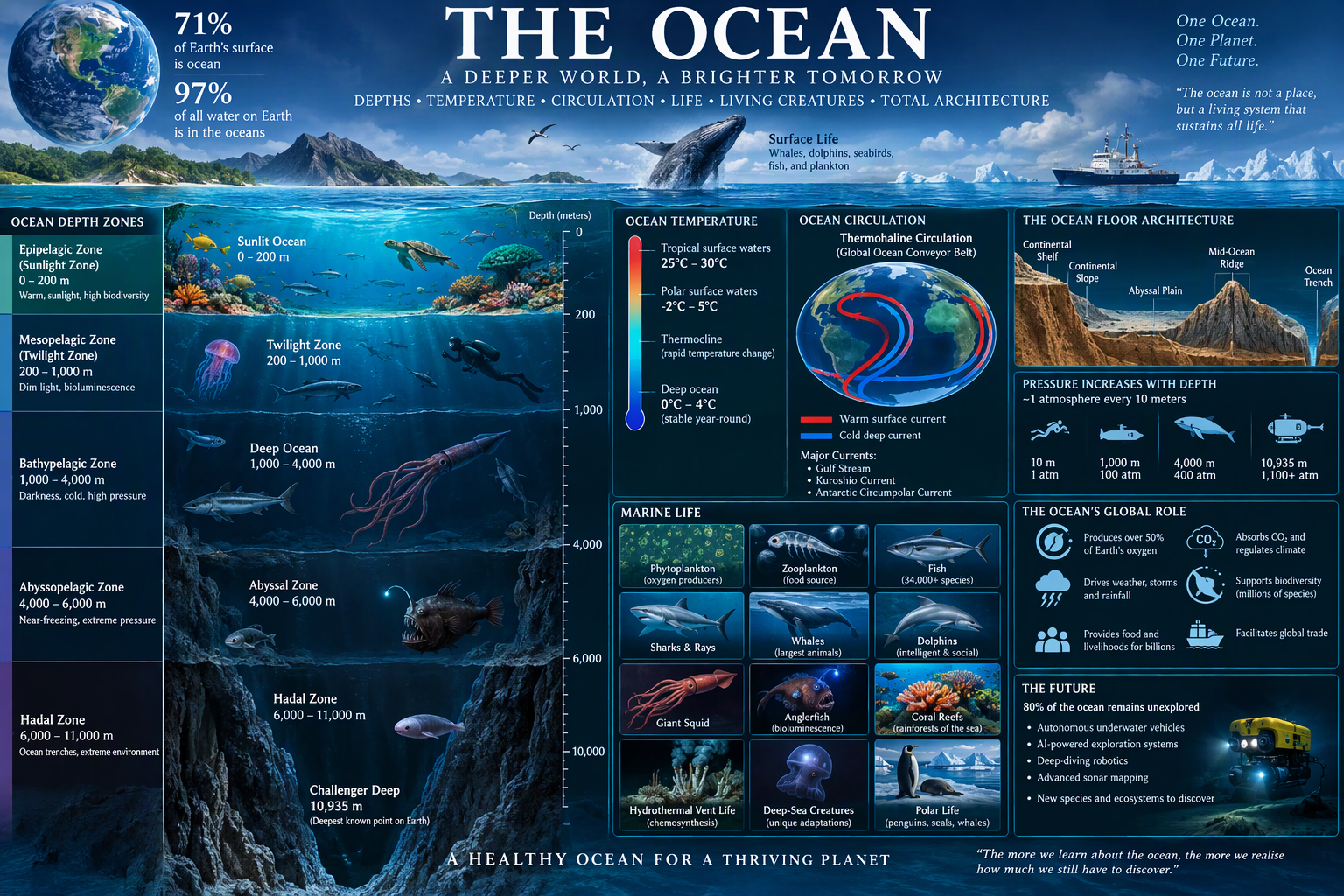
The world’s oceans form the largest continuous ecosystem on Earth, covering approximately 71% of the planet’s surface and containing about 97% of all water on Earth. The oceans are not merely vast reservoirs of water; they are dynamic, interconnected systems that regulate climate, support biodiversity, influence atmospheric processes, and sustain life. This thesis presents a comprehensive examination of ocean depth, temperature distribution, circulation systems, biological communities, marine creatures, and the complete architectural structure of the ocean environment. Through an analysis of physical, chemical, geological, and biological dimensions, this work demonstrates how the ocean functions as a planetary life-support system.
Chapter 1: Introduction to Earth’s Oceans
1.1 Definition of the Ocean
An ocean is a vast body of saline water that covers much of Earth’s surface. All oceans are interconnected, creating a single global ocean system.
The five recognized oceans are:
- Pacific Ocean
- Atlantic Ocean
- Indian Ocean
- Southern Ocean
- Arctic Ocean
Together they constitute the world’s largest ecosystem.
1.2 Importance of Oceans
The oceans:
- Produce over 50% of Earth’s oxygen
- Absorb huge amounts of carbon dioxide
- Regulate global temperatures
- Support marine food chains
- Facilitate global trade
- Influence weather patterns
- Maintain biodiversity
Without oceans, life on Earth would be impossible.
Chapter 2: How Deep is Our Ocean?
2.1 Average Ocean Depth
The average depth of the world’s oceans is approximately:
3,688 meters (12,100 feet)
This average conceals enormous variations in depth.
2.2 Deepest Part of the Ocean
The deepest known location is:
Challenger Deep
Located in:
Mariana Trench, Pacific Ocean
Depth:
Approximately 10,935 meters (35,876 feet)
If Mount Everest were placed inside Challenger Deep, its peak would still remain more than 2 kilometers below sea level.
2.3 Major Ocean Depth Zones
Epipelagic Zone (Sunlight Zone)
Depth:
0-200 meters
Characteristics:
- Receives sunlight
- Photosynthesis occurs
- Highest biodiversity
Mesopelagic Zone (Twilight Zone)
Depth:
200-1,000 meters
Characteristics:
- Dim light
- Limited photosynthesis
- Bioluminescent organisms
Bathypelagic Zone
Depth:
1,000-4,000 meters
Characteristics:
- Complete darkness
- High pressure
- Cold temperatures
Abyssopelagic Zone
Depth:
4,000-6,000 meters
Characteristics:
- Near-freezing waters
- Extreme pressure
- Specialized organisms
Hadal Zone
Depth:
6,000-11,000 meters
Characteristics:
- Ocean trenches
- Extreme environment
- Rare life forms
Chapter 3: Ocean Temperature Structure
3.1 Surface Temperatures
Ocean surface temperatures vary globally.
Range:
- Polar oceans: -2°C to 5°C
- Tropical oceans: 25°C to 30°C
Highest temperatures occur near the equator.
3.2 Thermocline Layer
The thermocline is a region where temperature decreases rapidly with depth.
Functions:
- Separates warm surface water
- Isolates cold deep water
- Influences marine life distribution
3.3 Deep Ocean Temperature
Most deep ocean water ranges between:
0°C and 4°C
These temperatures remain remarkably stable throughout the year.
Chapter 4: The Architecture of Ocean Layers
The ocean can be viewed as a multi-layered architecture.
Layer One: Surface Layer
Characteristics:
- Warm
- Lighted
- Highly productive
Contains:
- Plankton
- Fish
- Marine mammals
Layer Two: Transition Layer
Characteristics:
- Declining light
- Increasing pressure
Contains:
- Lanternfish
- Jellyfish
- Squid
Layer Three: Deep Ocean
Characteristics:
- Darkness
- Cold
- Slow biological activity
Contains:
- Deep-sea fish
- Giant squid
- Unique microbes
Layer Four: Ocean Floor
Consists of:
- Sediments
- Basaltic crust
- Hydrothermal vents
Chapter 5: Ocean Circulation Systems
5.1 Global Ocean Conveyor Belt
The oceans possess a giant circulation network called:
Thermohaline Circulation
Driven by:
- Temperature differences
- Salinity differences
This circulation transports heat globally.
5.2 Surface Currents
Major currents include:
Gulf Stream
Transfers warm water to Europe.
Kuroshio Current
Pacific equivalent of the Gulf Stream.
Antarctic Circumpolar Current
Largest current on Earth.
5.3 Deep Water Formation
Occurs mainly near:
- Greenland
- Antarctica
Cold dense water sinks and begins deep-ocean circulation.
Chapter 6: Ocean Pressure Architecture
6.1 Pressure Increase
Pressure increases:
Approximately 1 atmosphere every 10 meters.
At Challenger Deep:
Pressure exceeds:
1,100 atmospheres
This is equivalent to the weight of approximately fifty jumbo jets pressing on a human body.
6.2 Biological Adaptations
Deep-sea organisms possess:
- Flexible cell membranes
- Specialized proteins
- Pressure-resistant tissues
Chapter 7: Geological Architecture of the Ocean Floor
7.1 Continental Shelf
Shallow underwater extension of continents.
Importance:
- Rich fisheries
- Oil reserves
- Biodiversity hotspots
7.2 Continental Slope
Steep descent into deep ocean.
Acts as a transition zone.
7.3 Abyssal Plains
Largest habitat on Earth.
Extremely flat regions.
7.4 Mid-Ocean Ridges
Longest mountain chain on Earth.
Length:
Approximately 65,000 kilometers.
7.5 Ocean Trenches
Examples:
- Mariana Trench
- Tonga Trench
- Philippine Trench
Deepest structures on Earth.
Chapter 8: Marine Life Architecture
8.1 Biodiversity
Scientists estimate millions of marine species exist.
Marine biodiversity includes:
- Microbes
- Invertebrates
- Fish
- Reptiles
- Birds
- Mammals
8.2 Food Web Structure
Foundation:
Phytoplankton
Produces oxygen and organic matter.
Consumes:
- Sunlight
- Nutrients
- Carbon dioxide
Chapter 9: Microscopic Life
9.1 Phytoplankton
Responsible for enormous oxygen production.
Examples:
- Diatoms
- Dinoflagellates
- Cyanobacteria
9.2 Zooplankton
Important food source.
Includes:
- Copepods
- Larvae
- Microorganisms
Chapter 10: Fish Architecture
Major groups include:
Cartilaginous Fish
Examples:
- Sharks
- Rays
Bony Fish
Examples:
- Tuna
- Cod
- Sardines
Over 34,000 known fish species inhabit the oceans.
Chapter 11: Marine Mammals
Examples:
Whales
Largest animals ever known.
Blue whale length:
Approximately 30 meters.
Weight:
Up to 200 tons.
Dolphins
Highly intelligent.
Use echolocation for navigation.
Seals
Adapted for diving and polar environments.
Chapter 12: Giant Ocean Creatures
Examples include:
Giant Squid
Length:
Up to 13 meters.
Colossal Squid
Among the heaviest invertebrates.
Whale Shark
World’s largest fish.
Length:
Up to 18 meters.
Chapter 13: Coral Reef Architecture
Coral reefs are often called:
“The Rainforests of the Sea”
Functions:
- Habitat creation
- Coastal protection
- Biodiversity support
Chapter 14: Hydrothermal Vent Ecosystems
Discovered in 1977.
Key feature:
Life without sunlight.
Energy obtained through:
Chemosynthesis
Microbes convert chemical energy into food.
Chapter 15: Polar Oceans
Characteristics:
- Extremely cold
- Rich nutrients
- High seasonal productivity
Support:
- Penguins
- Seals
- Whales
Chapter 16: Deep-Sea Creatures
Examples:
- Anglerfish
- Viperfish
- Gulper eel
- Dumbo octopus
Adaptations include:
- Bioluminescence
- Slow metabolism
- Improved sensory systems
Chapter 17: Ocean Oxygen Cycle
The ocean serves as a critical oxygen generator.
Major contributors:
- Marine algae
- Cyanobacteria
- Phytoplankton
Chapter 18: Carbon Cycle
Oceans absorb large amounts of atmospheric carbon dioxide.
Benefits:
- Climate stabilization
- Reduction of greenhouse effects
Chapter 19: Ocean and Climate
The oceans control:
- Rainfall
- Storms
- Hurricanes
- Heat distribution
They act as a planetary thermostat.
Chapter 20: Future of Ocean Exploration
More than 80% of the ocean remains unexplored.
Future technologies include:
- Autonomous underwater vehicles
- AI-powered exploration systems
- Deep-diving robotics
- Advanced sonar mapping
Conclusion
The Earth’s ocean is a vast, interconnected planetary system whose architecture extends from sunlit tropical waters to the deepest trenches known to science. With an average depth of nearly 3.7 kilometers and maximum depths exceeding 10 kilometers, the ocean represents one of the most complex environments on Earth. Its thermal structures, circulation systems, geological formations, and biological communities function together as a single global mechanism that regulates climate, supports biodiversity, generates oxygen, stores carbon, and sustains humanity.
The ocean’s architecture is not merely physical but also biological and ecological. Every layer, from microscopic plankton to blue whales, contributes to an intricate web of life. As exploration technology advances, humanity will continue uncovering the mysteries of the deep ocean, revealing new species, ecosystems, and geological structures that may fundamentally reshape our understanding of life on Earth and beyond.

Be First to Comment