
Introduction
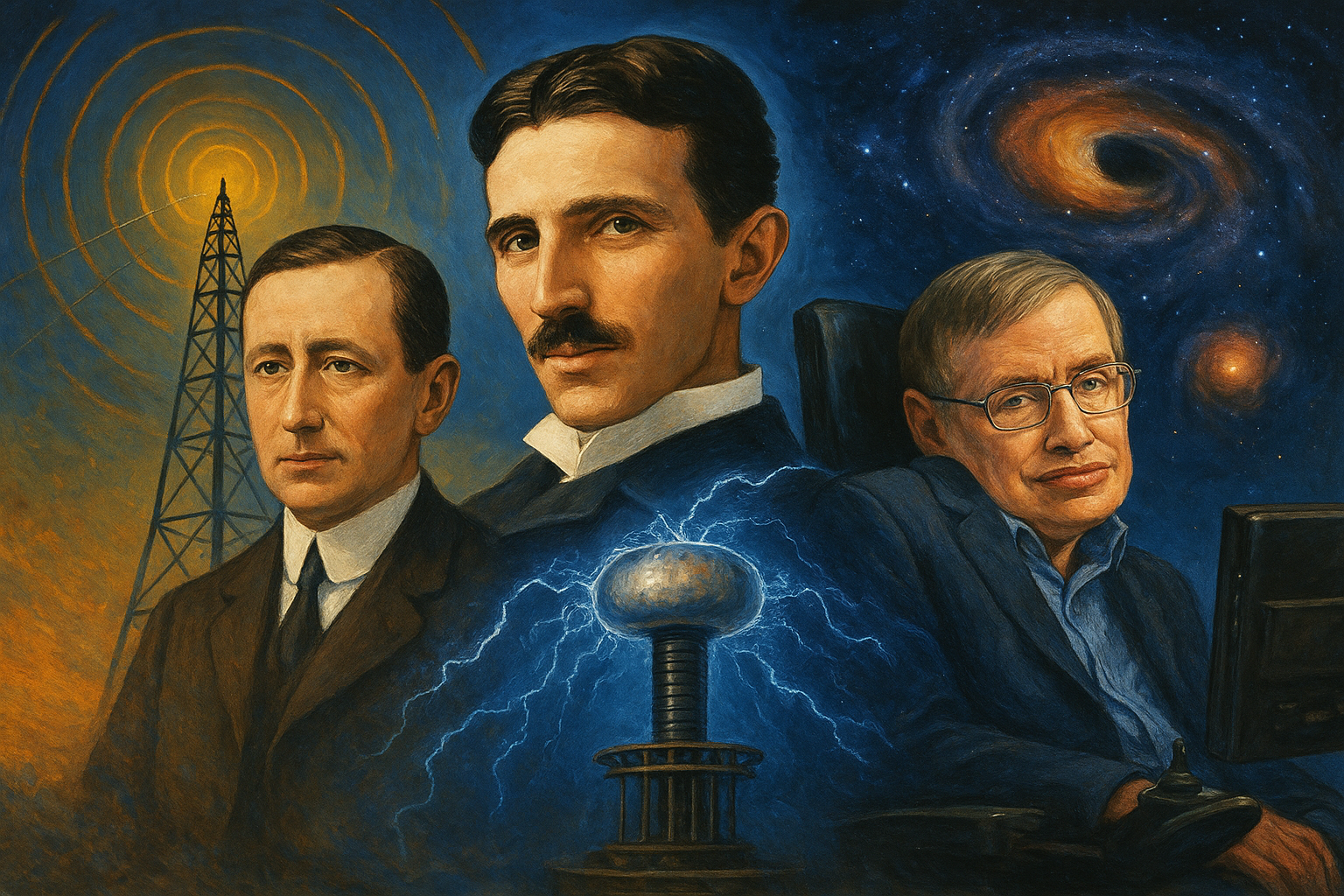
Throughout history, certain individuals have possessed an extraordinary capacity to reshape our understanding of the world and harness its forces for human benefit. Three such figures stand prominently in the annals of scientific achievement: Guglielmo Marconi, the pioneering Italian inventor who gave the world wireless communication; Nikola Tesla, the visionary Serbian-American engineer whose ideas were decades ahead of his time; and Stephen Hawking, the brilliant theoretical physicist who revolutionized our comprehension of black holes and the cosmos. Though separated by time, geography, and scientific discipline, these three men shared a common thread: an relentless pursuit of knowledge that transcended the limitations of their eras and left indelible marks on human civilization.
Guglielmo Marconi: The Father of Wireless Communication
Early Life and Education
Guglielmo Giovanni Maria Marconi was born on April 25, 1874, in Bologna, Italy, to a prosperous and influential family. His father, Giuseppe Marconi, was an Italian landowner, while his mother, Annie Jameson, was from an Irish whiskey-producing family. This cosmopolitan background exposed young Guglielmo to diverse intellectual traditions and provided the financial resources necessary to pursue scientific interests without the constraints faced by many inventors of his era.
Marconi’s education was somewhat unconventional. Rather than following a rigid academic path, he was tutored privately and developed a strong interest in physics and electrical engineering. This practical orientation would prove invaluable to his later work. During his teenage years, Marconi became fascinated with the emerging science of electricity and the recent discoveries in electromagnetism, particularly the theoretical work of James Clerk Maxwell and the experimental demonstrations of Heinrich Hertz, who had successfully generated and detected electromagnetic waves in 1888.
The Birth of Wireless Telegraphy
The turning point in Marconi’s life came when he learned about Hertz’s discovery. At approximately 20 years old, Marconi became consumed with a singular vision: if electromagnetic waves could be generated and detected over short distances in a laboratory, why couldn’t they be transmitted over much greater distances to carry information? This question would occupy him for the remainder of his life and lead to one of the most transformative innovations of the modern age.
Working initially in his family’s villa near Bologna, and later in laboratories in Italy, Marconi began conducting experiments with wireless transmission. He improved upon existing designs, extending the range of transmission from a few meters to increasingly impressive distances. His breakthrough came through a combination of technical innovations: he enhanced the transmitter using a spark gap oscillator connected to an antenna, and he developed more sensitive receivers incorporating a coherer—a device that could detect incoming electromagnetic waves.
By 1895, at just 21 years old, Marconi had achieved wireless transmission over distances of nearly one and a half miles—a dramatic improvement that vindicated his conviction that wireless communication over significant distances was possible. Recognizing the enormous commercial potential of his discovery, Marconi initially sought support from the Italian government. When his proposal for a wireless telegraph system was rejected, he followed his mother’s suggestion and took his invention to England, where he would find a more receptive audience.
The Commercial Triumph
In 1896, Marconi traveled to London and conducted successful public demonstrations of his wireless telegraphy system. The response was enthusiastic, and he quickly secured financial backing to establish the Wireless Telegraph & Signal Company, which later became Marconi’s Wireless Telegraph Company Ltd. This marked the beginning of Marconi’s transformation from inventor to entrepreneur and businessman.
Throughout the late 1890s and early 1900s, Marconi pushed the boundaries of wireless communication with relentless determination. He conducted experiments across the English Channel, successfully transmitting signals between England and France in 1899. His most famous achievement came on December 12, 1901, when he successfully transmitted a wireless signal across the Atlantic Ocean from Poldhu in Cornwall, England, to St. John’s, Newfoundland, Canada. This momentous achievement proved that wireless communication could work on an intercontinental scale and captured the world’s imagination.
The transatlantic transmission was not merely a technical triumph—it was a watershed moment in human civilization. It demonstrated that the vast distances of the ocean need not isolate people from one another. Information could now travel across continents at the speed of light, fundamentally altering commerce, international relations, and human connection itself.
Legacy and Later Years
Marconi’s commercial success was substantial. His company established wireless stations throughout the world and became instrumental in maritime communication. The wireless telegraph system he pioneered proved invaluable for ships at sea, saving countless lives through improved safety communications. After the sinking of the RMS Titanic in 1912, Marconi’s wireless technology gained further significance, as survivors’ distress calls transmitted via wireless had alerted rescue ships to the disaster.
In recognition of his contributions, Marconi was awarded numerous honors. In 1909, he shared the Nobel Prize in Physics with Karl Ferdinand Braun, another wireless pioneer. He was knighted by the Italian government and received accolades from scientific institutions worldwide. In 1929, he was created a marquis by the Italian state.
Later in his career, Marconi continued to explore new applications of wireless technology, including early work on what we now recognize as radar and ultrashort wave transmission. He died on July 20, 1937, in Rome, at the age of 63, his legacy firmly established as a foundational figure in the development of modern telecommunications.
Nikola Tesla: The Unrecognized Genius
A Visionary Born Too Soon
Nikola Tesla (1856–1943) was one of history’s most brilliant yet tragically underappreciated scientists. Born in Smiljan, a small village in what is now Croatia, Tesla possessed an intellect of extraordinary power and imagination. Unlike Marconi, whose life followed a relatively linear path to recognition and wealth, Tesla’s trajectory was marked by spectacular vision, frustrating patent disputes, financial ruin, and ultimate vindication—though mainly after his death.
Tesla’s early life was marked by intellectual precociousness and an unusual relationship with reality. He reported experiencing vivid mental visions that preceded his experimental work, a form of imagination so intense that he could visualize complete devices in his mind’s eye with such clarity that he could virtually test them mentally before building physical prototypes. This unusual cognitive gift enabled him to conceptualize complex systems but also contributed to his reputation as something of an eccentric.
The Education and Early Innovations
Tesla received his education in Prague and Budapest, studying electrical and mechanical engineering. He worked for a time in Paris and later in Hungary, gaining practical experience with telephone and telegraph systems. In 1884, at the age of 28, Tesla emigrated to the United States, arriving in New York City with minimal funds but boundless confidence in his abilities.
In America, Tesla initially worked for Thomas Edison, the most famous inventor of the age. However, the partnership was short-lived. Tesla and Edison represented fundamentally different approaches to electrical power. Edison championed direct current (DC) electricity, while Tesla became an advocate for alternating current (AC). This wasn’t merely a technical disagreement—it was a battle for the future of electrical power distribution, and Tesla’s vision would ultimately prevail.
Tesla’s most significant early innovation was the rotating magnetic field principle and the development of the induction motor in 1887. This device could convert electrical energy into mechanical energy with greater efficiency than existing motors and had the profound advantage of working with alternating current. The implications were enormous: alternating current could be transmitted over long distances more efficiently than direct current, using step-up transformers to increase voltage for transmission and step-down transformers to reduce it for local use.
The War of Currents
The competition between Edison’s direct current system and Tesla’s alternating current system became known as the “War of Currents,” one of the great technological battles of the age. Edison, anxious to discredit AC as dangerous, even went so far as to stage public electrocutions of animals using Tesla’s alternating current to demonstrate its hazards. Despite these tactics, Tesla’s vision gradually gained support from other engineers and investors, particularly George Westinghouse, a wealthy industrialist who licensed Tesla’s AC patents.
The defining moment came at the 1893 World’s Columbian Exposition in Chicago, where Westinghouse and Tesla demonstrated the superiority of AC power by illuminating the entire fair with alternating current. The spectacle was breathtaking—tens of thousands of electric lights transformed the night sky in a display that left visitors awestruck. The public’s imagination was captured, and Tesla’s vindication was complete. Alternating current became the standard for electrical power distribution worldwide, a decision that Tesla’s inventions had made possible.
The Wireless Vision and Beyond
Building on his success with AC electrical systems, Tesla became increasingly fascinated with the possibility of transmitting electrical energy without wires—not merely communications signals, but actual power itself. This ambitious vision led him to construct his most famous and mysterious facility: Wardenclyffe Tower on Long Island, New York.
Wardenclyffe Tower, built between 1901 and 1904, was Tesla’s attempt to create a wireless transmission system for both communications and energy distribution. The massive structure, standing 187 feet tall, was designed to transmit electrical energy through the earth and the surrounding atmosphere to receivers elsewhere on the globe. Tesla was convinced that such a system could revolutionize energy distribution, making power available anywhere without the need for transmission lines.
Unfortunately, Tesla’s ambitions exceeded both contemporary engineering capabilities and his available funding. The project consumed vast sums of money and never achieved its intended purpose. When funding dried up, the Wardenclyffe Tower stood as a monument to Tesla’s vision and his financial mismanagement. It was eventually demolished, and the site passed into obscurity. Tesla’s dreams of wireless power transmission would remain unrealized during his lifetime, though modern researchers have revisited such concepts with more sophisticated technology.
The Later Years and Complex Legacy
As the 20th century progressed, Tesla’s fortunes declined while his eccentricities became more pronounced. Living in poverty in New York hotels and feeding pigeons in public parks, Tesla continued to conceive of revolutionary ideas but lacked the resources and business acumen to bring most of them to fruition. He worked on schemes for earthquake machines, death rays, and other devices that seemed increasingly disconnected from practical reality.
Yet Tesla’s fundamental contributions to science and technology remained immense. The alternating current motor, the transformer, wireless transmission principles, and numerous patents in electrical engineering were all products of his fertile mind. In 1943, Tesla died in obscurity, his final years marked by financial hardship and relative neglect. However, the subsequent decades saw a remarkable rehabilitation of his reputation. As wireless communication technologies developed throughout the 20th century, Tesla’s contributions became increasingly recognized and appreciated.
Today, Tesla is celebrated as a genius whose ideas often preceded the technological capacity to realize them. Many contemporary innovations in wireless power transmission, remote operation, and radio technology have roots in Tesla’s pioneering work. He has become a cultural icon, inspiring scientists, engineers, and innovators worldwide. The irony is bitter but instructive: while Marconi gained wealth and recognition for developing wireless telegraphy, Tesla—whose fundamental discoveries made much of Marconi’s work possible—spent his final years in poverty and relative obscurity.
Stephen Hawking: The Mind That Unlocked the Cosmos
From Brilliant Student to Cosmic Explorer
Stephen William Hawking was born on January 8, 1942, in Oxford, England, at the height of World War II. Unlike Marconi or Tesla, Hawking grew up in the modern age of nuclear physics, quantum mechanics, and relativity—frameworks that would define his scientific career. His father, Frank Hawking, was a physician, and his mother, Isobel Walker, came from a medical family. The household was intellectual and scientifically oriented, providing fertile ground for young Stephen’s curiosity.
Hawking showed exceptional abilities from an early age, though he was not uniformly outstanding in all subjects during his schooling. He possessed an intuitive grasp of physics and mathematics, but his early teachers sometimes found him quirky and not particularly diligent in some areas of study. Nonetheless, by the time he entered University College, Oxford, at age 17, his gifts were evident. He pursued physics, completing his degree in 1962 with what he later described as an undistinguished record—he was interested in physics but less motivated by the tedious work required for top honors.
The Cambridge Years and Black Hole Discoveries
After his undergraduate studies, Hawking pursued graduate work in cosmology at Cambridge University under the supervision of Dennis Sciama, a leading cosmologist of the era. It was at Cambridge that Hawking’s genius truly flourished. In 1963, at age 21, Hawking was diagnosed with amyotrophic lateral sclerosis (ALS), a degenerative neurological disease that gradually paralyzed his body. Doctors gave him two to three years to live.
Rather than being defeated by this dire prognosis, Hawking experienced something of an epiphany. He realized he had enough time to accomplish significant scientific work, and this realization seemed to galvanize his focus. The disease’s slow progression meant that for decades, his mind remained entirely intact even as his physical capacities deteriorated. This cruel paradox—a universe of physical limitation encasing an increasingly powerful intellect—came to define his life and, in some sense, his scientific perspective.
In 1965, Hawking completed his doctoral thesis on singularities in the universe. Working with mathematician Roger Penrose, he developed theorems about gravitational singularities, particularly the “big bang” singularity at the origin of the universe and the singularities that form at the centers of black holes. This work earned him recognition as a leading theoretical physicist while he was still in his twenties.
The Revolutionary Breakthrough
Hawking’s most transformative discovery came in 1974, when he made a startling prediction that overturned conventional understanding of black holes. Black holes had been understood as regions of spacetime where gravity was so intense that nothing—not even light—could escape once it crossed the event horizon. They were considered cosmic sinks from which nothing could ever emerge.
However, Hawking demonstrated through a rigorous calculation combining general relativity with quantum mechanics that black holes are not entirely black. Due to quantum effects near the event horizon, black holes actually emit radiation—now known as Hawking radiation. This radiation arises because quantum fluctuations near the event horizon can produce particle-antiparticle pairs where one particle falls into the black hole while the other escapes to infinity. The escaping particle represents energy loss from the black hole, causing the black hole to gradually evaporate.
The implications were staggering. Black holes were not the permanent cosmic prisons everyone had assumed. They could evaporate, converting mass into radiation. The smaller a black hole, the faster it radiates and the higher its temperature. A small black hole might explode in a brilliant burst of radiation. Hawking’s discovery transformed black holes from mathematical curiosities into astrophysical objects with profound thermodynamic properties and established a deep connection between gravity, quantum mechanics, and thermodynamics—three of physics’ greatest frameworks.
The Quest to Unify Physics
Beyond his specific discovery about black holes, Hawking became increasingly focused on the grand challenge of theoretical physics: unifying general relativity (which governs gravity and the large-scale structure of the universe) with quantum mechanics (which governs atoms and subatomic particles). These two pillars of modern physics are fundamentally incompatible in their current forms, leading to contradictions and infinities when physicists try to apply both to extreme conditions like those inside black holes or at the moment of the Big Bang.
Hawking was convinced that a deeper understanding of quantum gravity and the nature of spacetime would eventually provide this unification. He investigated whether black holes provided a window into this deeper physics. He explored whether information lost in black holes implied that quantum mechanics itself might need modification—a proposition that generated significant debate in the physics community. These investigations led to a re-examination of the role of thermodynamics in black hole physics and the possibility that the universe itself might have holographic properties at the most fundamental level.
Communication and Popular Science
As Hawking’s ALS progressed, his physical condition worsened dramatically. By the 1980s, he had lost the ability to speak and communicate through handwriting. Initially, he used a speech synthesizer connected to a computer, which allowed him to produce speech through electronic means. The distinctive robotic voice of his speech synthesizer became iconic, recognized worldwide as the voice of genius struggling against physical limitation.
Rather than retreating into isolation, Hawking became increasingly visible as a public intellectual. He wrote popular science books, beginning with “A Brief History of Time” in 1988, which became a bestseller worldwide. The book attempted to make cosmology, black holes, and the history of the universe accessible to non-specialist readers. Though frequently described as notoriously difficult to understand, the book captured the public imagination in a way few scientific works have done, making Hawking into a celebrity scientist.
Following the success of his first book, Hawking wrote numerous other popular works and gave lectures worldwide. Despite his severe physical limitations—he was eventually entirely paralyzed and dependent on round-the-clock care—he continued his research and traveled extensively to share his ideas. He became a symbol of human determination and intellectual courage, proof that physical limitation could not confine a powerful mind.
Scientific Contributions and Philosophical Implications
Throughout his career, Hawking contributed to numerous areas of theoretical physics. Beyond his work on black holes, he made contributions to the study of the early universe, exploring models of how the universe might have arisen from quantum fluctuations. He investigated the nature of spacetime singularities and proposed that the initial singularity of the Big Bang might be described using quantum mechanics, potentially eliminating the infinity that plagued classical descriptions of the universe’s origin.
Hawking also engaged in philosophical speculation about the nature of reality itself. In his later years, he became increasingly materialist in his worldview, suggesting that a complete understanding of the universe might be achieved through physics alone, without need for religious or spiritual frameworks. His book “The Grand Design,” co-authored with Leonard Mlodinow, presented the idea that quantum gravity provided a mechanism by which a universe could arise spontaneously from “nothing,” without requiring divine creation.
These ideas were not universally accepted by his colleagues, and Hawking was comfortable with controversy. He relished debate and intellectual challenge, and he surrounded himself with brilliant students and collaborators. Cambridge University, where he spent most of his career, became a center for theoretical physics partly due to his presence and influence.
Later Life and Legacy
Stephen Hawking continued his research and public engagement until his death on March 14, 2018, at the age of 76. This date, the birthday of Albert Einstein, seemed fitting for someone who had contributed so significantly to our understanding of gravity and the cosmos. His death was mourned worldwide, and tributes poured in from the scientific community, from politicians, and from the general public. He had become not just a great scientist but a symbol of human intellectual achievement in the face of adversity.
Comparative Analysis: Three Different Paradigms of Genius
The Inventors and the Theorist
Marconi and Tesla were inventors—individuals who conceived of practical devices and systems that could be built and commercialized. Their genius lay in applying scientific principles to create real-world technologies that transformed daily life. Marconi was particularly effective at the business aspects of invention, creating a company, securing patents, and bringing his innovations to market. Tesla was a brilliant inventor with unparalleled intuition for electromagnetic phenomena, but his lack of business acumen and his overly ambitious vision often left his most spectacular projects incomplete.
Hawking, by contrast, was a theoretical physicist working at the frontiers of abstract mathematical physics. He did not invent devices or create businesses. Instead, his genius operated at the conceptual level, pushing forward the boundaries of human knowledge about the fundamental nature of reality. His contribution was not a technology that could be sold or patented, but understanding that would eventually influence how scientists approached quantum gravity, thermodynamics, and cosmology.
Vision and Its Realization
Each of the three men possessed extraordinary vision that extended beyond the immediate technical challenges of their work. Marconi envisioned a world connected by wireless signals before the technology was adequately developed to make this vision fully real. Tesla imagined wireless power transmission and various other applications of electromagnetic energy that seemed fantastic in his era but that have been partially realized in modern times. Hawking envisioned a deeper understanding of the cosmos rooted in the marriage of quantum mechanics and gravity, a vision that drives current research but remains incomplete.
The tragedy of Tesla lies in the gap between his vision and the technological reality of his era. He imagined things that were theoretically possible but practically beyond the reach of his time. Marconi, by contrast, succeeded in translating his vision into practical reality relatively quickly, though the full implications of wireless communication took decades to develop. Hawking’s vision has not been fully realized during his lifetime, but the path forward is clearer than it was, and his insights have guided subsequent generations of physicists toward deeper understanding.
The Relationship Between Individual and Technology
Marconi was molded by his technology; his identity became inseparable from wireless telegraphy. Once this technology was successfully developed and commercialized, Marconi’s primary contribution was complete, though he remained involved in subsequent developments. Tesla was consumed by his technology; his life became a prolonged struggle to realize his visions of what electromagnetic engineering could achieve. The technology expanded faster than Tesla could personally advance it, and he became somewhat of a relic of a past era even while still alive.
Hawking, conversely, was defined not by a particular technology but by a fundamental intellectual position about how reality works. His insights will likely guide theoretical physics for generations, being refined and expanded upon but remaining essentially valid. His physical limitation, imposed by disease, created an unusual relationship to his work. Unable to manipulate apparatus or conduct experiments, his mind operated entirely in the abstract realm, working with equations and concepts rather than physical devices.
The Lasting Impact: How Each Changed Civilization
Marconi’s Transformation of Communication
Guglielmo Marconi’s primary legacy is the establishment of wireless communication as a fundamental technology of modern civilization. Without wireless telegraphy and the subsequent development of radio, television, and eventually mobile telecommunications, the modern world would be unrecognizable. The ability to communicate without wires has shaped geopolitics, commerce, entertainment, and social relationships in ways both obvious and subtle.
From maritime distress signals to global broadcasting, from radar systems that changed warfare to the mobile phones that define modern life, the lineage of technologies descending from Marconi’s wireless telegraph is immense. His greatest gift to humanity was the liberation of communication from the constraints of physical wires, enabling information to travel through space instantaneously. This freedom has been refined and amplified through the 20th and 21st centuries, but its origins lie clearly with Marconi’s pioneering work.
Tesla’s Revolutionary Foundations
Nikola Tesla’s legacy is more complex and diffuse than Marconi’s, but in some ways equally profound. The alternating current motor and power system that he championed became the foundation of industrial civilization. Every factory, home, and city relies on AC electricity and the transformers that Tesla helped develop. This is perhaps his greatest practical gift to humanity.
Beyond this, Tesla’s conceptual contributions to wireless transmission, remote control, and electromagnetic phenomena provided foundations upon which subsequent scientists and engineers built. His intuitive grasp of electromagnetic energy and his willingness to explore ideas that seemed fantastic at the time foreshadowed later developments in radio, television, radar, and wireless power transmission. In the 21st century, as researchers explore wireless power transmission and advanced electromagnetic applications, they often find themselves rediscovering principles that Tesla had already grasped decades earlier.
Tesla also became an archetype in popular imagination: the obsessive genius, the visionary ahead of his time, the brilliant mind trapped by circumstance and financial limitation. This cultural significance has influenced how subsequent scientists and inventors understand their own roles. Tesla demonstrated that pure technical brilliance and imagination could carry someone far, but that business acumen and fortunate circumstances were necessary for transforming vision into lasting achievement.
Hawking’s Transformation of Cosmology and Physics
Stephen Hawking’s legacy is being written in real time. His discovery of black hole radiation remains one of the most significant developments in theoretical physics of the late 20th century, fundamentally altering how physicists understand the relationship between gravity, thermodynamics, and quantum mechanics. This discovery will likely influence physics for centuries to come.
Beyond specific discoveries, Hawking demonstrated that theoretical physics could be conducted at the highest level of creativity and originality by someone working entirely in the abstract realm, without laboratory experiments or complex apparatus. His example inspired subsequent generations of theoretical physicists to pursue ambitious intellectual goals, knowing that physical limitation need not constrain intellectual achievement.
Hawking’s public engagement and popular writings also transformed the relationship between scientific elite and the general public. Before Hawking, theoretical physics seemed incomprehensibly abstract and disconnected from everyday life. Hawking made it clear that the deepest questions about the nature of reality and the origin of the universe were not merely academic curiosities but profound inquiries into existence itself. He brought cosmology into popular consciousness and made it clear that the public had both the right and the capability to engage with the deepest questions of science.
The Democratization of Knowledge
A secondary but significant legacy that all three figures share is their contribution to the democratization of knowledge. Marconi demonstrated that technical achievement could be turned into practical systems available to vast numbers of people. Tesla, through his lectures and demonstrations, showed that scientific principles could be presented to public audiences in dramatic and compelling ways. Hawking, through his books and public appearances, insisted that the most advanced theoretical physics should be explained in ways that intelligent non-specialists could comprehend.
Conclusion: The Eternal Struggle for Understanding
The lives of Guglielmo Marconi, Nikola Tesla, and Stephen Hawking represent different expressions of human genius in pursuit of understanding and mastery over the natural world. Marconi embodied the inventor-entrepreneur who translates scientific possibility into technological reality and commercial success. Tesla represented the visionary whose ideas often exceeded the technological capacity of his era, whose struggles illuminate the difficult path from imagination to implementation. Hawking exemplified the theoretical physicist whose abstract reasoning probes the fundamental nature of reality, whose insights reshape our conceptual frameworks.
Each of these men faced limitations and obstacles: Marconi faced skepticism and the need to convince investors of the commercial viability of untested technology; Tesla faced financial mismanagement and visions that exceeded practical capability; Hawking faced a progressive paralytic disease that trapped him in an immobile body while his mind continued to soar.
Yet each transcended these limitations through sheer intellectual force and determination. Their legacies are woven into the fabric of modern civilization. We communicate wirelessly because of Marconi; we benefit from alternating current systems pioneered by Tesla; we understand black holes and the quantum nature of reality because of Hawking. Though they lived in different eras, worked in different domains, and approached problems through different methodologies, their common commitment to pushing the boundaries of human knowledge and capability earned them immortal places in the history of science.
In studying the lives and contributions of these three visionaries, we are reminded of the profound impact that individual human genius can have on civilization. We are also reminded that genius comes in many forms—the practical inventor, the conceptual dreamer, the theoretical physicist—and that each form of genius makes irreplaceable contributions to human progress. The twentieth and twenty-first centuries would have been radically different without the work of Marconi, Tesla, and Hawking. Their examples continue to inspire scientists, engineers, and thinkers to pursue ambitious goals and to contribute, in their own ways, to the ongoing human project of understanding and transforming our world.




Be First to Comment