South Africa: Comprehensive SOE & Metropolitan Cities Analysis Report
Data Period: 2023/24–2025/26 | Sources: National Treasury, Auditor-General, Parliament (SCOPA), World Bank, StatsSA
EXECUTIVE OVERVIEW
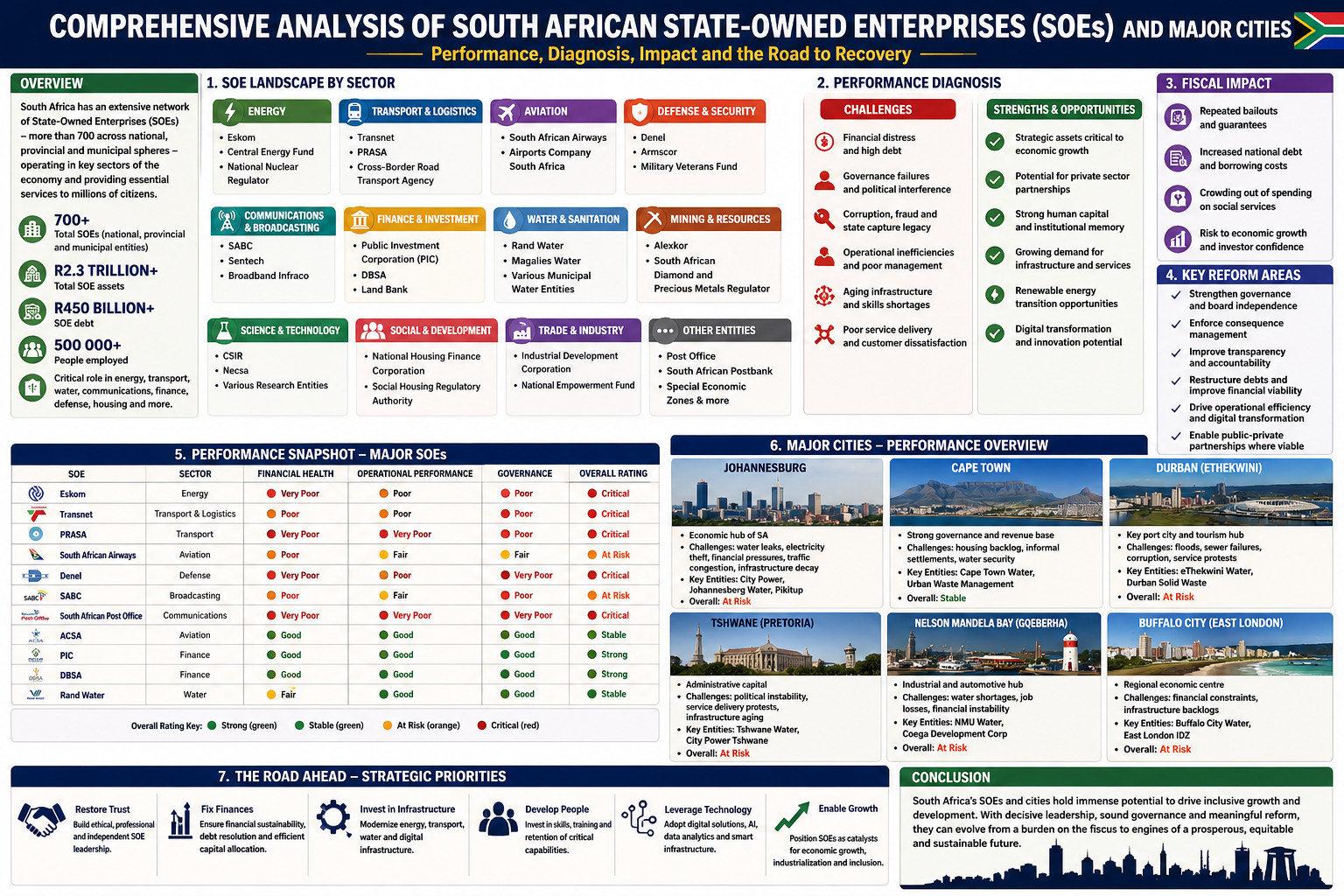
South Africa’s state-owned enterprise ecosystem encompasses approximately 700 public entities across all spheres of government. Governed by the Public Finance Management Act (PFMA) of 1999, these entities range from JSE-listed mega-corporations to small provincial agencies. Together they contribute over 8.5% of GDP, manage critical infrastructure, and employ hundreds of thousands — yet have collectively cost the fiscus over R500 billion in bailouts since 2009, draining fiscal resources and redirecting funds from critical priorities such as education, health and social services. Yahoo Finance
SOEs racked up aggregate losses of R172bn over a five-year period, per National Treasury. Despite this, reforms anchored by the Presidential State-Owned Enterprises Council, stricter conditions on bailouts, and the alignment of SOE mandates with national development priorities have begun introducing greater accountability and fiscal discipline — with leadership appointments increasingly merit-based, and performance targets and public reporting strengthening transparency. MoneywebTrendsnafrica
PART ONE: THE PFMA SCHEDULING FRAMEWORK
The Public Finance Management Act classifies all state entities into distinct schedules based on their autonomy, commercial mandate, and borrowing powers.
Schedule 1 — Constitutional Institutions (10 entities) These are established directly by the Constitution and operate independently of executive control with no commercial mandate. They include the Independent Electoral Commission (IEC), the Human Rights Commission, the Commission for Gender Equality, ICASA, the Public Protector, the Pan South African Language Board, the Financial and Fiscal Commission, and the Municipal Demarcation Board.
Schedule 2 — Major Public Entities / State-Owned Companies (21 entities + 47 subsidiaries) Schedule 2 entities are intended to generate profits and declare dividends. They have the most autonomy of all public entities, operating in a competitive marketplace and run in accordance with general business principles. They may also borrow money through the accounting authority, implying extensive borrowing powers. These include Eskom, Transnet, SAA, ACSA, ATNS, Denel, DBSA, IDC, Land Bank, CEF/PetroSA, NECSA, Telkom, Alexkor, SA Forestry Company, SABC, Trans-Caledon Tunnel Authority, Broadband Infraco, and Armscor. Western Cape Government
Schedule 3A — National Public Entities (166 entities including subsidiaries) Regulatory agencies, research councils, cultural institutions, SETAs, and statutory boards. Cannot borrow independently. Funded largely by government grants and levies. Include NERSA, the National Nuclear Regulator, SANEDI, SANRAL, the Agricultural Research Council, 21 SETAs, the Water Research Commission, the South African Weather Service, and numerous heritage and arts bodies.
Schedule 3B — National Government Business Enterprises (19 entities + 5 subsidiaries) Government-owned businesses at national level with limited borrowing powers, including 14 water boards (Rand Water, Umgeni Water, Lepelle Northern Water, Amatola Water, Magalies Water, Sedibeng Water, Bloem Water, Overberg Water, Mhlathuze Water and others), the SA Post Office, and Postbank.
Schedule 3C/3D — Provincial Public Entities and Business Enterprises (47+ entities) Entities established under provincial legislation, reporting to MECs. Include Gauteng Development Agency, WESGRO (Western Cape), Invest KZN, Eastern Cape Development Corporation, Limpopo Development Corporation, Mpumalanga Development Corporation, provincial gaming boards, housing finance entities, and agri bodies.
SOEs, or public entities as defined in South Africa, can range from massive corporations listed on the JSE and international bourses, to small local agencies with a couple of staff members. The common denominator is that they are controlled by the state, undertaking their activities under a mandate from government and in accordance with government policies. BMIT
PART TWO: MAJOR SOE PERFORMANCE PROFILES
ENERGY SECTOR
Eskom Holdings SOC — STATUS: RECOVERY
Eskom is South Africa’s national electricity utility and by far the country’s most systemically important SOE. It generates approximately 90% of South Africa’s electricity and operates the national transmission grid. After a decade of governance collapse, load-shedding crises, and sustained losses, Eskom’s turnaround is the most significant development in the SOE landscape.
Energy not supplied as a result of load-shedding declined significantly to below 0.4TWh (compared to 13.2TWh the year before). This corresponds to a total load-shedding duration of 175 hours (compared to 6,367 hours), and a decrease in load-shedding days to 13 (compared to 329 days). Consequently, Eskom was able to supply electricity on 96% of the days in the reporting period. After adjusting for a once-off recovery of previously disallowed fuel levy rebates from SARS, Eskom recorded a normalised profit before tax of R11.9bn. Esi-africa
Improved maintenance, better supply-chain management, and partnerships with private engineering firms sharply reduced load shedding and restored operational stability. By 2025, the utility recorded its first pre-tax profit in eight years. Trendsnafrica
Despite this recovery, Eskom’s financial sustainability remains critically threatened. Total municipal arrears escalated to R94.6bn from R74.4bn the prior financial year, driven by persistently low payment levels. The City of Johannesburg and City Power’s refusal to honour payment agreements has forced Eskom to issue formal notices of supply interruption. Audit recovery remains incomplete — the Auditor-General issued a qualified opinion, and a three-year Audit Recovery Programme is active. Moneyweb
CEF (Pty) Ltd / PetroSA — STATUS: DISTRESS
The Central Energy Fund group — comprising PetroSA, iGas, and AEMFC — faces structural commercial decline. PetroSA’s Mossel Bay gas-to-liquid refinery is severely constrained by depleting offshore gas reserves, and the entity has recorded losses. Governance concerns and irregular expenditure compound the challenge. PetroSA lacks a viable commercial model without a new gas supply solution. A national energy security policy decision on its future mandate is overdue.
NECSA (SA Nuclear Energy Corporation) — STATUS: STABLE
NECSA’s commercial subsidiary NTP Radioisotopes is a globally recognised supplier of medical radioisotopes and represents the group’s strongest revenue stream. The nuclear research mandate is underfunded relative to South Africa’s stated nuclear expansion ambitions. Clarity on the mandate — whether as a research and safety regulator or a commercially-oriented nuclear developer — is required before meaningful capital commitment can occur.
TRANSPORT & LOGISTICS SECTOR
Transnet SOC Ltd — STATUS: TURNAROUND (FRAGILE)
Transnet is the backbone of South Africa’s freight logistics, operating approximately 30,000 km of rail, seven major ports, and a petroleum pipeline network. State capture during the Zuma era (2010–2018) caused catastrophic damage — R47bn in questionable locomotive contracts, looted maintenance budgets, and management collapse across all divisions.
In the 2024/25 financial year, Transnet had revenue growth to R82.7bn. This comes alongside a net loss of R1.9bn, despite improvements in cost management and operational efficiency — representing a 74% reduction in losses from the previous year. Government has given Transnet additional guarantees totalling R145.8bn to help the entity manage maturing loans and support critical capital investments, raising the total guarantee facility to R196.3bn. However, the entity continues to struggle with high debt levels and breaches of loan agreements. Parliament of South Africa
Transnet has reduced losses, increased freight volumes, and eased port congestion through infrastructure investment and selective private-sector participation. The minerals and mining export corridors — Sishen-Saldanha (iron ore) and Richards Bay (coal) — remain the highest economic-risk points. Full recovery requires sustained governance discipline and accelerated private terminal operator participation. Trendsnafrica
South African Airways (SAA) — STATUS: RESTRUCTURED, UNPROVEN
SAA entered Business Rescue in 2019, relaunched in 2021, and has received over R11.5bn in public funds. A partnership with the Takatso Consortium (51% private stake) has expanded the fleet and route network. SAA was given a R10.5bn bailout in 2020, and a further R1bn in 2023. SAA reported a net loss of R761m against a budgeted profit of R92m, and missed its revenue targets by R900m. The airline remains commercially unproven without continued state support and has not demonstrated a sustainable path to profitability. Democratic Alliance
PRASA (Passenger Rail Agency of SA) — STATUS: IMPROVING SIGNIFICANTLY
PRASA represents the most dramatic governance turnaround in the SOE landscape. The agency has improved from disclaimers to unqualified audit opinions, mainly due to a multi-year audit action plan aimed at correcting previous deficiencies. In the 2024/25 financial year, PRASA successfully reconstructed its contract register, ensuring transparency and accountability. PRASA has restored most commuter corridors, doubling passenger numbers. Signalling systems, cybersecurity infrastructure, and IT financial management remain priority risks requiring continued investment. Parliament of South AfricaTrendsnafrica
ACSA (Airports Company SA) — STATUS: STABLE
ACSA manages South Africa’s nine major airports including OR Tambo International (Africa’s busiest hub), Cape Town International, and King Shaka International. It has recovered strongly from COVID-19 disruption and maintains a relatively clean governance record — one of the few Schedule 2 entities to do so consistently. Capacity expansion at Cape Town and OR Tambo is critical as passenger volumes approach and begin exceeding pre-pandemic highs.
SANRAL — STATUS: FUNCTIONAL
SANRAL manages over 22,000 km of national roads. The controversial Gauteng e-tolls system was abolished in 2022, eliminating a major revenue stream for Gauteng freeways. The entity advances regional infrastructure with multilateral financing from the World Bank and DBSA. Road maintenance backlogs are serious in secondary networks but the entity is comparatively well-governed.
FINANCE, BANKING & DEVELOPMENT FINANCE INSTITUTIONS
DBSA (Development Bank of Southern Africa) — STATUS: BEST-PERFORMING MAJOR SOE
The DBSA is South Africa’s premier development finance institution for infrastructure and municipal lending. It provides financing for energy (Independent Power Producers), water, transport, and social infrastructure. It has maintained consistent unqualified audit outcomes — the strongest governance record among all Schedule 2 entities. Its lending to municipalities creates growing credit risk as metros’ fiscal positions deteriorate. The DBSA extended a R3.5bn infrastructure deal to Cape Town in 2024 and backed a R2.5bn loan for Johannesburg that was subsequently cancelled due to the city’s failure to meet conditions.
IDC (Industrial Development Corporation) — STATUS: STABLE, SELF-SUSTAINING
The IDC is a self-sustaining development finance institution providing risk capital for industrial, agro-processing, and green economy ventures. Unlike most SOEs, the IDC has never required a government bailout and operates commercially. Its strategic pivot toward green economy investments — renewable energy, electric vehicle batteries, green hydrogen — is strategically sound but requires deepened capital commitment. Exposure to struggling state-owned mining and manufacturing sectors creates latent portfolio risk.
Land Bank — STATUS: FINANCIAL DISTRESS
The Land Bank has been in technical debt default since April 2020, triggering a R7bn liquidity crisis. The Land Bank, which has been in default on its debt obligations since 2020 and subject to recapitalization from the state, recorded a net loss of R97 million as of December 2023, against a budgeted profit of R99.4 million. Government recapitalisation and a debt restructuring plan were implemented but the Bank continues to record losses against its own targets. The agricultural finance mandate is critical for rural development and land reform support — but the institution’s financial model is structurally broken and requires comprehensive redesign. Democratic Alliance
DEFENCE & SECURITY SECTOR
Denel SOC Ltd — STATUS: NEAR-COLLAPSE / EARLY RECOVERY
Denel — South Africa’s strategic defence manufacturer covering aerospace, land systems, and weapons — came perilously close to complete dissolution following state capture orchestrated through the Gupta network. Contracts were looted, world-class engineers fled abroad, and production across multiple divisions halted entirely. The Zondo Commission found that corrupt practices brought Denel to its knees.
Denel has returned to operating profitability after near collapse, supported by tighter governance and reduced irregular expenditure. The appointment of a permanent executive team, production ramp-up at the aeronautics subsidiary, and securing of new contracts represent real progress. However, the Auditor-General did not express an opinion on its financial results because of insufficient audit evidence. R156 million of the R3.4bn government allocation remains ring-fenced for strategic repairs, maintenance, working capital and capital projects. Denel’s sovereign defence capability value is unquestioned — its commercial viability requires sustained vigilance and continued governance reform. TrendsnafricaMoneyweb
Armscor — STATUS: FUNCTIONAL BUT CONSTRAINED
Armscor serves as the procurement agency for the South African National Defence Force (SANDF). Its operations are largely sound but constrained by declining SANDF budgets — South Africa’s defence spending remains consistently below the 2% of GDP minimum required for functional armed forces. Research and development capabilities are being eroded by budget cuts.
COMMUNICATIONS, MEDIA & ICT SECTOR
SABC (South African Broadcasting Corporation) — STATUS: CHRONIC DISTRESS
The SABC is constitutionally mandated as South Africa’s public broadcaster but has operated in crisis for over a decade, characterised by political interference in editorial content, financial mismanagement, and the near-total collapse of TV licence collection enforcement. It received a R3.2bn government bailout and continues to face structural revenue decline from digital streaming competition. Without a complete funding model reform — including direct appropriation or a broadband-linked device levy — the SABC will remain a perennial bailout recipient. Public broadcasting independence from political capture remains unresolved.
Telkom SA SOC Limited — STATUS: COMMERCIAL ENTITY IN TRANSITION
Telkom is the most commercially oriented Schedule 2 entity — JSE-listed with significant private shareholders (the state holds approximately 40.5%). It has transformed from a legacy fixed-line operator to a converged ICT company spanning Openserve (broadband infrastructure), BCX (enterprise ICT), and Telkom Mobile. Intense competition from Rain’s 5G network and the MTN/Vodacom duopoly continues to pressure mobile market share. The failed MTN merger attempt highlighted the complexity of SOE strategic pivots. Government needs to decide: full privatisation, or a defined state mandate.
Broadband Infraco (BBIco) — STATUS: MARGINAL
BBIco was established to provide affordable wholesale broadband infrastructure. Its mandate has been largely superseded by the rapid private rollout of fibre networks (Vumatel, Openserve, MetroFibre). The entity is underscale, under-resourced, and cannot compete commercially. A strategic review of its continued existence — or merger into a larger digital infrastructure mandate — is overdue.
WATER BOARDS (SCHEDULE 3B — 14 NATIONAL ENTITIES)
South Africa faces a systemic water security crisis: ageing bulk infrastructure, a national non-revenue water loss rate of approximately 37%, widespread municipal non-payment to water boards, and the collapse of the Department of Water & Sanitation (itself placed under administration). Water board performance varies sharply:
Rand Water (Gauteng) — Functioning. Supplies bulk water to 19 million people across Gauteng and surrounding provinces. Key risk: R94.6bn in unpaid municipal bills cascades directly from Eskom’s crisis to water supply sustainability. Ageing distribution infrastructure.
Umgeni Water (KZN) — Under pressure. Qualified audit outcomes. Water losses and infrastructure capacity expansion delays undermine performance. Serves eThekwini and surroundings.
Lepelle Northern Water (Limpopo) — Distress. Disclaimer audit outcomes. Revenue collection failures. Serves one of South Africa’s most rural and under-developed provinces.
Amatola Water (Eastern Cape) — Distress. Under-resourced. Severe rural service delivery backlogs in one of South Africa’s poorest regions.
Sedibeng Water (Free State/Northern Cape) — Critical. Financial distress, irregular expenditure, and qualified audit outcomes.
Overberg Water (Western Cape) — Stable. Clean audit. Benefits from Western Cape’s comparatively stronger municipal governance environment.
Trans-Caledon Tunnel Authority — Operational. Manages the Lesotho Highlands Water Project — one of Africa’s most significant water infrastructure schemes. Phase 2 completion is critical for Gauteng’s long-term water security.
OTHER NOTABLE SOEs
SA Post Office (SAPO) — Near Collapse. Entered business rescue, underwent mass retrenchments, and is in the process of separating Postbank from its operations. The SASSA social grant payment mandate is at risk.
Postbank — Transitioning. The separation from SAPO is operationally complex. As the vehicle for distributing SASSA grants to 18 million+ beneficiaries, its operational continuity is a social security imperative.
Alexkor — Marginal. Diamond mining SOE in the Northern Cape managing a complex community equity arrangement with the Richtersveld people. Limited commercial scale.
SA Forestry Company (SAFCOL) — Operational. Commercial timber operations providing employment in rural areas. Fire risk management is the primary operational challenge.
SETAs (21 Sector Education and Training Authorities) — Systemic Failure. Collectively mismanage R6bn+ in skills levies with negligible measurable employment outcomes. Training-to-employment conversion rates are critically low. Radical rationalisation and outcome-based funding reform are required.
CSIR, NRF, SANSA — Functional. These science and technology entities perform reasonably well on their mandates but are chronically underfunded. The CSIR has developed meaningful commercial revenue streams.
Agricultural Research Council — Underfunded. Critical for food security research but budget cuts are eroding its capacity. South Africa’s agricultural competitiveness depends on its function.
PART THREE: THE EIGHT METROPOLITAN MUNICIPALITIES
In the 2023/24 reporting period, the eight metros delivered services to 8.9 million households — 46% of all households in the country. Together with their entities, they were responsible for 57% (R351.37bn) of the estimated local government expenditure budget for the year. Together, these municipalities are home to 22 million people and account for 85% of South Africa’s economic activity. Daily MaverickSt Francis Chronicle
Only 16% of South Africa’s municipalities can be trusted to spend public funds effectively — and they account for just 19% of the municipal expenditure budget. The audit picture among metros is stark: of South Africa’s eight metros, only Cape Town was given a clean bill of health by the Auditor-General. Johannesburg, eThekwini and Ekurhuleni received unqualified audits with findings. Buffalo City, Tshwane, Mangaung and Nelson Mandela Bay all received qualified audit opinions with findings. Daily MaverickDaily Maverick
City of Johannesburg — STATUS: CRITICAL FINANCIAL CRISIS
Johannesburg is South Africa’s economic capital, housing the headquarters of most JSE-listed companies, the country’s largest financial district, and a population of approximately 6.1 million. It has the largest municipal budget in the country — over R90bn annually. Yet it is currently in a full-blown governance and financial crisis that threatens service delivery to millions.
By the end of 2025, households, businesses, and even state entities had racked up nearly R72bn in debt to the City of Johannesburg. Over 70% of it is older than one year — in municipal terms, that often means it is effectively lost. Despite billing R37.2bn for services like electricity, water, and refuse collection in just six months, the city only collected R31.9bn. Joburg ETC
The JSE suspended trading in the City of Johannesburg’s listed bonds in March 2026 after the city failed to publish its audited annual financial statements for the 2025 financial year. The city’s dismal financial situation further hurts service delivery, as it cannot pay all service providers within 30 days of receiving the relevant invoice. Daily Investor
The Auditor-General’s annual report revealed that the city’s debt collection expenses have surged from R30 million to R423 million in the 2023/24 financial year. The City of Johannesburg faces a R1.4 billion financial burden due to water losses. The electricity losses are staggering, with R1.4 billion in technical losses and R3.4 billion in non-technical losses. IOL
The City of Johannesburg had spent just 8% of its R8.7bn capital budget by the end of September 2025, improving to 26% by December — still far below the roughly 50% level expected at that stage. Experts estimate that Johannesburg needs at least R26bn just to stabilise its water infrastructure, and over R200bn for full maintenance and future upgrades. Finance Minister Godongwana has formally intervened after the city approved an unlawful adjustment budget. GCR credit rating agency downgraded the city’s outlook to Negative, citing material uncertainty around audit completion. Daily Maverick
City of Cape Town — STATUS: BEST PERFORMER IN SA
Cape Town stands as South Africa’s singular metropolitan success story — the only metro to achieve and sustain a clean audit, maintain functional revenue collection, and invest proactively in infrastructure ahead of demand rather than in crisis response.
Cape Town has set all-time records for capital spending, investing over R9.5bn in 2024/25 alone, to “avoid the service delivery collapses seen in other cities,” as Mayor Hill-Lewis described it. The city secured a R3.5bn finance deal in 2024 to fund further infrastructure through 2027, expected to create over 130,000 construction jobs. Architectafrica
Cape Town’s revenue collection rate exceeds 95%, its capital budget execution rate is among the highest in South Africa, and it has maintained a clean audit for multiple consecutive years under the DA-led administration. The city demonstrated exceptional crisis management during the 2018 “Day Zero” drought — implementing demand management measures that reduced consumption by 50% and avoided a complete water supply failure. The gap between Cape Town and the other seven metros has grown so dramatically that it now represents a governance model study in its own right.
eThekwini / Durban — STATUS: IMPROVING
eThekwini is South Africa’s third-largest city and the economic powerhouse of KwaZulu-Natal. Home to Africa’s busiest container port, eThekwini represents more than half of KwaZulu-Natal province’s productivity and approximately 10% of South Africa’s GDP. Durban
Parliament’s SCOPA commended eThekwini for transparency and comprehensive reporting. The municipality reported that interventions contributed to a reduction in audit findings from 25 in the 2022/23 financial year to 13 in the 2024/25 financial year. However, eThekwini still lacks valid operating licences for its wastewater treatment works — a serious public health and environmental compliance failure. The July 2021 unrest caused significant infrastructure damage still being repaired. The city’s trajectory is improving but has not yet reached the governance standards required of a city of its economic importance. allAfrica.com
City of Tshwane — STATUS: DISCLAIMER AUDIT / CRITICAL
Tshwane is South Africa’s administrative capital, home to Union Buildings, the diplomatic corps, and government headquarters. The paradox is acute: the city governing the seat of national government received a disclaimer audit — the worst possible outcome. Pretoria now ranks as the second most crime-ridden city in the world on one major index (Numbeo 2025), with violent crimes like carjackings and murders surging in several precincts. The city failed to maintain its wastewater treatment works, and public spaces that were once well-kept show signs of advanced neglect. Service delivery collapse and governance failure in South Africa’s administrative capital sends a devastating signal about the state’s capacity to manage its own institutions. Architectafrica
Ekurhuleni Metro — STATUS: DISCLAIMER AUDIT
Ekurhuleni encompasses the East Rand industrial corridor — one of South Africa’s most important manufacturing regions — and surrounds OR Tambo International Airport. It received a disclaimer audit in 2023/24. Public trust has been severely eroded by allegations of nepotism within the administration. Allegations of nepotism eroded trust under the current leadership. Electricity distribution inefficiency and water service delivery failures create direct cost burdens on industrial and residential users in one of South Africa’s most economically active corridors. The Citizen
Nelson Mandela Bay — STATUS: QUALIFIED AUDIT / HIGH RISK
Nelson Mandela Bay (Gqeberha/Port Elizabeth) has experienced chronic political instability — multiple mayors in rapid succession — and a scandalous attempt to write off R3.2bn in unauthorised expenditure. Nelson Mandela Bay had the highest senior manager vacancy rate at 67%. The Eastern Cape’s long-term economic underperformance is directly linked to the metro’s persistent governance failures. The city sits at South Africa’s second major container port and has significant automotive manufacturing capacity (Volkswagen SA), but financial mismanagement has made the infrastructure investment needed to leverage these assets impossible. Daily Maverick
Buffalo City Metro — STATUS: QUALIFIED AUDIT
Buffalo City (East London/King William’s Town) is South Africa’s smallest metro and faces multiple compliance failures — including no valid wastewater treatment operating licences. Its economic base includes the Mercedes-Benz SA manufacturing plant and the East London Industrial Development Zone, but municipal governance has not kept pace with the city’s industrial potential. Political instability under Mayor Princess Faku — including a motion of no confidence — reflects internal governance dysfunction.
Mangaung Metro — STATUS: WORST PERFORMER IN SOUTH AFRICA
Mangaung (Bloemfontein) is by most measures South Africa’s worst-performing metropolitan municipality. Mangaung had the highest overall vacancy rate at 61%. Without the necessary human resources, fulfilling the mandate of municipalities will remain a pipe dream. Mangaung also did not have a valid operating licence for its solid waste management facility in addition to its wastewater treatment works. It received a disclaimer audit — the worst possible outcome. Bloemfontein is South Africa’s judicial capital, home to the Supreme Court of Appeal, yet it is governed by an institution incapable of basic service delivery. The Free State ANC’s cadre deployment policy has been directly blamed for the systematic dismantling of the city’s institutional capacity. National government intervention under Section 139 of the Constitution is under active consideration. Daily Maverick
PART FOUR: NATIONAL DIAGNOSIS — THE STRUCTURAL CRISIS
Root Cause 1: State Capture and Political Interference The Zondo Commission documented how politically connected networks systematically looted Eskom, Transnet, Denel, PRASA, and others during 2010–2018. Irregular and wasteful expenditure ran into hundreds of billions. Board appointments were politically motivated rather than merit-based. This institutional rot persists years after the implicated individuals left office.
Root Cause 2: Cadre Deployment Policy The practice of placing party loyalists into executive and board positions regardless of competence has systematically degraded management capacity at SOEs and municipalities alike. Mangaung’s 61% vacancy rate and Denel’s near-collapse are direct consequences of prioritising political loyalty over technical competence.
Root Cause 3: Fragmented Oversight Architecture SOEs answer to multiple principals simultaneously — the shareholder ministry, National Treasury, Parliament (SCOPA), and sectoral regulators — creating an accountability vacuum where each principal can defer to the others. Proposed reforms, including the National State Enterprises Bill introduced in 2024, aim to consolidate oversight under a centralised holding company structure, but SOEs remain governed by the extant PFMA and sectoral laws without a unified SOE-specific statute. This decentralised framework has been critiqued for fragmented accountability, contributing to governance challenges observed in empirical audits by the Auditor-General. Grokipedia
Root Cause 4: The Bailout Moral Hazard Government’s stated “no bailout” policy is perpetually undermined by the reality that critical SOEs are deemed too systemically important to fail. This creates moral hazard — boards and management know that failure triggers government support, reducing the incentive for genuine financial discipline. Government has announced a strict no-bailout approach but will provide government guarantees with stringent conditions. The R196.3bn guarantee facility for Transnet is the most recent expression of this contradiction. Yahoo Finance
Root Cause 5: The Municipal Debt Cascade The R94.6bn owed by municipalities to Eskom, and Johannesburg’s R71.9bn in consumer debt, creates a cascading financial failure loop. When municipalities don’t collect from residents, they can’t pay SOEs. When SOEs don’t receive payment, they can’t maintain infrastructure. When infrastructure fails, economic activity declines, reducing the tax base and making debt recovery even harder. This circular doom loop is now the single greatest threat to South Africa’s macroeconomic stability.
Root Cause 6: Skills Emigration and Capacity Drain South Africa’s accelerating skills emigration — engineers, accountants, project managers, and technical specialists — has compounded the governance challenge at a structural level. Eskom lost critical generation maintenance expertise. PRASA lost railway engineering capacity. Water boards cannot retain qualified engineers. The public sector’s uncompetitive salaries drive talent to the private sector or abroad, while procurement irregularities corrupt replacement recruitment.
Signs of Recovery Against this structural diagnosis, measurable green shoots exist. Eskom’s turnaround illustrates the change most clearly. Improved maintenance, better supply-chain management and partnerships with private engineering firms have sharply reduced load shedding and restored operational stability. Transnet has reduced losses, increased freight volumes and eased port congestion. Denel has returned to operating profitability after near collapse. PRASA has restored most commuter corridors, doubling passenger numbers. SANRAL continues to advance regional transport infrastructure with multilateral financing. Trendsnafrica
PART FIVE: STRATEGIC RECOMMENDATIONS
1. Enact the National State Enterprises Bill Create a centralised holding company (modelled on Singapore’s Temasek or Malaysia’s Khazanah) to unify shareholder oversight, professionalise board appointments, and eliminate the multi-principal accountability vacuum. This is the single most structurally impactful reform available.
2. Place the Worst-Performing Metros Under Section 139 Administration Mangaung, Tshwane, and Ekurhuleni meet the constitutional threshold for national intervention. Continued non-intervention is a dereliction of the national government’s oversight duty and a betrayal of millions of residents.
3. Mandate Revenue Ring-Fencing at Metros Legislate that electricity and water revenue collected by municipalities must be immediately transferred to bulk suppliers (Eskom, Rand Water, Umgeni Water). This breaks the cascading debt cycle before it reaches the macro-financial system.
4. Accelerate Strategic Privatisation Advance private sector participation in Eskom’s generation and distribution tiers; open Transnet’s port terminals to private operators; consider full privatisation of Telkom and SAFCOL; sunset non-viable entities like SAPO and BBIco where the commercial mandate cannot be restored.
5. Radically Reform the SETA System Consolidate 21 SETAs into 5–7 sector-aligned entities. Introduce outcome-based funding — payment triggered by learner employment, not training registration. Establish independent quality auditing of all training delivery.
6. Execute the World Bank Metro Programme in Full The World Bank approved the South Africa Metro Trading Services Program, the first-ever Program-for-Results operation in the country, aimed at improving the accountability, financial health, and operational performance of essential urban services in the country’s eight largest metropolitan municipalities. This US$925m (R55bn) programme must be disbursed only upon verified service delivery and financial management improvements — not on political commitments. worldbank
7. Commission a National Water Security Infrastructure Plan Accelerate Lesotho Highlands Phase 2 completion, refurbish bulk water treatment facilities nationally, implement smart metering to reduce the 37% non-revenue water loss rate, and mandate water board financial sustainability targets.
8. Legislate the Cape Town Governance Model as a National Standard Study and codify the governance conditions enabling Cape Town’s sustained performance — merit-based appointments, functional internal audit committees, outcome-based performance contracts, zero tolerance for irregular expenditure — and apply them as minimum standards for all metropolitan leadership appointments and funding access.
Sources: National Treasury (PFMA Schedules, Budget Reviews 2024–2026), Auditor-General of South Africa, Parliament SCOPA, World Bank, BMIT Research 2025, StatsSA, Moneyweb, Daily Maverick, ESI-Africa, SAnews.gov.za, Parliament of South Africa press releases. All figures in South African Rand (ZAR). Report period: 2023/24–2024/25 financial years, with legislative and political developments current to May 2026.






Be First to Comment