
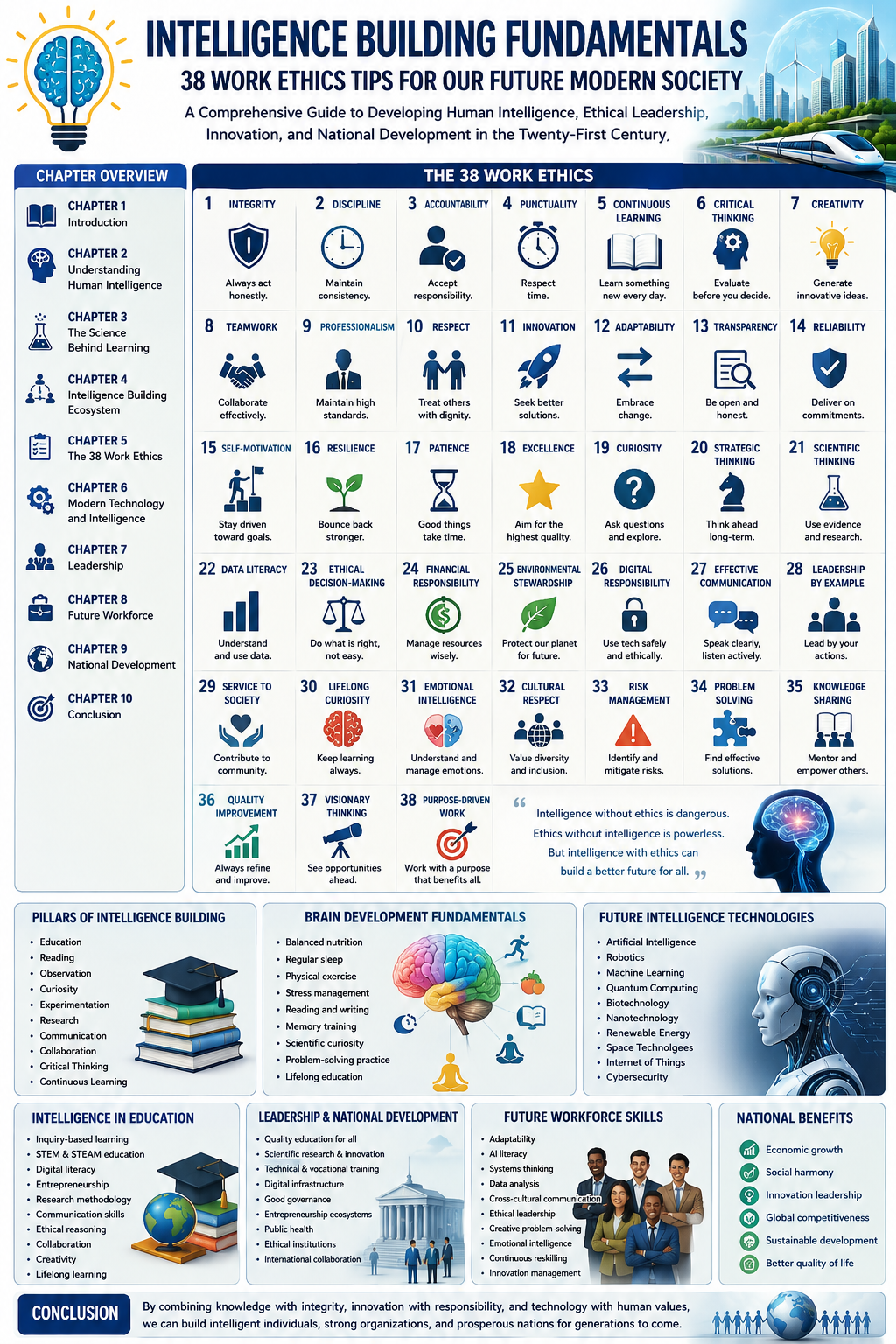
Work ethics is often treated as a soft, unmeasurable quality — a matter of personality rather than a set of learnable habits. This article argues the opposite: work ethics is a discipline built from specific, describable behaviors, and the more automated and distributed our workplaces become, the more those behaviors matter — not less.
Here are 38 tips, organized into six themes, for building an ethical, intelligent, and resilient approach to work in the decades ahead.
Part I: Foundations of Personal Work Ethics
1. Punctuality and Time Stewardship Punctuality isn’t just showing up on time — it’s proof that you treat time as a shared resource, not a personal convenience. As synchronous attention gets scarcer, guarding it well becomes a real professional signal.
2. Personal Accountability Accountability means owning outcomes, good or bad, without diffusing blame across teams, algorithms, or “the process.” Ask “what will I do differently,” not “whose fault was it.”
3. Integrity in Small Decisions Most scandals start small — a rounded-up expense claim, a quietly ignored conflict of interest. Apply the same standard to unwitnessed choices as to public ones.
4. Reliability and Follow-Through Every kept promise compounds trust; every broken one withdraws it faster than it was earned. Reliable people need less oversight and get more autonomy.
5. Respect for Institutional Rules and Governance Respecting governance doesn’t mean blind obedience — it means engaging with the reasoning behind a rule and challenging it through legitimate channels, not quietly working around it.
6. Self-Discipline as a Daily Practice Self-discipline is a muscle, not a personality trait. Tackle your hardest task before checking notifications, and repeat that daily.
7. Honesty in Reporting and Communication Honest reporting means leading with the real picture — including the uncomfortable parts — so decision-makers can actually act on reality.
Part II: Intelligence Building and Continuous Learning
8. A Lifelong Learning Mindset Qualifications have a shrinking shelf life. Treat your degree as a foundation, not a finished credential, and keep building on it.
9. Critical Thinking Under Uncertainty Separate verified fact from assumption, question first impressions, and stay open to revising conclusions — without freezing in the absence of certainty.
10. Digital Literacy as a Baseline Skill Digital fluency is no longer optional in any profession. Increasingly, it means knowing how to direct and verify AI output, not just operate software.
11. Data-Informed Decision Making Blend evidence with judgment. Ask where the data came from and what it fails to capture before letting it drive a conclusion.
12. Adaptive Reskilling Treat your skill set like an investment portfolio — diversified, reviewed periodically, rebalanced before a crisis forces the issue.
13. Curiosity as a Competitive Advantage Asking “why” generates the novel questions that automated systems can’t yet ask. Curiosity is one of the clearest remaining sources of human value.
14. Knowledge Sharing and Mentorship Hoarding knowledge for job security is a losing long-term strategy. Document what you know and mentor someone — it multiplies your value, it doesn’t dilute it.
Part III: Collaboration and Human Capital
15. Psychological Safety in Teams Teams where people can admit mistakes without fear surface problems early, when they’re cheap to fix — not late, when they’re expensive.
16. Constructive Conflict Resolution Disagreement is unavoidable; the goal is resolving it on substance, not personality, and addressing underlying interests instead of declaring a winner.
17. Cross-Cultural Competence Don’t assume your default communication style is the universal standard. Stay curious about difference instead of merely tolerating it.
18. Active Listening Listen to understand, not to prepare your rebuttal. It’s rarer than it should be — which is exactly why it stands out.
19. Distributed and Remote Collaboration Etiquette Clear written communication, respect for time zones, and realistic response-time norms matter more than ever in hybrid and remote teams.
20. Feedback as a Growth Tool Specific, respectful, development-focused feedback is one of the most efficient tools an organization has. Withholding it out of discomfort does more harm than good.
21. Servant Leadership The best leaders remove obstacles for their people rather than extracting effort from them. It builds loyalty that authority alone never will.
Part IV: Technology, Artificial Intelligence, and the Future of Work
22. Human-AI Collaboration Literacy Know where AI tools are likely to be confidently wrong. Treat every AI output as a first draft requiring verification, not an oracle.
23. Ethical Use of Automation Automation raises real questions — who’s displaced, how transparent is the decision, how are gains shared. Raise these questions; don’t wait for someone else to.
24. Cybersecurity Hygiene as Professional Duty Strong unique passwords, multi-factor authentication, and healthy suspicion of unsolicited requests are now baseline professional obligations, not IT’s problem alone.
25. Algorithmic Accountability When an algorithm shapes hiring, lending, or evaluation, someone has to be able to explain, audit, and correct it. “The system decided” isn’t accountability.
26. Balancing Efficiency with Human Judgment Decide in advance which calls always require a human — before efficiency pressure tempts you to automate something that shouldn’t be.
27. Data Privacy Stewardship You’re a steward of other people’s privacy, not just a custodian of a data asset. Collect only what’s genuinely needed, and be transparent about its use.
28. Continuous Technology Adaptation Learn new tools as they emerge instead of defending familiar but outdated ones. Adaptability is now scarcer — and more valuable — than mastery of any single tool.
Part V: Governance, Compliance, and Institutional Integrity
29. Regulatory and Compliance Awareness Understand the purpose behind your compliance obligations well enough to meet them proactively, not scramble reactively once a deadline looms.
30. Transparent Reporting Structures Information should flow in a form that reflects reality — not one filtered to protect any single person’s position.
31. Anti-Corruption Vigilance Corruption starts small: a favor here, an informal arrangement there. Recognize the pattern early and decline participation, even when it’s uncomfortable.
32. Sustainable Resource Stewardship Ask not just whether a resource can legally be used, but whether its use is proportionate and sustainable for the long term.
33. Diversity, Equity, and Fair Practice Apply consistent standards of opportunity and reward regardless of background — it’s both a moral obligation and a competitive advantage.
34. Institutional Reputation as a Shared Asset Reputation is built over years and can be damaged in a moment by one person’s conduct. Treat your own conduct as a direct contribution to it.
Part VI: Resilience, Wellbeing, and Sustainable Performance
35. Work-Life Integration Rigid separation between work and life is unrealistic in a connected world — but so is letting work colonize all of it. Aim for a rhythm you can sustain for an entire career.
36. Mental Health Awareness at Work Recognize the signs of burnout in yourself and colleagues, and respond with support rather than stigma. Concealing struggle usually causes more damage than seeking help early.
37. Purpose-Driven Motivation Motivation tied to a clear sense of purpose outlasts motivation tied only to external reward — especially when things get hard.
38. Adaptive Resilience in Economic Uncertainty Economic volatility is now a near-permanent feature of modern work. Build the capacity to absorb setbacks, reassess without abandoning your principles, and keep going.
The Constant Beneath a Changing Surface
The surface of work is changing fast — automation, distributed teams, AI collaboration. But the underlying ethical architecture that makes work valuable and trustworthy hasn’t changed nearly as much: punctuality, honesty, accountability, curiosity, fairness, and resilience were valuable a century ago and remain valuable now. What’s new is the context they must be practiced in, and the domains — especially AI and distributed digital work — they must now be deliberately extended to.
No institutional policy or technological safeguard replaces the daily, often unwitnessed decisions of the people doing the work. That’s where the future of modern society actually gets built.






Be First to Comment