Introduction
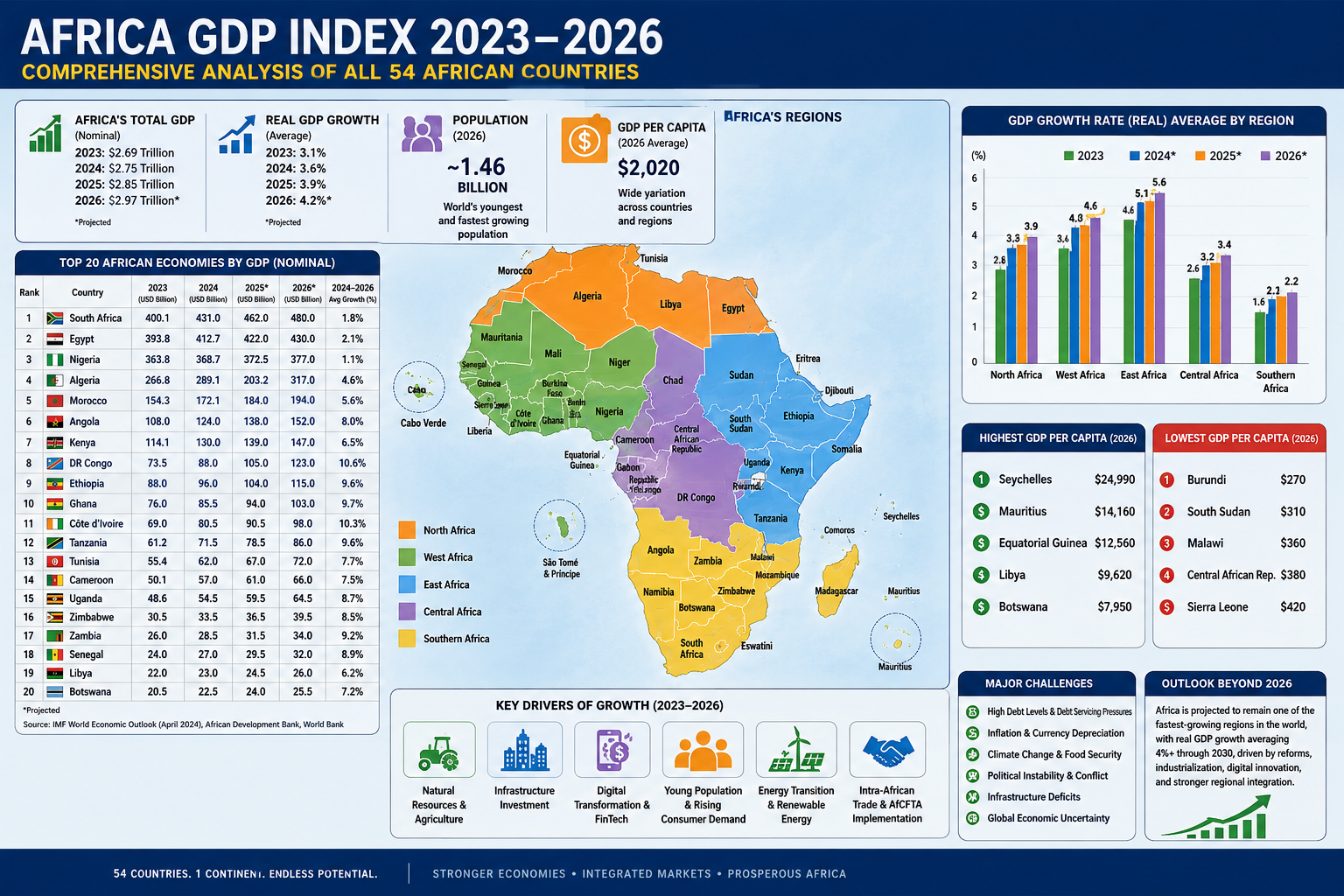
Africa remains one of the most dynamic and strategically important economic regions in the world. With a population exceeding 1.4 billion people, vast mineral resources, expanding digital infrastructure, rapid urbanization, and a growing middle class, the continent has become central to global discussions on development, trade, energy, manufacturing, and technology.
Between 2023 and 2026, African economies experienced both resilience and instability. Major factors influencing GDP performance included:
- Commodity price fluctuations
- Inflation and currency depreciation
- Global geopolitical tensions
- Climate change and droughts
- Debt pressures
- Expansion of digital economies
- Infrastructure investments
- The African Continental Free Trade Area (AfCFTA)
According to IMF and African Development Bank projections, Africa’s economic growth improved from around 3.1% in 2023 to approximately 4.2–4.4% by 2025–2026.
Understanding GDP in Africa
GDP (Gross Domestic Product) measures the total monetary value of goods and services produced within a country.
The African GDP landscape can be divided into several categories:
- Resource Economies
- Nigeria
- Algeria
- Angola
- Libya
- Industrial and Diversified Economies
- South Africa
- Egypt
- Morocco
- Fast-Growing Frontier Economies
- Ethiopia
- Rwanda
- Côte d’Ivoire
- Kenya
- Fragile or Conflict-Affected Economies
- Sudan
- South Sudan
- Somalia
- Central African Republic
Africa’s Largest Economies (2023–2026)
Top African Economies by Nominal GDP
| Rank | Country | 2026 Projected GDP |
|---|---|---|
| 1 | South Africa | ~$480 billion |
| 2 | Egypt | ~$430 billion |
| 3 | Nigeria | ~$377 billion |
| 4 | Algeria | ~$317 billion |
| 5 | Morocco | ~$194 billion |
| 6 | Angola | ~$152 billion |
| 7 | Kenya | ~$147 billion |
| 8 | Democratic Republic of the Congo | ~$123 billion |
| 9 | Ethiopia | ~$122 billion |
Regional Economic Analysis
1. Southern Africa
South Africa
South Africa remained Africa’s most industrialized economy. Key sectors include:
- Mining
- Financial services
- Manufacturing
- Telecommunications
- Retail
Challenges:
- Electricity shortages
- Unemployment
- Logistics inefficiencies
- Corruption
Strengths:
- Johannesburg Stock Exchange
- Advanced banking sector
- Automotive manufacturing
GDP projections increased steadily from approximately:
- 2023: $381 billion
- 2024: $403 billion
- 2025: $427 billion
- 2026: $480 billion
Botswana
Botswana maintained one of Africa’s strongest governance systems.
Economic drivers:
- Diamonds
- Tourism
- Financial stability
Main challenge:
- Economic dependence on diamonds
Namibia
Namibia expanded:
- Uranium mining
- Green hydrogen projects
- Renewable energy initiatives
The country became strategically important for future clean-energy supply chains.
Zimbabwe
Zimbabwe continued to struggle with:
- Inflation
- Currency instability
- Debt problems
However:
- Gold exports
- Lithium mining
- Agriculture
provided moderate GDP support.
Zambia
Zambia benefited from:
- Copper demand
- Electric vehicle battery supply chains
- Mining investment
Debt restructuring remained a key issue.
2. West Africa
Nigeria
Nigeria is Africa’s most populous country and one of its largest oil producers.
Key sectors:
- Oil and gas
- Fintech
- Banking
- Entertainment
- Agriculture
Major issues:
- Currency depreciation
- Inflation
- Oil theft
- Infrastructure deficits
Despite challenges, Nigeria’s digital economy grew rapidly.
Projected GDP:
- 2024: ~$252 billion
- 2025: ~$290 billion
- 2026: ~$377 billion
Ghana
Ghana experienced:
- Debt restructuring
- IMF support
- Inflation management
Economic pillars:
- Gold
- Cocoa
- Oil exports
Côte d’Ivoire
One of Africa’s fastest-growing economies.
Growth drivers:
- Cocoa exports
- Construction
- Infrastructure
- Ports and logistics
Senegal
Senegal gained momentum due to:
- Offshore oil and gas discoveries
- Infrastructure modernization
- Dakar urban expansion
Mali, Burkina Faso, and Niger
These Sahel states faced:
- Political instability
- Security crises
- Economic sanctions
- Military transitions
Economic growth slowed because of conflict and reduced foreign investment.
3. East Africa
Kenya
Kenya remained East Africa’s commercial and technological hub.
Key sectors:
- Mobile banking
- Tourism
- Agriculture
- ICT
Nairobi emerged as a major African tech ecosystem.
Ethiopia
Ethiopia recorded some of Africa’s highest growth rates.
Drivers:
- Infrastructure development
- Manufacturing
- Industrial parks
- Population growth
Challenges:
- Foreign exchange shortages
- Political tensions
- Debt burdens
Growth rates exceeded 8–9% in some projections.
Tanzania
Tanzania expanded through:
- Mining
- Tourism
- Port trade
- Rail infrastructure
The country increasingly became a logistics gateway for inland Africa.
Rwanda
Rwanda continued to build:
- Digital governance
- Conference tourism
- Technology infrastructure
It remained one of Africa’s most business-friendly economies.
Uganda
Uganda’s future outlook improved because of:
- Oil pipeline projects
- Agriculture
- Population growth
4. North Africa
Egypt
Egypt became one of Africa’s largest economies.
Key strengths:
- Suez Canal
- Construction
- Energy
- Tourism
- Manufacturing
Economic reforms and IMF support improved growth performance.
Algeria
Algeria benefited strongly from:
- Natural gas exports
- European energy demand
The economy remained heavily hydrocarbon-dependent.
Morocco
Morocco diversified into:
- Automotive manufacturing
- Aerospace
- Renewable energy
- Phosphate exports
It became one of Africa’s most industrialized export economies.
Tunisia
Tunisia struggled with:
- Political uncertainty
- Fiscal deficits
- Unemployment
However, manufacturing and tourism partially supported recovery.
Libya
Libya’s GDP fluctuated heavily depending on:
- Oil production
- Political stability
- Militia conflicts
5. Central Africa
Democratic Republic of the Congo
DRC became strategically critical because of:
- Cobalt
- Copper
- Rare earth minerals
These minerals are essential for:
- Electric vehicles
- Batteries
- AI infrastructure
- Renewable energy
Despite resource wealth, infrastructure and governance remain weak.
Cameroon
Cameroon maintained a relatively diversified economy:
- Agriculture
- Timber
- Oil
- Manufacturing
Gabon
Gabon focused on:
- Oil
- Timber processing
- Environmental conservation
The country also promoted carbon-credit economics.
Overview of All 54 African Countries
Northern Africa
- Algeria
- Egypt
- Libya
- Morocco
- Sudan
- Tunisia
Western Africa
- Benin
- Burkina Faso
- Cape Verde
- Côte d’Ivoire
- Gambia
- Ghana
- Guinea
- Guinea-Bissau
- Liberia
- Mali
- Mauritania
- Niger
- Nigeria
- Senegal
- Sierra Leone
- Togo
Central Africa
- Cameroon
- Central African Republic
- Chad
- Democratic Republic of the Congo
- Republic of the Congo
- Equatorial Guinea
- Gabon
- São Tomé and Príncipe
Eastern Africa
- Burundi
- Comoros
- Djibouti
- Eritrea
- Ethiopia
- Kenya
- Madagascar
- Malawi
- Mauritius
- Mozambique
- Rwanda
- Seychelles
- Somalia
- South Sudan
- Tanzania
- Uganda
- Zambia
- Zimbabwe
Southern Africa
- Angola
- Botswana
- Eswatini
- Lesotho
- Namibia
- South Africa
Major Continental Economic Trends (2023–2026)
1. Rise of Critical Minerals
Africa became central to:
- Lithium
- Cobalt
- Copper
- Graphite
- Rare earths
This transition was driven by:
- Electric vehicles
- Batteries
- AI infrastructure
- Renewable energy
2. Digital Transformation
African fintech expanded rapidly.
Leading digital economies:
- Nigeria
- Kenya
- South Africa
- Egypt
Mobile banking revolutionized financial access.
3. Infrastructure Expansion
Major investments included:
- Railways
- Ports
- Energy grids
- Data centers
- Fiber optics
China, Gulf states, Europe, and the US all increased strategic investments.
4. AfCFTA Integration
The African Continental Free Trade Area aims to create:
- Unified markets
- Industrial supply chains
- Reduced tariffs
- Greater intra-African trade
This may become Africa’s biggest long-term economic catalyst.
Key Challenges
Africa still faces major structural barriers:
| Challenge | Impact |
|---|---|
| Debt burden | Fiscal instability |
| Climate change | Agricultural disruption |
| Political instability | Reduced investment |
| Weak industrialization | Import dependence |
| Energy shortages | Slower manufacturing |
| Currency depreciation | Inflation |
Future Outlook to 2030
Africa could become:
- The world’s fastest urbanizing region
- A major green-energy supplier
- A critical AI mineral hub
- A manufacturing alternative to Asia
Countries with strongest long-term potential:
- Nigeria
- South Africa
- Egypt
- Kenya
- Morocco
- Ethiopia
- Democratic Republic of the Congo
Conclusion
Between 2023 and 2026, Africa demonstrated resilience despite inflation, geopolitical shocks, debt crises, and climate pressures. The continent’s GDP structure increasingly shifted from raw commodity dependence toward digital services, manufacturing, infrastructure, and strategic mineral extraction.
The economic future of Africa will largely depend on:
- Governance reforms
- Industrialization
- Regional integration
- Energy access
- Education and technology adoption
If these structural transformations continue successfully, Africa may become one of the most influential economic regions of the 21st century.




Be First to Comment