
A Comprehensive Organisational Diagnostic Report
Identifying, Measuring, and Remedying Systemic Incompetence
1. EXECUTIVE SUMMARY
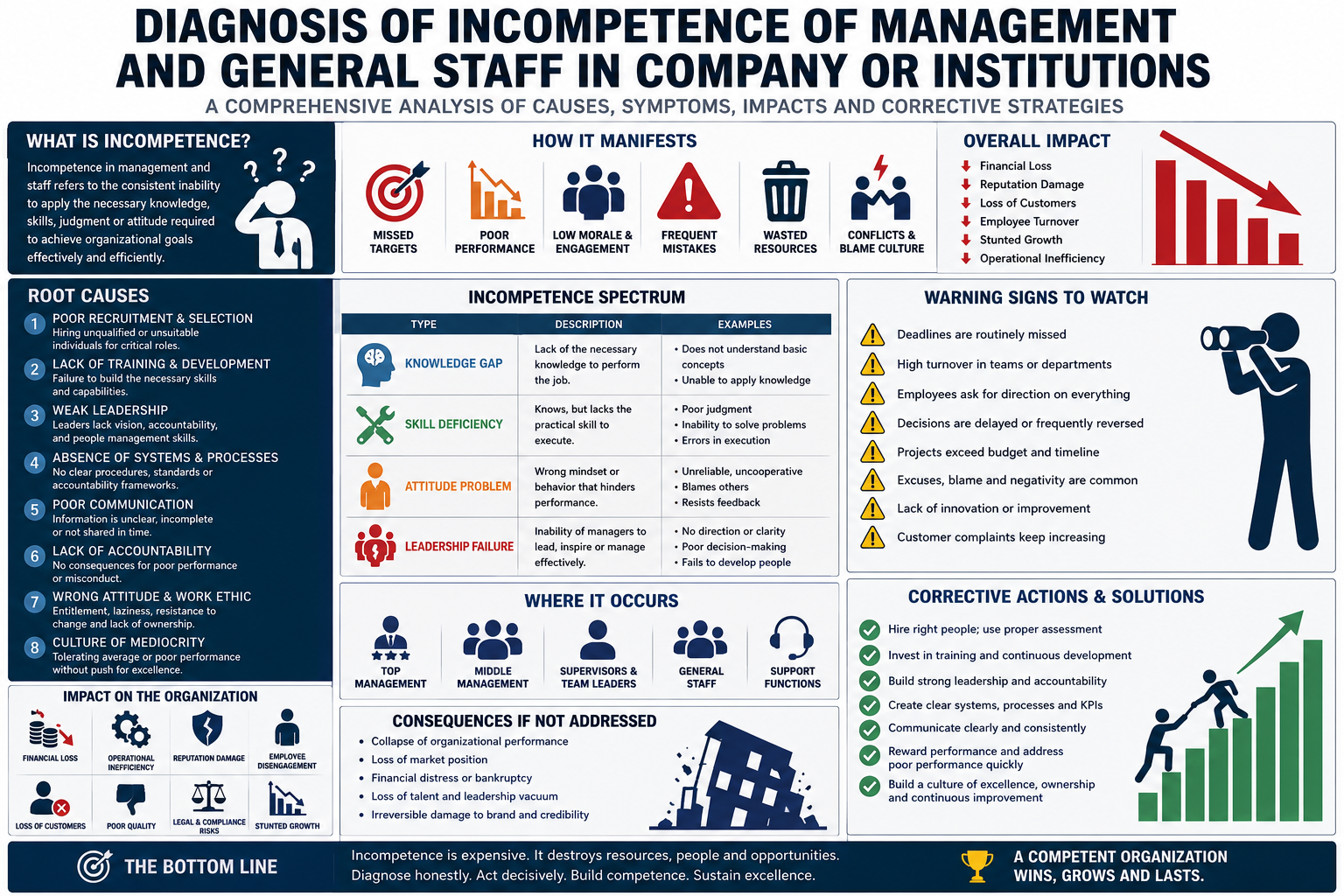
Incompetence within an organisation is not merely an inconvenience — it is a systemic risk that erodes productivity, poisons institutional culture, wastes finite resources, and ultimately threatens the long-term viability of the enterprise. This report provides a rigorous, multi-dimensional diagnostic of managerial and staff incompetence across companies and public institutions. It is designed to assist boards, senior executives, human resource professionals, and organisational consultants in identifying root causes, assessing severity, and charting a path toward structural correction.
The diagnosis is structured around ten core domains: definitional frameworks, leadership and strategic failure, operational and procedural breakdown, communication dysfunction, human capital mismanagement, financial mismanagement, cultural and ethical deterioration, technology and innovation aversion, legal and compliance failures, and a comprehensive remediation roadmap.
Key findings indicate that incompetence rarely exists in isolation. It propagates through organisational layers, is frequently protected by toxic loyalty networks, and is often invisible to those who perpetuate it. Without deliberate diagnostic intervention, incompetent systems self-reinforce. This report offers the tools necessary to break that cycle.
Critical Insight: Research consistently shows that up to 65% of all organisational failures can be traced directly to management incompetence rather than external market forces. The problem is internal — and it is solvable.
2. DEFINING INCOMPETENCE: FRAMEWORKS AND TYPOLOGIES
2.1 What Is Organisational Incompetence?
Incompetence, in an organisational context, is the persistent failure to perform the duties of a role at a standard that meets the requirements of the position, the expectations of stakeholders, or the norms of the professional field — despite having been provided with adequate time, resources, and opportunity to do so. It is distinct from inexperience, which implies a correctable knowledge gap, and from occasional error, which is an inherent feature of human cognition.
Three primary categories of incompetence are diagnosed in this report:
Technical incompetence refers to a lack of subject-matter expertise, functional skill, or professional knowledge required to execute core job responsibilities. The individual simply does not know enough to do the job at the required standard.
Managerial incompetence is the inability to lead, organise, plan, delegate, motivate, or develop people effectively. This category is particularly damaging because its effects multiply through every subordinate the manager oversees.
Systemic incompetence describes institutional structures, policies, and cultures that normalise, protect, and replicate incompetent performance regardless of the individual actors involved. This is the most insidious form, because removing individual underperformers does not address it.
2.2 The Peter Principle Revisited
Dr. Laurence Peter’s foundational theory — that in a hierarchy, every employee tends to rise to their level of incompetence — remains highly relevant. Individuals are typically promoted on the basis of performance in their current role, not on demonstrated capacity for the next. A talented engineer becomes a poor engineering manager; a gifted teacher becomes an ineffective school principal. Over time, organisations accumulate a critical mass of individuals who have exceeded their competence ceiling.
Modern research extends the Peter Principle to include lateral incompetence — where individuals are moved sideways into roles that also exceed their capabilities — and competence theatre, where the appearance of competence through charisma, credentials, or networking substitutes for the reality of capability. Many organisations are effectively managed by performers rather than competent practitioners.
2.3 Diagnostic Severity Scale
The following five-tier scale is used throughout this report to classify the severity of identified competence failures:
Level 1 — Sub-optimal: Minor lapses that are self-correcting with normal feedback mechanisms. Addressable through routine coaching conversations.
Level 2 — Concerning: Recurring patterns that require deliberate managerial intervention. Left unaddressed, these escalate.
Level 3 — Significant: Systemic gaps causing measurable performance losses. Structured improvement plans and external support are required.
Level 4 — Critical: Widespread dysfunction affecting the viability of a department, function, or major programme. Leadership changes may be necessary.
Level 5 — Catastrophic: An existential threat to the organisation’s mission or survival. Requires immediate board-level intervention and likely structural transformation.
3. DIAGNOSIS: MANAGEMENT INCOMPETENCE
3.1 Strategic Failure and Vision Deficits
Incompetent management is most visibly diagnosed at the strategic level. Organisations with poor leadership suffer from a chronic inability to define, communicate, and execute on a clear strategic direction. The following indicators signal strategic incompetence:
Mission creep is one of the most reliable diagnostic markers. The organisation’s stated objectives change unpredictably, reflecting the shifting personal preferences of leaders rather than coherent institutional planning. Staff cannot articulate what the organisation’s priorities are because those priorities change without transparent rationale or process.
Short-termism manifests as an obsessive focus on immediate metrics — quarterly earnings, month-end outputs — at the expense of sustainability, capacity building, and long-term positioning. Organisations run by short-term thinkers consistently consume their own seed corn.
Analysis paralysis describes the pattern of perpetual committees and working groups that are convened without resulting in decisions, or decisions made without supporting analysis. Incompetent leaders confuse process with progress.
Reactive rather than proactive leadership means the organisation is perpetually in crisis mode, responding to problems that competent foresight would have anticipated and prevented. Every crisis is treated as unforeseeable, and the same crises recur year after year.
Inability to prioritise is perhaps the most common strategic failure at the management level. When all initiatives are treated as equally urgent, energy is diffused, resources are fragmented, and the organisation consistently fails to achieve depth or excellence in any domain.
3.2 Leadership Behavioural Incompetence
Beyond strategy, individual leadership behaviour represents a second major domain of managerial incompetence. The following behavioural signatures are diagnostic of a management layer operating beyond its capability.
Micromanagement and distrust reveal incompetence through the inability to delegate meaningfully. Micromanaging managers distrust their teams, require approval on trivial decisions, and bottleneck workflows through their own cognitive and time limitations. This behaviour is frequently a defence mechanism against the manager’s own fear of being exposed as technically inferior to the subordinates they manage. The result is a team that is simultaneously over-supervised and underleveraged.
Conflict avoidance and non-decision characterise many incompetent managers, who are pathologically averse to difficult conversations. They avoid making hard personnel decisions, permit chronic underperformance to continue without consequence, and prefer ambiguity over the discomfort of enforcing standards. The result is a culture where accountability disappears entirely, and high performers are penalised by being required to absorb the work of those who face no consequences for not performing.
Favouritism and cronyism are among the most corrosive management behaviours. Incompetent managers frequently rely on loyalty networks rather than merit systems. Promotions, assignments, and recognition flow to those who are socially close to or ideologically aligned with the manager, rather than those who demonstrate the highest capability or output. This corrupts the organisation’s talent pipeline and demoralises the staff who most deserve advancement.
Credit appropriation and blame deflection form a reliable diagnostic pattern: incompetent managers take disproportionate credit for team successes while deflecting blame for failures onto subordinates, external factors, or market conditions. This asymmetric attribution destroys psychological safety, suppresses innovation, and makes honest reporting of problems impossible because the messenger is reliably punished.
Communication as performance rather than function describes the pattern where managers invest heavily in appearing communicative — sending lengthy emails, hosting frequent meetings, using strategic jargon fluently — while generating almost no genuine shared understanding. Their communications confuse rather than clarify, and their meetings consume time without producing decisions.
3.3 Planning and Execution Incompetence
Even where strategic vision exists, managerial incompetence manifests in the failure to convert strategy into operational reality. This execution gap is where the most quantifiable damage is done:
Projects are consistently delivered late, over budget, or below specification. Scope management fails: projects expand without corresponding resource adjustment. Governance structures are absent or cosmetic — no meaningful milestones, risk registers, or escalation protocols exist. Post-mortem analysis is avoided because honest lessons-learned exercises would expose management decision failures. Most tellingly, a persistent disconnection exists between strategic plans and actual resource allocation — plans exist on paper but budgets do not reflect stated priorities. The organisation says one thing and funds another.
4. DIAGNOSIS: GENERAL STAFF INCOMPETENCE
4.1 Technical and Functional Skill Deficits
At the staff level, incompetence frequently manifests as a mismatch between the technical requirements of a role and the actual skill base of the incumbent. This may result from poor recruitment screening, inadequate onboarding, failure to maintain continuing professional development, or the organisation’s tolerance of declining performance without intervention.
Common indicators of technical incompetence include the inability to complete core job tasks without excessive supervisor intervention; repeated errors in work product that should fall within normal professional standards; failure to meet deadlines on routine tasks without extraordinary circumstances; ignorance of industry-standard tools, methodologies, or regulations relevant to the role; and most diagnostically, the inability to learn from feedback, such that the same errors recur after correction.
4.2 Behavioural and Attitudinal Incompetence
Beyond technical deficits, staff incompetence has a significant behavioural dimension. Attitudinal incompetence is often more damaging than skill gaps because it is actively resistant to correction and tends to spread through team culture.
Entitlement without contribution describes staff who believe they deserve reward independent of performance output. This attitude typically develops in organisations where tenure is rewarded regardless of performance, creating an expectation that employment and increment are rights rather than earned outcomes.
Chronic absenteeism and presenteeism — physical or virtual presence without productive engagement — represent a significant and often underestimated productivity drain. Presenteeism in particular is difficult to quantify and therefore tends to go unaddressed, even though research suggests its cost exceeds that of absenteeism in most organisations.
Deflection of responsibility manifests as the consistent attribution of personal failures to external causes. The technology failed; the brief was unclear; the deadline was unreasonable. In every case, the individual is blameless. Over time, this pattern signals either a genuine inability to accept accountability or a systemic management failure to communicate expectations clearly — and both diagnoses require intervention.
Resistance to change is one of the most consequential forms of staff incompetence in dynamic operating environments. Pathological attachment to existing ways of working, regardless of evidence of their inadequacy, presents an active barrier to organisational modernisation and adaptation.
4.3 Communication Incompetence
Effective communication is a core professional competency at every level of an organisation. Communication incompetence generates enormous organisational cost through wasted time, misaligned effort, and relationship damage. Specific manifestations include written communications that are unclear, unprofessional, or factually incorrect; verbal communication that generates ambiguity rather than resolution; failure to read and respond to correspondence in a timely manner; an inability to listen actively; and unproductive meeting behaviour, whether through dominating discussions without advancing outcomes or through passive disengagement without contribution.
4.4 Interpersonal and Team Incompetence
Organisations are collaborative systems. Staff who cannot function effectively within teams impose costs on collective performance that far exceed their individual contribution deficit:
Free-riding — benefiting from team effort while contributing sub-proportionally — is one of the most common and damaging team-level incompetence patterns. Conflict generation, where certain individuals consistently create interpersonal friction that distracts from task focus, compounds the damage. Knowledge hoarding — withholding information as a source of personal leverage rather than contributing to institutional learning — is perhaps the most strategic form of team incompetence, as it creates artificial indispensability at the cost of organisational resilience.
5. SYSTEMIC CAUSES AND ENABLING CONDITIONS
5.1 Recruitment and Selection Failures
Incompetence does not appear spontaneously within organisations — in a majority of cases, it is recruited in. Flawed selection systems are among the most powerful structural enablers of incompetence. Key failure modes include over-reliance on credentials and qualifications that signal effort but not competence; unstructured interviews that assess social likeability rather than job-relevant capability; the absence of skills-based assessments, psychometric testing, or practical work simulations; nepotism and referral bias that fills roles through personal networks rather than competitive merit-based processes; poorly defined job specifications that make competency assessment impossible; and short-staffed recruitment panels that cut corners in the urgency to fill vacancies.
The consequence of these failures is that organisations frequently hire the most confident candidate rather than the most competent one, the most credentialled rather than the most capable, and the most familiar rather than the most suitable.
5.2 Onboarding and Development Deficits
Even competent recruits can become incompetent staff when the organisation fails to invest adequately in structured onboarding and continuous development. No formal onboarding programme means new staff are expected to absorb institutional knowledge by osmosis. Training budgets that are the first cut in cost-reduction exercises reveal that leadership treats development as discretionary rather than essential. Performance reviews conducted annually at best provide insufficient feedback frequency for meaningful behaviour change. The absence of individual development plans treats staff as current operational units rather than future assets. And management training that is generic, irregular, or treated as a box-ticking exercise fails to build the genuine supervisory capability that organisations most urgently need.
5.3 Performance Management Dysfunction
The single most common systemic enabler of sustained incompetence is the failure of performance management systems. Performance improvement plans that are procedurally conducted but psychologically designed to fail — appearing to address underperformance without the organisational will to act on findings — are perhaps the most expensive form of institutional dishonesty. Managers who are themselves incompetent cannot accurately assess, document, or address incompetence in others. HR departments that function as protectors of the organisation’s legal exposure rather than genuine architects of performance culture prioritise procedural compliance over genuine accountability. Cultural norms that equate challenging underperformance with bullying effectively make accountability conversations psychologically unsafe, completing the system that protects incompetence from consequence.
5.4 Cultural Enablers of Incompetence
Culture is the most powerful determinant of whether incompetence proliferates or is contained. Seniority-based deference allows long-tenured underperformers to operate without scrutiny. The normalisation of low standards creates a collective rationalisation where mediocrity is reframed as institutional wisdom. Psychological safety deficits mean that staff fear the consequences of raising concerns about incompetent colleagues or managers, creating a culture of silent complicity. Excellence aversion — where high performers are viewed with suspicion or resentment rather than admiration — implicitly rewards the suppression of standards. And blame culture, where failure is punished rather than learned from, makes staff so risk-averse that innovative capacity atrophies and the organisation stagnates in self-protective repetition.
6. FINANCIAL AND OPERATIONAL IMPACT ANALYSIS
6.1 Direct Financial Costs
Incompetence generates quantifiable financial losses across multiple cost categories. Organisations that have conducted rigorous internal audits consistently find that the true cost of incompetence substantially exceeds intuitive estimates:
Wasted labour through rework of preventable errors typically represents 15 to 25 percent of payroll costs. Staff turnover driven by the flight of competent staff who resign in frustration costs an estimated 150 to 200 percent of each departing employee’s annual salary when recruitment, onboarding, and productivity gap costs are included. Decision latency — where delayed management decisions compound downstream operational costs — often adds 20 percent or more to project costs. Litigation and compliance failures resulting from negligent management generate legal exposure that frequently ranges from 7 to 15 percent of annual revenue. Lost client and customer revenue from service failures and reputational damage is sector-specific but consistently significant. And the innovation opportunity cost — the compounding competitive disadvantage of failing to adapt to market changes — is structural and long-term, often the most expensive consequence of all, though the hardest to isolate.
6.2 Operational Dysfunctions
Beyond direct financial losses, incompetence generates operational disruptions that are acutely experienced across the organisation. Bottlenecked decision-making means critical choices are delayed because incompetent managers lack the confidence or knowledge to decide independently. Process duplication — where the absence of clear ownership and role clarity leads multiple people to perform the same function, or no one to perform necessary functions — generates friction and wasted resource in equal measure. Quality degradation is self-reinforcing: outputs decline as low standards are set and consistently met at that level, eventually becoming the new normal. Regulatory and compliance exposure accumulates silently until it erupts as a crisis. And IT and cybersecurity failures driven by technological incompetence create infrastructure vulnerabilities that can materialise as catastrophic operational or reputational events.
7. HUMAN RESOURCES AND TALENT MANAGEMENT FAILURES
7.1 The HR Complicity Problem
In many organisations, the Human Resources function — designed to safeguard performance standards — has become an institutional protector of incompetence. HR’s structural incentive to avoid litigation and tribunal exposure consistently overrides its mandate to enforce performance standards: dismissing incompetent employees carries legal risk, while tolerating them carries only operational cost, and the operational cost lands on line managers and their teams rather than HR. HR professionals who are themselves technically incompetent lack the capability to design effective performance management architectures. HR departments that report to the very executives whose performance they should be monitoring are structurally compromised from the outset.
7.2 Succession Planning Failures
Organisations without deliberate succession planning systematically place incompetent individuals in critical roles by default. When leadership transitions occur without preparation, organisations default to internal availability rather than suitability — promoting the person who is present rather than the person who is capable. The absence of talent pipeline management is itself a form of institutional incompetence, one with long-latency consequences that tend to emerge precisely at the moments of strategic stress when strong leadership is most needed.
7.3 Compensation Systems That Reward Incompetence
Pay structures can actively incentivise incompetence when they are disconnected from performance. Tenure-based pay scales, flat salary bands, and guaranteed annual increments unlinked to output create compensation systems where competent and incompetent staff are remunerated identically. Over time, this attracts and retains the risk-averse and the mediocre while repelling the ambitious and the talented — who quickly discover that their additional contribution generates no additional reward.
8. CULTURAL DETERIORATION AND ETHICAL FAILURES
8.1 The Culture-Competence Nexus
Organisational culture both reflects and determines competence levels. When incompetence becomes the norm, it generates a cascade of cultural pathologies that progressively deepen the problem.
Cynicism develops in staff who observe incompetent leadership making consequential decisions without accountability. They learn that effort and quality are not meaningfully rewarded, and that the organisation’s stated values are aspirational fiction rather than operational reality. This cynicism is rational — it is an accurate read of the cultural environment — which makes it exceptionally difficult to displace without genuine structural change.
Disengagement follows cynicism. Gallup research consistently shows that a majority of the global workforce is actively disengaged, with poor management cited as the primary cause. Disengaged staff are not simply neutral contributors — they actively undermine organisational performance through reduced effort, negative peer influence, and the slow-motion withdrawal of discretionary engagement.
Learned helplessness is the long-term psychological consequence of sustained exposure to incompetent management. Staff stop attempting to improve outcomes because they have learned that their efforts will be negated, appropriated, or punished. Innovation and initiative disappear not because the individuals lack capability but because the cultural environment has systematically extinguished the impulse to exercise it.
8.2 Ethical Dimensions of Managerial Incompetence
Incompetence and ethical failure are not identical, but they are deeply intertwined. Incompetent managers are significantly more likely to make ethically compromised decisions — not always from malice but from cognitive limitation, self-protection impulse, and the absence of the moral courage that genuine competence tends to enable.
Fraudulent competence signalling involves actively misrepresenting capability, credentials, or organisational performance to superiors and stakeholders. Scapegoating — attributing blame to subordinates for failures caused by management decisions — is a routine ethical violation in incompetent leadership cultures. Suppression of whistleblowers means that incompetent leaders who are exposed by staff concerns respond by penalising those who raise them rather than correcting the problem. Budget manipulation obscures financial incompetence through accounting practices that present a false operational picture. And in the most severe cases, harassment functions as a management tool — incompetent managers who feel threatened by competent subordinates may resort to marginalisation, constructive dismissal, or active victimisation as instruments of self-protection.
9. TECHNOLOGY, INNOVATION AVERSION AND DIGITAL INCOMPETENCE
9.1 Technological Incompetence
In the contemporary operating environment, technological competence is not a specialist skill — it is a core professional baseline. Organisations where management and staff lack basic digital literacy suffer competitive and operational disadvantages that compound rapidly in a technology-intensive economy.
The inability to effectively utilise enterprise software systems results in workarounds, data quality degradation, and wasted licensing investment. Resistance to digital transformation initiatives — frequently driven by management’s personal discomfort with change — blocks modernisation programmes regardless of their strategic merit. Failure to understand and use available data means that decisions are made on intuition and anecdote in contexts where evidence-based decision-making is entirely feasible. Cybersecurity negligence — staff who click malicious links, use weak passwords, or mishandle sensitive data — generates disproportionate organisational exposure from individual behavioural incompetence. And vendor and contractor management failure, where organisations cannot write adequate technical specifications or competently evaluate technology proposals, repeatedly results in expensive, underdelivering technology investments.
9.2 Innovation Suppression
Incompetent management is structurally hostile to innovation because innovation is inherently threatening to those whose value depends on the status quo. Ideas from junior staff are routinely ignored, dismissed, or appropriated without attribution. Research and development functions are systematically underfunded relative to competitors and relative to stated strategy. Failure mode analysis is avoided because conducting honest post-mortems would expose management decision failures. The organisation’s offerings stagnate despite evident shifts in the market environment. And staff who propose improvements are labelled as troublemakers or cultural misfits — not because their ideas are wrong, but because their ideas are threatening to those with no capacity to implement or compete with them.
10. LEGAL AND REGULATORY COMPLIANCE FAILURES
10.1 Governance and Compliance Incompetence
Regulatory compliance is an unforgiving domain — the law does not accept incompetence as a defence. Employment law violations arise from managers who operate without foundational knowledge of fair process, discrimination protections, or contractual obligations. Health and safety failures — negligent risk management resulting in preventable workplace injuries — are among the most ethically serious expressions of operational incompetence. Data protection violations under applicable national and international frameworks expose organisations to financial penalties, reputational damage, and regulatory sanction. Financial reporting failures resulting from accounting incompetence or management override of internal controls undermine institutional integrity and investor confidence. And procurement fraud and mismanagement — arising from failures to conduct competitive processes, conflicts of interest in supplier selection, and contract management incompetence — represent some of the most costly and legally consequential expressions of management failure in both public and private sector organisations.
10.2 Board-Level Oversight Failures
In many organisations, incompetence at the executive level is enabled by an insufficiently independent and capable board of directors or governing body. Boards that lack the technical expertise to competently challenge executive management create governance structures where executives effectively oversee themselves. Board capture — where executive management exercises undue influence over board composition — produces a governing body that is constitutionally incapable of independent scrutiny. Inadequate board meeting frequency, depth, or quality reduces strategic governance to rubber-stamping of management proposals. And the failure to respond appropriately to audit findings, whistleblower reports, or external reviews that signal executive incompetence or misconduct represents the ultimate governance failure: a system designed to protect the institution that actively protects the individuals harming it instead.
11. DIAGNOSTIC INSTRUMENTS AND ASSESSMENT METHODOLOGY
11.1 The Competence Audit Framework
A structured competence audit provides the empirical foundation for any serious intervention. The following three-phase methodology is recommended for organisations conducting a comprehensive diagnostic:
Phase 1: Data Collection (Weeks 1–4) involves 360-degree feedback assessments for all management-level staff using validated psychometric instruments; a staff engagement survey deployed to all employees and benchmarked against sector and national norms; a document and output review auditing work products, project deliverables, reports, and communications across sampled periods; structured interviews with a stratified sample of staff across levels, functions, and tenure bands; and HR data analysis covering turnover rates, absenteeism patterns, grievance and disciplinary frequencies, and performance review completion rates.
Phase 2: Analysis (Weeks 5–6) encompasses competency gap mapping that plots actual assessed competency levels against role requirements for each position; cultural health mapping identifying the teams, functions, and leadership units with the highest concentration of dysfunction indicators; financial impact modelling that quantifies the estimated cost of identified incompetence patterns; and root cause classification that categorises findings as individual, managerial, structural, or cultural in origin.
Phase 3: Reporting and Prioritisation (Week 7) produces a tiered findings report where Level 5 catastrophic findings are escalated for immediate intervention; Levels 3 and 4 are assigned to 90-day improvement plans; and Levels 1 and 2 are addressed through routine management practices. Stakeholder briefings are calibrated to audience across board, senior leadership, HR, and general management.
11.2 Key Diagnostic Questions
The following questions, applied systematically across the organisation, provide a rapid diagnostic screen for the presence and severity of management and staff incompetence:
Can every manager in the organisation articulate the three highest-priority strategic objectives and their team’s specific contribution to each? When was the last time a documented underperformer was formally managed out of the organisation? What percentage of projects in the last 24 months were delivered on time, within budget, and at specified scope? What is the voluntary turnover rate among the top-performing quartile of staff, and how does it compare to the sector benchmark? How many formal complaints, grievances, or tribunal claims have been lodged against management in the past three years? Is there a current, funded, and documented succession plan for every critical role in the organisation? What proportion of training and development expenditure is directed at management and leadership capability versus technical skills? And when staff raise concerns about process, performance, or conduct, what happens to them?
12. COMPREHENSIVE REMEDIATION ROADMAP
12.1 Immediate Interventions (0–30 Days)
Where Level 4 or 5 incompetence is diagnosed, immediate intervention is non-negotiable. Authority must be suspended or restructured where individual incompetence poses immediate financial, legal, or safety risk. Experienced interim managers or consultants should be deployed alongside identified critical failure points to provide competence bridging. A communication audit must identify and correct the most damaging communication breakdowns affecting operational performance. Emergency HR protocol review must ensure performance management frameworks are legally sound and practically workable. And external stakeholder triage — proactively communicating with clients, regulators, or funders at immediate risk of relationship damage — must begin before problems compound.
12.2 Short-Term Structural Interventions (30–90 Days)
Recruitment processes must be redesigned to implement structured competency-based interviewing, skills assessments, and panel diversity requirements for all appointments above a defined seniority threshold. Mandatory management development must ensure all people-managers complete a structured management competency programme with assessable outcomes rather than attendance certificates. Performance management must be reset so that all active performance objectives are specific, measurable, and time-bound, and overdue performance reviews are completed. Cultural health findings must be communicated transparently to all staff, with concrete commitments attached — not aspirational statements. And the HR function must be restructured or resourced to ensure genuine performance management capability rather than solely compliance-focused administration.
12.3 Medium-Term Cultural Transformation (90 Days–12 Months)
Leadership pipeline development requires identifying high-potential staff at every level and providing structured development experiences — secondments, project leadership, mentoring, external programmes — that build future management capability from the ground up rather than waiting for vacancies to expose the absence of ready successors. Accountability architecture must introduce transparent performance dashboards at team and departmental level that make performance patterns impossible to obscure. Psychological safety investment through structured team coaching, leader behaviour change, and communication training must create conditions where staff feel safe raising concerns without career risk. Knowledge management systems must formally capture and distribute institutional knowledge, reducing the organisation’s dangerous dependence on individual knowledge-holders. And innovation infrastructure must create protected channels for staff at all levels to propose improvements, with a transparent evaluation process and public recognition of implemented innovations.
12.4 Long-Term Governance Strengthening (12–36 Months)
A board competency audit must assess the collective capability of the governing body against the organisation’s strategic needs and address identified gaps through targeted board development or membership refreshment. Succession planning must be formalised into a documented, funded, annually reviewed plan for all critical roles. Competency-linked compensation must redesign remuneration structures to reward sustained high performance with market-competitive variable components, breaking the system where incompetence and excellence are remunerated identically. External benchmarking must commission independent organisational effectiveness assessments on a regular cycle to provide an objective mirror that internal assessments cannot provide. And competence, accountability, and continuous learning must be embedded in revised organisational values, codes of conduct, and governance frameworks — not as aspirational slogans, but as institutionalised commitments with real and visible consequences for adherence and breach.
12.5 Conclusion
Incompetence — whether in individual managers, operational staff, or the institutional systems that enable both — is not an inevitable feature of organisational life. It is a diagnosable, measurable, and remediable condition. The tools, frameworks, and interventions presented in this report provide a comprehensive pathway from diagnosis to resolution.
The critical precondition for success is leadership courage: the willingness to confront uncomfortable findings, make difficult decisions about people, and sustain the commitment to cultural change through the inevitable resistance that genuine improvement provokes. Organisations that develop this courage do not merely solve the competence problem — they build the institutional capacity to continuously raise the standard of what is expected and what is achieved.
Final Recommendation: Begin with an honest, independently conducted diagnostic. No remediation programme can succeed without a clear-eyed understanding of the actual problem. The cost of the diagnostic is orders of magnitude smaller than the cost of the incompetence it will uncover — and infinitely smaller than the cost of continuing to ignore it.






Be First to Comment